The five signed restart gates, reconciliation of who was dialyzed where, staff fatigue and distress, and patients' distress after disasters.
PublishedNailathalaGipatikPepalwal:ReferencesMga SanggunianMga TinubdanReng Reperensya:4Audience: Every member of the dialysis unit: hemodialysis, charge, head and safety nurses, physicians-on-duty, the Dialysis Clinical Head and attending nephrologists, dialysis, water treatment, biomedical and reprocessing technicians, nurse assistants and support staff, social workers, records officers, dietitians, unit managers and ownersRead timeOras ng pagbasaOras sa pagbasaOras ning pamamasa:
This module is study material for dialysis teams. It explains the reasoning behind disaster decisions; it is not a unit protocol or an order set. Early dialysis, shortened sessions, priority rosters and emergency diets are decisions of the attending nephrologist and the Dialysis Clinical Head. Escalation follows your unit protocol, and you always ask the attending nephrologist for guidance. Every case, name, and identifier is fictional.
Learning objectives
After this module you should be able to
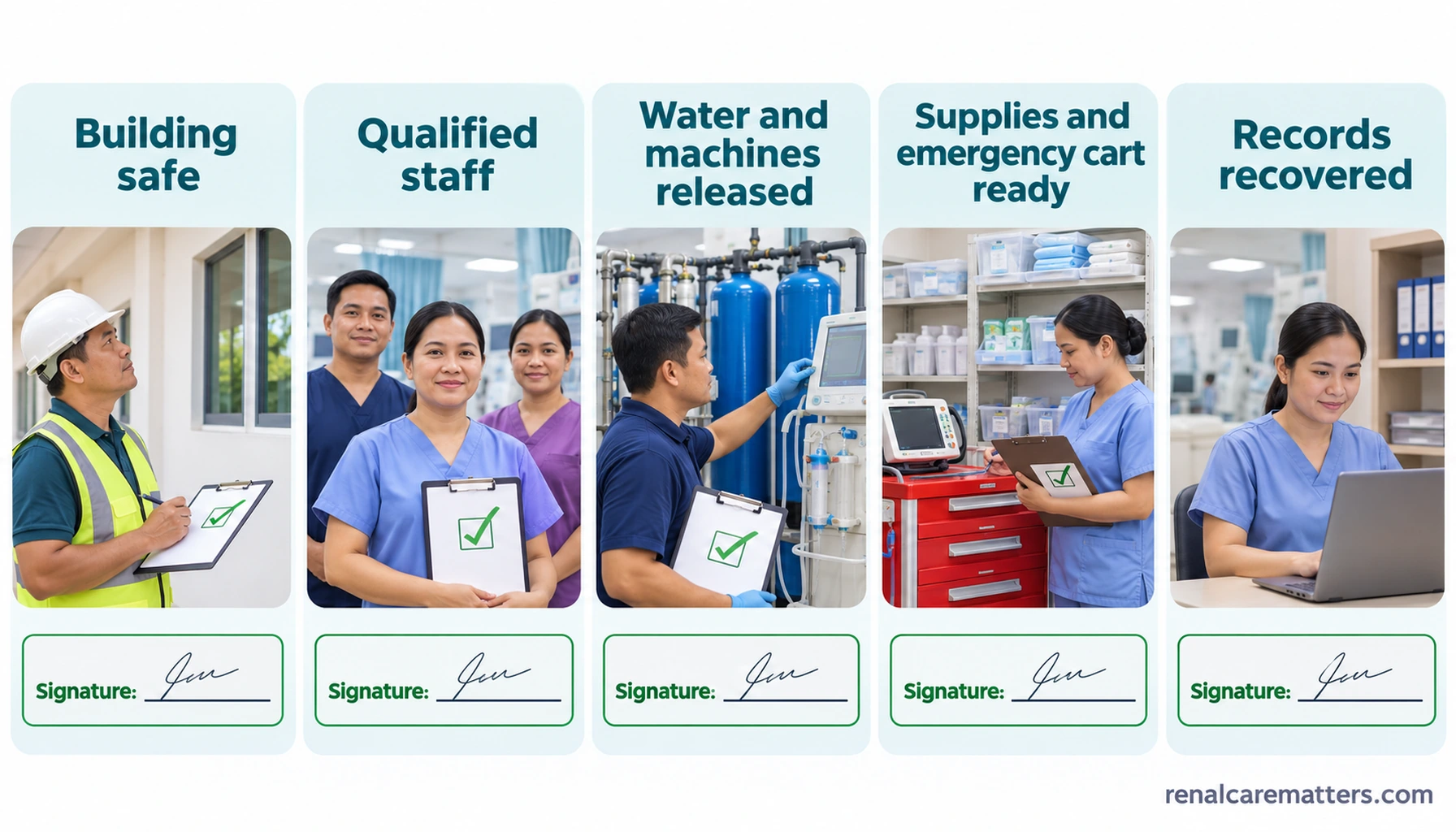
Reopen only through the five signed restart gates: building, staff, water and machines, supplies and cart, records.
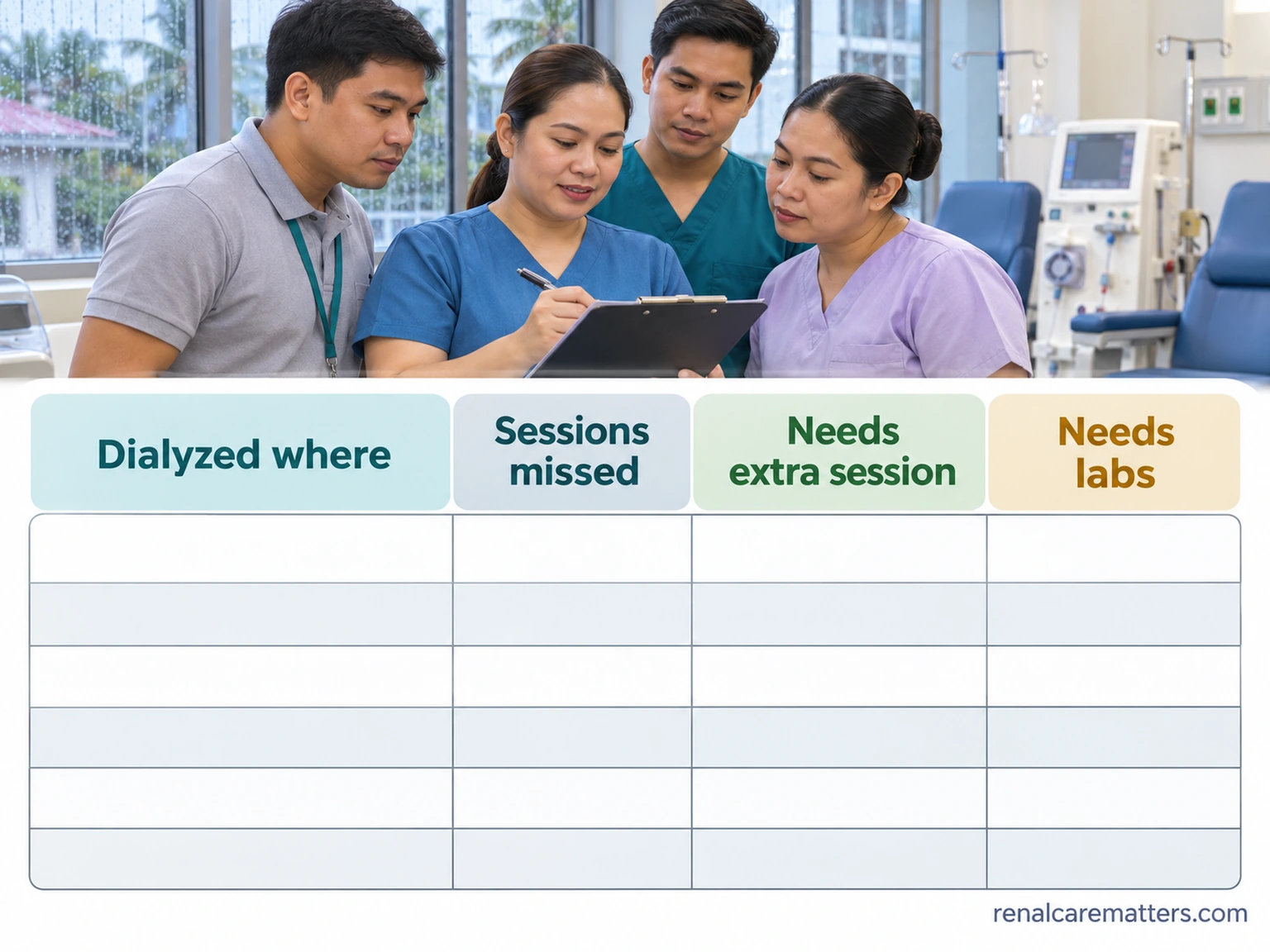
Reconcile who was dialyzed where, who missed sessions, who needs an extra session and who needs laboratory tests.
Recognize fatigue and distress in staff after a disaster, and what a unit can do.
Recognize distress in patients after a disaster, and what the evidence shows about it.
Classroom 1 hSkills lab 0.5 hSupervised placement 0 h
Pre-testBefore you read, answer the 5 self-assessment questions and note your score. After the module, select New set of questions and compare. The difference is what you learned; the questions you still miss are what to reread.
Start here
The big picture, in plain words
In plain wordsReopening a dialysis unit after a disaster is like a plane’s pre-flight check after a storm. The pilot does not take off because the sky looks clear; every item on the list is checked and signed, and one unsigned item keeps the plane on the ground.
The picture has a limit. A plane’s checklist is the same every day; a unit’s restart depends on what the disaster did. A flood may have reached the water room; an earthquake may have cracked a column; a long outage may have let bacteria grow in the water loop. The five gates are the same every time, but what each signer checks depends on the event. And unlike a plane, a unit carries the disaster forward in its people: patients who missed sessions, and staff who worked while their own homes flooded.
Restart gateOne of five signed checks before the unit treats patients again.
Water releaseThe water technician’s and medical head’s signed approval that the water is fit for dialysis.
ReconciliationThe record of who was dialyzed where and when, who missed sessions, and what each patient needs next.
Downtime recordA paper record kept while the electronic system was unavailable.
Posttraumatic stressA lasting stress reaction after a frightening event.
BurnoutExhaustion and detachment from work after long strain.
Opening case · fictional
Case: The gate that wasn't signed
A 14-station unit in Marikina was closed for four days after a flood reached its ground floor, including the water treatment room. On day five the building engineer has signed the building gate, the head nurse has a full roster with an ACLS-current nurse, the supply room is restocked, and the records officer has entered the paper downtime records.
The water treatment technician says on the phone, “The system is running and the readings look fine, you can start.” The water tests have been sent but the results are not back. Twenty patients are waiting, several of them overdue. The owner asks the head nurse to open “since everything else is signed.”
Before reading on, decide:
Can the unit open? Which gate is not met?
What can the unit do for the twenty waiting patients meanwhile?
What goes on the reconciliation board when the unit opens?
Keep your answers in mind. The lesson gives you what you need, and the case review near the end shows one sound response.
Lesson · part 1
Restart only through five signed gates
The unit restarts only when the five gates are signed.
Figure 2. Reopen through five signed gates. A verbal yes is not a gate.
Gate
What it means
Who signs (typical)
Building
Safe to occupy, power stable.
Building engineer or facilities officer; the hospital for a hospital-based unit
Staff
Qualified nurses and Advanced Cardiovascular Life Support (ACLS) cover.
Head nurse
Water and machines
Tested and released after the outage.
Water treatment technician and biomedical technician, with the medical head
Supplies and cart
Stock and emergency cart checked.
Head nurse or charge nurse
Records
Recovered, and paper downtime records entered.
Records officer
A verbal “it looks fine” is not a signature. The water gate in particular depends on test results: when a test fails, the Department of Health’s dialysis water order requires the facility to stop operations until a repeat test complies, disinfect the loop and notify its patients.1 The water technician and the medical head decide when water is fit; the owner and the schedule do not.
RememberRestart only when all five gates are signed: building, staff, water and machines released, supplies and cart, records. One unsigned gate keeps the unit closed.
Lesson · part 2
Who was dialyzed where
Reopening day starts with a list. For every patient on the unit’s census, the reconciliation board records where they were dialyzed and when, how many sessions they missed, whether they need an extra session, and which laboratory tests they need.
Figure 3. Reconciliation after the event: who was dialyzed where, who missed sessions, who needs more.
Dialyzed where: from the tracking board (Module 10) and the receiving units’ reports.
Sessions missed: counted honestly; this is the measure of the plan.
Needs an extra session: the attending nephrologist decides, usually for patients who missed sessions or had shortened ones.
Needs laboratory tests: potassium and others as the nephrologist orders, and any hepatitis testing needed after treatment at another unit, per the unit’s infection control protocol.
Patients still not reached stay on the board until found. Any shortened sessions end and full prescriptions resume as capacity allows, with the date recorded (Module 10).
Lesson · part 3
Staff fatigue and distress
Staff often work through a disaster while their own homes are flooded or damaged. In the weeks after, fatigue and distress are common and easy to miss. There is little dialysis-specific research on staff after disasters, so this section gives practical steps rather than evidence-graded advice.
Figure 4. After the event, the people who kept the unit running need rest and support too.
Rest and recover: rotate shifts so nobody works for days without rest; send home staff who are exhausted.
Look out for each other: ask how colleagues and their families are.
Talk: a short, voluntary conversation after the event; refer staff who are struggling to the support the unit or hospital offers.
Do not ignore signs of burnout: withdrawal, irritability, mistakes, and lasting exhaustion.
The after-action report (Module 12) records what staff needed and did not have, so the next plan includes it. After Hurricane Maria, a Puerto Rico nephrology service listed attention to the staff’s own needs among its lessons, so that staff could keep responding.2
Lesson · part 4
Patients’ distress after disasters
Patients carry the disaster too. About a year after Hurricane Katrina, 23.8% of 391 New Orleans hemodialysis patients reported symptoms consistent with posttraumatic stress disorder (PTSD). Symptoms were more common in those who missed three or more treatments, were evacuated fewer than two days before landfall, went first to a shelter, or stayed displaced for three months or more.3
In the same group, 46% screened positive for depression. Depression was associated with a 33% higher risk of hospitalization or death over the following years (hazard ratio 1.33); PTSD was not significantly associated with those outcomes.4 Both studies are observational. They support asking about mood and stress after a disaster, and referring patients who are struggling, as part of ordinary care.
Nurses and social workers can ask simple questions at the first sessions after reopening: how the patient and family are, where they are living, whether they are sleeping, and whether they feel low. The social worker coordinates support (Social Worker, Module 17).
Stop and callAny patient who expresses hopelessness or thoughts of self-harm after a disaster: stay with the patient, tell the physician-on-duty at once, and follow your unit’s protocol for urgent mental health referral. Always ask the attending nephrologist for guidance.
On the floor
Real situations: problems and solutions
These are fictional but typical. For each one, cover the answer, decide what you would do, then compare. Where a step depends on local rules, your unit’s procedure and your supervisor’s direction come first.
“Everything else is signed”
What you see
Four gates are signed and the owner presses to open before the water results arrive.
What is likely going on
Pressure to restart for overdue patients.
What to do
Keep the unit closed, send the most urgent patients to a receiving unit with a handoff, and open when the water is released.
Why it matters
One unsigned gate is enough to stay closed.
The missing downtime sheets
What you see
On reopening, paper records from the outage are in a nurse’s bag at home.
What is likely going on
The records gate was signed too early.
What to do
Recover and enter them before the gate is signed; count what is missing.
Why it matters
Unrecorded sessions break the reconciliation.
The quiet nurse
What you see
A nurse who worked through the flood while her house was damaged is withdrawn and making small errors.
What is likely going on
Exhaustion and distress.
What to do
Give her rest, ask how she is, and offer the unit’s support.
Why it matters
Staff care is part of recovery.
Field notes
Keep a printed copy of the five gates with signature lines in the grab bag.
Ask about mood and sleep at the first sessions after reopening.
Case review
Back to the case: The gate that wasn't signed
Can the unit open? No. The water and machines gate is not signed: the water room was flooded, and test results are not back. A phone call saying the readings “look fine” is not a release. The owner’s request does not change the gate; the water technician and the medical head decide when water is fit.
The waiting patients. The attending nephrologist reviews them by priority (time since treatment, last potassium, fluid status, symptoms). The most urgent go to a receiving unit today, with a handoff; the others get diet and medicine reminders and a planned slot once the water is released.
The reconciliation board. For each of the 52 patients: dialyzed where and when, sessions missed, need for an extra session, laboratory tests needed. The seven who missed three or more sessions are flagged for the nephrologist first.
Interactive case · fictional
Interactive case: The gate that wasn’t signed
Work through a shift one decision at a time. The panel at the top changes with what you choose. After each choice you see why it is, or is not, the best move; after a weaker one you can try again or carry on and see where it leads. Your first choice at each step is scored. The score stays on this device and nothing is sent anywhere. In real practice, your unit’s protocol and the people responsible for each decision come first.
Skills lab · with your preceptor
Skills checklist: Restart and reconciliation
In the restart checklist drill, or after a real closure. Your preceptor rates each step as satisfactory, needs practice, or not observed. Steps marked Critical must all be satisfactory before sign-off. This checklist supports supervised learning; your unit’s own procedure and competency form are the authority. A printable version of every checklist is on the trainer page.
CriticalNames the five gates in order and who signs each.
CriticalRefuses to open while any gate is unsigned, including a verbal water release.
Builds the reconciliation board with dialyzed where, sessions missed, extra session needed, laboratory tests needed.
Flags patients who missed sessions or had shortened sessions for the nephrologist.
Asks at least one patient and one colleague how they are coping, and knows where to refer.
Placement activity. Run the restart checklist drill with the head nurse: fill in each gate as if after a flood and note what was hard to confirm.
Self-assessment
Check your understanding
Each visit draws 5 questions at random from this module’s 10-question bank. Choose the single best answer for each, then select Check answers; an explanation appears under the best answer. Select New set of questions for a different mix. A good target is 4 of 5 on two different sets. Nothing you select is sent anywhere; scoring happens in your browser.
Department of Health. (2013). Administrative Order No. 2013-0003: Implementing guidelines in the analysis, monitoring and maintenance of water used in dialysis facilities. Republic of the Philippines.
Bonilla-Félix, M., & Suárez-Rivera, M. (2019). Disaster management in a nephrology service: Lessons learned from Hurricane Maria. Blood Purification, 47(1–3), 199–204. https://doi.org/10.1159/000494580
Hyre, A. D., Cohen, A. J., Kutner, N., Alper, A. B., & Muntner, P. (2007). Prevalence and predictors of posttraumatic stress disorder among hemodialysis patients following Hurricane Katrina. American Journal of Kidney Diseases, 50(4), 585–593. https://doi.org/10.1053/j.ajkd.2007.07.013
Edmondson, D., Gamboa, C., Cohen, A., Anderson, A. H., Kutner, N., Kronish, I., Mills, M. A., & Muntner, P. (2013). Association of posttraumatic stress disorder and depression with all-cause and cardiovascular disease mortality and hospitalization among Hurricane Katrina survivors with end-stage renal disease. American Journal of Public Health, 103(4), e130–e137. https://doi.org/10.2105/AJPH.2012.301146
Educational course and drill resource for dialysis units. It is not a hospital disaster plan, a licensing requirement, or a substitute for your unit’s approved protocol, the machine manufacturer’s instructions, or instructions from PAGASA, PHIVOLCS, the Bureau of Fire Protection or your local disaster office. Clinical decisions in a disaster (early dialysis, shortened sessions, priority, diet) belong to the attending nephrologist.