After this module you should be able to
- Explain why access bleeding can be fatal within minutes, and why most deaths happen away from the unit.
- Read the skin over an aneurysm for signs of impending rupture.
- Respond to major access hemorrhage: focused pressure, help, resuscitation, transfer.
- Teach patients and staff what to do, and plan definitive care and the next dialysis route.
The big picture, in plain words
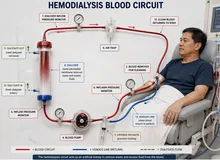
The picture has a limit. A hose is the same pressure along its length. An access runs at near-arterial flow but venous wall strength, and its pressure rises further when outflow is narrowed. Repeated needling in one area weakens the wall and the skin over it. When it ruptures, blood loss can be fast enough to kill before help arrives, which is why recognition and teaching matter more than any repair technique.
Figure 1 · Key terms for this module
Your work is to spot threatened skin before it bleeds, to make sure nobody needles it, and to rehearse the first two minutes of a major bleed so that everyone does them without thinking.
Case: The shiny bulge
Mr. Benigno Tolentino, 59, has a left upper-arm fistula created eight years ago. Most of his cannulations have used the same 4 cm segment. It has become a 3 cm bulge with shiny, thin skin and a dark scab at its top. Last night the scab bled onto his pillow; his wife pressed a towel on it for twenty minutes until it stopped.
This morning at the unit, the nurse sends you a photograph and asks: “He says the usual needle site is the easiest. Can we cannulate there today? The bleeding has stopped.” His venous pressures have been rising for two months.
Before reading on, decide:
- Can the usual site be used today?
- What does this bulge tell you, and what needs to happen next?
- What do Mr. Tolentino and his wife need to know before they go home?
Keep your answers in mind. The lesson gives you what you need, and the case review near the end shows one sound response.
Why access bleeding can be fatal
Access hemorrhage is rare but catastrophic. Reviewing 14 years of reported deaths in Australia and New Zealand, Jose and colleagues estimated fewer than one fatal access bleed per 1,000 patient-years; a unit may see one only once a decade. Their review of each unit’s root-cause analyses concluded that these deaths are potentially preventable with the right policies.1 In a forensic series of 100 deaths from access-site hemorrhage, 81% of the bleeds occurred at home and 44% of patients died there.2 These are descriptive series, not trials, but they show where prevention must reach: the patient’s home.
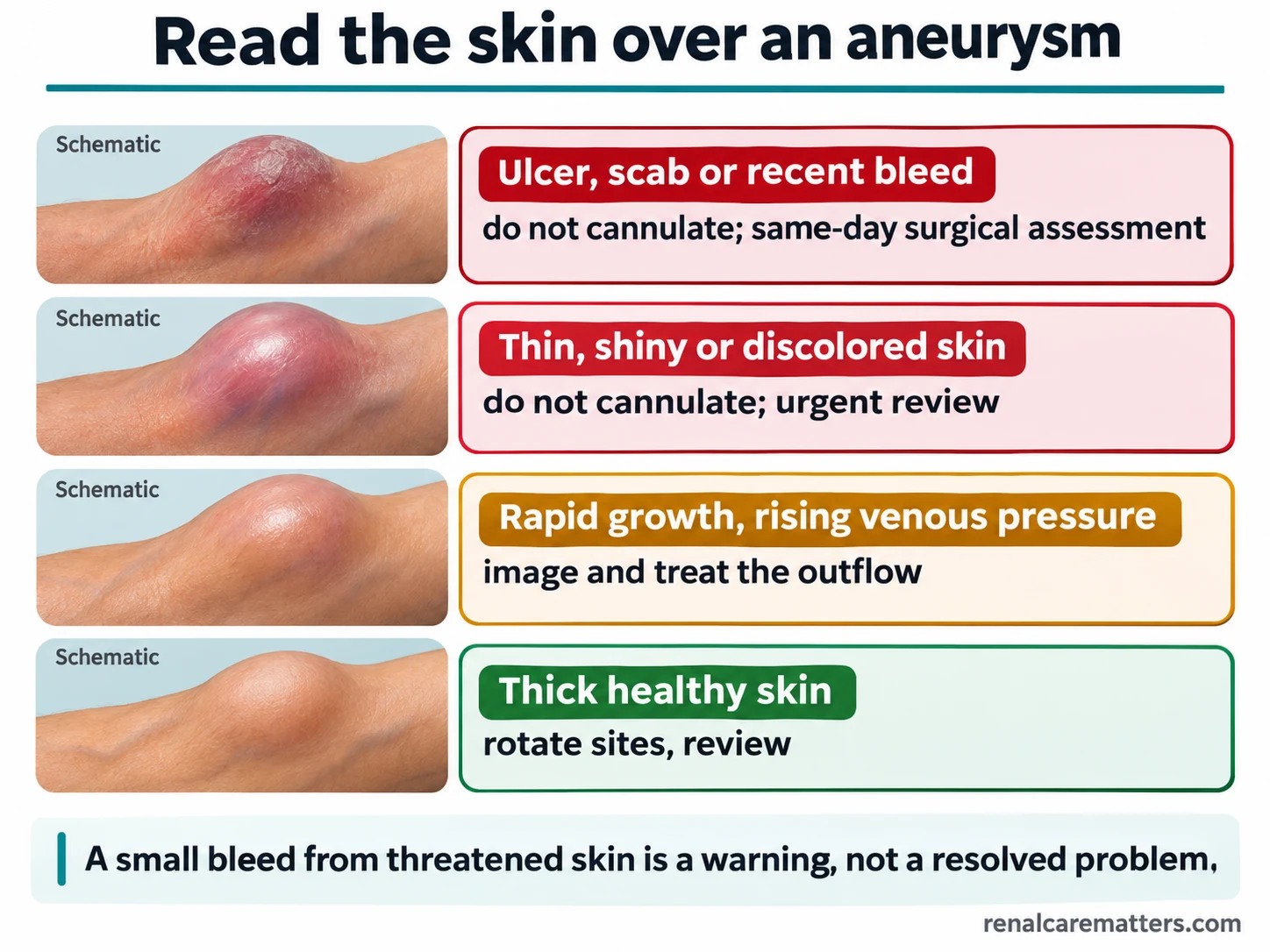
The mechanism explains the speed. Access flow is often over a liter a minute, the wall is thin, and the bleeding point sits just under the skin. An outflow stenosis raises the pressure further. Skin that is thin, shiny, ulcerated or scabbed, or a recent small bleed, means the barrier has almost gone.
| Finding | What it means | Action |
|---|---|---|
| Stable aneurysm, healthy thick skin | Low immediate risk | Rotate sites; regular review |
| Rapid enlargement, rising venous pressure | Possible outflow stenosis | Image and treat the outflow |
| Thin, shiny or discolored skin | Skin threat | Do not cannulate; urgent surgical review |
| Ulcer, scab, or recent bleeding | Impending rupture | Do not cannulate; same-day surgical assessment |
Responding to a major bleed
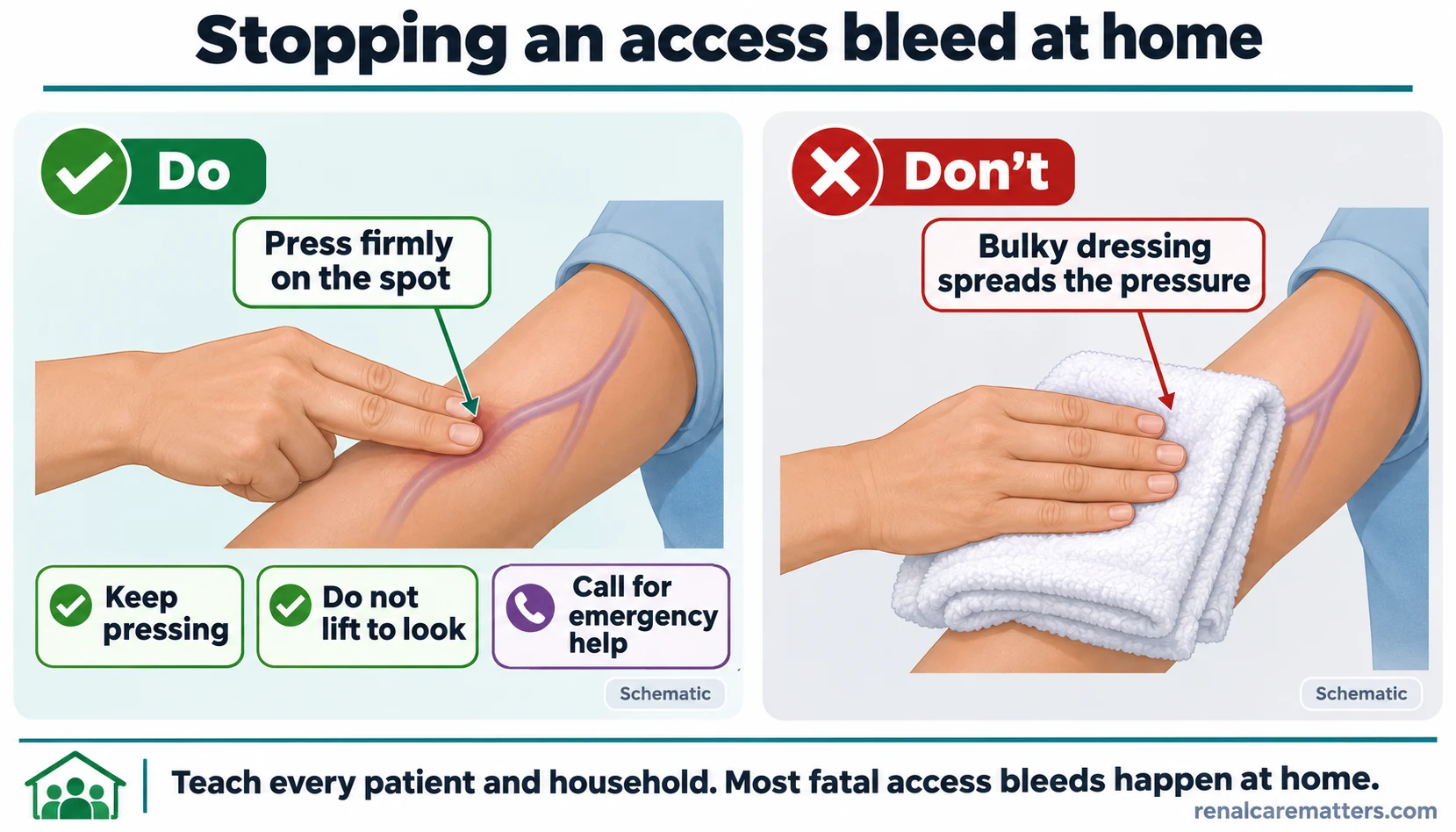
In major access hemorrhage, the first minutes decide the outcome. Call for help and activate the emergency response. Apply firm, focused pressure with one or two fingers directly on the bleeding point, not a large dressing that spreads the pressure. Lay the patient down and start the institution’s resuscitation and transfer pathway. If a tourniquet is part of your local protocol, follow it; otherwise maintain direct pressure until a surgeon controls the bleeding. Do not send the patient for imaging while bleeding continues, and do not attempt an unsupervised repair because an algorithm describes one.
Figure 3 · Major access hemorrhage
- CallEmergency help; say “major bleeding from a dialysis access.”
- PressFirm focused pressure on the bleeding point with one or two fingers.
- Position and resuscitateLie flat; airway, breathing, circulation; intravenous access and blood per protocol.
- TransferTo a surgeon who can control and repair it, with pressure maintained.
- Plan dialysisThe access may be lost; arrange a temporary route.
After control, the specialist assessment considers the whole circuit: an outflow stenosis that raised the pressure, infection in the aneurysm, the options for repair or reconstruction, and the next dialysis route. The UK Kidney Association (UKKA) 2025 guideline recommends regular assessment of aneurysms with intervention guided by symptoms, access function and the risk of spontaneous bleeding (statement 4.6, grade 1C), and suggests surgical repair as the main approach, combined with inflow reduction or treatment of downstream stenosis where appropriate (4.7, grade 2D).3
Teaching patients and staff
Because most fatal bleeds happen at home, every patient and household member should know what to do: press firmly with two fingers on the spot, keep pressing, call for emergency help, and do not remove the pressure to look. Teach it at the first-use visit and repeat it when an aneurysm appears. A unit can rehearse the response the way it rehearses a cardiac arrest.
Prevention is mostly about cannulation and outflow: rotating needle sites, avoiding area puncture, and treating outflow stenosis that raises pressure. A photograph cannot establish that skin is safe. Know who provides definitive care out of hours, and write it in the coverage arrangement.
The head nurse runs a bleeding drill with a simulator arm. A new nurse reaches for a thick gauze pad; the trainer stops her and shows two-finger focused pressure. The next drill takes 40 seconds from alarm to pressure and help called.
What this shows. The right response has to be automatic. Drills make it so.
Illustrative scenario. Names and details are invented.
Back to the case: The shiny bulge
The usual site. No. Shiny thin skin, a scab, and a bleed last night are signs of impending rupture. Needling there could start a bleed he might not survive. Tell the nurse not to cannulate that segment or anywhere on the threatened skin.
What next. Arrange same-day surgical assessment. The rising venous pressures suggest an outflow stenosis that has been raising the pressure in the aneurysm; it needs imaging and treatment along with the aneurysm. Agree with the nephrologist on a safe dialysis plan meanwhile: another usable segment far from the threatened skin if one exists, or a temporary catheter.
Before going home. Teach Mr. Tolentino and his wife two-finger pressure on the bleeding point and to call for emergency help without lifting the pressure. Give them the unit’s and the surgeon’s numbers and the name of the nearest hospital that can treat a bleed.
Skills checklist: Skin threat recognition and hemorrhage response
Simulator station and supervised clinic. Your preceptor rates each step as satisfactory, needs practice, or not observed. Steps marked Critical must all be satisfactory before sign-off. This checklist supports supervised learning; your unit’s own procedure and competency form are the authority. A printable version of every checklist is on the trainer page.
- CriticalIdentifies skin warning signs over an aneurysm
- CriticalInstructs that threatened skin is never cannulated
- CriticalRehearses focused pressure and emergency activation on a simulator
- Communicates transfer to a surgeon who can control bleeding
- Documents an alternative dialysis plan and teaches the patient home response
Check your understanding
Each visit draws 5 questions at random from this module’s 5-question bank. Choose the single best answer for each, then select Check answers; an explanation appears under the best answer. Select New set of questions for a different mix. A good target is 4 of 5 on two different sets. Nothing you select is sent anywhere; scoring happens in your browser.
Read next on this site
- Understanding Your Fistula After Years on DialysisFistula aneurysms and the warning signs patients should know.
- Dialysis Access CareHow patients are taught to stop a bleed.