After this module you should be able to
- Explain access-related hand ischemia as loss of distal perfusion pressure, not simply reversed flow.
- Recognize and grade a threatened hand, and separate it from acute nerve injury and from other causes of hand pain.
- Use the digital–brachial index and access flow as supporting tests, knowing their limits.
- Escalate a threatened hand urgently, without waiting to name the operation.
The big picture, in plain words
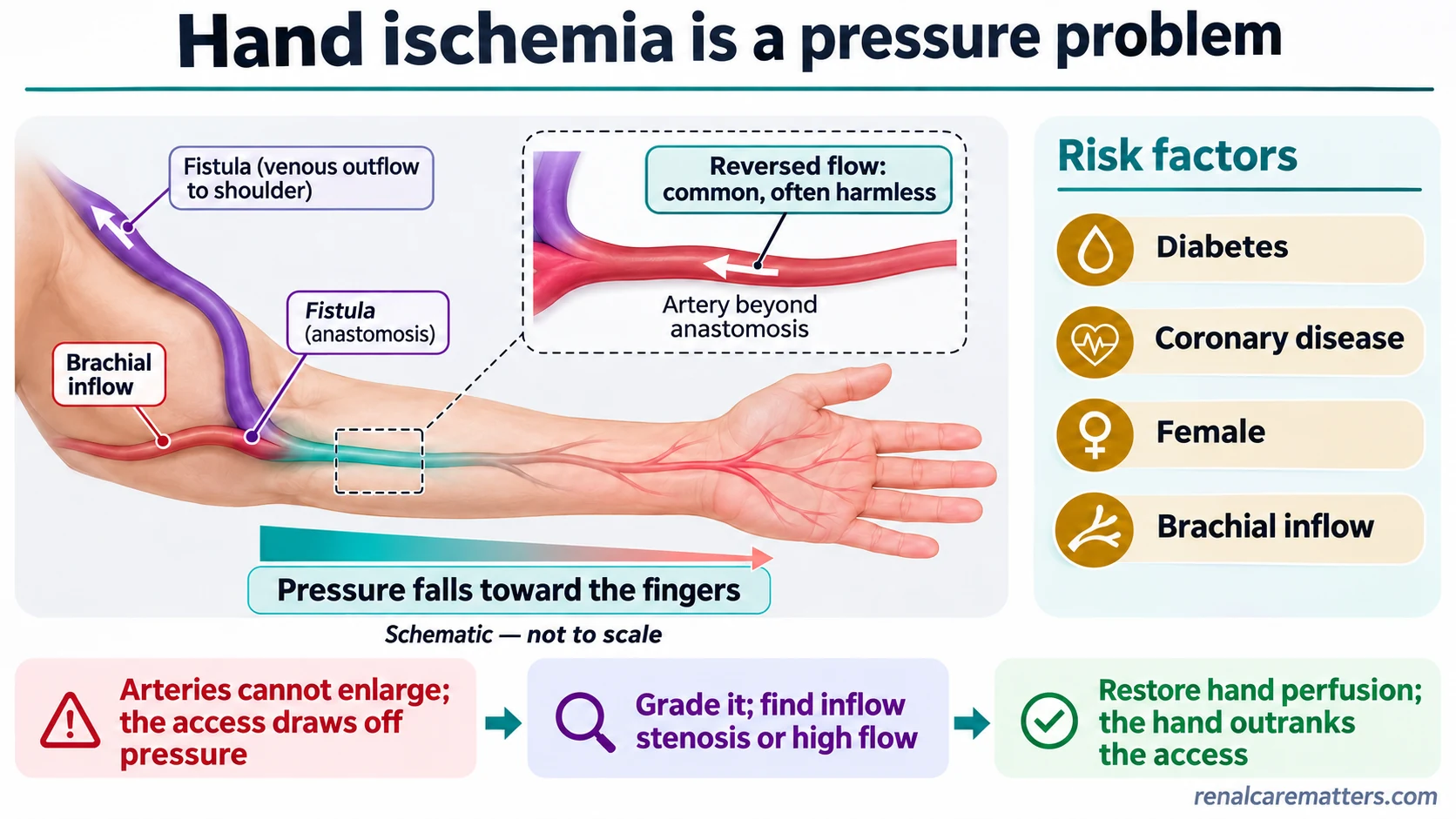
The picture has a limit. The houses do not care which way the water flows in the street; they care about pressure at their taps. In the hand it is the same. Reversed flow in the artery beyond the access, “steal,” is common and often harmless. Ischemia happens when perfusion pressure in the hand falls below what the tissues need, usually because the arteries upstream could not enlarge enough, or are diseased, and the access draws off the pressure.1
Figure 1 · Key terms for this module
Most cool hands after access creation are mild and improve. A few are threatened. A thrill tells you nothing about which kind you are seeing. Your work is to examine the hand, grade the threat, and escalate a severe one at once.
Case: “It’s still buzzing, doctor”
Mrs. Imelda Navarro, 71, has diabetes and coronary artery disease. Yesterday afternoon you created a left brachiocephalic fistula. At 9:30 p.m., the ward nurse calls: Mrs. Navarro has severe burning pain in her left hand and cannot grip her cup. “But the fistula is still buzzing strongly, doctor. Should I just give tramadol?”
The nurse adds that the hand is warm, the radial pulse is weak, and the fingertips feel numb. Mrs. Navarro is distressed.
Before reading on, decide:
- What do you tell the nurse?
- What are you worried about, and how would you grade it?
- What are the options a qualified surgeon may consider, and how fast?
Keep your answers in mind. The lesson gives you what you need, and the case review near the end shows one sound response.
Why the hand loses pressure
An arteriovenous access offers blood a path of very low resistance. Flow in the inflow artery rises sharply. In a healthy arterial tree, the arteries enlarge over weeks and hand pressure is maintained. In patients with diabetes, calcified arteries or proximal stenosis, the arteries cannot enlarge enough; pressure falls progressively toward the fingers, and turbulence at the anastomosis drops it further. Reversed flow in the artery beyond the access may follow, but it reflects the pressure gradient and collaterals; it is not itself the cause of ischemia.1
Timing points to cause. In a systematic review of 464 treated patients, ischemia within 24 hours of routine access surgery was strongly associated with grafts (88%), while chronic ischemia, after a month, followed autogenous access based on the brachial artery in 91%.2 Severe pain and weakness within hours of creation, in a warm hand with intact or weak pulses, suggests ischemic monomelic neuropathy, an acute nerve injury that needs immediate surgical assessment.
The UK Kidney Association (UKKA) 2025 guideline cites a cohort of 602 patients in which symptomatic steal developed in 7%, more often in women, people with diabetes and people with coronary disease; routine anatomic measurements predicted it poorly.3
Grading the threat
UKKA grades steal clinically and links each grade to action.3 It suggests that all clinicians caring for hemodialysis patients be aware of steal syndrome, its risk factors and indications for urgent treatment (statement 4.8, grade 2C), and that mild steal be managed conservatively (4.9, grade 2C).
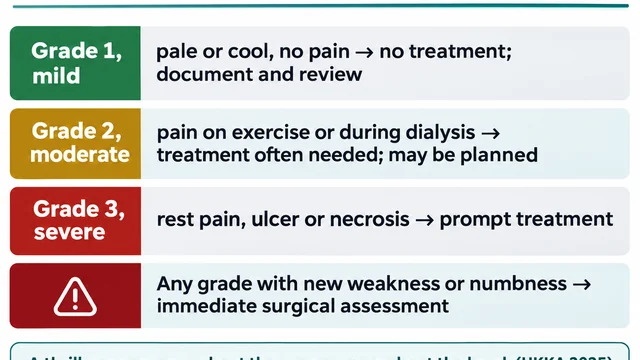
| Grade | Clinical features | Implication |
|---|---|---|
| 1, mild | Pale or cool extremity, no pain | No treatment needed; document and review |
| 2, moderate | Pain on exercise or during dialysis | Treatment often needed; may be planned |
| 3, severe | Pain at rest, ulcer or necrosis | Prompt treatment |
| Any grade plus new motor or sensory deficit | Possible acute nerve ischemia | Immediate surgical assessment |
Supporting tests help when the picture is unclear. The digital–brachial index compares finger pressure with arm pressure; low values are common after access creation and do not by themselves mean ischemia, so interpret them with symptoms. In a small series, banding in patients with hand ischemia raised the DBI from 0.52 to 0.65 while symptoms improved.4 Duplex can find an arterial stenosis or a high-flow access. Consider other causes of hand pain: carpal tunnel syndrome, arthritis, neuropathy.
What a qualified surgeon may consider
There are no randomized trials to guide treatment; choices follow the mechanism.3 An inflow arterial stenosis may be treated with angioplasty, leaving the access alone. A high-flow access may be banded to reduce flow. Procedures such as distal revascularization and interval ligation (DRIL), proximalization of arterial inflow (PAI) and revision using distal inflow (RUDI) aim to restore hand perfusion while keeping the access. In the most severe cases, and in acute nerve ischemia, ligation restores perfusion most quickly and reliably. Preserving the access is valuable, but it does not outrank a functioning hand.
The learner’s job is not to choose among these operations. It is to recognize the threat, grade it, and get the patient to a surgeon who can, quickly, with the history and examination ready.
Three months after a brachiocephalic fistula, a patient reports hand pain only during dialysis and cool fingers. Grade 2. Duplex shows access flow of 2.3 L/min. After discussion, the team plans banding, and the patient continues dialyzing meanwhile with the hand reviewed every session.
What this shows. Moderate ischemia with high flow points to flow reduction, planned rather than rushed.
Illustrative scenario. Names and details are invented.
Back to the case: “It’s still buzzing, doctor”
What to tell the nurse. Do not give analgesia and wait. Severe pain with new weakness and numbness hours after a brachial-based fistula is a surgical emergency. Ask her to record the hand findings and to call the surgeon on call, or tell her you are coming now.
Your worry and grade. Rest pain with new motor and sensory deficit means at least grade 3, and a warm hand with early onset raises the possibility of ischemic monomelic neuropathy. Her diabetes and coronary disease are known risk factors.
Options and speed. A qualified surgeon assesses her tonight. In acute nerve ischemia, prompt restoration of hand perfusion, often by ligating the fistula, is usually favored over attempts to preserve it. Explain this to Mrs. Navarro and her family, update her Life-Plan, and tell her nephrologist that the fistula may be lost.
Skills checklist: Urgent limb assessment
Emergency station simulation or supervised ward review. Your preceptor rates each step as satisfactory, needs practice, or not observed. Steps marked Critical must all be satisfactory before sign-off. This checklist supports supervised learning; your unit’s own procedure and competency form are the authority. A printable version of every checklist is on the trainer page.
- Establishes onset relative to surgery or dialysis
- CriticalAssesses color, temperature, capillary refill, sensation and power in each hand
- CriticalGrades severity and identifies new neurologic deficit
- CriticalEscalates to a qualified surgeon with a named destination and time
- Documents findings and informs the nephrologist
Check your understanding
Each visit draws 5 questions at random from this module’s 5-question bank. Choose the single best answer for each, then select Check answers; an explanation appears under the best answer. Select New set of questions for a different mix. A good target is 4 of 5 on two different sets. Nothing you select is sent anywhere; scoring happens in your browser.
Read next on this site
- Dialysis Access CareWarning signs patients are taught to report.
- Understanding Your Fistula After Years on DialysisChanges in the access arm over time.