The emergency card, the three-day emergency kidney diet, medicines, contacts, and what to do on the machine: stay connected and wait for staff.
PublishedNailathalaGipatikPepalwal:ReferencesMga SanggunianMga TinubdanReng Reperensya:4Audience: Every member of the dialysis unit: hemodialysis, charge, head and safety nurses, physicians-on-duty, the Dialysis Clinical Head and attending nephrologists, dialysis, water treatment, biomedical and reprocessing technicians, nurse assistants and support staff, social workers, records officers, dietitians, unit managers and ownersRead timeOras ng pagbasaOras sa pagbasaOras ning pamamasa:
This module is study material for dialysis teams. It explains the reasoning behind disaster decisions; it is not a unit protocol or an order set. Early dialysis, shortened sessions, priority rosters and emergency diets are decisions of the attending nephrologist and the Dialysis Clinical Head. Escalation follows your unit protocol, and you always ask the attending nephrologist for guidance. Every case, name, and identifier is fictional.
Learning objectives
After this module you should be able to
Help a patient fill in an emergency card that another unit could use to dialyze them safely.
Teach a patient the Academy three-day emergency kidney diet sheet and fill in its personal fields, including the team’s fluid allowance.
Help a patient plan a medicine supply, two phone numbers and a family contact before typhoon season.
Teach the rule on the machine: stay calm, stay connected, protect the access arm, wait for staff; patients are not taught to self-disconnect.
Adapt the preparation for patients on peritoneal dialysis (PD) and for children.
Classroom 1 hSkills lab 0.5 hSupervised placement 0 h
Pre-testBefore you read, answer the 5 self-assessment questions and note your score. After the module, select New set of questions and compare. The difference is what you learned; the questions you still miss are what to reread.
Start here
The big picture, in plain words
In plain wordsA patient’s go-bag is like a passport for treatment. If the patient arrives at a strange unit after a flood, the card in that bag tells the nurse who they are, how they dialyze and what they take. Without it, the nurse has to guess.
The passport has a limit: it does not keep potassium down or fluid off during the days before the patient reaches another unit. That is the diet’s job, and it is the part patients find hardest, because relief food is often salty, potassium-rich, or both. And the go-bag does nothing for a patient who is on the machine when the ground shakes. For that moment, the patient needs one simple rule, practiced in advance.
After Hurricane Katrina, patients who did not know their unit’s emergency plan were among the more likely to miss three or more sessions.1 Preparing patients is not a leaflet handed out once; it is a short conversation, repeated before every typhoon season. The social worker’s role in this is taught in Social Worker, Module 17.
Figure 1 · Key terms for this module
Emergency cardA wallet card with the facts another unit needs to dialyze the patient safely.
Go-bagA packed, waterproof bag with the card, medicines, diet sheet, water, a power bank and a flashlight.
Three-day emergency kidney dietA short-term eating plan that limits potassium, salt and fluid more tightly than usual, to buy time until the next session.
Medicine listThe patient’s current medicines, doses and times, kept with the card.
Self-disconnectionA patient separating themselves from the machine; not taught in this course.
Backup unitThe receiving unit the patient goes to if their own unit cannot open.
Opening case · fictional
Case: Mang Ernesto's go-bag
Mr. Ernesto Villanueva, 67, has been on hemodialysis for three years through a left forearm fistula. He lives with his daughter, Liza, in a flood-prone part of Valenzuela. Before typhoon season the unit’s social worker asks them to bring his go-bag to the next session.
The bag holds: a photocopy of a prescription from two years ago, a plastic bag of mixed pills, a packet of instant noodles “for emergencies,” two bananas, a phone with a cracked screen and no power bank, and a note with the unit’s landline. Liza asks, “If the power goes out while he is on the machine, should he pull the needles out himself? My neighbor said patients are taught to do that abroad.”
Before reading on, decide:
What is missing from Mang Ernesto’s card and bag?
Which items in the bag work against him in a three-day emergency?
How do you answer Liza’s question about self-disconnection?
Keep your answers in mind. The lesson gives you what you need, and the case review near the end shows one sound response.
Lesson · part 1
A card another unit can use
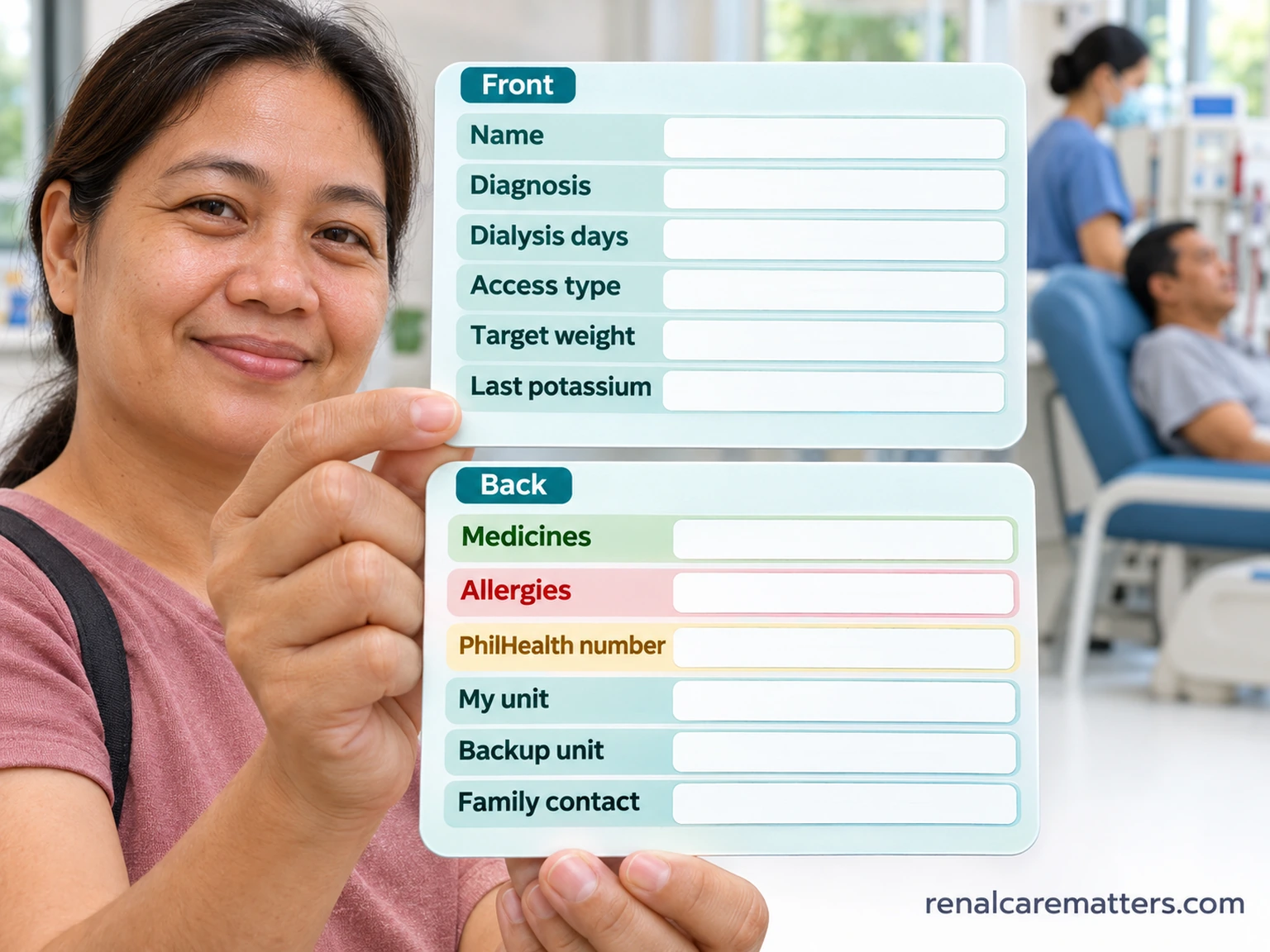
The card carries what a stranger needs to dialyze the patient safely, and nothing more. Keep it in a waterproof sleeve in the go-bag and a photo of it on the patient’s and a family member’s phone.
Figure 2. The patient emergency card: everything a strange unit needs, carried at all times.
Front
Back
Name; kidney diagnosis
Current medicines and doses
Dialysis days and session length
Allergies
Access type and side (fistula, graft, catheter)
Philippine Health Insurance Corporation (PhilHealth) number
Target (dry) weight
My unit, with two phone numbers
Last potassium, with its date
Backup unit; family contact
The site’s climate extremes guide has a printable Kidney Emergency Card. The nurse updates the card when the prescription, access or dry weight changes, and checks it at the start of each typhoon season. The card is the patient’s own document; the unit keeps no copy outside the patient’s record.
Lesson · part 2
The three-day emergency kidney diet
When sessions are missed, food decides how fast potassium and fluid build up. The Academy’s Three-Day Emergency Kidney Diet sheet, approved by Dr. Rivero on November 28, 2026, gives adults on hemodialysis the amounts: a no-cook, no-refrigerator menu in measured household portions, swaps for when it is safe to cook, a “hold for now” list of local foods, food and water safety when the power is out, advice for diabetes, the warning signs that mean go to a hospital now, and a kit list. The patient starts it as soon as the emergency is announced, before a session is missed.
Before typhoon season, the team fills in the sheet’s “My information” page with the patient: the daily fluid allowance (the team sets it; if no number is written, the sheet shows the national plan’s 2 cups, about 480 mL, a day), the unit and backup unit numbers, the diabetes plan, and any low-salt brands the unit recommends. The patient’s own dietitian may adjust the plan.
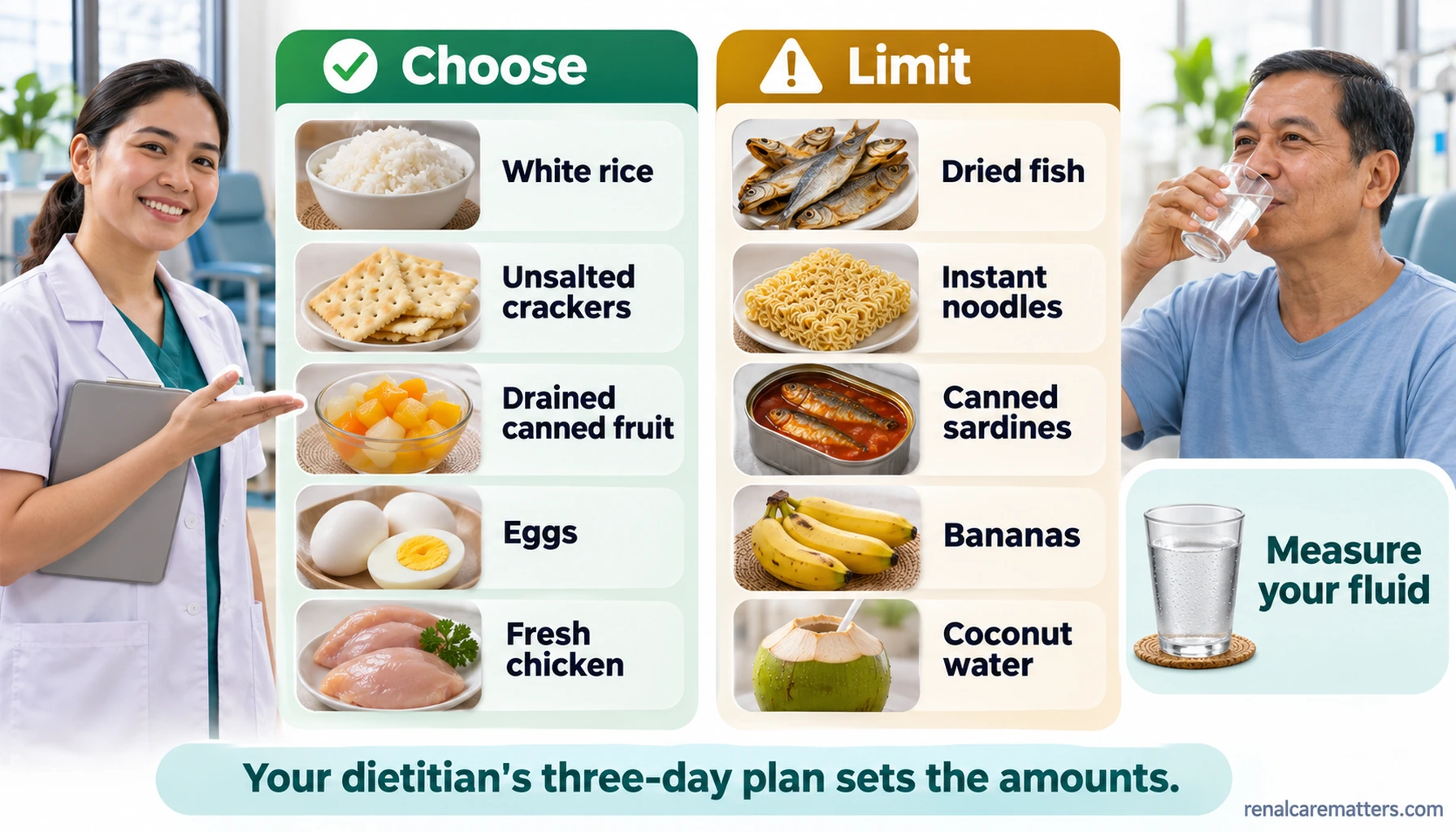
Figure 3. The three-day emergency kidney diet in principle: choose lower-potassium, lower-salt foods and measure fluid. The dietitian's plan sets the amounts.
Choose foods that are lower in potassium and salt and keep without a refrigerator: white rice, unsalted crackers, canned fruit with the syrup drained, eggs, and fresh chicken or fish only while it can be kept cold.
Limit the foods that relief packs and stores are full of: dried and salted fish, instant noodles (and their seasoning packet), canned sardines and processed meat, and high-potassium foods such as bananas and coconut water.
Measure fluid. Use one marked cup for all drinks. Salty food drives thirst, so less salt makes the fluid limit easier.
Amounts come from the sheet; the fluid number comes from the team. The plan has less protein than the usual dialysis diet and lasts only until the next session; it is not a reason to skip dialysis.
For patients with diabetes, the sheet drops the candy and added sugar except to treat a low blood sugar, and tells them not to change insulin or diabetes pills on their own. The sheet is for adults on hemodialysis only: patients on PD, children, pregnant patients and transplant recipients need their own plan from the team. For children, the pediatric nephrologist orders a weight-based plan.
RememberLimit potassium, salt and fluid until the next session, with the sheet’s measured portions and the team’s fluid number. No one should skip dialysis because they are “on the emergency diet.”
Lesson · part 3
Medicines, phones and family
Medicines. A written list (name, dose, time), kept with the card, and an extra supply agreed with the patient’s doctor and pharmacist, rotated so it does not expire. Pharmacies may close after a disaster. The list lets a receiving unit or a hospital continue treatment without guessing.
Two phone numbers and a family contact. One number is rarely enough: phones are lost, batteries die, and numbers change. The unit records two numbers and a family contact, and checks them before typhoon season (the call-down drill, Module 12).
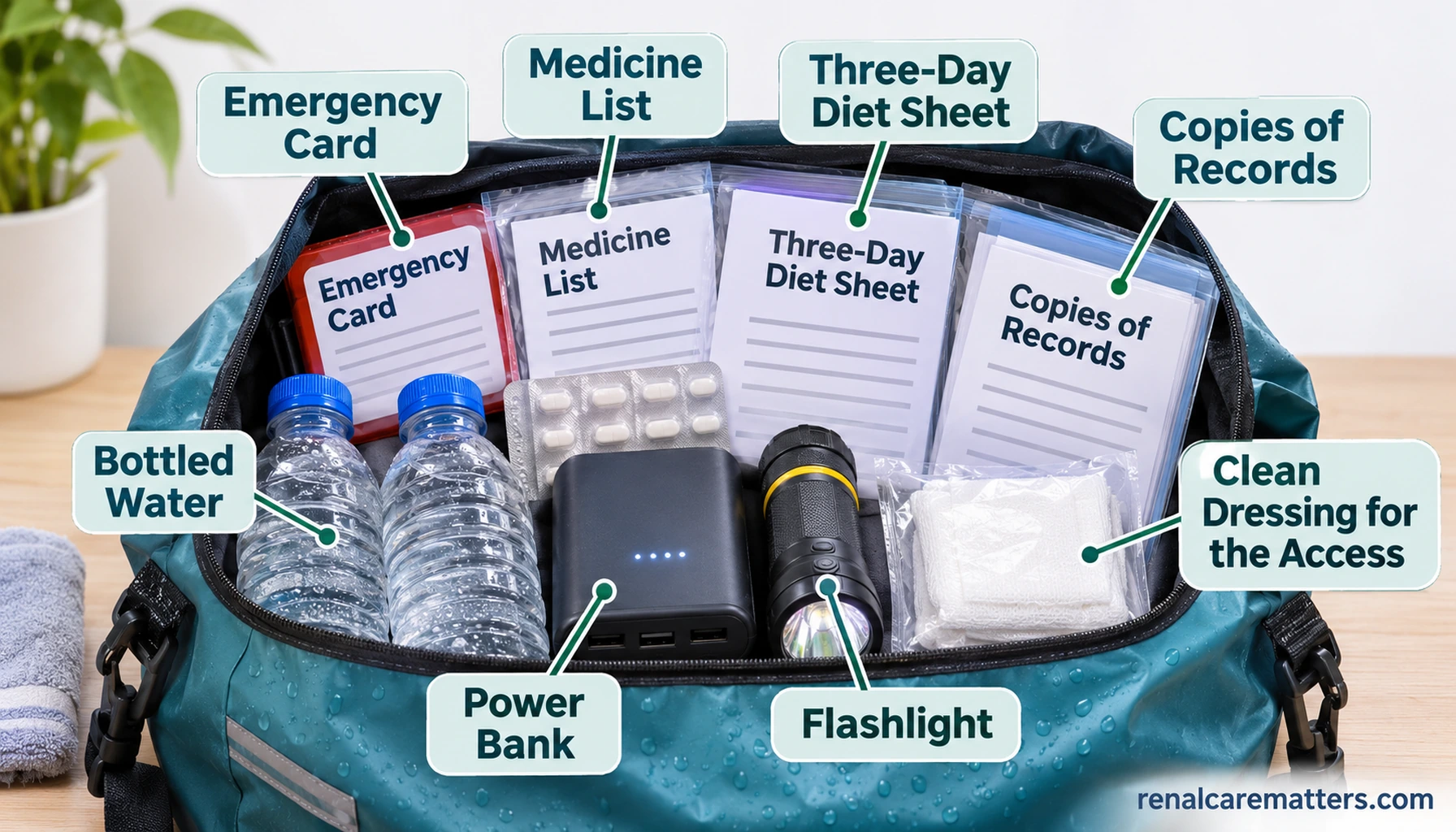
The go-bag. Card, medicine list and supply, the diet sheet, bottled water, a power bank, a flashlight, copies of recent records, and a clean dressing for the access.
Figure 4. The go-bag, packed before the season.
Patients on PD and home dialysis. They need a supply of solution bags and a clean place for exchanges, and a way to reach their PD unit when phone lines are down. A Japanese hospital reported on its communication with PD patients after the 2016 Kumamoto earthquake.2 PD units keep a list of patients’ addresses and supply levels, protected under the Data Privacy Act.
Lesson · part 4
What a patient does on the machine when disaster strikes
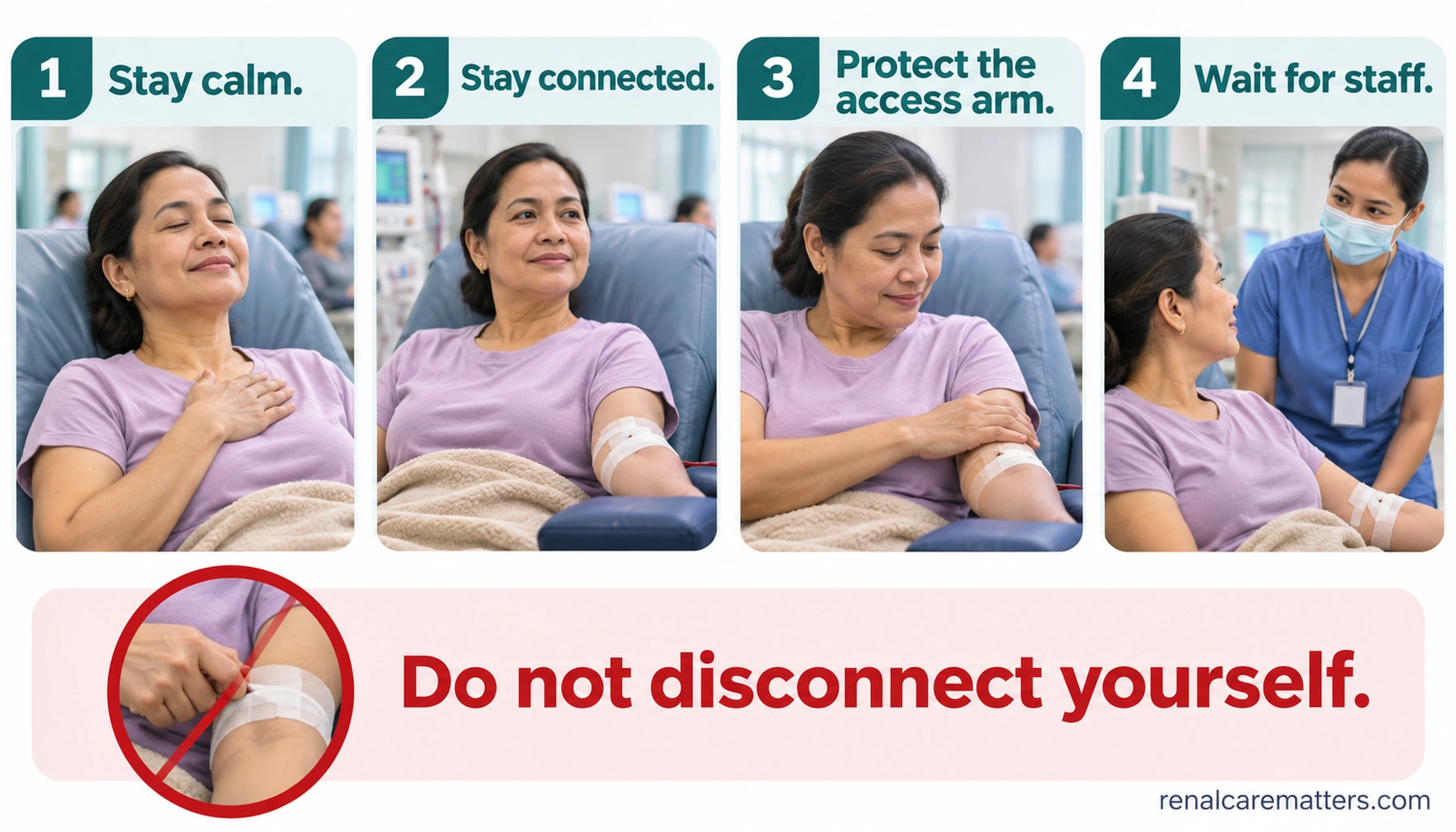
This is the rule every patient learns: stay calm, stay connected, protect the access arm, and wait for staff. Staff take patients off.
Figure 5. If disaster strikes during your session: stay calm, stay connected, protect your access arm, and wait for staff.
Some countries teach patients to disconnect themselves in an emergency. The Academy does not (Dr. Rivero’s decision), for a clear reason. In 626 hemodialysis patients in 10 centers across six countries, only 20.0% had been trained in self-disconnection, and on a checklist only 40.3% identified the first stage of the procedure correctly and 38.3% the second.3 A patient who pulls a needle, opens a catheter or separates lines under stress risks bleeding, air entering a central vein, or a lost access. Staff are trained to do this with the blood rule (Module 6) and the right clamps.
During shaking, a patient in a recliner stays seated and covers the head and neck with the free arm or a pillow, keeping the access arm still.4 In a fire or an evacuation, staff come to each patient and take them off in turn (Module 7).
Stop and callA patient on the machine who is bleeding from the access, feels faint, or tries to disconnect during an event is attended at once by the nearest staff member. Follow your unit protocol, and always ask the attending nephrologist for guidance.
🧒
Units that dialyze children
A child’s go-bag also holds what the caregiver needs: a car seat or stroller plan for evacuation, the child’s weight on the card, pediatric supplies, and comfort items. The diet is weight-based and ordered by the pediatric nephrologist. A caregiver stays with the child during the session when the unit allows it, and knows the same rule: stay connected and wait for staff.
On the floor
Real situations: problems and solutions
These are fictional but typical. For each one, cover the answer, decide what you would do, then compare. Where a step depends on local rules, your unit’s procedure and your supervisor’s direction come first.
The old card
What you see
A patient shows an emergency card listing a catheter that was removed a year ago, and a dry weight 4 kg off.
What is likely going on
The card was never updated.
What to do
Update it now, and add card checks to the start of each typhoon season and every access change.
Why it matters
A wrong card can mislead a receiving unit.
The relief pack
What you see
After a flood, a patient’s family has only relief packs of noodles and canned meat.
What is likely going on
The pack is salty and the patient has missed sessions.
What to do
Advise half the seasoning or none, rinsing where possible, small portions, measured fluid, and getting to a unit as soon as possible; tell the dietitian.
Why it matters
Relief food is often the most dangerous food for a dialysis patient.
“Can I unplug myself?”
What you see
A patient asks to be taught to disconnect in case staff are busy.
What is likely going on
He is worried about being left alone in an event.
What to do
Explain the rule and why, and reassure him that the plan assigns staff to every patient on a machine.
Why it matters
Reassurance about the plan is what the patient really needs.
Field notes
Practice the rule on the machine with patients during a quiet session: ask them to say it back.
Keep blank emergency cards at the nurses’ station.
Case review
Back to the case: Mang Ernesto's go-bag
What is missing. A current emergency card (access type and side, dry weight, last potassium, medicines, allergies, PhilHealth number, backup unit, family contact); a written medicine list with an agreed extra supply instead of mixed loose pills; two phone numbers; a power bank; the diet sheet; bottled water; a flashlight; a clean dressing.
What works against him. Instant noodles (and their seasoning) are very salty, and bananas are high in potassium; both make the days before the next session more dangerous. Swap them for the “choose” foods, give him the three-day diet sheet, and fill in his fluid allowance with him.
Liza’s question. “No. At this unit patients are not taught to disconnect themselves. If the power goes out, he stays calm and connected, keeps his fistula arm still, and waits; a nurse will come to him and take him off safely.” Explain why: pulling needles under stress can cause bleeding and lose the fistula, and the nurses are trained to do it with the right clamps.
Interactive case · fictional
Interactive case: Mang Ernesto’s go-bag
Work through a shift one decision at a time. The panel at the top changes with what you choose. After each choice you see why it is, or is not, the best move; after a weaker one you can try again or carry on and see where it leads. Your first choice at each step is scored. The score stays on this device and nothing is sent anywhere. In real practice, your unit’s protocol and the people responsible for each decision come first.
Skills lab · with your preceptor
Skills checklist: Preparing a patient for typhoon season
With a patient (and a family member where possible), complete the preparation conversation before typhoon season. Your preceptor rates each step as satisfactory, needs practice, or not observed. Steps marked Critical must all be satisfactory before sign-off. This checklist supports supervised learning; your unit’s own procedure and competency form are the authority. A printable version of every checklist is on the trainer page.
CriticalFills in or updates the emergency card with access type and side, dry weight, last potassium with date, medicines, allergies, units and contacts.
CriticalChecks two phone numbers and a family contact, and updates the unit record.
Teaches the three-day diet sheet and fills in its personal fields: the team’s fluid allowance, the unit and backup numbers, and the diabetes plan.
Reviews the go-bag and the medicine supply plan.
CriticalTeaches the rule on the machine and confirms the patient can say it back: stay calm, stay connected, protect the access arm, wait for staff.
CriticalDoes not teach or encourage self-disconnection.
Placement activity. Complete the conversation with five patients, including one on PD or one child where the unit treats them.
Self-assessment
Check your understanding
Each visit draws 5 questions at random from this module’s 10-question bank. Choose the single best answer for each, then select Check answers; an explanation appears under the best answer. Select New set of questions for a different mix. A good target is 4 of 5 on two different sets. Nothing you select is sent anywhere; scoring happens in your browser.
Anderson, A. H., Cohen, A. J., Kutner, N. G., Kopp, J. B., Kimmel, P. L., & Muntner, P. (2009). Missed dialysis sessions and hospitalization in hemodialysis patients after Hurricane Katrina. Kidney International, 75(11), 1202–1208. https://doi.org/10.1038/ki.2009.5
Kawabata, C., Hamanoue, S., Maekawa, A., Toyoda, M., Miyata, A., & Uekihara, S. (2017). Communication with peritoneal dialysis patients post-Kumamoto earthquake. Peritoneal Dialysis International, 37(4), 484–485. https://doi.org/10.3747/pdi.2016.00310
Ozen, N., Ozturk, S., Dunya, C. P., Hryszko, T., Fernandes, F., Vovlianou, S., Rotmans, J. I., Lindhard, K., Velarde, E. C., Parmaksiz, E., Kaya, D., Kocak, S. Y., Turan, F., Celik, A., Coban, I., Sousa, C. N., & Unver, V. (2026). An international multicentre study of haemodialysis patients’ knowledge of safe self-disconnection from the dialysis machine in emergencies. Journal of Renal Care, 52(3), e70080. https://doi.org/10.1111/jorc.70080
Educational course and drill resource for dialysis units. It is not a hospital disaster plan, a licensing requirement, or a substitute for your unit’s approved protocol, the machine manufacturer’s instructions, or instructions from PAGASA, PHIVOLCS, the Bureau of Fire Protection or your local disaster office. Clinical decisions in a disaster (early dialysis, shortened sessions, priority, diet) belong to the attending nephrologist.