After this module you should be able to
- Treat a thrombosed access as two problems at once: dialysis safety and access salvage.
- Explain why access clots form, and why salvage that ignores the cause fails again.
- Compare surgical and endovascular thrombectomy using the randomized evidence and its gaps.
- Record times, owners and the contingency so the patient is never left between teams.
The big picture, in plain words
The picture has a limit. A bridge collapses from its own weakness. An access usually clots because something downstream narrowed it, or because flow fell: hypotension after a long session, compression while sleeping, or dehydration. Rebuilding without fixing that cause is rebuilding the same weak bridge.
Figure 1 · Key terms for this module
Your work is to make sure the patient’s immediate danger, usually potassium and fluid after a missed session, is managed now, while you plan the rescue and treat the cause.
Case: The declot list is tomorrow
Mr. Alfredo Ramos, 68, has a left upper-arm graft. He missed his Saturday session because the graft was silent when he woke. It is now Monday, 10:30 a.m. He arrives at your hospital’s emergency department breathless, sitting upright, with ankle edema. His potassium is 7.1 mmol/L and the electrocardiogram shows wide QRS complexes. The emergency physician calls you: “Graft is clotted. Your declot list is tomorrow morning. Can we admit him and wait?”
Before reading on, decide:
- What must happen in the next hour, and who owns it?
- How do you plan the salvage?
- What do you need to find and fix at the time of salvage?
Keep your answers in mind. The lesson gives you what you need, and the case review near the end shows one sound response.
Two problems, two owners, one timeline
The danger of access thrombosis is rarely the clot. It is the dialysis the patient has missed. Potassium rises between sessions because, in kidney failure from chronic kidney disease (CKD), nothing excretes it; fluid accumulates. A patient who missed a session over a weekend can reach a lethal potassium and pulmonary edema. These need emergency medical treatment and, often, dialysis through a temporary catheter, today. That decision belongs to the emergency team and the nephrologist.
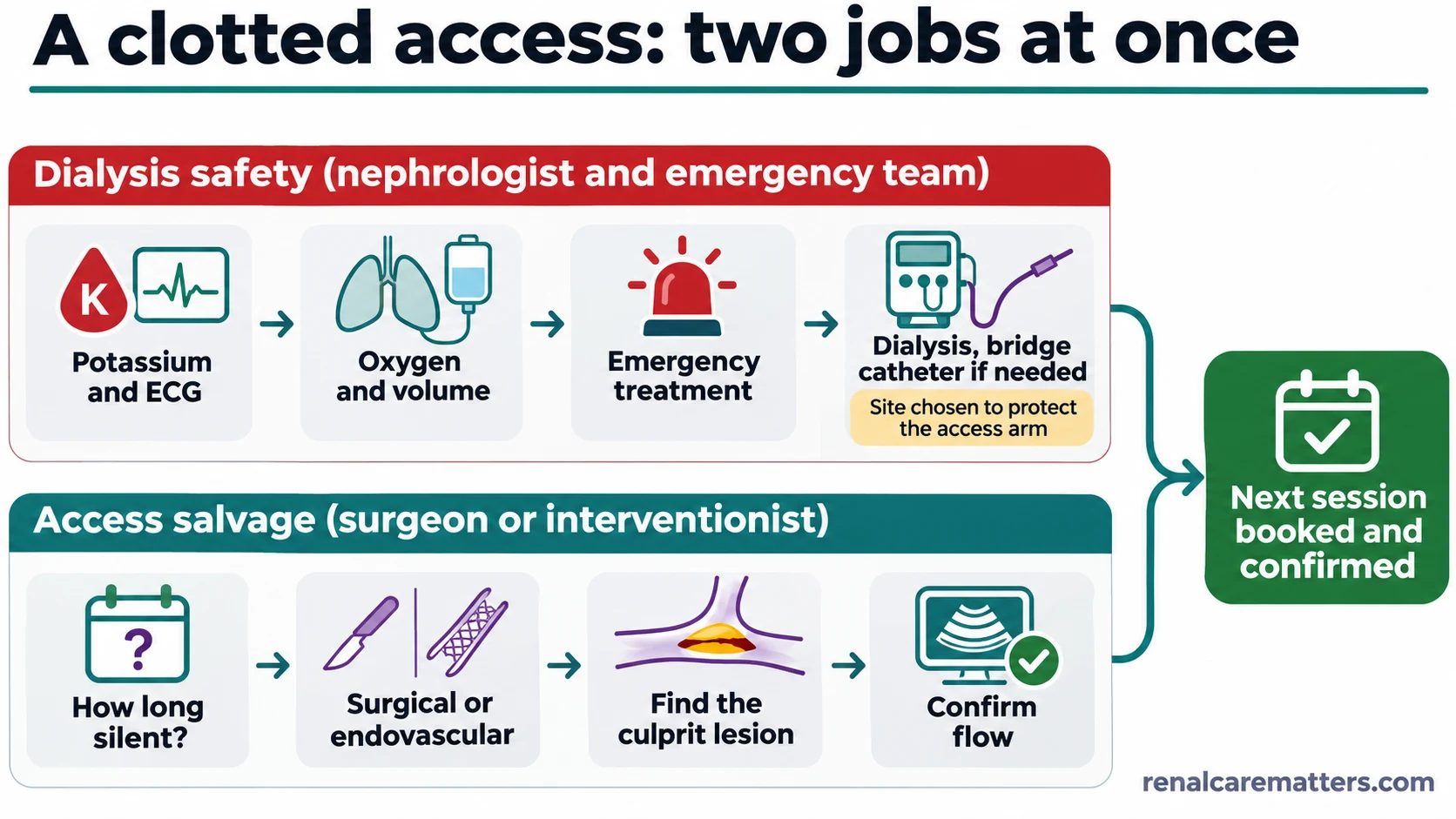
Salvage belongs to you or the interventionist, and it can run in parallel. Ask when the last successful session was, how long the access has been silent, whether the patient is stable enough for a procedure, and what rescue services exist today. Agree with the nephrologist whether a catheter is placed first, and where, so it does not harm the arm you are trying to save.
Figure 3 · Parallel pathway for a clotted access
- Assess the patientPotassium, electrocardiogram, oxygen, blood pressure, volume.
- Treat the threatEmergency potassium treatment and dialysis as the nephrologist directs.
- Plan the bridgeTemporary catheter site chosen to protect the access arm.
- Plan salvageSurgical or endovascular, today or at a set time, with a named operator.
- Find the causeImage the whole circuit and treat the culprit lesion.
- Close the loopNext dialysis session booked and confirmed with the unit.
Why accesses clot, and why the cause matters
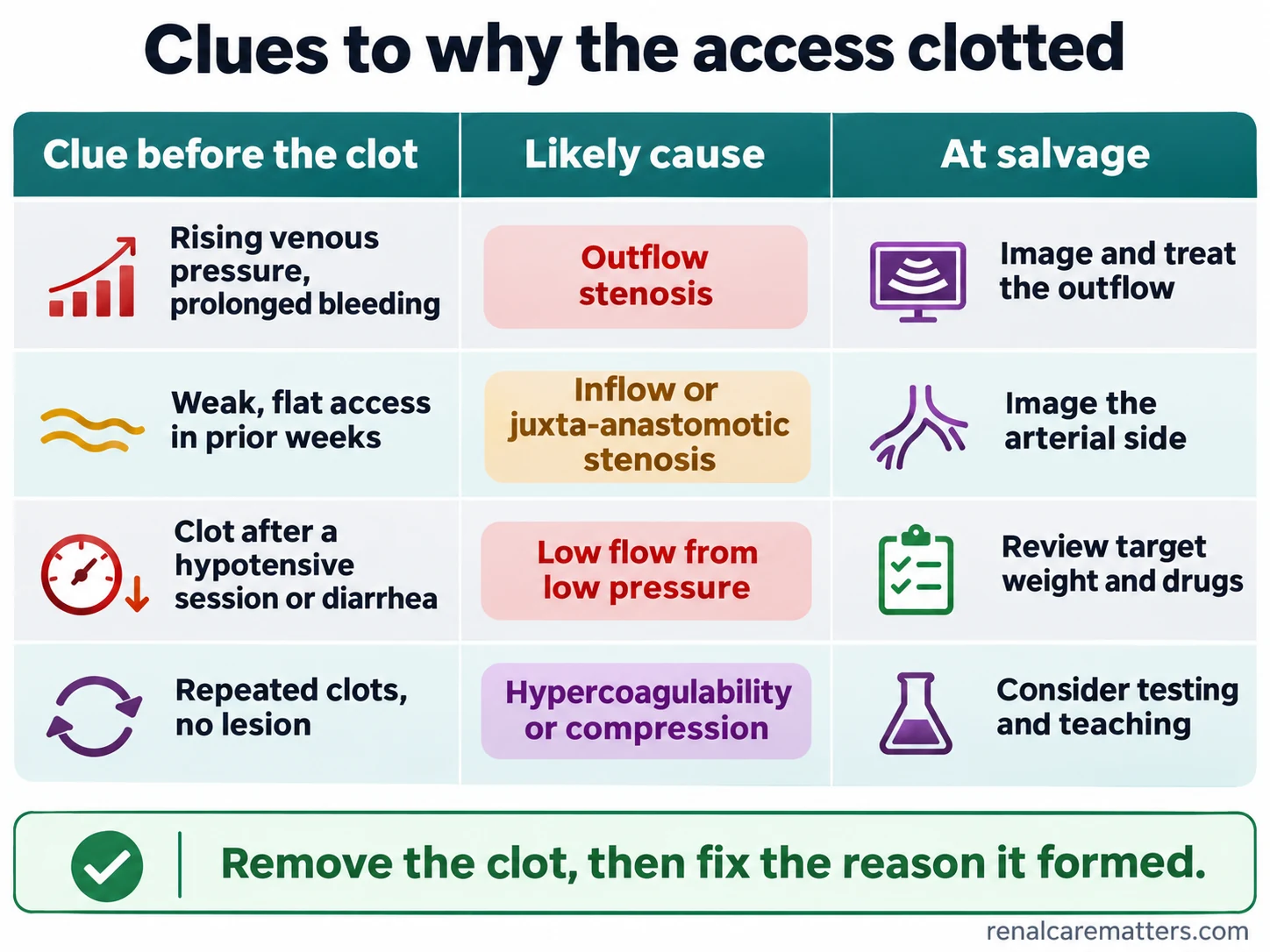
Most graft thromboses follow a venous anastomotic or outflow stenosis that has gradually lowered flow until it falls below the threshold at which blood stays liquid. Fistulas clot from juxta-anastomotic or outflow stenosis, from low pressure (intradialytic hypotension, dehydration), from compression, or from a hypercoagulable state. Removing the clot restores flow but leaves the stenosis; the access clots again unless the culprit is treated.
The UK Kidney Association (UKKA) 2025 guideline recommends either an endovascular or surgical approach to salvage based on local expertise, with surgical approaches followed by treatment of the underlying culprit stenosis (statement 4.5, grade 1C).1
| Clue | Likely cause | Implication at salvage |
|---|---|---|
| Rising venous pressures and prolonged bleeding before the clot | Outflow stenosis | Image and treat the outflow |
| Weak, flat access in the weeks before | Inflow or juxta-anastomotic stenosis | Image the arterial side |
| Clot after a hypotensive session or diarrhea | Low flow from low pressure | Review dry weight and drugs with the nephrologist |
| Repeated clots without a lesion | Hypercoagulability or compression | Consider testing and patient education |
Surgical or endovascular: what the evidence shows
Kuhan and colleagues found six randomized trials, all in thrombosed grafts, with 573 grafts. Technical success, need for a temporary line and 30-day primary patency were similar between surgery and endovascular therapy; one-year primary patency did not differ significantly, and a single study suggested better assisted patency with surgery. There were no randomized trials for native fistulas.2 Choice therefore rests on local expertise, the anatomy, the age of the clot and what remains for the future.
A restored image is not the end. Confirm that the access supports dialysis at the next session, and decide what happens if rescue fails: who places a catheter, where, and when the next access discussion happens. Record the times: when the access was found silent, when the patient was assessed, when salvage was done. Delays between teams are where these patients come to harm.
A fistula patient calls the unit on Sunday: no thrill since morning, no breathlessness, potassium last Friday normal. The nephrologist arranges a potassium check and a Monday dialysis plan; you book an early Monday fistulogram and possible thrombectomy, and the unit reads the plan back.
What this shows. A stable patient can wait hours for salvage when dialysis safety has an owner and a time.
Illustrative scenario. Names and details are invented.
Back to the case: The declot list is tomorrow
The next hour. This is a medical emergency. The emergency team treats the potassium now (cardiac membrane stabilization and measures that shift potassium into cells, per protocol) and the nephrologist arranges urgent dialysis, which needs a temporary catheter. You advise on catheter site: a right internal jugular line protects the left arm. Waiting for tomorrow’s list would be unsafe.
Salvage. Once he is stabilized and dialyzed, plan thrombectomy, endovascular or surgical according to local expertise, today if possible or at a fixed time tomorrow, with a named operator. The graft has been silent since Saturday; the longer the delay, the harder salvage may be.
The cause. Image the whole circuit at salvage. A graft clot is usually a venous anastomotic or outflow stenosis; treat it, which in a graft may mean a stent graft (Module 11). Check whether low blood pressure or dehydration contributed. Book his next session through the graft only after flow is confirmed, and set the catheter’s removal date.
Skills checklist: Parallel salvage and dialysis plan
Emergency station simulation or supervised emergency case. Your preceptor rates each step as satisfactory, needs practice, or not observed. Steps marked Critical must all be satisfactory before sign-off. This checklist supports supervised learning; your unit’s own procedure and competency form are the authority. A printable version of every checklist is on the trainer page.
- CriticalAsks first about the last session, potassium, electrocardiogram and breathing
- CriticalContacts the nephrologist and emergency team for dialysis safety in parallel
- Advises a bridge catheter site that protects the access arm
- Agrees salvage approach, operator and time
- Plans imaging and treatment of the culprit lesion
- Confirms the next dialysis session with the unit
Check your understanding
Each visit draws 5 questions at random from this module’s 5-question bank. Choose the single best answer for each, then select Check answers; an explanation appears under the best answer. Select New set of questions for a different mix. A good target is 4 of 5 on two different sets. Nothing you select is sent anywhere; scoring happens in your browser.
Read next on this site
- Potassium & Hyperkalemia in CKDWhy potassium becomes dangerous after a missed session.
- Dialysis Access CareWhat patients should do if the thrill is gone.