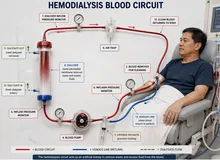
A focused assessment before the session, the decision to start, delay, or transfer, and the check before the patient leaves.
PublishedNailathalaGipatikPepalwal:ReferencesMga SanggunianMga TinubdanReng Reperensya:14Audience: Physicians who cover hemodialysis shifts · attending nephrologists, medical directors, and head nurses who orient themRead timeOras ng pagbasaOras sa pagbasaOras ning pamamasa:
This module is study material for physicians on duty in hemodialysis units. It explains the reasoning behind common decisions; it is not a protocol. At the chairside, follow your unit’s protocol and ask the attending nephrologist for guidance. Doses and cut-off values are set by your unit. Every case is fictional.
Learning objectives
After this module you should be able to
Perform a focused three-minute assessment of a patient who is about to start hemodialysis.
Choose among four decisions: start as ordered, start after a call for changes, delay, or transfer to the emergency room.
Recognize the red flags that mean a patient should not be connected in an outpatient unit.
Assess a patient who missed sessions and report the findings before connection.
Confirm serology and isolation status before a patient is connected.
Perform the post-dialysis check and decide whether a patient is safe to go home.
Pre-testBefore you read, answer the 8 self-assessment questions and note your score. After the module, select New set of questions and compare. The difference is what you learned; the questions you still miss are what to reread.
Start here
The big picture, in plain words
In plain wordsThink of an inter-island ferry. Before it leaves port, an officer checks the weather, the vessel, and the passengers. At the other end, nobody steps off until the ramp is secure. A dialysis session has the same two gates. You check the patient before the blood leaves the body, and again before the patient leaves the building.
The picture has one limit. A ferry that stays in port is safe. A dialysis patient who is not dialyzed is not. The fluid, potassium, and acid that Module 2 described keep building while the patient waits. “Do not start” is therefore never a complete decision. It must come with a plan for where and when the patient will be dialyzed.
Figure 1 · Key terms for this module
Pre-dialysis assessmentA short, structured look at the patient before connection.
Clearance noteYour written record of that assessment and of the decision made.
Red flagA finding that suggests a condition the dialysis unit cannot diagnose or treat safely.
Serology statusRecorded test results for hepatitis B, hepatitis C, and human immunodeficiency virus (HIV), with their dates.
Isolation stationA room or area with a machine used only for patients with hepatitis B infection.
Orthostatic hypotensionA fall in blood pressure on standing, often with dizziness.
HemostasisBleeding from the needle sites has stopped and stays stopped.
Opening case · fictional
Case: She walked in breathless.
Mrs. Lourdes Villanueva, 64, dialyzes every Tuesday and Friday through a left arm fistula. She has been away for two weeks at a family wake in her home province. She had one session at a center there last Tuesday and missed the Friday session because of the burial. Today is Tuesday. It has been seven days since her last dialysis.
She walks in holding her daughter’s arm and stops twice to catch her breath. She speaks in short phrases. She is 5.2 kilograms above her dry weight. Her blood pressure is 190/104 mm Hg, her heart rate is 112 per minute, and her oxygen saturation is 89% on room air. She has no chest pain and no fever.
The charge nurse, Ms. Aquino, says quietly: “Doctor, she dialyzed somewhere else last week. We have no record from that center.”
Before reading on, decide:
What do you need to find out in the next three minutes?
Which of the four decisions fits her: start as ordered, start after a call, delay, or transfer?
What must be settled about her session in another center before she is connected?
Keep your answers in mind. The lesson gives you what you need, and the case review near the end shows one sound response.
Lesson · part 1
Two gates and four possible answers
Most patients who arrive for dialysis are well enough to start and, later, to go home. The assessment exists to find the few who are not. It works only when it is done for every patient, in the same order.
Philippine licensing rules expect a physician to be present while a dialysis clinic operates, and they assign nurses to assess patients before, during, and after treatment.1 Professional standards add that the physician on duty evaluates all patients during the tour of duty.2 Read the nurse’s assessment before you begin yours.
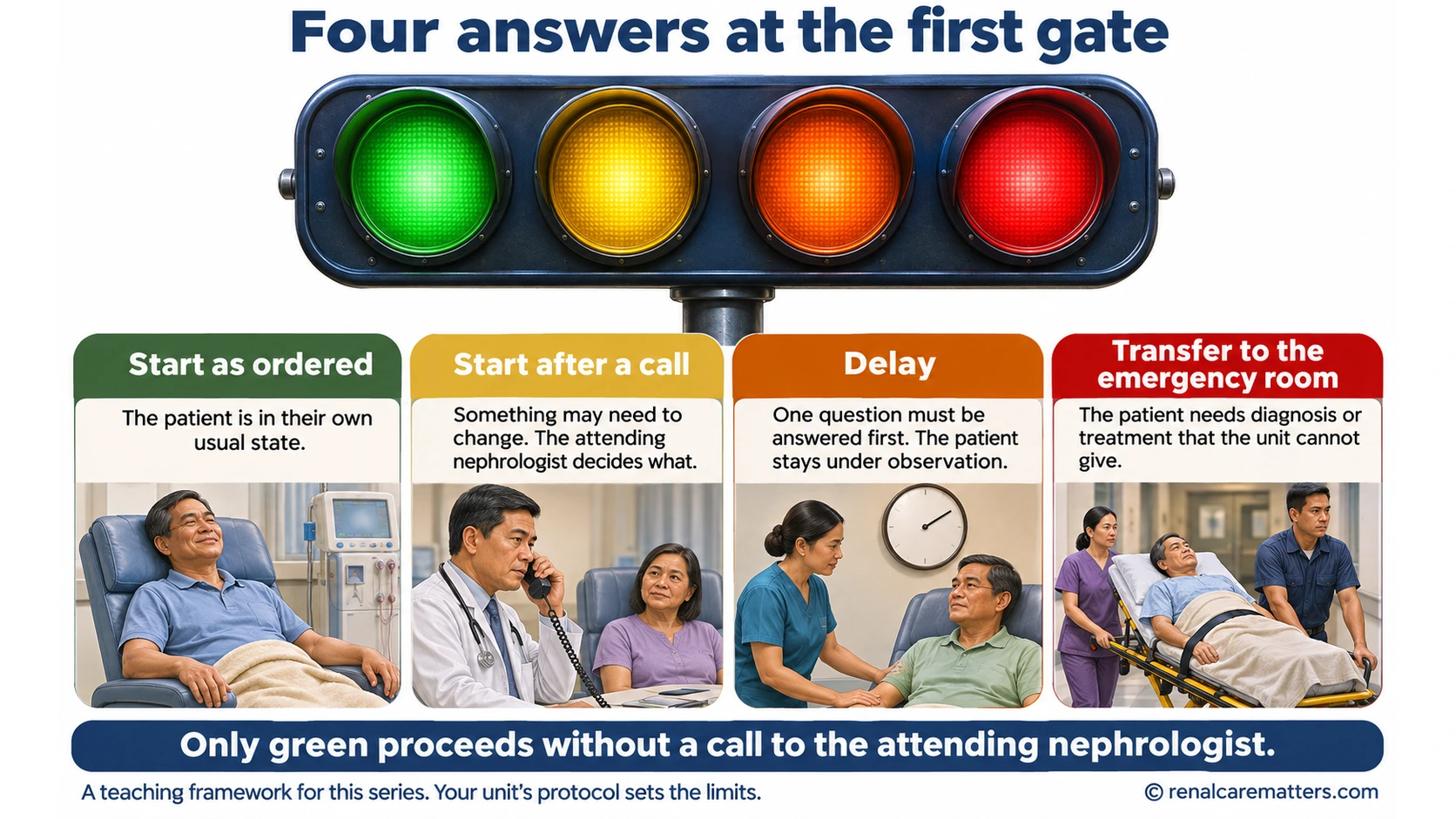
At the first gate there are four possible answers, not two.
Figure 2 · Four answers at the first gate
Start as orderedThe patient is in their own usual state. Nothing calls for a change to the prescription.
Start after a callThe patient can be dialyzed here, but something may need to change. The attending nephrologist decides what.
DelayOne question must be answered first, such as an electrocardiogram (ECG), a blood sugar, or a call back. The patient stays under observation.
TransferThe patient needs diagnosis or treatment that the unit cannot give. Dialysis, if still needed, is arranged in the hospital.
Figure 3. Four answers at the first gate. Only green proceeds without a call to the attending nephrologist.
Figure 4 · Safe to start?
Look for red flagsUnstable vital signs, chest pain, a new neurologic deficit, active bleeding, or altered consciousness. If present, follow the emergency protocol, call, and prepare to transfer.
Compare with the patient’s usualWeight gain, blood pressure, heart rate, breathing, and temperature, against your unit’s limits and this patient’s pattern.
Ask about the gapMissed sessions, dialysis elsewhere, illness, bleeding, falls, and new medicines.
Check the accessA thrill and healthy skin, or a clean catheter exit site.
Confirm the stationSerology status is known, current, and matches the machine.
Decide and writeOne of the four answers, with the time.
This four-answer structure is a teaching framework built for this series. It does not come from a guideline, and no trial has tested it. Your unit’s protocol and the attending nephrologist set the limits between one answer and the next.
RememberA delay needs a clock. Decide what you are waiting for and for how long. A delay with no end point becomes a missed session.
Lesson · part 2
The three-minute assessment
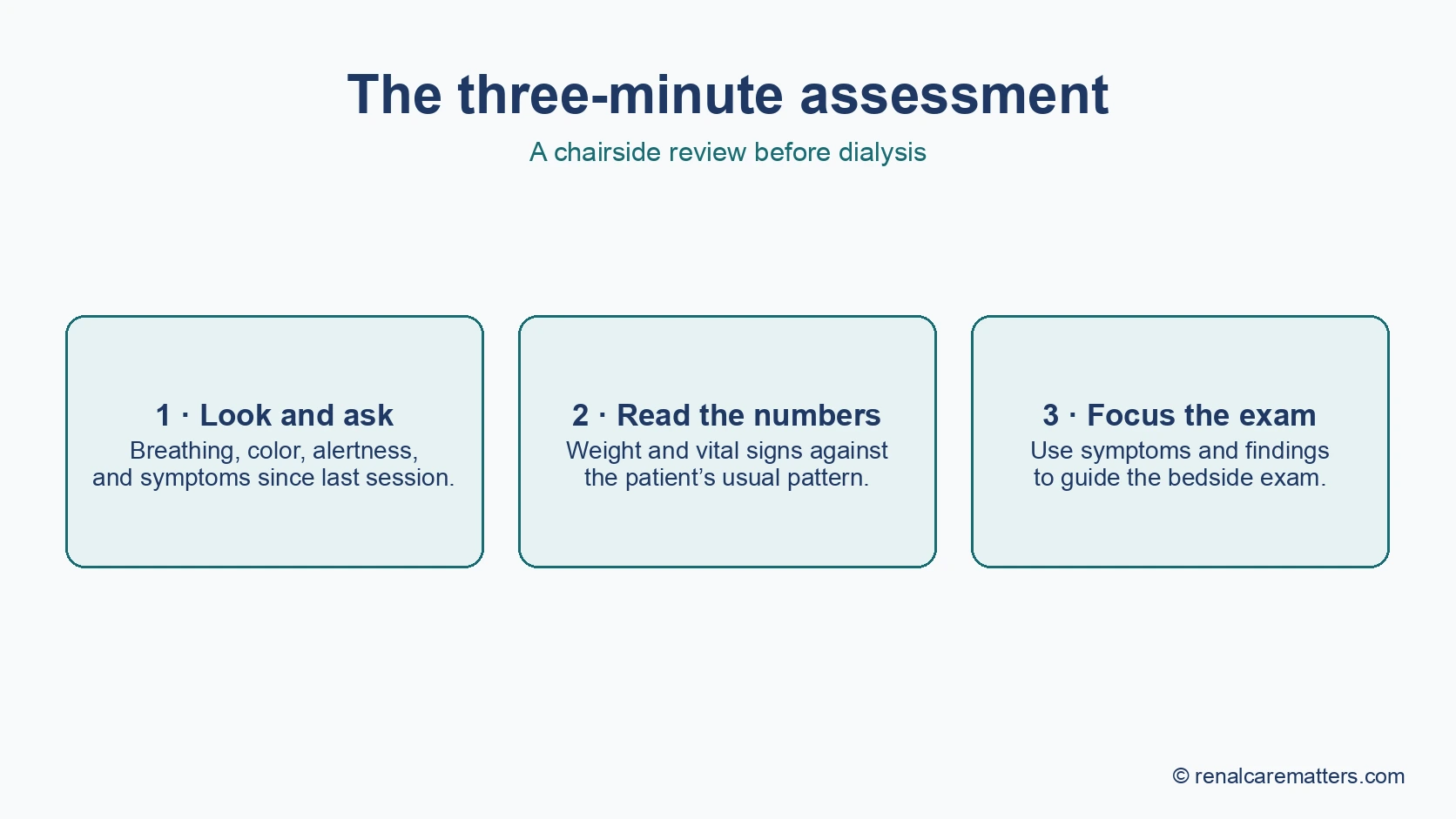
A full history and examination takes too long when twelve patients arrive together. A fixed short sequence does not. It moves from what you can see across the room, to the numbers, to your hands.
Figure 5. The three-minute sequence: look and ask, read the numbers, then examine.
Figure 6 · Three minutes, in order
Minute one, look and askWatch the patient walk from the scale. Note breathing, color, alertness, and speech. Ask, “How have you been since your last session?”
Minute two, read the numbersWeight against the dry weight and the last post-dialysis weight. Blood pressure, heart rate, temperature, and oxygen saturation. Blood sugar in patients with diabetes, as protocol states.
Minute three, examineNeck veins, lung bases, ankles or sacrum, and the access.
Then decideSay the decision to the nurse and write the clearance note.
Read the numbers against the patient’s own pattern
Dialysis patients often live with values that would alarm you in anyone else. A single reading tells you little. A reading that departs from that patient’s last several sessions tells you a great deal, so open the previous treatment records before you examine.
What the chest and the ankles cannot tell you
Listening for crackles and pressing on the ankles are quick, and you should do both. They are also weak tests. In a study of 79 hemodialysis patients with 1,106 paired examinations, crackles and leg edema agreed poorly with lung congestion seen on ultrasound, alone or combined.3 Those patients had heart disease, so the figures may not apply to every unit. The lesson still holds: a clear chest does not rule out fluid in the lungs. Breathlessness, sleeping upright, a large weight gain, and a low oxygen saturation count for more.
The access
Figure 7. Look, listen, and feel. A fistula or graft should have a continuous thrill and no redness, swelling, or discharge.
For a fistula or graft, look at the skin and feel for the thrill, the buzzing vibration of blood flowing through the access. For a catheter, look at the exit site and ask about fever or chills. An access with no thrill, or one that looks infected, is not needled until the attending nephrologist has been told. The access plan is part of the prescription.
Lesson · part 3
Red flags that belong in the emergency room
An outpatient dialysis unit cannot image a brain, monitor a heart overnight, transfuse rapidly, or support a failing circulation. Connection also adds stress. Blood moves outside the body, fluid is removed, and heparin, a blood thinner, is usually given.4 An unstable patient tolerates this poorly, and heparin can worsen bleeding.
A red flag does not cancel dialysis. It means the outpatient chair is the wrong place to begin. The nephrologist can arrange dialysis in the hospital once the emergency has been assessed.
Red flag
What it may be
Why not the outpatient chair
Chest pain, or new ECG changes
Heart attack or a dangerous rhythm
Needs cardiac monitoring and tests
New weakness, facial droop, slurred speech, or sudden severe headache
Stroke, including bleeding in the brain
Needs urgent imaging. Heparin could worsen a bleed
New confusion or drowsiness
Low blood sugar, infection, stroke, severe uremia (buildup of wastes the kidneys normally clear)
Check blood sugar per protocol. The cause must be found
Low blood pressure with a fast pulse, cold skin, or fainting
Sepsis, bleeding, or a heart problem
Fluid removal would lower the pressure further
Severe breathlessness that does not ease with oxygen and sitting up
Pulmonary edema, pneumonia, heart attack
May need airway support. Urgent dialysis is arranged with the nephrologist
Black or bloody stools, vomiting blood, or a bleeding access
Active bleeding
Heparin and needling add risk. May need transfusion
Fall with a head injury since the last session
Bleeding inside the skull
Symptoms can be delayed. Heparin adds risk
Stop and callStop and call the attending nephrologist before connection for unstable vital signs, chest pain, a new neurologic deficit, or active bleeding. Begin your unit’s emergency protocol while someone else dials. Do not start dialysis while you wait.
Fever in a patient with a catheter
A dialysis catheter runs from the skin into a large central vein. Bacteria on the skin or in the catheter hub can enter the blood each time it is opened. Fever or chills in a patient with a catheter is therefore treated as a bloodstream infection until shown otherwise.
The reverse does not hold. A prospective study at one large center in the United States followed 305 episodes of suspected infection in catheter-dependent patients. Infection was confirmed in 88%, and catheter-related bloodstream infection made up 69% of confirmed infections. Fever was a presenting symptom in fewer than half of those bloodstream infections.5 This was a single center, and local patterns may differ. A catheter patient who feels cold or weak without fever still deserves suspicion.
Stop and callCall the attending nephrologist for any catheter patient with fever, chills, or a new feeling of being unwell. Follow your unit’s protocol for blood cultures. Whether to dialyze, which antibiotic to give, and whether the catheter stays are the nephrologist’s decisions.
Lesson · part 4
Questions about the days since the last session
The patient has lived several days without you. On a twice-weekly schedule the gaps are three and four days long. Most of what makes a session unsafe happened during those days, and patients often do not mention it unless asked.
Ask about
Why it matters
Missed or shortened sessions
A longer gap means more fluid, potassium, and acid
Dialysis anywhere else
Serology status and the treatment record need review
Breathlessness, or trouble lying flat
Early signs of fluid in the lungs
Chest pain, palpitations, or fainting
Possible heart disease or a rhythm problem
Fever or chills, at home or after the last session
Access infection can show hours after a session
Bleeding, black stools, falls, or a blow to the head
Heparin is usually given during dialysis
Vomiting, loose stools, or poor appetite
The patient may be below dry weight
Admission, procedure, or new medicine
Bleeding risk, blood pressure, and potassium may have changed
Time needed to feel normal after the last session
A long recovery suggests the session was hard on the patient
In an international study of 6,040 patients, one in ten reported needing more than 12 hours to recover from a session. They had a higher risk of hospital admission and death than patients who recovered in 2 to 6 hours.6 The answer is subjective, and the study cannot show that long recovery causes harm. It is still worth passing to the nephrologist.
RememberAsk the same questions of every patient at every session. The patient who “never has problems” is the one whose new problem gets missed.
Lesson · part 5
The patient who missed sessions
Module 2 explained why the longest gap of the week is the most dangerous time. A missed session makes that gap longer. On a twice-weekly schedule, one missed session leaves the patient a full week without dialysis.
What the evidence shows
Three large observational studies point the same way. In an international cohort, patients who skipped one or more sessions a month had a 30% higher risk of death.7 Among 4,493 patients in countries where missed treatments were common, one or more missed treatments in four months was associated with a higher risk of death (hazard ratio 1.68), sudden death, and hospital admission.8 In records of 182,536 patients in the United States, the odds of admission in the two days after a missed treatment were about four times those after an attended one.9
These studies have limits. Patients who miss sessions differ in many ways from those who do not. Most were prescribed three sessions a week, so the figures cannot be applied directly to twice-weekly patients in the Philippines. The physiology gives no reason to expect a smaller risk when the usual gap is already longer.
The same studies linked missed sessions to longer travel, symptoms of depression, transport problems, and bad weather.8,9 A patient who feels blamed will hide the next missed session. Ask why with interest, and pass the reason to the team.
What is different today
Figure 8 · Three dangers after a missed session
FluidMore weight gain, and a higher chance of fluid in the lungs.
PotassiumMore time to build up. A normal ECG does not exclude a high level.
Acid and uremiaNausea, drowsiness, or deep rapid breathing.
Faced with a large weight gain, it is natural to want all of it removed today. Module 2 showed that fast fluid removal is associated with harm.10 After several missed sessions the blood urea may be very high. Standard texts advise a gentler session when urea is very high, to lower the risk of dialysis disequilibrium, a brain swelling syndrome.4 That advice comes mainly from patients new to dialysis. How to divide the work across sessions is a prescription decision.
Figure 9 · Missed-dialysis pathway
Count the daysDays since the last full session, and sessions missed or shortened.
Look for the three dangersBreathing and oxygen saturation, weakness or palpitations, drowsiness or vomiting.
Test as protocol allowsAn ECG and a pre-dialysis blood sample.
Call before connectionReport the days missed, the weight gain, the vital signs, and any results.
Carry out the ordersFluid goal, time, dialysis fluid, and any extra session are the nephrologist’s to set.
Ask whyShare the reason with the nurse and the social worker.
Fix the next dateConfirm the next session before the patient leaves.
Stop and callCall the attending nephrologist before connecting any patient who missed a session. Treat it as an emergency under your unit’s protocol if the patient is breathless at rest, weak, drowsy, or has an abnormal ECG.
Lesson · part 6
Serology and isolation status
In dialysis, blood leaves the body through tubing handled by staff who move between patients. Small amounts reach gloves, clamps, and machine surfaces, and can carry viruses to the next patient without a visible spill.
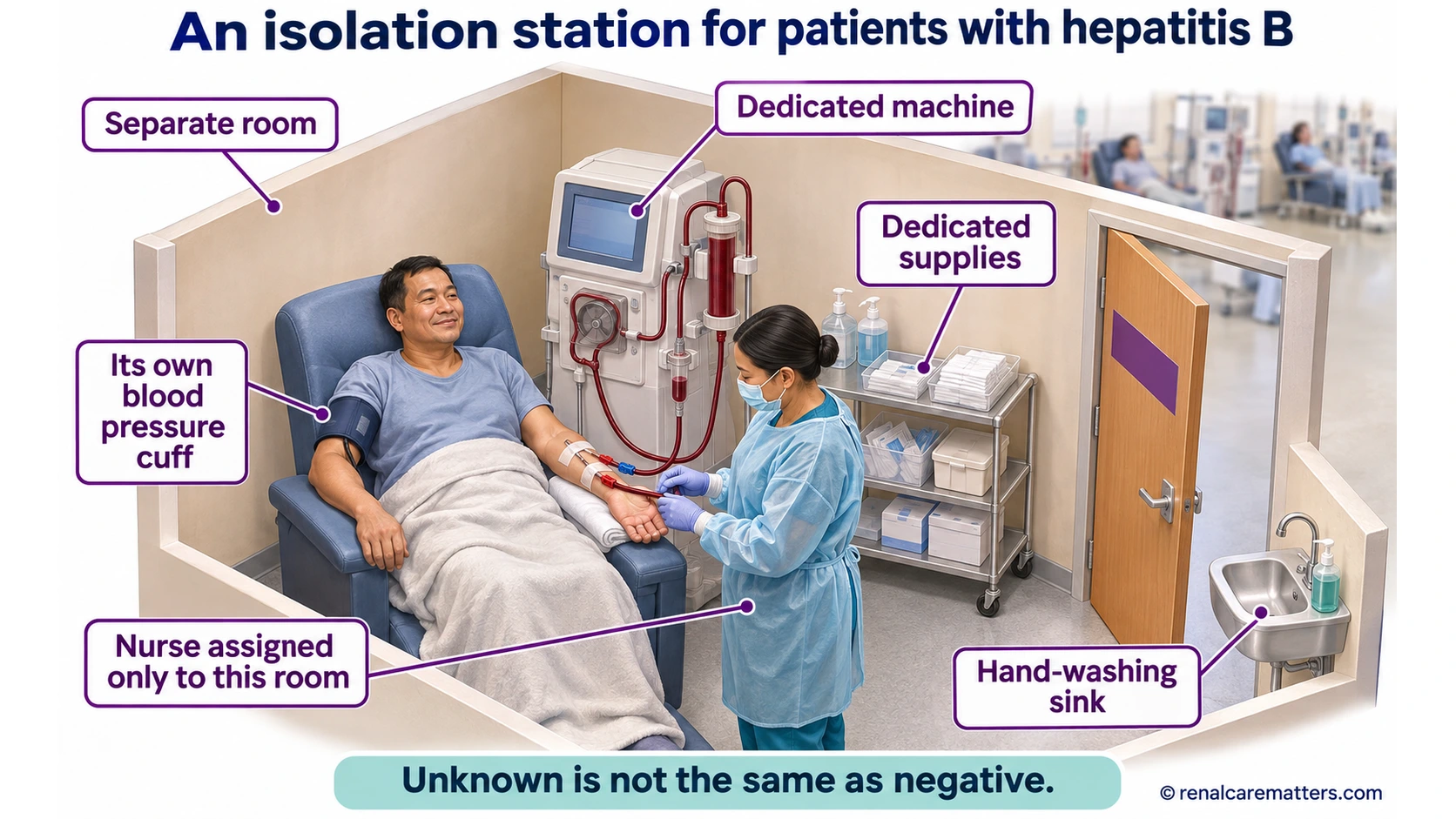
Hepatitis B is the main concern because the virus is hardy. The United States Centers for Disease Control and Prevention (CDC) note that it stays viable on surfaces for at least seven days and has been found on clamps, scissors, and machine control knobs in dialysis centers.11
Figure 10. An isolation station for patients with hepatitis B: a separate room, a dedicated machine, and dedicated supplies and staff.
What the guidelines say
The CDC recommendations state that hepatitis B status should be known before a patient is admitted to a unit, and before a transfer. Patients positive for hepatitis B surface antigen (HBsAg) are dialyzed in a separate room on a dedicated machine. Staff who care for them do not care for susceptible patients at the same time.11 Philippine licensing rules require a clinic to assign at least one machine to patients with hepatitis B.1
For hepatitis C, guidance and common practice differ. The CDC document does not recommend isolation or dedicated machines, and relies on strict infection control for every patient. It also does not recommend routine HIV testing for infection control.11 The Kidney Disease: Improving Global Outcomes (KDIGO) guideline strongly recommends hepatitis C testing at the start of in-center dialysis and on transfer.12 Some units assign separate machines for hepatitis C by local policy. Follow your unit’s policy, which may be stricter than these documents.
These recommendations rest largely on outbreak investigations and expert consensus, and the CDC document dates from 2001. Module 29 covers infection control in depth.
Your check before connection
Situation
Confirm
If it is not clear
Regular patient
Results are on file and current under unit policy. The station matches
Tell the charge nurse
New patient or transfer
Dated results from the referring unit are in the chart
Do not assume a negative result. Call the nephrologist and follow unit policy
Returning after dialysis elsewhere
Where, how many sessions, and whether a record came back
Unit policy decides the station and retesting
Sent from a ward or emergency room
Status is written in the referral
Treat as unknown under unit policy
The charge nurse assigns stations and usually knows each patient’s status. Your task is to confirm that the question was asked and answered before connection. Discuss results quietly, as Module 1 advised.
RememberUnknown is not the same as negative. A patient with no result on file is managed under your unit’s policy for unknown status until the result arrives.
Lesson · part 7
Safe to go home: the post-dialysis check
The end of a session is not the end of the risk. The patient may have lost several liters in a few hours. Module 2 explained plasma refilling. Refilling continues after the machine stops, so blood volume is still low when the patient stands.
Standing adds a second stress. Blood pools in the legs, and the body normally responds by tightening vessels and raising the heart rate. Many dialysis patients respond weakly because of diabetic nerve damage, blood pressure medicines, or age.4 The result is orthostatic hypotension, often in the hallway or on the ride home.
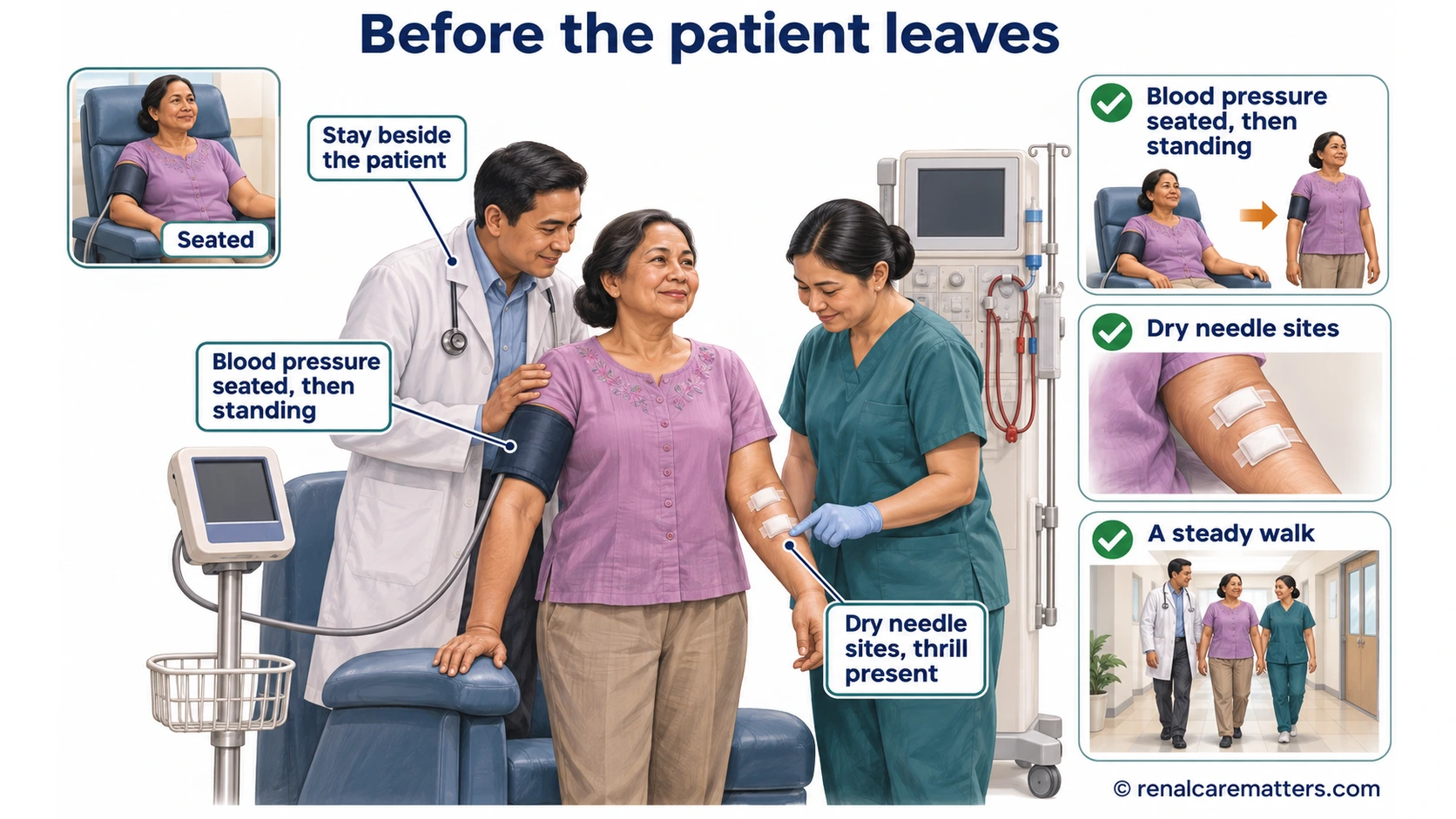
Figure 11. Before the patient leaves: blood pressure seated and then standing, dry needle sites, and a steady walk.
The evidence is limited but points one way. In 1,244 patients at 28 Japanese dialysis centers, a larger fall in systolic pressure on standing soon after dialysis was associated with a higher risk of death over two years. The routine readings taken before and after the session were not.13 The study was observational and does not show that preventing the fall saves lives. It suggests that the standing reading carries information the routine readings lack.
Figure 12 · Safe to go home?
Review the sessionTime completed, fluid removed against the goal, and any event.
Ask about symptomsDizziness, chest pain, breathlessness, cramps, headache, or chills.
Measure seated, then standingBlood pressure and heart rate, as your unit’s protocol describes. Stay beside the patient.
Check the accessNeedle sites are dry and the thrill is present. A catheter is capped, clamped, and dressed.
WeighCompare the post-dialysis weight with the dry weight.
Watch the walkThe patient walks steadily and speaks normally.
Confirm the planWho takes the patient home, the next session date, and reasons to return early.
The access before the patient leaves
Bleeding from a needle site normally stops within minutes of steady pressure that is not hard enough to stop the thrill. The vascular access guideline of the Kidney Disease Outcomes Quality Initiative (KDOQI) lists bleeding from the needle sites that lasts longer than usual for that patient, at three sessions in a row, among the clinical signs that an access may be narrowing.14 One long bleed can also reflect heparin or poor pressing technique. A pattern over several sessions should reach the nephrologist.
Finding after dialysis
What it may mean
What to do
Pressure falls on standing, with dizziness
Too much fluid removed, dry weight too low, medicine effect
Lay the patient down. Follow the hypotension protocol and call
Weight well above target
Goal not reached, or session cut short
Reweigh. Check breathing. Report, since an extra session may be considered
Weight below target
More fluid removed than planned, or true weight loss
Check standing pressure. Report for dry weight review
Needle site still bleeding
Heparin effect, technique, or high pressure in the access
Reapply pressure per protocol. Keep the patient until dry. Call if the bleeding does not stop or returns
No thrill after the needles are out
The access may be clotting
Call the nephrologist now
Chills or fever
Bloodstream infection, above all with a catheter
Cultures per protocol and call
Chest pain, confusion, or a new neurologic sign
Heart attack, stroke, or low blood sugar
Emergency protocol, call, and prepare to transfer
Stop and callDo not send home a patient who is dizzy on standing, still bleeding, feverish, confused, or in pain. Keep the patient in the unit, follow your protocol, and call the attending nephrologist. The decision to transfer is made together.
On the floor
Real situations: problems and solutions
These are fictional but typical. For each one, cover the answer, decide what you would do, then compare. Where a step depends on local rules, your unit’s procedure and your supervisor’s direction come first.
The headache she almost did not mention
What you see
A 67-year-old woman arrives with her usual weight gain and usual vital signs. When asked about falls, she says she slipped in the bathroom three days ago and hit her head. She has had a dull headache since.
What is likely going on
She may have a slow bleed inside the skull. Symptoms can be mild at first, and dialysis usually involves heparin.
What to do
Do not connect her. Examine her nervous system, follow your unit’s protocol, and call the attending nephrologist. Expect a transfer for imaging, with dialysis arranged afterward.
Why it matters
The question about falls takes five seconds. Heparin given to a patient with a head injury can turn a small bleed into a large one.
Cold and tired, with a catheter
What you see
A man with a tunneled catheter says he has felt cold and tired since last night. His temperature is normal. His blood pressure is lower than at any of his last six sessions.
What is likely going on
A catheter-related bloodstream infection can present without fever. A pressure below his own pattern supports the concern.
What to do
Delay connection. Examine him and the exit site, follow your unit’s protocol for blood cultures, and call the attending nephrologist, who decides on dialysis, antibiotics, and the catheter.
Why it matters
In one prospective study, fever was a presenting symptom in fewer than half of catheter-related bloodstream infections.
Back from the province
What you see
A regular patient returns after three weeks away. He dialyzed six times at a center in another region. He has no treatment record with him, and his last serology in your chart is several months old.
What is likely going on
His status is probably unchanged, but your unit cannot know that. He has been exposed to a different unit’s environment.
What to do
Tell the charge nurse and the attending nephrologist. Follow your unit’s policy for returning patients on the station assigned and on retesting. Ask the family to request the record from the other center.
Why it matters
Unknown is not the same as negative. One unrecognized infection at a general station can put other patients at risk.
Fine in the chair, faint at the door
What you see
After an uneventful session, a diabetic woman has her usual seated blood pressure. The physician signs her out. She stands, takes four steps, turns pale, and is caught by a nurse.
What is likely going on
Her pressure fell on standing. Blood volume is low at the end of a session, and nerve damage from diabetes blunts the normal response.
What to do
Lay her down, follow the unit’s hypotension protocol, and call the attending nephrologist. Do not discharge her until she can stand and walk without symptoms. Report the event so that her dry weight and medicines can be reviewed.
Why it matters
A seated reading alone would have sent her to the stairs. The standing reading is the one that predicts the walk home.
The needle site that kept bleeding
What you see
A man with a forearm fistula needs much longer than usual for his needle sites to stop bleeding. The nurse says it is the third session in a row.
What is likely going on
A repeated pattern suggests high pressure inside the fistula from a narrowing downstream. Heparin or pressing technique are other possible causes.
What to do
Keep him until the sites are dry and a thrill is present. Examine the arm for swelling. Tell the attending nephrologist the same day, with the number of sessions affected.
Why it matters
A narrowing found early can often be treated before the fistula clots. The nurse’s count of three sessions is the key fact.
Field notes
Stand where you can see the scale at arrival. How a patient walks to it tells you more than the first set of vital signs.
Open the last three treatment records before you examine. Today’s numbers mean little without them.
When you decide to delay, say aloud what you are waiting for and for how long, and write it down.
Ask about missed sessions without blame. The reason is usually transport, money, or family, and the team can often help.
Stay beside the patient for the standing blood pressure. If the patient is going to faint, that is the moment.
Case review
Back to the case: She walked in breathless.
What to find out in three minutes. Mrs. Villanueva told you a great deal by walking in. She stops to breathe and speaks in phrases, and her numbers agree. Sit her upright and give oxygen as your protocol allows while you continue. Ask about chest pain, palpitations, and fever, and examine her. Seven days without dialysis also gives potassium and acid time to build, so obtain an ECG and a blood sample if your protocol provides for them. A heart attack or pneumonia can look like fluid overload at the door.
Which of the four decisions. She cannot start as ordered, and she cannot be sent home, because dialysis is the treatment for her fluid and potassium. The choice lies between starting here after a call and transferring. If she settles with oxygen, has no chest pain, and her ECG shows no new change, the nephrologist may ask you to start promptly with orders for today. If she stays breathless at rest, or has chest pain or an abnormal ECG, she needs the emergency room, and the nephrologist arranges dialysis there. Either way, the call comes before the needles. The fluid goal and time for a 5.2-kilogram gain are the nephrologist’s to set.
The session in another center. Ms. Aquino raised the right point. A patient who dialyzed elsewhere returns with two unknowns: what was done there, and whether her serology status is still what your records say. Ask the daughter for any record from that center, tell the nephrologist, and follow your unit’s policy on the station and on retesting. Units differ on this, and the practice rests on infection control principles, not trial evidence. It should not hold up emergency care.
At the end of the day. If she is dialyzed in your unit, she should leave breathing more easily, steady on standing, with dry needle sites, a thrill, and her next session fixed. Ask what would have made Friday possible. A burial in the province is a reason, not a fault.
Skills lab · with your preceptor
Skills checklist: Pre-dialysis clearance note and post-dialysis discharge check
Complete both parts on three patients in one shift while your preceptor observes. Write each note in the patient’s record. Your preceptor rates each step as satisfactory, needs practice, or not observed. Steps marked Critical must all be satisfactory before sign-off. This checklist supports supervised learning; your unit’s own procedure and competency form are the authority. A printable version of every checklist is on the trainer page.
Reads the nurse’s pre-dialysis assessment and the last three treatment records before seeing the patient.
CriticalWatches the patient walk and speak, and asks about the days since the last session, including missed sessions and dialysis elsewhere.
CriticalCompares weight, blood pressure, heart rate, temperature, and oxygen saturation with the patient’s own usual values.
Examines neck veins, lung bases, and ankles or sacrum.
CriticalExamines the access: thrill and skin for a fistula or graft, exit site for a catheter.
CriticalConfirms that serology results are on file and current, and that the assigned station matches.
CriticalStates one of four decisions aloud to the nurse: start as ordered, start after a call, delay, or transfer.
CriticalWrites a clearance note with the findings, the decision, the time, and any call made with the orders received.
After dialysis, reviews time completed, fluid removed against the goal, and events during the session.
Asks about dizziness, chest pain, breathlessness, cramps, and chills before the patient stands.
CriticalMeasures blood pressure and heart rate seated and then standing, staying beside the patient.
CriticalConfirms that needle sites are dry and the thrill is present, or that the catheter is capped and dressed.
Compares the post-dialysis weight with the dry weight and reports a clear mismatch.
Confirms who is taking the patient home, the next session date, and the reasons to return early, and writes the discharge note.
Placement activity. During your first week, keep a list of every patient you did not start as ordered. For each one, note which of the four decisions you made, what the attending nephrologist advised, and what you would do the same way next time.
Self-assessment
Check your understanding
Each visit draws 8 questions at random from this module’s 15-question bank. Choose the single best answer for each, then select Check answers; an explanation appears under the best answer. Select New set of questions for a different mix. A good target is 7 of 8 on two different sets. Nothing you select is sent anywhere; scoring happens in your browser.
Torino, C., Gargani, L., Sicari, R., Letachowicz, K., Ekart, R., Fliser, D., Covic, A., Siamopoulos, K., Stavroulopoulos, A., Massy, Z. A., Fiaccadori, E., Caiazza, A., Bachelet, T., Slotki, I., Martinez-Castelao, A., Coudert-Krier, M.-J., Rossignol, P., Gueler, F., Hannedouche, T., . . . Zoccali, C. (2016). The agreement between auscultation and lung ultrasound in hemodialysis patients: The LUST study. Clinical Journal of the American Society of Nephrology, 11(11), 2005–2011. https://doi.org/10.2215/CJN.03890416
Daugirdas, J. T., Blake, P. G., & Ing, T. S. (Eds.). (2015). Handbook of dialysis (5th ed.). Wolters Kluwer.
Al-Solaiman, Y., Estrada, E., & Allon, M. (2011). The spectrum of infections in catheter-dependent hemodialysis patients. Clinical Journal of the American Society of Nephrology, 6(9), 2247–2252. https://doi.org/10.2215/CJN.03900411
Rayner, H. C., Zepel, L., Fuller, D. S., Morgenstern, H., Karaboyas, A., Culleton, B. F., Mapes, D. L., Lopes, A. A., Gillespie, B. W., Hasegawa, T., Saran, R., Tentori, F., Hecking, M., Pisoni, R. L., & Robinson, B. M. (2014). Recovery time, quality of life, and mortality in hemodialysis patients: The Dialysis Outcomes and Practice Patterns Study (DOPPS). American Journal of Kidney Diseases, 64(1), 86–94. https://doi.org/10.1053/j.ajkd.2014.01.014
Saran, R., Bragg-Gresham, J. L., Rayner, H. C., Goodkin, D. A., Keen, M. L., Van Dijk, P. C., Kurokawa, K., Piera, L., Saito, A., Fukuhara, S., Young, E. W., Held, P. J., & Port, F. K. (2003). Nonadherence in hemodialysis: Associations with mortality, hospitalization, and practice patterns in the DOPPS. Kidney International, 64(1), 254–262. https://doi.org/10.1046/j.1523-1755.2003.00064.x
Al Salmi, I., Larkina, M., Wang, M., Subramanian, L., Morgenstern, H., Jacobson, S. H., Hakim, R., Tentori, F., Saran, R., Akiba, T., Tomilina, N. A., Port, F. K., Robinson, B. M., & Pisoni, R. L. (2018). Missed hemodialysis treatments: International variation, predictors, and outcomes in the Dialysis Outcomes and Practice Patterns Study (DOPPS). American Journal of Kidney Diseases, 72(5), 634–643. https://doi.org/10.1053/j.ajkd.2018.04.019
Chan, K. E., Thadhani, R. I., & Maddux, F. W. (2014). Adherence barriers to chronic dialysis in the United States. Journal of the American Society of Nephrology, 25(11), 2642–2648. https://doi.org/10.1681/ASN.2013111160
Flythe, J. E., Kimmel, S. E., & Brunelli, S. M. (2011). Rapid fluid removal during dialysis is associated with cardiovascular morbidity and mortality. Kidney International, 79(2), 250–257. https://doi.org/10.1038/ki.2010.383
Centers for Disease Control and Prevention. (2001). Recommendations for preventing transmission of infections among chronic hemodialysis patients. MMWR Recommendations and Reports, 50(RR-5), 1–43. https://www.cdc.gov/mmwr/preview/mmwrhtml/rr5005a1.htm
Gordon, C. E., Berenguer, M. C., Doss, W., Fabrizi, F., Izopet, J., Jha, V., Kamar, N., Kasiske, B. L., Lai, C.-L., Morales, J. M., Patel, P. R., Pol, S., Silva, M. O., Balk, E. M., Earley, A., Di, M., Cheung, M., Jadoul, M., & Martin, P. (2019). Prevention, diagnosis, evaluation, and treatment of hepatitis C virus infection in chronic kidney disease: Synopsis of the Kidney Disease: Improving Global Outcomes 2018 clinical practice guideline. Annals of Internal Medicine, 171(7), 496–504. https://doi.org/10.7326/M19-1539
Shoji, T., Tsubakihara, Y., Fujii, M., & Imai, E. (2004). Hemodialysis-associated hypotension as an independent risk factor for two-year mortality in hemodialysis patients. Kidney International, 66(3), 1212–1220. https://doi.org/10.1111/j.1523-1755.2004.00812.x
Lok, C. E., Huber, T. S., Lee, T., Shenoy, S., Yevzlin, A. S., Abreo, K., Allon, M., Asif, A., Astor, B. C., Glickman, M. H., Graham, J., Moist, L. M., Rajan, D. K., Roberts, C., Vachharajani, T. J., & Valentini, R. P. (2020). KDOQI clinical practice guideline for vascular access: 2019 update. American Journal of Kidney Diseases, 75(4, Suppl. 2), S1–S164. https://doi.org/10.1053/j.ajkd.2019.12.001
Educational study material for physicians. Does not replace the attending nephrologist’s orders, the unit’s protocols, required certification courses, or supervised practice.