When the Circuit Fails: Air, Hemolysis, Reactions, and Blood Loss
Air embolism, hemolysis, dialyzer reactions, needle dislodgement, and clotting, and when the blood must not be returned.
PublishedNailathalaGipatikPepalwal:ReferencesMga SanggunianMga TinubdanReng Reperensya:11Audience: Physicians who cover hemodialysis shifts · attending nephrologists, medical directors, and head nurses who orient themRead timeOras ng pagbasaOras sa pagbasaOras ning pamamasa:
This module is study material for physicians on duty in hemodialysis units. It explains the reasoning behind common decisions; it is not a protocol. At the chairside, follow your unit’s protocol and ask the attending nephrologist for guidance. Doses and cut-off values are set by your unit. Every case is fictional.
Learning objectives
After this module you should be able to
Name the points where the blood circuit can fail and the machine guard that watches each one.
Carry out the first two minutes for air embolism, hemolysis, a dialyzer reaction, and blood loss from a dislodged needle or separated line.
State the events in which the blood in the circuit must not be returned to the patient, and give the reason for each.
Respond to a clotting circuit, a blood leak alarm, and a dialysis fluid alarm within your unit’s protocol.
Recognize a cluster event and start the unit-wide response.
Report a circuit emergency to the attending nephrologist and preserve what the investigation will need.
Pre-testBefore you read, answer the 8 self-assessment questions and note your score. After the module, select New set of questions and compare. The difference is what you learned; the questions you still miss are what to reread.
Start here
The big picture, in plain words
In plain wordsThink of the dialysis circuit as a loop road. Blood leaves the body, makes a short trip through the machine, and comes home. Air can get onto the road. The travelers can be injured on the way, which is hemolysis. The road itself can provoke them, which is a dialyzer reaction. The road can break open, or jam with clot. Each time, you ask one question first: is this blood safe to bring home?
The picture has a limit. Blood is not a passive traveler. It reacts to the plastic, the membrane, the dialysis fluid, and the pump, and the patient reacts to what comes back. The circuit also holds only a small share of the patient’s blood at any moment. Giving up that share costs far less than returning air, broken red cells, or an allergen. That trade is the center of this module.
Figure 1 · Key terms for this module
Extracorporeal circuitThe blood lines and dialyzer outside the body, from the arterial needle to the venous needle.
Air embolismAir that enters a vein or artery and blocks blood flow in the heart, lungs, or brain.
HemolysisBreaking of red blood cells, which releases hemoglobin and potassium into the plasma.
Dialyzer reactionAn allergic or inflammatory response to the dialyzer or to something used to make or sterilize it.
Venous needle dislodgementThe needle that returns blood to the patient comes out of the access while the pump is running.
Rinse-backThe usual end of treatment, when saline pushes the blood in the circuit back to the patient.
Cluster eventTwo or more patients with the same new symptoms in the same shift, which points to a shared cause.
Opening case · fictional
Case: Three patients, one complaint.
It is 40 minutes into the second shift on a Wednesday. Mrs. Villanueva, 54, calls the nurse because her upper abdomen and back hurt and she feels sick. Her blood pressure, usually 140/80 mm Hg, is 186/104. While you examine her, Mr. Bautista, two chairs away, vomits. He also has abdominal pain. Then Ms. Ocampo, on the other side of the room, says her chest feels tight and her stomach aches.
The nurse, Ms. Reyes, points to Mrs. Villanueva’s venous line. “Doctor, look at the color.” The blood is a bright, almost see-through red. A staff member at the next chair has already picked up a saline bag to end Mr. Bautista’s treatment and return his blood. The technician mentions that the carbon tanks were changed the day before. Nine other patients are on machines.
Before reading on, decide:
What do three patients with the same complaint in the same half hour tell you?
What do you do in the first two minutes, and is the blood returned?
Whom do you call, and what must be kept for the investigation?
Keep your answers in mind. The lesson gives you what you need, and the case review near the end shows one sound response.
Lesson · part 1
Where the circuit can fail, and the first question
Life-threatening events in hemodialysis (HD) are rare. A review credits machine safety features, water testing, written protocols, and staff training, and attributes most emergencies that do occur to human error.1
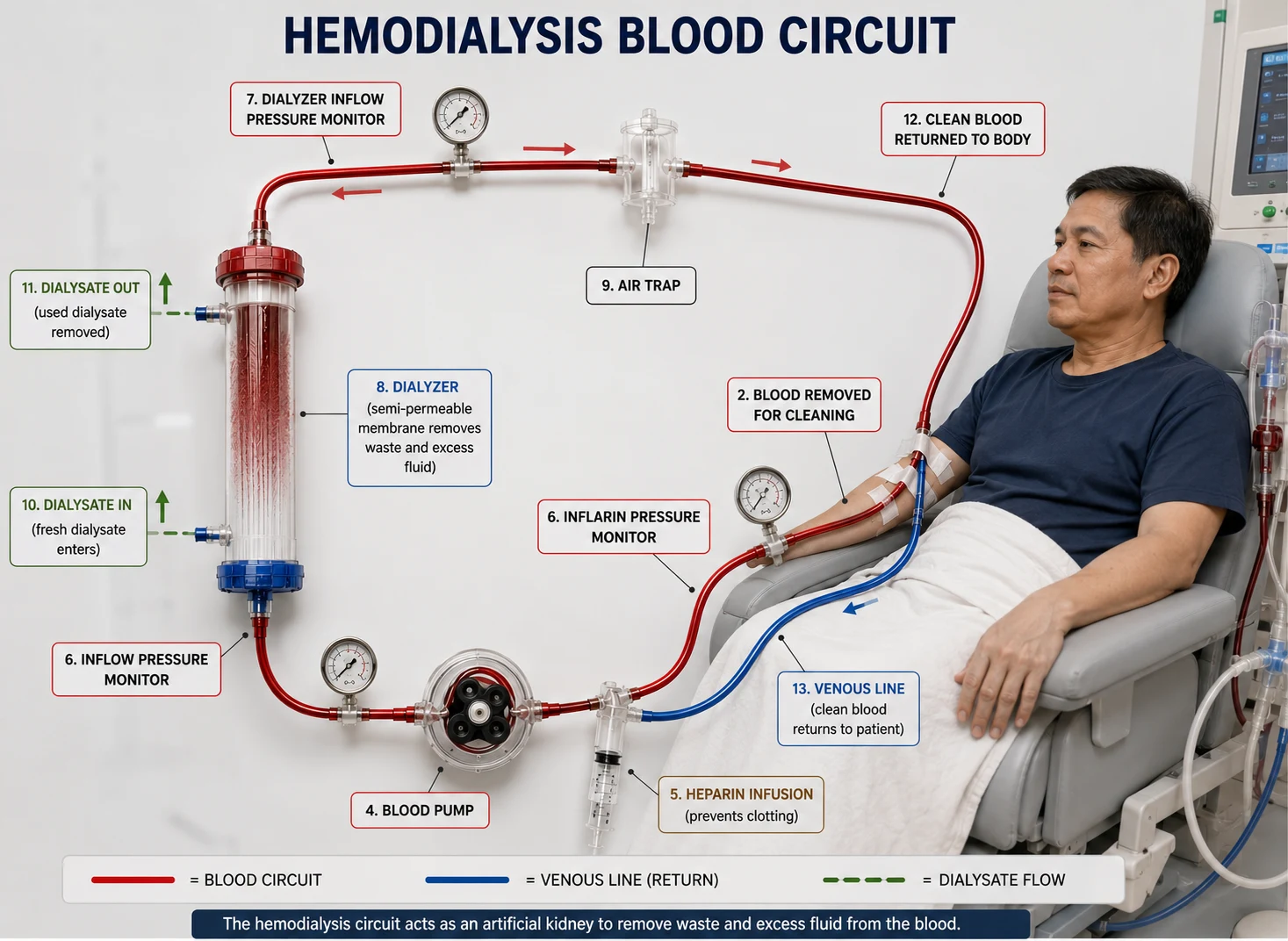
Figure 2. The blood circuit. Blood is pulled from the access by the pump, pushed through the dialyzer, and returned through the venous chamber, the air detector, and the venous clamp.
Each part of the circuit has a guard. Pressure monitors on the arterial and venous sides sense kinks and clots. The air detector and venous clamp sit below the venous chamber. The blood leak detector watches the used dialysis fluid for blood. Conductivity and temperature monitors check the dialysis fluid before it reaches the dialyzer.2
When something fails, you make three decisions in this order. Stop the blood pump or not. Return the blood or not. Then call. Rinse-back is a habit, so the second decision is the easiest to get wrong.
RememberThree firm rules. Blood is not returned when there is air in the line, when hemolysis is suspected, and in a severe dialyzer reaction. When you are unsure which event you are facing, stop the pump, clamp the lines, and do not return the blood until you have spoken to the nephrologist.
Lesson · part 2
Air embolism: air on the wrong side of the detector
The part of the circuit between the access and the blood pump is under negative pressure, because the pump is pulling. Any opening there sucks air in instead of leaking blood out. A loose needle connection, a crack in the tubing, an uncapped or unclamped dialysis catheter, an empty saline bag left open, or a badly primed dialyzer can each admit air.3 The air detector catches large volumes. Very small bubbles can pass it.3
What happens next depends on posture. In a seated patient, air can rise through the internal jugular vein into the veins of the brain. In a patient lying down, it travels to the right heart and the lung vessels, where a large volume can cause low oxygen, low blood pressure, and cardiac arrest.3 One review cites 100 to 300 mL as a volume likely to be lethal in an adult.3
Suspect air embolism when a patient suddenly coughs, becomes breathless or confused, collapses, or seizes, and there is air or foam in the venous line.
Figure 3 · First response to suspected air embolism
Stop and clampHave the blood pump stopped and the venous line clamped. The blood is not returned.
PositionLay the patient flat on the left side. This tends to hold air in the right heart, away from the outflow to the lungs.
OxygenGive supplemental oxygen as your unit’s protocol directs.
SupportCall for the emergency cart. Begin resuscitation per protocol if the patient arrests.
CallCall the attending nephrologist and arrange hospital transfer.
Sources differ on the head-down tilt. Older teaching adds it to the left-side position. A 2021 review advises the left lateral position for venous air and cautions that a head-down position may worsen brain swelling when air has reached the brain.3 No trial has compared positions. Follow your unit’s protocol.
Stop and callStop and call for any air or foam below the venous chamber, and for any sudden cough, breathlessness, or change in consciousness on dialysis. The blood is not returned. Never override the air detector to finish a treatment.
Lesson · part 3
Hemolysis: blood damaged on the trip
Red cells are flexible but fragile. They break when they are squeezed through a narrow point at high speed, heated, swollen by dilute fluid, or attacked by an oxidizing chemical. The broken cells release hemoglobin, which turns the plasma pink, and potassium. Module 2 explained why a potassium load is dangerous here.
Figure 4 · What breaks red cells in a dialysis circuit
MechanicalA kinked or defective blood line, a needle too small for the blood flow, or a very negative arterial pressure.
ChemicalChloramine, copper, or nitrates in the water, or disinfectant left in the machine.
ThermalDialysis fluid that is too hot.
OsmoticDialysis fluid that is too dilute, so water enters the cells until they burst.
These causes are drawn from a published review.3 In May 1998, 30 patients in three states of the United States developed hemolysis during dialysis. Twenty had high blood pressure, 18 had abdominal pain, 10 needed intensive care, and two died. Investigators traced the outbreak to one lot of blood tubing with a narrowed opening.4 In 1987, a carbon filter failed in a center whose city water contained chloramine, and 41 patients needed transfusion for hemolytic anemia.5
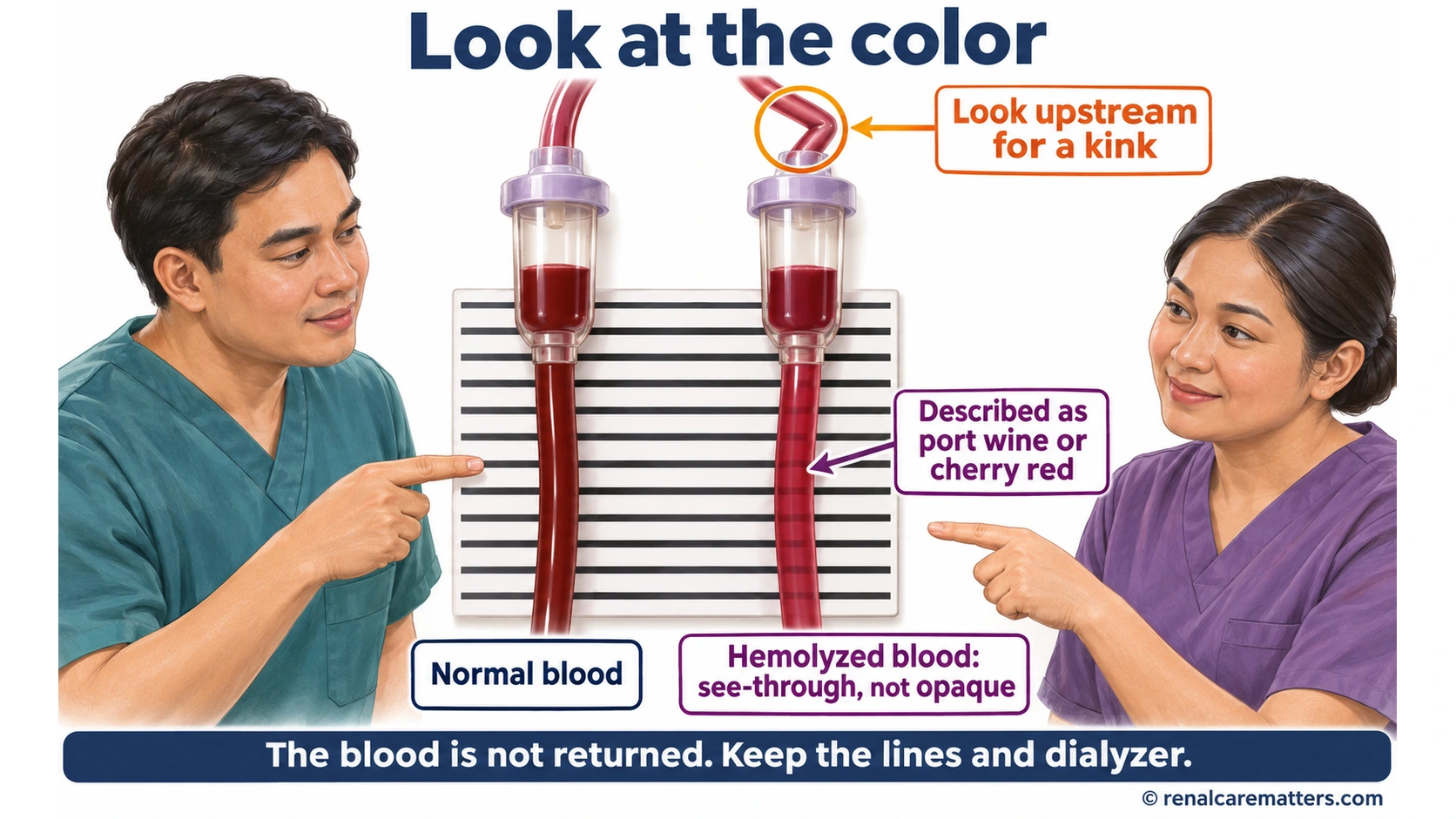
Figure 5. Hemolyzed blood in the line looks see-through rather than opaque, a color described as port wine or cherry red. Look upstream for a kink.
The patient may report nausea, vomiting, abdominal, back, or chest pain, breathlessness, or chills. Blood pressure often rises. The blood in the line looks translucent, see-through rather than opaque. Sources describe its color as port wine or cherry red.3,2
Figure 6 · First response to suspected hemolysis
Stop and clampHave dialysis stopped at once and the lines clamped. The blood is not returned.
AssessCheck airway, breathing, circulation, and the heart rhythm on a monitor.
TestSend urgent potassium and hemoglobin, and tests for hemolysis, as your protocol lists.
Look for the causeTrace the lines for a kink. Ask for the dialysis fluid temperature and conductivity readings.
Look aroundAsk whether any other patient has similar symptoms.
CallCall the attending nephrologist and arrange urgent hospital evaluation. The patient may need dialysis again on a new circuit for hyperkalemia.
The rule on blood return is explicit. The circuit blood should not be returned, because the potassium released from broken cells can cause severe hyperkalemia.3 Severe hemolysis can also cause dangerous heart rhythms, pancreatitis, and death, so the review advises urgent emergency department evaluation, with repeat potassium and hemoglobin tests.3
Stop and callStop and call for translucent (port-wine or cherry-red) blood in the line, pink plasma in a sample, or abdominal, back, or chest pain with a rising blood pressure on dialysis. The blood is not returned. Keep the lines and dialyzer.
Lesson · part 4
Dialyzer reactions: when the membrane is the trigger
The dialyzer puts a large foreign surface in contact with blood. Most patients tolerate it. A few react, either to the membrane or to a chemical used to sterilize it. Daugirdas and Ing divided these reactions into two types in 1988, and the division is still used.6
Feature
Type A (anaphylactic)
Type B (nonspecific)
Timing
Early, usually within the first 20 to 30 minutes, often in the first minutes
Chest pain and back pain, sometimes nausea and vomiting
Mechanism
Allergy to a sterilant such as ethylene oxide, or a bradykinin surge when certain membranes are used in a patient taking an angiotensin-converting enzyme (ACE) inhibitor
Activation of the complement system by the membrane
Severity
Can be fatal
Usually mild
Return the blood?
No
Treatment can continue if symptoms are mild
The details in the table follow a 2021 review, which also notes that both types are now rarely seen.3 ACE inhibitors slow the breakdown of bradykinin, a substance that widens blood vessels, and one membrane material (AN69) increases its production.3
Figure 7 · First response to an early, severe (type A) reaction
Stop and clampHave dialysis stopped and the lines clamped. The blood is not returned.
Treat as anaphylaxisFollow your unit’s anaphylaxis protocol. Protect the airway and give oxygen.
CallCall for help and call the attending nephrologist.
KeepKeep the dialyzer and its packaging. Record the model and lot number.
Next sessionThe nephrologist chooses a different dialyzer and reviews the medicines.
Type B is diagnosed only after excluding cardiac, embolic, and hemolytic causes of chest pain. Check vital signs, oxygen saturation, an electrocardiogram (ECG), and the color of the blood in the line, then call the nephrologist. Continuing the treatment, or changing the dialyzer, is the nephrologist’s decision. Medicines given during treatment can also cause allergic reactions, and the first response is the same.1
Stop and callStop and call for itching, hives, wheeze, hoarseness, throat tightness, or a fall in blood pressure in the first minutes of a treatment. The blood is not returned in a severe reaction. Do not wait to see whether it passes.
Lesson · part 5
Blood loss: a dislodged needle or a separated line
The pump does not know where the blood is going. If the venous needle slips out of the access, or a connection on the return side comes apart, the pump keeps delivering blood at the set flow, onto the bed or the floor. One review gives the loss as 300 to 450 mL per minute until the pump stops, and notes that severe bleeding and death can occur within minutes.3
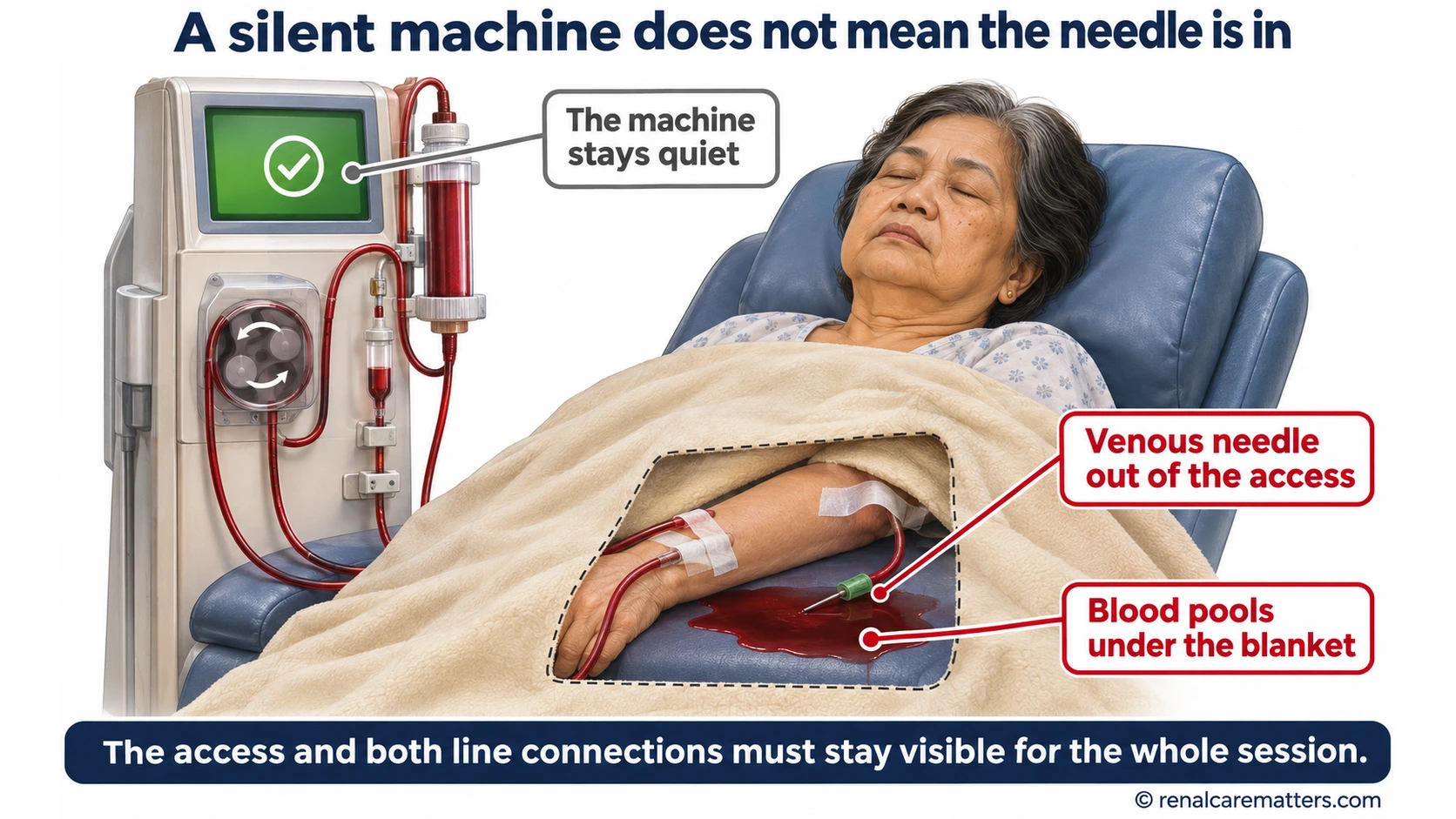
The venous pressure alarm often fails to catch this. The pressure the machine reads on the venous side is mostly a sum of two things: the resistance of the return tubing and needle, and the pressure inside the access. In a fistula the access pressure is usually the smaller part.7 When the needle comes out, only that part is lost. The alarm sounds only if the fall is larger than the gap between the reading and the lower alarm limit.3 In a study of 99 patients, 29% of fistulas, against 94% of grafts, had an access pressure high enough for the alarm to be expected to detect a dislodgement.8 In an engineering feasibility study, which used mostly laboratory data, the standard venous pressure alarm detected half of the dislodgements.9 These figures are not clinical event rates, but the direction is clear: a silent machine does not mean the needle is in.
Figure 8. A dislodged venous needle can pump blood onto the bed while the machine stays quiet. The access and both line connections must stay visible for the whole session.
Risk is higher in patients who are restless or confused, in those with difficult access or an allergy to tape, and whenever the access is covered.3 European renal nurses published 12 practice recommendations, based on expert consensus, not trials.10 Prevention is plain work: secure taping, needle sites and connections left uncovered, alarm limits left as set, and closer watch on high-risk patients.
Figure 9 · First response to a dislodged needle or separated line
Stop and clampHave the blood pump stopped and the open line clamped on both sides of the break.
PressApply firm pressure to the needle site with gloved hands and gauze.
Assess the patientLay the patient flat. Check consciousness, pulse, and blood pressure. Give oxygen.
Estimate the lossLook under the blanket, on the chair, and on the floor.
TreatFollow your unit’s protocol for blood loss and call for the emergency cart if the patient is unstable.
CallCall the attending nephrologist. Fluids, transfusion, and transfer are decided together.
The blood on the floor is lost. The published reviews used here give no rule about the blood still in the circuit after a dislodgement, so your unit’s protocol decides. One principle holds everywhere: a needle that has come out is never reinserted, and a line end that has been open is contaminated and is never reconnected to the patient.
Stop and callStop and call for any blood on the bed, chair, or floor, for a wet dressing over the access, or for a patient who becomes pale, sweaty, or drowsy with no explanation. Lift the blanket before you do anything else.
Lesson · part 6
A clotting circuit and a blood leak alarm
Blood clots when it touches plastic. Heparin or another blood thinner, ordered by the nephrologist, holds this back for the length of a treatment. Clotting becomes more likely when blood flow is low or keeps stopping for alarms, or when the blood thinner was reduced or omitted for a good reason such as recent bleeding.2
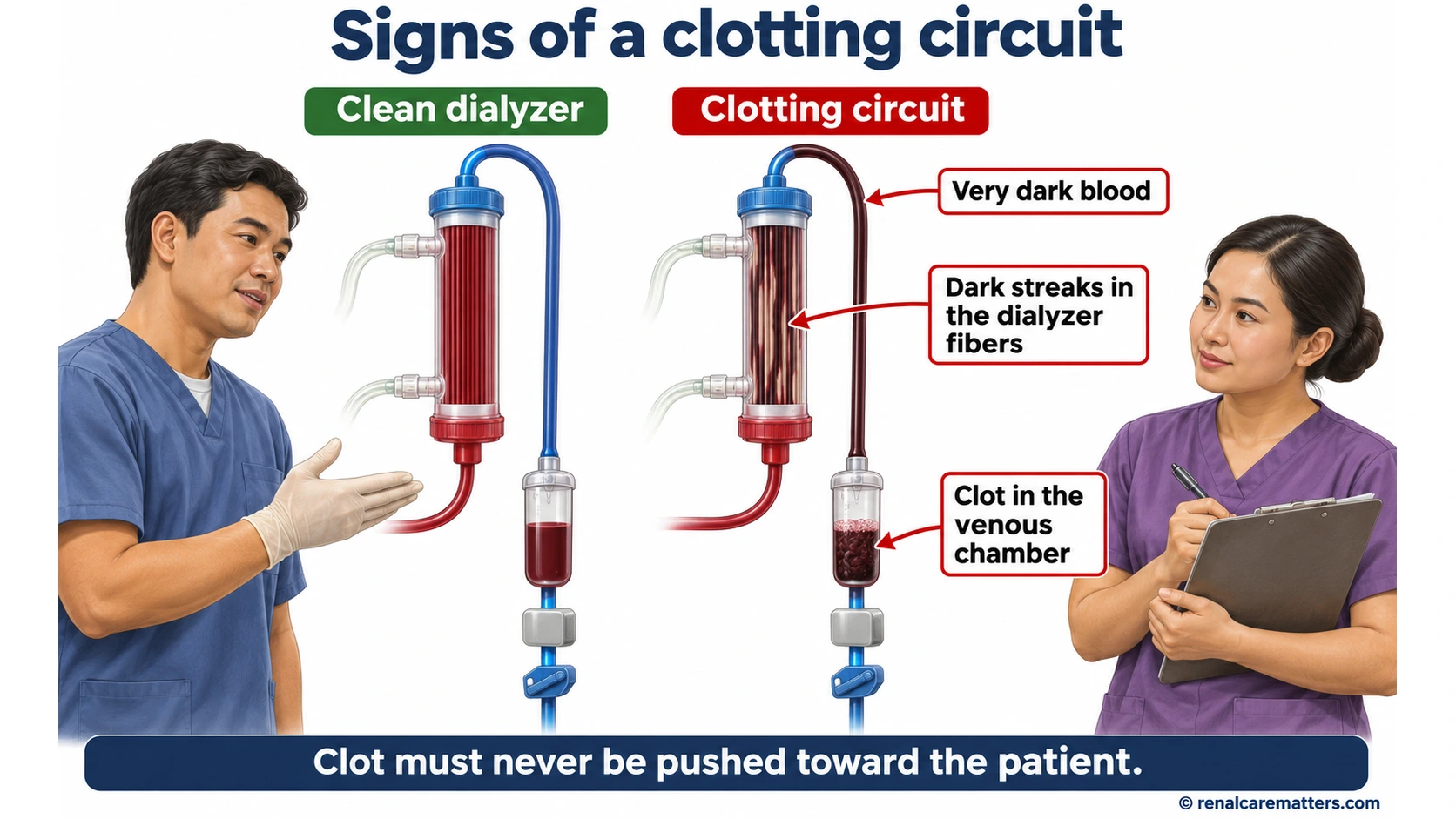
Figure 10. Signs of a clotting circuit: very dark blood, dark streaks in the dialyzer fibers, and clot in the venous chamber.
The signs are very dark blood in the circuit, dark streaks in the dialyzer fibers, clot in the venous chamber, and changing circuit pressures.2
The nurses usually see these signs first and act under protocol. If the circuit can still be rinsed back safely, the blood is returned early and the circuit replaced. If the dialyzer or venous chamber is clotted, the blood in that part is not returned, because clot must never be pushed toward the patient.2 Record and report the blood lost in the circuit. Whether to restart, and with what blood thinner, is a prescription decision.
Blood leak alarm
A blood leak alarm means the detector has sensed blood in the used dialysis fluid. If true, the membrane has torn. Blood is escaping into the fluid, and non-sterile fluid may be reaching the blood. False alarms occur, so staff confirm the leak by testing the used fluid for blood, as the unit protocol describes.2
When a leak is confirmed, the treatment on that dialyzer stops. Practice on returning the blood differs between units and depends on the size of the leak. This rests on custom, not trial evidence. Follow your protocol, tell the nephrologist, and watch the patient afterward for fever or chills.
Stop and callStop and call when a circuit clots, when a blood leak is confirmed, and whenever blood was not returned. Report the estimated blood loss. Do not order a restart or a change in blood thinner on your own.
Lesson · part 7
Dialysis fluid errors, cluster events, and the Call card
Every problem so far affects one patient. A fault in the water or the dialysis fluid can affect every patient in the room at once. The machine mixes treated water with concentrates and checks the result by its conductivity, which reflects the salt content, and by its temperature. If either is out of range, the machine diverts the fluid away from the dialyzer. This is called bypass.2
The guard fails when a monitor is faulty or overridden, or when the contaminant is something the machine does not measure. Fluid that is too dilute or too hot breaks red cells.3 Chloramine, which many city water suppliers add as a disinfectant, is not removed by reverse osmosis. Dialysis units rely on carbon filters to remove it, and outbreaks of hemolysis have followed when the carbon was exhausted.11 Bacteria and endotoxin in the fluid cause fever, chills, and low blood pressure.3
Figure 11. The water treatment steps. The carbon tanks remove chloramine. A failure here reaches every machine on the loop.
Stop and callStop and call when a conductivity or temperature alarm does not clear, or when anyone tries to override it. No patient is dialyzed against fluid the machine has rejected.
Recognizing a cluster event
One patient with nausea is a patient problem. Two or more patients with the same new symptoms in the same shift are a unit problem until proved otherwise.
Figure 12 · Cluster event response
Say it aloudTell the charge nurse that this is a possible cluster event.
StopHave treatments stopped per the cluster protocol, starting with patients who have symptoms. Hold all new starts.
Do not return bloodIf hemolysis is possible, the blood is not returned for any affected patient.
Check water and fluidThe technician tests for chlorine and chloramine and checks conductivity, temperature, and the water system log.
Assess every patientVital signs, blood color in each line, and urgent potassium and hemoglobin for those with symptoms.
Call the Medical DirectorAlso call each attending nephrologist. The Medical Director decides when the unit may restart.
PreserveKeep the lines, dialyzers, packaging with lot numbers, and samples of water and dialysis fluid.
Afterward the unit carries out a root cause analysis, a structured review of how the failure passed each guard.1 Your notes are its raw material.
Dialysis disequilibrium, briefly
One event looks like a circuit failure and is not. Dialysis disequilibrium syndrome is headache, nausea, confusion, or seizures during or shortly after a session. The leading explanation is that urea falls faster in the blood than in the brain, so water moves into brain cells. It is most likely in a first treatment with a very high urea.3 If you suspect it, have the treatment stopped and call the nephrologist. The circuit is sound, so the usual blood return applies unless the nephrologist says otherwise.
Figure 13 · Call card: when the circuit fails
RecognizeSudden cough or breathlessness. Abdominal, back, or chest pain. Itching or wheeze in the first minutes. Blood outside the circuit. Translucent, very dark, or foamy blood in the line. Several patients with one complaint.
First 2 minutesHave the blood pump stopped and the lines clamped. Check airway, breathing, and circulation. Give oxygen. Lift the blanket and look at the access and the lines.
Stop dialysis?Yes for air, hemolysis, a severe reaction, blood loss, a clotted circuit, a confirmed blood leak, rejected dialysis fluid, and a cluster. A mild later reaction may continue if the nephrologist agrees.
Return the blood?NOT returned when there is air in the line, when hemolysis is suspected, and in a severe dialyzer reaction. NOT returned through a clotted dialyzer or chamber or through a line end that has been open. If unsure, do not return it until you have spoken to the nephrologist.
CallThe attending nephrologist for every event. The Medical Director as well for a cluster or a suspected water or dialysis fluid fault. The emergency team if the patient is unstable.
WriteTime, symptoms, vital signs, whether blood was returned and why, estimated blood loss, machine and lot numbers, and whom you called.
On the floor
Real situations: problems and solutions
These are fictional but typical. For each one, cover the answer, decide what you would do, then compare. Where a step depends on local rules, your unit’s procedure and your supervisor’s direction come first.
The alarm that keeps being silenced
What you see
A machine’s arterial pressure alarm has sounded four times in ten minutes. Each time a busy staff member resets it. The patient now says her upper abdomen hurts.
What is likely going on
A kinked or partly blocked line may be damaging red cells as the pump forces blood through the narrow point. Repeated alarms were the early warning.
What to do
Go to the chair. Look at the color of the blood in the venous line and trace the tubing for a kink. If hemolysis is possible, have the pump stopped and the lines clamped, do not return the blood, follow the unit protocol, and call the attending nephrologist.
Why it matters
An alarm that returns after a reset is a finding. Resetting it without finding the cause removes the machine’s protection.
Cold arm, warm blanket
What you see
An elderly man with dementia is restless and cold. His daughter tucks a blanket over his fistula arm. Twenty minutes later he is pale and drowsy, and the machine shows no alarm.
What is likely going on
The venous needle may have come out under the blanket. The venous pressure can fall too little to trigger the alarm.
What to do
Lift the blanket. If the needle is out, have the pump stopped and the line clamped, press on the needle site, lay him flat, and follow the unit’s blood loss protocol while someone calls the attending nephrologist.
Why it matters
Severe blood loss can occur within minutes. A visible access is the only monitor that always works.
Itching in the third minute
What you see
A new patient on his first session with a new dialyzer model says his palms itch and his chest feels tight three minutes after the start. His voice sounds hoarse.
What is likely going on
An early, severe (type A) dialyzer reaction, which is a form of anaphylaxis.
What to do
Have dialysis stopped and the lines clamped at once. The blood is not returned. Start the unit’s anaphylaxis protocol, call for help, and call the attending nephrologist. Keep the dialyzer and its packaging.
Why it matters
Returning the circuit blood would deliver more of the trigger. Minutes matter for the airway.
Froth in the chamber during a power dip
What you see
After a brief power interruption a staff member begins to return blood by hand. You see froth in the venous chamber and a line of small bubbles moving toward the patient.
What is likely going on
During manual return the machine’s air detector and venous clamp do not protect the patient.
What to do
Say “stop” and have the venous line clamped. Blood with air in the line is not returned. If the patient coughs or becomes breathless, treat as air embolism per protocol and call the attending nephrologist.
Why it matters
The person turning the handle is the only air detector during a manual return.
Two chairs, same headache
What you see
Within ten minutes, two patients in the same row report headache and nausea. A third, across the aisle, is vomiting. All started within the same half hour.
What is likely going on
A shared cause is likely: the water, the dialysis fluid, or a common batch of supplies.
What to do
Treat it as a cluster event. Have the charge nurse stop treatments per the cluster protocol and hold new starts. Ask the technician to check the water and dialysis fluid now. Call the Medical Director and the attending nephrologists.
Why it matters
The second and third patients are the diagnosis. Waiting for a fourth costs time for everyone still connected.
Field notes
On every walk around the floor, look at three things at each chair: the patient’s face, the access, and the color of the blood in the lines.
Ask that needle sites and line connections stay uncovered. Offer a second blanket for the rest of the body instead.
Learn where the clamps are and where the hand crank is stored on your unit’s machines before you need them.
When you decide that blood is not returned, say it aloud to the nurse and write the reason. It avoids a well-meant rinse-back.
Keep what failed. The dialyzer, the lines, the packaging with lot numbers, and a sample of the dialysis fluid are evidence the Medical Director will need.
Case review
Back to the case: Three patients, one complaint.
What do three patients with the same complaint tell you? They tell you the cause is shared. Abdominal pain, vomiting, chest tightness, and a sharp rise in blood pressure in three patients within one half hour do not fit three separate illnesses. The translucent, wine-red blood in Mrs. Villanueva’s line points to hemolysis. The carbon tanks were changed the day before, so chloramine in the dialysis fluid is a leading possibility. A faulty lot of tubing or a dialysis fluid error would look the same. You do not need to know which it is to act.
What do you do in the first two minutes, and is the blood returned? You stop the staff member holding the saline bag. In suspected hemolysis the blood is not returned, because the circuit blood carries potassium released from broken cells. You tell the charge nurse that this is a possible cluster event. The three patients with symptoms are stopped and clamped first, the other nine under the cluster protocol, and no one new is connected. Each affected patient gets a heart monitor, oxygen as protocol directs, and urgent potassium and hemoglobin tests. The technician tests the water and checks the dialysis fluid readings while you examine patients.
Whom do you call, and what is kept? You call the Medical Director, because the event may involve the water system and affects the whole unit, and each patient’s attending nephrologist. The three patients with symptoms are likely to need hospital care and repeat potassium tests. The unit keeps the lines, dialyzers, packaging with lot numbers, the water system log, and samples of water and dialysis fluid. It does not restart until the Medical Director says it may.
The nurse who said “look at the color” made the diagnosis.
Skills lab · with your preceptor
Skills checklist: Emergency disconnect and manual blood return on a training circuit
Perform both drills on a primed training circuit that is not connected to a patient, with a dialysis nurse or technician as preceptor. The aim is to know the steps well enough to direct and assist, not to replace the nursing staff. Your preceptor rates each step as satisfactory, needs practice, or not observed. Steps marked Critical must all be satisfactory before sign-off. This checklist supports supervised learning; your unit’s own procedure and competency form are the authority. A printable version of every checklist is on the trainer page.
CriticalStates aloud the reason for the disconnect and whether the blood will be returned.
CriticalStops the blood pump, or confirms that it has stopped.
CriticalCloses the clamps on both needle lines and both blood lines before any connection is opened.
Puts on gloves, mask, and eye protection before handling the connections.
Disconnects the blood lines from the needle lines and caps or covers the open ends without touching them.
Explains how the needles or catheter are secured or flushed after an emergency disconnect, per unit protocol.
CriticalNames the three events in which blood is not returned: air in the line, suspected hemolysis, and a severe dialyzer reaction.
CriticalFor manual return, identifies a situation in which it is allowed, such as a power failure with a sound circuit.
Locates the hand crank and fits it to the blood pump.
CriticalOpens the venous line from the machine’s clamp as the manufacturer describes and states that the air detector no longer protects the patient.
CriticalTurns the crank in the marked direction at a slow, steady rate while watching the venous chamber and line for air.
CriticalStops and clamps the venous line when saline reaches the patient end or as soon as any air is seen.
Labels and sets aside the lines, dialyzer, and packaging when the event needs investigation.
Gives a structured report to the preceptor, acting as the attending nephrologist, that includes whether blood was returned.
Placement activity. During one supervised shift, find the clamps, the hand crank, the emergency cart, and the written protocols for air embolism, hemolysis, anaphylaxis, blood loss, and cluster events. Note any protocol you could not find and tell the charge nurse.
Self-assessment
Check your understanding
Each visit draws 8 questions at random from this module’s 15-question bank. Choose the single best answer for each, then select Check answers; an explanation appears under the best answer. Select New set of questions for a different mix. A good target is 7 of 8 on two different sets. Nothing you select is sent anywhere; scoring happens in your browser.
Go deeper
Read next on this site
Hemodialysis ComplicationsA wider survey of problems during dialysis, including those outside the circuit.
Saha, M., & Allon, M. (2017). Diagnosis, treatment, and prevention of hemodialysis emergencies. Clinical Journal of the American Society of Nephrology, 12(2), 357–369. https://doi.org/10.2215/CJN.05260516
Daugirdas, J. T., Blake, P. G., & Ing, T. S. (Eds.). (2015). Handbook of dialysis (5th ed.). Wolters Kluwer.
Greenberg, K. I., & Choi, M. J. (2021). Hemodialysis emergencies: Core curriculum 2021. American Journal of Kidney Diseases, 77(5), 796–809. https://doi.org/10.1053/j.ajkd.2020.11.024
Duffy, R., Tomashek, K., Spangenberg, M., Spry, L., Dwyer, D., Safranek, T. J., Ying, C., Portesi, D., Divan, H., Kobrenski, J., Arduino, M., Tokars, J., & Jarvis, W. (2000). Multistate outbreak of hemolysis in hemodialysis patients traced to faulty blood tubing sets. Kidney International, 57(4), 1668–1674. https://doi.org/10.1046/j.1523-1755.2000.00011.x
Tipple, M. A., Shusterman, N., Bland, L. A., McCarthy, M. A., Favero, M. S., Arduino, M. J., Reid, M. H., & Jarvis, W. R. (1991). Illness in hemodialysis patients after exposure to chloramine contaminated dialysate. ASAIO Transactions, 37(4), 588–591. https://pubmed.ncbi.nlm.nih.gov/1768494/
Daugirdas, J. T., & Ing, T. S. (1988). First-use reactions during hemodialysis: A definition of subtypes. Kidney International Supplement, 24, S37–S43. https://pubmed.ncbi.nlm.nih.gov/2966256/
Frinak, S., Kennedy, J., Zasuwa, G., Passalacqua, K. D., & Yee, J. (2023). Detection of hemodialysis venous needle dislodgment using venous access pressure measurements: A simulation study. Kidney360, 4(4), e476–e485. https://doi.org/10.34067/KID.0000000000000093
Ribitsch, W., Schilcher, G., Hafner-Giessauf, H., Krisper, P., Horina, J. H., Rosenkranz, A. R., & Schneditz, D. (2014). Prevalence of detectable venous pressure drops expected with venous needle dislodgement. Seminars in Dialysis, 27(5), 507–511. https://doi.org/10.1111/sdi.12169
Holmer, M., Olde, B., Sandberg, F., & Sörnmo, L. (2020). Detection of needle dislodgement using extracorporeal pressure signals: A feasibility study. ASAIO Journal, 66(4), 454–462. https://doi.org/10.1097/MAT.0000000000001020
Van Waeleghem, J.-P., Chamney, M., Lindley, E. J., & Pancírová, J. (2008). Venous needle dislodgement: How to minimise the risks. Journal of Renal Care, 34(4), 163–168. https://doi.org/10.1111/j.1755-6686.2008.00047.x
Educational study material for physicians. Does not replace the attending nephrologist’s orders, the unit’s protocols, required certification courses, or supervised practice.