Physician Education · Course home

Physician on Duty in the Dialysis Unit

A study series for physicians who cover hemodialysis shifts. Learn why a patient without kidney function is a different patient, and what to do when a session goes wrong.

PublishedNailathalaGipatikPepalwal: ReferencesMga SanggunianMga TinubdanReng Reperensya: 5 Audience: Physicians who cover hemodialysis shifts · attending nephrologists, medical directors, and head nurses who orient them Read timeOras ng pagbasaOras sa pagbasaOras ning pamamasa:
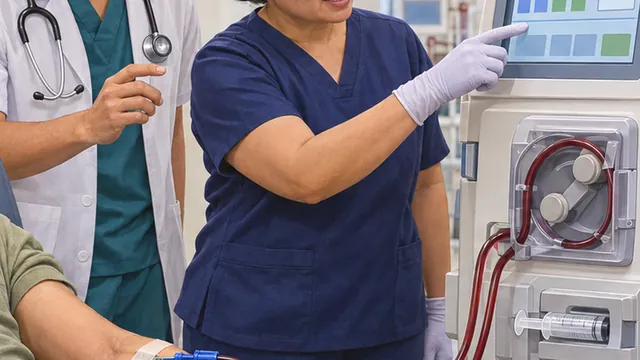
A physician on duty talking with a nurse beside a patient on hemodialysis.
Renal Care Academy›Study series for physicians on duty32 modulesFree · no accountEnglish

The doctor in the room

For four hours at a time, a hemodialysis (HD) machine takes over part of the work of two failed kidneys. Most sessions are uneventful. Some are not: blood pressure falls, a patient has chest pain, a fever starts, or an alarm will not clear. The physician on duty is the doctor in the room when that happens.

Most physicians on duty are not nephrologists. Medical school teaches the healthy kidney and the failing kidney, but very little about the patient who has no kidney function at all and lives by a machine three times a week. That patient breaks many rules of general medicine. A liter of intravenous fluid that would help another patient can put this one in pulmonary edema. A “normal” laboratory result may be alarming, and an alarming one may be this patient’s normal.

Figure 1 · What this series will help you do

Understand the patientExplain how a body without kidney function handles water, salt, potassium, acid, and medicines.
Understand the treatmentKnow what the machine, the dialyzer, and the dialysis fluid are doing.
AssessDecide whether it is safe to start a session and safe to send the patient home.
RespondAct in the first minutes of an emergency in the chair.
EscalateCall the attending nephrologist early, with the right facts.
Care over timeRecognize the long-term problems of patients on dialysis.

The series is written in plain language. Every new term is explained when it first appears, and every module has figures, a case, a skills checklist, and a self-assessment.

⚠️

What this series is, and is not

It is study material written independently from published guidelines, textbooks, and research. It is not a certificate, and it does not replace the requirements for physicians on duty in the Philippines. The Philippine Society of Nephrology (PSN) standards for hemodialysis clinics expect a physician on duty to hold a current advanced cardiac life support (ACLS) certificate and a certificate from a PSN-conducted or PSN-accredited course for physicians on duty, and to work under the supervision of the attending nephrologist and the clinical head of the unit.1 This series is not that course and is not affiliated with or endorsed by PSN. Use it to prepare, to review, and to support orientation in your own unit.

Start with what you need for your first shift

The series has 32 modules in seven parts. You do not need all of them before your first duty. Each module is marked with one of three tiers.

Figure 2 · The three tiers

First-Shift EssentialsNine modules to finish before your first supervised shift: your role, the basic physiology, the machine, the access, the assessment, and the emergencies you are most likely to meet.
CoreTwenty modules to finish before you take duty on your own: the rest of the physiology and treatment, the remaining emergencies, and the long-term care of dialysis patients.
AdvancedThree modules for the months after: special patients, other treatment paths, and care outside the unit.

Modules open as they are completed and reviewed. A module marked “In preparation” is planned but not yet published.

Thirty-two modules in seven parts

Study the modules in order within your tier. The parts follow a physician’s own path: the patient, the treatment, one session, emergencies, long-term care, and the unit.

Part 1 · Starting out

Part 2 · The patient is different

Module 2Essentials Life Without Kidney Function I: Water, Salt, Potassium, and Acid What healthy kidneys do each day, what builds up between sessions, why a fluid bolus behaves differently, and why potassium and acid rise.
Module 3CoreIn preparation Life Without Kidney Function II: Uremia, Residual Function, and Starting Dialysis The uremic syndrome, the toxins dialysis removes well and poorly, why leftover kidney function matters, and when dialysis begins.
Module 4CoreIn preparation Life Without Kidney Function III: Heart, Blood, Bone, and Defenses How kidney failure changes the heart and vessels, blood, bone, and immunity, and why common tests and medicines behave differently.

Part 3 · The treatment

Module 5Essentials Inside the Machine: How Blood Is Cleaned The blood circuit, the dialyzer, diffusion and ultrafiltration, the machine’s monitors, and what the common alarms mean.

Module 6CoreIn preparation Water and Dialysate: The Hidden Half of the Treatment What is in dialysis fluid, how water is treated, which contaminants harm patients, and how to recognize a problem that affects several patients at once.
Module 7CoreIn preparation Reading the Dialysis Order and Judging the Dose What each line of the dialysis order means, who may change it, how the dose of dialysis is measured, and what newer therapies add.
Module 8CoreIn preparation Dry Weight: Finding the Right Amount of Fluid What dry weight is, how to judge volume at the bedside, how to calculate the fluid goal and rate, and why fast removal drops blood pressure.
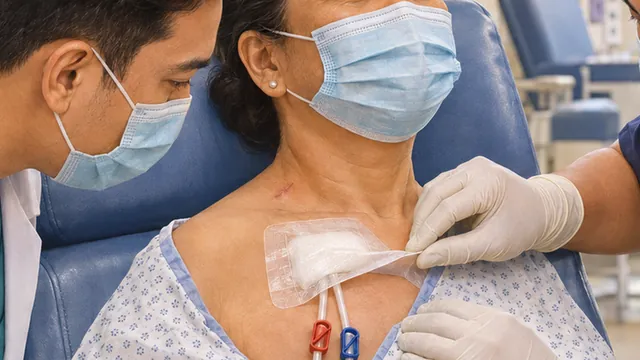
Module 9Essentials The Lifeline I: Fistulas and Grafts How to examine a fistula or graft, recognize narrowing, clotting, infection, and aneurysm, and control bleeding. Module 10Essentials The Lifeline II: Catheters Catheter types, exit-site and tunnel checks, poor flow, infection, and catheter emergencies.
Part 4 · The session

Module 11Essentials Safe to Start, Safe to Go Home A focused assessment before the session, the decision to start, delay, or transfer, and the check before the patient leaves.
Module 12CoreIn preparation First Sessions and Unusual Sessions The first dialysis, disequilibrium, the patient with acute kidney injury, the visiting patient, and isolated ultrafiltration.

Part 5 · Emergencies in the chair

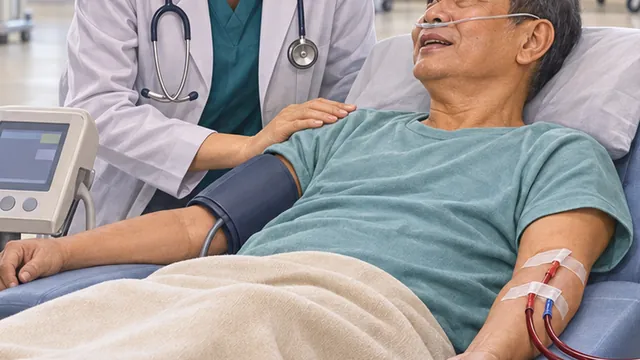
Module 13Essentials When the Pressure Falls Why blood pressure falls during dialysis, the stepwise response, and how to tell a simple drop from a dangerous cause.
Module 14CoreIn preparation High Blood Pressure and the Breathless Patient Rising pressure during dialysis, hypertensive emergency, the causes of breathlessness, and how blood pressure is managed between sessions.
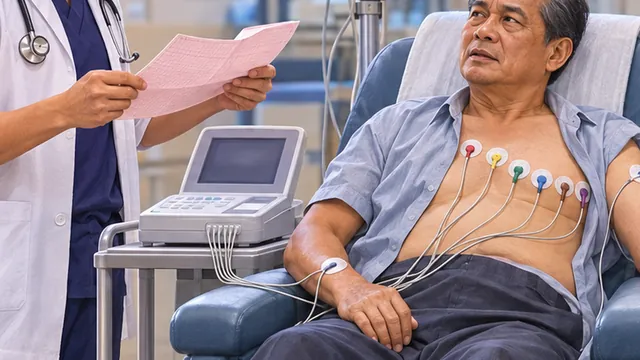
Module 15Essentials Heart Emergencies in the Chair: Chest Pain, Arrhythmia, and Cardiac Arrest Sorting chest pain by cause, reading the electrocardiogram in a dialysis patient, and leading resuscitation beside a dialysis machine. Module 16Essentials When the Circuit Fails: Air, Hemolysis, Reactions, and Blood Loss Air embolism, hemolysis, dialyzer reactions, needle dislodgement, and clotting, and when the blood must not be returned.

Module 17CoreIn preparation The Shivering Patient: Fever and Bloodstream Infection Telling catheter infection from a pyrogenic reaction, drawing cultures, and recognizing sepsis in a dialysis patient.
Module 18CoreIn preparation The Confused or Seizing Patient: Potassium, Sugar, and the Brain High and low potassium, low blood sugar, seizures, altered consciousness, and stroke in the dialysis chair.
Module 19CoreIn preparation Bleeding and Heparin Why heparin is used, when to reduce or omit it, and how to manage bleeding from the access and elsewhere.

Part 6 · The long game

Module 20CoreIn preparation Prescribing Without Kidneys The medicines dialysis patients take, rules for prescribing, timing doses around a session, and the common prescriptions that cause harm.
Module 21CoreIn preparation Blood and Bone: Anemia and Mineral Disorders Why hemoglobin is low, how iron and stimulating agents are used, and what calcium, phosphate, and parathyroid hormone results mean.
Module 22CoreIn preparation Diabetes on Dialysis Why insulin needs fall, how to prevent low blood sugar in the chair, which medicines are safe, and how to check the feet.
Module 23CoreIn preparation Food, Fluid, and Muscle Protein needs on dialysis, signs of wasting, and practical advice on fluid, salt, potassium, and phosphate with Filipino foods.
Module 24CoreIn preparation Symptoms in the Chair and at Home: Cramps, Itch, Sleep, Pain, and Fatigue Cramps, nausea, and headache during a session; itch, poor sleep, pain, and fatigue at home; and when a minor symptom signals a serious cause.
Module 25AdvancedIn preparation Special Patients: Frailty, Complex Illness, and Pregnancy Dialysis in heart failure, liver disease, cancer, and frailty, and what changes when a dialysis patient is pregnant.
Module 26CoreIn preparation The Person in the Chair: Mood, Burden, and Choices About Care Depression, missed sessions, caregiver strain, and how to respond when a patient wants to stop dialysis.
Module 27AdvancedIn preparation Other Roads: Transplant, Peritoneal Dialysis, and Conservative Care The other long-term paths, who suits each, and how to keep a patient ready for transplant.
Module 28AdvancedIn preparation Outside the Unit: Surgery, Contrast, Hospital Stays, and Travel Timing dialysis around procedures, advice on contrast, protecting the access in hospital, and preparing for travel.

Part 7 · The unit and the system

Module 29CoreIn preparation A Clean Unit: Hepatitis, human immunodeficiency virus (HIV), Tuberculosis, and Vaccines How infection spreads in a dialysis unit, isolation rules, screening, vaccines, and what to do after a needlestick.
Module 30CoreIn preparation When the Power or Water Fails The first ten minutes of a power, water, or building emergency, and how patients stay dialyzed when the unit cannot open.
Module 31CoreIn preparation Rules, Records, and Quality The rules that govern dialysis units, what a physician signs, consent, data privacy, sound records, and how a unit measures its quality.
Module 32CoreIn preparation Putting It Together: Bedside Skills and a Simulated Shift Orders, handoffs, practice stations, and a simulated shift that brings the series together.

The same seven steps every time

Figure 3 · How to work through a module

  1. ObjectivesRead what you should be able to do by the end.
  2. Big pictureA plain-words summary and the key terms, before any detail.
  3. Opening caseA fictional shift problem. Decide what you would do first.
  4. LessonShort parts with pictures, tables, and worked examples.
  5. Case reviewCompare your answer with one sound response.
  6. Skills checklistPractice with a preceptor on real or training equipment.
  7. Self-assessmentFive questions drawn from a larger bank, with explanations.

New terms are explained the first time they appear, and every page ends with a glossary. Abbreviations are spelled out at first use. If a sentence still reads like jargon, check the glossary, then ask your preceptor to show you the real object on the unit: most of this work makes sense faster when you can see and touch the equipment.

The series at a glance

Each module takes about 45 to 75 minutes to read and work through. Skills checklists are completed on the unit with a preceptor.

No.ModuleLessonsOpening caseSkills checklistPractice
1Your Role on the Dialysis Floor
  1. What a physician on duty is, and is not
  2. Who does what on the dialysis floor
  3. The shape of one shift
  4. What you may do at once, and what needs a call
  5. How to call the nephrologist: Situation, Background, Assessment, Recommendation (SBAR)
  6. What to write, and when
  7. Professional conduct on the floor
The first MondayStart-of-shift readiness round15 questions · 5 real situations
2Life Without Kidney Function I: Water, Salt, Potassium, and Acid
  1. What healthy kidneys do every day
  2. Water and salt: the closed drain
  3. What an intravenous fluid bolus does here
  4. Potassium: a small pool with large effects
  5. Acid: the daily load and the buffer
  6. The week on dialysis and the long gap
  7. General medicine rules that change in this patient
One liter, fastBedside volume assessment15 questions · 5 real situations
3Life Without Kidney Function II: Uremia, Residual Function, and Starting Dialysis—In preparation
4Life Without Kidney Function III: Heart, Blood, Bone, and Defenses—In preparation
5Inside the Machine: How Blood Is Cleaned
  1. The blood circuit, step by step
  2. Diffusion, ultrafiltration, and convection
  3. The dialyzer: fibers, surface, and flux
  4. The dialysis fluid side and what guards it
  5. What the pressure readings say about the patient
  6. The safety detectors and what each one prevents
  7. Reading the screen and responding to alarms
The venous pressure alarmCircuit and alarm walk-through on a training machine15 questions · 5 real situations
6Water and Dialysate: The Hidden Half of the Treatment—In preparation
7Reading the Dialysis Order and Judging the Dose—In preparation
8Dry Weight: Finding the Right Amount of Fluid—In preparation
9The Lifeline I: Fistulas and Grafts
  1. Fistula or graft: two ways to join an artery to a vein
  2. Look, listen, feel: the one-minute examination
  3. Narrowing and clotting: when the flow changes
  4. Infection, aneurysm, and steal
  5. Safe to needle today: the decision and the arm rules
  6. Bleeding from a needle site or a ruptured access
The thrill is goneFull access examination15 questions · 5 real situations
10The Lifeline II: Catheters
  1. Two kinds of catheter, and where the tip sits
  2. Inspecting the exit site, the tunnel, and the limbs
  3. Safe connection and disconnection, and what each step is for
  4. Poor flow, step by step
  5. Recognizing catheter infection and taking the first steps
  6. Why every catheter needs an exit plan
  7. Catheter emergencies and the first actions
The catheter that would only pushExit-site inspection and hub handling15 questions · 5 real situations
11Safe to Start, Safe to Go Home
  1. Two gates and four possible answers
  2. The three-minute assessment
  3. Red flags that belong in the emergency room
  4. Questions about the days since the last session
  5. The patient who missed sessions
  6. Serology and isolation status
  7. Safe to go home: the post-dialysis check
She walked in breathless.Pre-dialysis clearance note and post-dialysis discharge check15 questions · 5 real situations
12First Sessions and Unusual Sessions—In preparation
13When the Pressure Falls
  1. Why the pressure falls: three defenses
  2. How the literature defines it, and how often it happens
  3. Why a low pressure matters beyond the moment
  4. The stepwise response at the chair
  5. Simple drop or dangerous cause
  6. Prevention: what to suggest to the nephrologist
  7. After the episode: record, hand off, and the call card
Hour threeHypotension response on a simulated patient15 questions · 5 real situations
14High Blood Pressure and the Breathless Patient—In preparation
15Heart Emergencies in the Chair: Chest Pain, Arrhythmia, and Cardiac Arrest
  1. Chest pain in the chair: eight causes
  2. Two tests and their limits: the electrocardiogram (ECG) and troponin
  3. The chest pain pathway: stop dialysis, return blood, transfer
  4. Why rhythms fail around dialysis, and new atrial fibrillation
  5. Cardiac arrest in the dialysis chair
  6. The machine, the blood, and the access during a code
  7. Reversible causes special to dialysis
  8. Team roles, the first five minutes, and the debrief
Palpitations at the end of the long weekend12-lead ECG at the chairside, and mock code as team leader15 questions · 5 real situations
16When the Circuit Fails: Air, Hemolysis, Reactions, and Blood Loss
  1. Where the circuit can fail, and the first question
  2. Air embolism: air on the wrong side of the detector
  3. Hemolysis: blood damaged on the trip
  4. Dialyzer reactions: when the membrane is the trigger
  5. Blood loss: a dislodged needle or a separated line
  6. A clotting circuit and a blood leak alarm
  7. Dialysis fluid errors, cluster events, and the Call card
Three patients, one complaint.Emergency disconnect and manual blood return on a training circuit15 questions · 5 real situations
17The Shivering Patient: Fever and Bloodstream Infection—In preparation
18The Confused or Seizing Patient: Potassium, Sugar, and the Brain—In preparation
19Bleeding and Heparin—In preparation
20Prescribing Without Kidneys—In preparation
21Blood and Bone: Anemia and Mineral Disorders—In preparation
22Diabetes on Dialysis—In preparation
23Food, Fluid, and Muscle—In preparation
24Symptoms in the Chair and at Home: Cramps, Itch, Sleep, Pain, and Fatigue—In preparation
25Special Patients: Frailty, Complex Illness, and Pregnancy—In preparation
26The Person in the Chair: Mood, Burden, and Choices About Care—In preparation
27Other Roads: Transplant, Peritoneal Dialysis, and Conservative Care—In preparation
28Outside the Unit: Surgery, Contrast, Hospital Stays, and Travel—In preparation
29A Clean Unit: Hepatitis, HIV, Tuberculosis, and Vaccines—In preparation
30When the Power or Water Fails—In preparation
31Rules, Records, and Quality—In preparation
32Putting It Together: Bedside Skills and a Simulated Shift—In preparation

Self-assessment is not sign-off

The questions at the end of each module are for practice. Each visit draws eight from a bank of fifteen, and every question explains its best answer. The questions were written for this series.

Competence is shown on the unit, not on a screen: examining an access, assessing a patient before a session, responding to a fall in blood pressure, and calling the attending nephrologist with a clear report. Each module has a skills checklist for a preceptor, usually the attending nephrologist or a senior physician on duty, to complete while watching you work.

End-of-course examination. When you have finished every module, take the end-of-course examination. It draws questions at random from all 9 modules, so no two sittings are the same.

What the series is built on

The series is built from published sources. Physiology follows standard textbooks.2,3 Clinical recommendations follow the guidelines of Kidney Disease: Improving Global Outcomes (KDIGO) and its conference reports, and the research they rest on.4 Philippine expectations for physicians on duty come from the Department of Health (DOH) licensing order for dialysis facilities and the PSN standards for hemodialysis clinics.5,1 Each module lists its own sources.

Where the evidence is strong, the text says so. Where a practice rests on observation, expert opinion, or local custom, the text says that instead. Doses and cut-off values are left to your unit’s protocol and the attending nephrologist.

Using the series in a training program

An attending nephrologist, medical director, or senior physician on duty can use these modules as the guided-study part of unit orientation. The trainer and preceptor page gathers the proposed hours, completion criteria, and every skills checklist in one printable place. These are proposals for a provider to adapt and validate on its own equipment; they are not requirements of any regulator.


Glossary & abbreviationsTalahulugan at mga daglatTalaan sa mga pulong ug daglatTalatinigan ampo reng daglat terms used on this page

Abbreviations

ACLS
Advanced Cardiovascular Life Support.
DOH
Department of Health — Philippines.
ECG
Electrocardiogram.
HD
Hemodialysis.
HIV
Human immunodeficiency virus.
KDIGO
Kidney Disease: Improving Global Outcomes — The international nephrology guideline body.
PSN
Philippine Society of Nephrology.
SBAR
Situation, Background, Assessment, Recommendation — A structure for clinical reports.

Terms in plain words

Preceptor
An experienced staff member who supervises a learner at work and judges whether a skill was done safely.
Competency sign-off
A written record that a preceptor watched you perform a skill correctly on the unit’s own equipment.
Scope of practice
The tasks you are trained, assigned, and legally allowed to do in your role.
ReferencesMga SanggunianMga TinubdanReng Reperensya 5 sources
  1. Philippine Society of Nephrology (PSN) Committee on Hemodialysis. (2024). Guidelines for nephrologists in the operation of hemodialysis clinics in the Philippines. https://psn.org.ph/wp-content/uploads/2024/03/HD-Guidelines-for-Nephrologists-Final-Revision-3.14.24.pdf
  2. Hall, J. E., & Hall, M. E. (2021). Guyton and Hall textbook of medical physiology (14th ed.). Elsevier.
  3. Daugirdas, J. T., Blake, P. G., & Ing, T. S. (Eds.). (2015). Handbook of dialysis (5th ed.). Wolters Kluwer.
  4. Flythe, J. E., Chang, T. I., Gallagher, M. P., Lindley, E., Madero, M., Sarafidis, P. A., Unruh, M. L., Wang, A. Y.-M., Weiner, D. E., Cheung, M., Jadoul, M., Winkelmayer, W. C., & Polkinghorne, K. R. (2020). Blood pressure and volume management in dialysis: Conclusions from a Kidney Disease: Improving Global Outcomes (KDIGO) Controversies Conference. Kidney International, 97(5), 861–876. https://doi.org/10.1016/j.kint.2020.01.046
  5. Department of Health (DOH). (2012). Administrative Order No. 2012-0001: New rules and regulations governing the licensure and regulation of dialysis facilities in the Philippines. https://hfsrb.doh.gov.ph/wp-content/uploads/2021/05/AO-2012-0001.pdf
Dr. William Gregory M. Rivero, MD

William Gregory Rivero, MD, FPCP, DPSN

Internal Medicine · Nephrology · Nutrition · Philippines · PRC 0105184

Educational study material for physicians. Does not replace the attending nephrologist’s orders, the unit’s protocols, required certification courses, or supervised practice.

QR code — scan to save Dr. Rivero's contact info

Scan and save