Philippine professional roles and clinical governance
Separate licensure, appointment, privileges and society standards, and report incidents through the right channel.
PublishedNailathalaGipatikPepalwal:ReferencesMga SanggunianMga TinubdanReng Reperensya:11Audience: Adult and pediatric nephrology fellows · internal medicine and pediatric residents · medical interns on medicine, pediatrics, ICU and dialysis rotations, and residents who work shifts as dialysis physicians on dutyRead timeOras ng pagbasaOras sa pagbasaOras ning pamamasa:
Training track for nephrology fellows, residents and medical interns
Study material for medical interns, residents and fellows. It explains the reasoning behind common decisions; it is not a protocol and gives no drug doses. Doses, rates and order sets come from current guidelines, product labels, your institution’s approved protocols and your supervising physician. Benefit rules change: confirm them on the date of service. Every case is fictional.
Learning objectives
After this module you should be able to
Intern: Separate licensure, appointment and clinical privileges, and name the registered physician who supervises each task you do as a trainee under Republic Act (RA) 2382.
Resident: Check your own eligibility before you accept a physician-on-duty (POD) shift, against the Department of Health (DOH) order, the Philippine Society of Nephrology (PSN) 2024 guidelines and the unit’s written appointment.
Fellow: Navigate DOH facility licensing, PSN standards, the Data Privacy Act and adverse-event reporting, and lead a learning response when care goes wrong.
Pre-testBefore you read, answer the 5 self-assessment questions and note your score. After the module, select New set of questions and compare. The difference is what you learned; the questions you still miss are what to reread.
Start here
The big picture, in plain words
Your role · knowing which key opens which doorThe intern owns one question: who is supervising me for this task, and do they know I am doing it? The resident owns a second: am I allowed to be here, in this post, tonight, on the documents and not just on the roster? The fellow owns a third: when something goes wrong in a unit I help run, does the system learn from it, and are the records true? None of these questions is clinical in the narrow sense. All of them decide whether patients are safe.
In plain wordsThink of a hospital as a building with many locked doors and a ring of separate keys. Your professional license is the key to the profession. Your appointment is the key to this particular building. Your clinical privileges are keys to particular rooms inside it. The dialysis unit itself needs a building permit, and the payer has its own contract with the building. Holding one key does not open the other doors.
The picture has a limit. Keys are all or nothing; real authority is graded. An intern is allowed to examine a patient but only under the direct supervision of a registered physician. A resident is licensed but works inside a training program that sets what she may sign. A fellow may run the dialysis rounds yet still answers to a consultant. Keys can also be copied on paper without the competence behind them: a name in a logbook is not the same as a physician in the room. Governance exists to keep the paper and the reality the same.
Figure 1 · Key numbers
POD to stations (DOH AO 2012-0001)Not more than 1:15
POD to stations (PSN 2024)Ideally 1:15; up to 1:20 only where PODs are scarce and needs are still met (professional standard, not a graded recommendation)
POD experience route for board-certified or board-eligible internists and pediatricians (DOH AO 2012-0001)At least 3 months in a DOH-licensed hemodialysis center
Nurse to stations (DOH AO 2012-0001)Not more than 1:4, with at least one nurse per shift with updated Advanced Cardiovascular Life Support (ACLS)
Continuous quality improvement meetings (PSN 2024)At least once a month, run by the Dialysis Clinical Head
Most governance questions you will meet are ordinary: whose name goes on the order, whether a photograph may go into a group chat, who is told when a patient falls. A few are sharp: a request to sign for a shift you did not cover, an offer of a POD post you are not eligible for, a death that someone wants left out of the logbook. Your work is to know the systems well enough to answer the ordinary questions without fuss, and to recognize the sharp ones early enough to say no, call the attending, and write things down as they happened.
Opening case · fictional
Case: The logbook on Saturday morning
Saturday, 7:40 a.m., a freestanding hemodialysis unit with 16 stations in Malolos, Bulacan. Dr. Paolo Santiago is a second-year internal medicine resident in a private hospital in Quezon City. He has worked weekend POD shifts at this unit for four months; before that he had no dialysis experience. He has a current Advanced Cardiovascular Life Support (ACLS) card. He has not taken a PSN post-graduate POD course.
The unit manager, Ms. Lorna Cruz, hands him the POD logbook. “Doc, Thursday afternoon is blank. Dr. Reyes had to leave at two for a family emergency and the second shift ran with the nurses. Philippine Health Insurance Corporation (PhilHealth) and the regional DOH office may come for a visit next week. Can you sign Thursday for us? You know the patients anyway.” The nurses’ notes for Thursday show that one patient, Mr. Isidro Valdez, 71, had a fall in pressure to 78/44 mm Hg at hour three, was laid back and given saline by the nurse, and recovered. No physician saw him. The complications logbook has no entry for it.
Ms. Cruz adds that the unit is short of PODs and asks whether Paolo can also take the full Sunday schedule alone, all 16 stations.
Before reading on, decide:
What does Paolo do about the request to sign Thursday’s logbook, and what does he do instead?
Is Paolo eligible to work as a POD in this freestanding unit at all, on the DOH order and the PSN guidelines as written?
What should happen to Thursday’s gap in physician coverage and Mr. Valdez’s episode, so that the unit learns from it?
Keep your answers in mind. The lesson gives you what you need, and the case review near the end shows one sound response.
Lesson · part 1
Licensure, appointment, privileges: the separate systems
Philippine kidney care sits inside several systems that do different jobs and rarely talk to each other. Confusing them is the root of most governance mistakes a trainee makes. The causal chain is simple. Each system checks one thing. If you assume that passing one check means passing the others, you end up doing work that no one has actually authorized.
The license. The Medical Act of 1959, RA 2382, governs medical education, the licensure examination and the practice of medicine. Its Section 11(a) exempts a medical student under training who serves without a professional fee in a government or private hospital, provided the service is rendered under the direct supervision and control of a registered physician.1 That clause is the legal frame for unlicensed trainee work. Ask your school and your hospital how it applies to your internship year, and assume that it covers supervised training work, not independent practice. The Professional Regulation Commission (PRC) issues and renews the license and the professional identification card.2
The facility. A hemodialysis center operates under a license to operate issued under DOH Administrative Order (AO) 2012-0001. The order sets the personnel requirements, including those for the POD, the nurses and the medical director, the logbooks the unit must keep, and the penalties: the licensing office may suspend, cancel or revoke the license of a facility found violating the order.3
The profession. The PSN writes professional standards, such as its 2024 hemodialysis guidelines, accredits nephrology training institutions and runs the specialty board.4,5 Its bylaws separate member-in-training, board-eligible and diplomate status from the membership title of Fellow.6 A nephrology fellow-in-training is not a Fellow of the PSN; never let a letterhead or a clinic sign say so.
The payer. The Philippine Health Insurance Corporation (PhilHealth) accredits facilities and pays claims under its own circulars, including quality standards for maintenance hemodialysis.7 Module 34 covers the benefits.
The hospital. Your appointment letter and the credentialing committee’s grant of privileges decide what you may do in that institution. A license allows you to practice medicine in the country; it does not admit you to a particular hospital or let you do a particular procedure there.
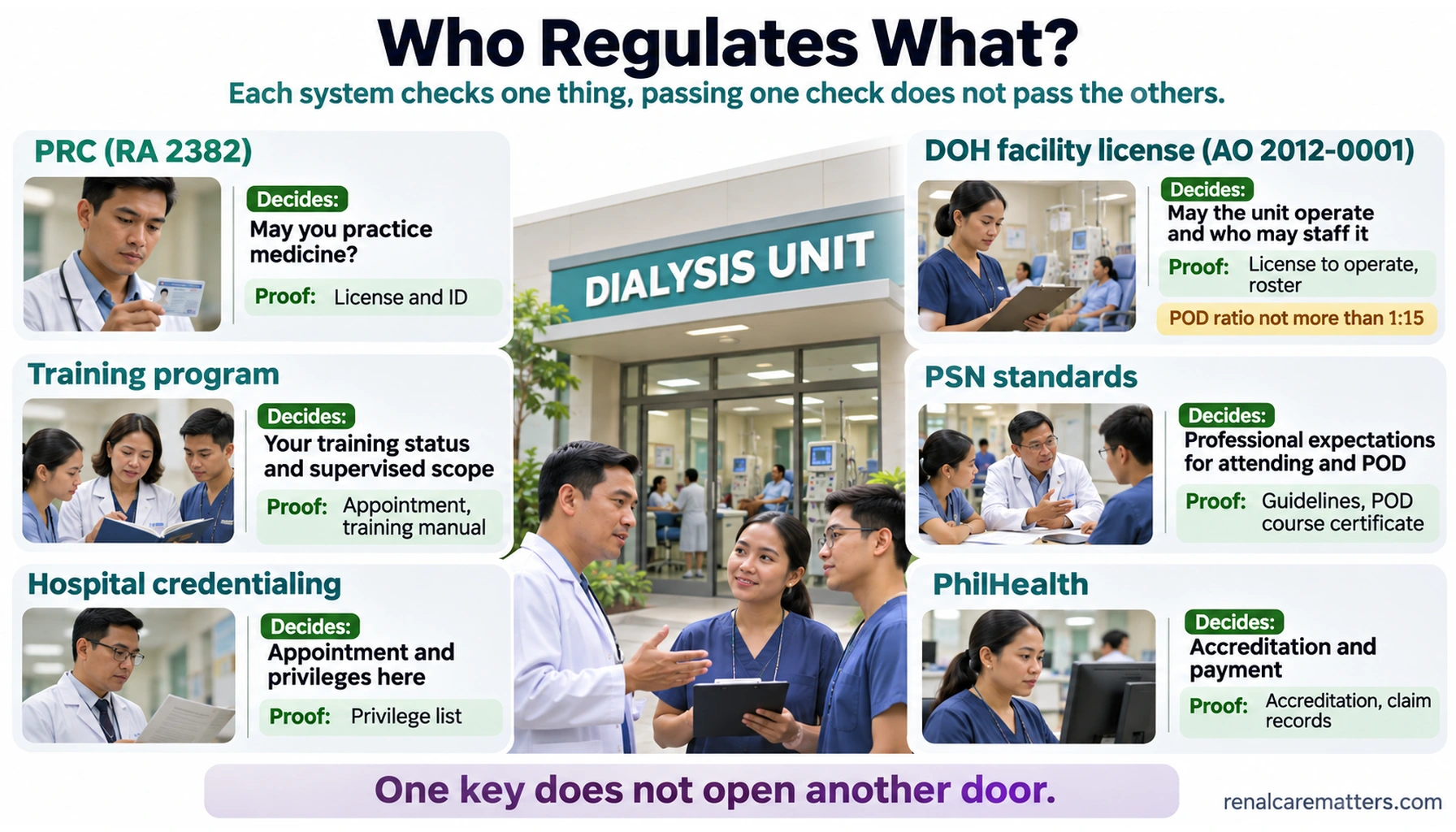
Figure 2. Who regulates what. Each system checks one thing; passing one check does not pass the others.
System
What it decides
What it cannot decide
Document you should be able to show
PRC (RA 2382)
Whether you may practice medicine at all
Where you work, which procedures you do
License and current professional Identification (ID) card
Training program (PCP, PPS, PSN, PNSP accreditation)
Your training status, rotations and supervised scope
Whether an outside unit may employ you
Appointment as resident or fellow; training manual
Hospital credentialing
Your appointment and clinical privileges there
Your eligibility at another facility
Appointment letter; privilege list
DOH licensing (AO 2012-0001)
Whether the unit may operate, and who may staff it
Your training or specialist status
The unit’s license to operate; its personnel roster
PSN standards
Professional expectations for attending nephrologists and PODs
Legal licensure of a facility
PSN guidelines; POD course certificate
PhilHealth
Accreditation and payment
Clinical indications or prescriptions
Accreditation certificate; claim records
There is little trial evidence on governance itself, and this module does not pretend otherwise. The case for these systems rests on regulation, law and the logic of accountability, plus observational and quality-improvement evidence that clear roles and structured communication reduce error. A multicenter study of a structured resident handoff program, in 10,740 admissions across nine hospitals, found medical errors fell from 24.5 to 18.8 per 100 admissions and preventable adverse events from 4.7 to 3.3 per 100 admissions after implementation.8 It was a before-and-after design without randomization, so it shows association, not proof that the program caused the fall; it does show that who tells whom what, and how, is measurable and improvable.
At your stageIntern: before any task, name the registered physician who supervises it, and make sure that person knows. Resident: keep copies of your license, appointment and privileges where you can produce them on a shift. Fellow: know which of your unit’s rules come from DOH, which from PSN, which from PhilHealth and which are local, because the consequences of breaking each are different.
RememberOne key does not open another door. Before you act, ask which system authorizes this task: your license, your training program, your hospital, the unit’s DOH license, or none of them.
Lesson · part 2
Checking your eligibility before you take a POD shift
The moonlighting POD shift is where the separate systems collide. A unit needs a physician in the room for every session. A resident needs income. The roster gets filled. The question that is easy to skip is whether the person on the roster is actually eligible under the rules that license that unit.
What the DOH order says. Under AO 2012-0001, the POD attends to patients in the center under the supervision of the medical director, must be licensed by the PRC, must have experience in the care of patients with kidney failure, must hold updated ACLS training, and must be present during the hours of operation. The order lists the routes to eligibility: board certified or board eligible in nephrology; board certified or board eligible in internal medicine or pediatrics with at least 3 months of work in a DOH-licensed hemodialysis center; undergoing an accredited residency in internal medicine or pediatrics, a route the order limits to training hospitals; or a general practitioner with at least 6 months of work in a DOH-licensed center. The ratio of POD to stations shall not be more than 1:15.3
What the PSN 2024 guidelines add. The PSN sets a priority order: board-certified or board-eligible nephrologists first, then nephrology fellows-in-training in hospital-based centers, then qualified internists or pediatricians with center experience. Internal medicine residents may serve as POD in hospitals with a Philippine College of Physicians (PCP)-accredited program as their training manual stipulates, with at least 3 months of center experience; residents of private hospitals need at least 6 months of work in a DOH-licensed center. The POD needs updated ACLS from a DOH-accredited provider and an updated certificate from a PSN-conducted or PSN-accredited post-graduate POD course, must be physically present, and makes no referral to another specialty without the knowledge of the attending nephrologist or the Dialysis Clinical Head. The ratio is ideally 1:15, with up to 1:20 allowed where PODs are scarce and patients’ needs can still be met.4
Notice where the two documents differ. The DOH order is a regulation that licenses the facility; the PSN guideline is a professional standard. The DOH order caps the ratio at 1:15; the PSN guideline allows up to 1:20 in scarcity. The PSN guideline asks for a POD course that the DOH order does not name. Regional DOH offices also use their own assessment tools, and amendments may exist that this module has not seen. When the documents disagree, the unit’s license is judged against the DOH order and its current issuances, and a doubt about your eligibility is resolved by the licensing office through the unit’s management, not by you on the roster.
Before you accept a shift, check
Source
What a “no” means
Current PRC license and ID
RA 2382; DOH AO 2012-0001
You cannot be the POD
Your route to eligibility (and, for residents, whether this is your training hospital)
DOH AO 2012-0001; PSN 2024
Ask the unit to verify with the licensing office before you start
Months of work in a DOH-licensed center
DOH AO 2012-0001; PSN 2024
You may need supervised experience first
Updated ACLS card
DOH AO 2012-0001; PSN 2024
Renew before the shift
PSN POD course certificate
PSN 2024
A gap against the professional standard; tell the unit and the attending
Stations you will cover alone
DOH AO 2012-0001 (1:15)
More than 15 stations alone breaches the order
Written standing orders, emergency cart, escalation list, attending nephrologist reachable
PSN 2024; unit protocol
You cannot practice safely; do not start the shift until fixed
Your own training program’s rules on outside work
Training manual
Moonlighting may breach your residency or fellowship terms
Figure 3 · Before you say yes to a shift
Read the appointmentAsk the unit for a written appointment that names you as POD and the medical director or Dialysis Clinical Head who supervises you.
Match your routeFind your route in the DOH order and the PSN guideline. Write down which one you meet and how.
Count the stationsAsk how many stations run per shift and how many PODs cover them.
Find the attendingGet the attending nephrologist’s number and the escalation list. Confirm that someone answers at night and on weekends.
Read the standing ordersRead the unit’s protocols for hypotension, chest pain, hyperkalemia and cardiac arrest before your first session.
Check your own programConfirm that your residency or fellowship allows outside work and how many hours.
Signing is the sharpest part of the POD role. A logbook, a treatment sheet or a claim form is a record that a particular physician was present and responsible at a particular time. The DOH order makes presence during operating hours a POD requirement, and the PSN guideline repeats it.3,4 Signing for a shift you did not cover makes a record false. It hides the coverage gap that the next licensing visit should have found, and it hides the patient who was treated without a physician. A false entry in a medical or claim record can also carry legal consequences for the person who signs it. No amount of goodwill toward a short-staffed unit changes that.
Stop and callStop and call the attending nephrologist, per unit protocol, but always ask the attending nephrologist for guidance, when:
you are asked to sign for a shift, a session or a patient you did not cover;
you are asked to cover more stations alone than the DOH ratio allows;
you arrive and there are no written standing orders, no working emergency cart, or no reachable attending;
you realize partway through a shift that you do not meet the eligibility route the unit assumed.
At your stageIntern: you are never the POD and never “watch the unit”; if asked, say so and call your supervising resident. Resident: do the checklist above once for every unit and keep it with your papers. Fellow: when you help run a unit, check the eligibility of every POD on the roster, not only your own.
RememberA POD is a physician in the room who meets a written route to eligibility. If either half is missing, the shift is not covered, whatever the logbook says.
Lesson · part 3
Records that tell the truth, and privacy that holds
A medical record does three jobs at once. It is the clinical memory that the next physician relies on. It is the legal account of what was done and by whom. It is the evidence behind a PhilHealth claim. A record that fails one job usually fails all three. The causal chain runs like this: a missing or false entry leads the next clinician to a wrong assumption, the claim to a payment that should not have been made, and the inquiry, if one comes, to a conclusion that protects no one.
The DOH order requires each patient record to be kept confidential and states that a patient’s right to obtain records of treatment and other relevant medical information shall be observed. It also requires a complications and adverse events logbook that includes delayed discharges, admissions after dialysis, deaths during or right after dialysis, dialysis and vascular access complications, disease complications and outcomes.3 The PSN guideline makes the medical records officer the custodian of records and asks that informed consent be witnessed by two people who also sign.4
The Data Privacy Act. RA 10173, the Data Privacy Act of 2012, treats information about an individual’s health as sensitive personal information and requires that personal data be processed with transparency, for a legitimate purpose and in proportion to that purpose.9 In practice, this law reaches the places where trainees handle data most carelessly: the group chat, the phone camera, the shared spreadsheet and the case presentation.
Situation
What goes wrong
Safer practice
Posting a patient’s laboratory result or photograph in a large Viber or Messenger group for advice
Health data shared beyond the people caring for the patient; copies you cannot recall
Use your institution’s approved channel; share only what the person advising needs; remove names and faces
Taking a phone photograph of a chart or a wound
Images stored in personal cloud backups
Follow the hospital policy on clinical photography; get consent; delete from personal devices
A relative asks for the patient’s results by telephone
Disclosure to someone the patient has not authorized
Confirm identity and the patient’s permission; involve the attending in difficult disclosures
Writing a late note
A late entry passed off as contemporaneous
Write it now, label it as a late entry, give the actual time of writing and the time of the event
Correcting an error in a note
Erasing or overwriting changes the record
Strike once so it stays readable, write the correction, date and sign it
Case presentation or poster
Identifiable details reach an audience
Remove identifiers; ask whether consent or ethics review is needed (Module 35)
The rules are not there to slow you down. A record you would be comfortable having read aloud, in front of the patient and the licensing officer, is usually a record that is both safe and useful. Viber orders are a particular trap: an order sent by message is still an order, and the unit’s protocol should say how it is confirmed, written and countersigned. If the unit has no such rule, ask the attending to write one.
At your stageIntern: document what you saw and did, at the time, and sign with your name and status. Resident: never sign for another physician’s work, and never let another sign for yours. Fellow: teach the team how to share images and results safely, and model it.
RememberWrite what happened, when it happened, as it happened. Label anything late, never erase, and share health data only with people who need it to care for the patient.
Lesson · part 4
When care goes wrong: reporting, learning and quality
Errors in a dialysis unit are rarely the work of one careless person. They grow from conditions: a short-staffed shift, a protocol nobody updated, a machine alarm everyone has learned to silence, a POD who left early and was never replaced. If the response to an adverse event is to find the nearest person and blame them, staff learn to stop reporting, the conditions stay, and the event repeats. If the response is to report, look at the system and fix it, the same event becomes less likely. That is the causal logic of a reporting culture.
The DOH national patient safety policy for health facilities, AO 2020-0007, revises and enhances the earlier national policy and sets patient safety as a program in health facilities.10 For dialysis, the DOH order gives the concrete minimum: the complications and adverse events logbook described in the previous lesson.3 The PSN guideline adds a monthly continuous quality improvement (CQI) meeting led by the Dialysis Clinical Head, a medical audit that covers ACLS activations, ambulance transfers, successful resuscitations and deaths, and risk metrics that include falls, needle injuries, medication errors and blood spills.4 PhilHealth’s maintenance hemodialysis quality standards add a payer’s view of the same work.7
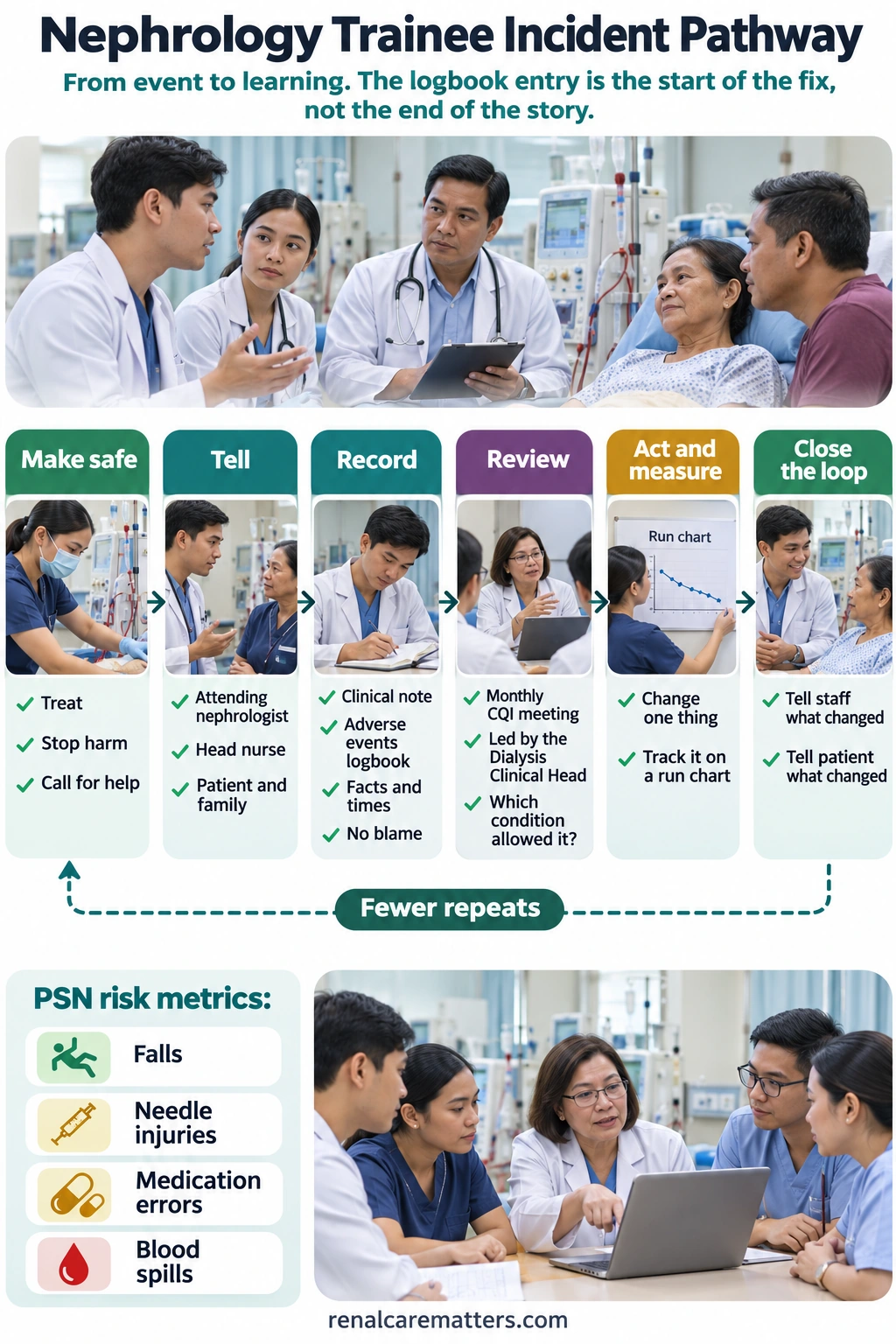
Figure 4. From event to learning. The logbook entry is the start of the fix, not the end of the story.
Step
What happens
Who usually does it
Make safe
Treat the patient; stop further harm; call for help
Whoever is present; the POD
Tell
Inform the attending nephrologist and the head nurse; tell the patient and family what happened
POD, with the attending
Record
Write the clinical note and the logbook or incident entry: facts, times, actions, no blame
POD and nurse
Review
At the CQI meeting or sooner: what conditions allowed it, what would prevent it
Dialysis Clinical Head, head nurse, team
Act and measure
Change one thing; track whether it worked
Quality lead; Module 35 tools
Close the loop
Tell staff, and where appropriate the patient, what changed
Dialysis Clinical Head
What the evidence shows. Quality improvement can change outcomes that patients feel, but most of the evidence comes from designs weaker than a trial. In a collaborative of 17 outpatient hemodialysis facilities supported by the United States Centers for Disease Control and Prevention, a package of chlorhexidine for catheter exit sites, staff training and competency checks, hand-hygiene and access-care audits, and feedback of rates to staff was followed by a fall in pooled bloodstream infection rates from 1.09 to 0.89 per 100 patient-months, and access-related bloodstream infections from 0.73 to 0.42 per 100 patient-months; modeled rates fell 32% and 54% at the start of the intervention.11 The facilities volunteered, most were hospital based, and there was no control group, so the result is an association with a plausible mechanism, not proof that every unit would see the same. Bloodstream infection is a real clinical outcome, not a surrogate.
A coverage gap, like Thursday’s in the case, is itself an incident. A session ran without a physician; a patient had a fall in pressure that no physician assessed. The useful questions are about conditions. Why was there no backup when Dr. Reyes had to leave? Is there a call list of replacement PODs? Did the nurses know whom to call? Was the attending told? Hiding the gap with a signature destroys the one piece of information that would have prompted the fix.
At your stageIntern: report what you see, including near misses, to your resident and in the hospital’s system. Resident: write incident entries as facts and times, and attend the review when invited. Fellow: run or join the CQI meeting, ask what condition allowed the event, and choose one measurable change.
RememberReport the event, fix the condition. A unit that punishes the reporter will stop hearing about its own errors.
On the floor
Real situations: problems and solutions
These are fictional but typical. For each one, cover the answer, decide what you would do, then compare. Where a step depends on local rules, your unit’s procedure and your supervisor’s direction come first.
The intern asked to watch the unit
What you see
At 6 a.m. in a hospital-based dialysis unit in Tarlac City, the POD has not arrived and a nurse asks the medical intern to “just watch the patients until Doc comes.”
What is likely going on
An unlicensed trainee is being asked to stand in for a POD.
What to do
Decline politely, stay to help as a trainee if useful, and call the supervising resident and the attending nephrologist at once so a physician comes.
Why it matters
RA 2382 frames trainee work as directly supervised; an intern in the POD role leaves patients without a physician.
The photograph in the group chat
What you see
A resident in Davao City sees a classmate post a dialysis patient’s fistula photograph, with the patient’s face, in a large batch group chat asking whether it is infected.
What is likely going on
Sensitive health information shared far beyond the care team.
What to do
Message the classmate privately to delete it, suggest the hospital’s approved consult channel, and raise the practice at the next department meeting without naming anyone.
Why it matters
The Data Privacy Act treats health data as sensitive personal information; images in large groups cannot be recalled.
The order by Viber
What you see
During a Sunday shift in Cainta, Rizal, the attending sends a Viber message changing a patient’s fluid removal goal. The unit has no rule on message orders.
What is likely going on
A valid clinical instruction with no defined way to be recorded and countersigned.
What to do
Read the order back by call, write it in the record as a telephone or message order with the time and the attending’s name, have it countersigned per policy, and ask the attending to write a unit rule.
Why it matters
An order that exists only on a phone is invisible to the next shift and to any review.
The needle-stick at the end of the shift
What you see
A dialysis nurse in Lipa City sustains a needle-stick while disconnecting a patient with hepatitis B and wants to “not make a fuss.”
What is likely going on
An occupational exposure that needs immediate assessment and an incident record.
What to do
Follow the unit’s exposure protocol at once, inform the head nurse and attending, record it as an incident, and bring the circumstances to the CQI review.
Why it matters
Needle injuries are a PSN risk metric; unreported exposures deny the nurse care and the unit its lesson.
Field notes
Keep photographs of your license, appointment, ACLS card and POD course certificate in one folder you can show on any shift.
Before your first shift at a new unit, read its standing orders and find the attending’s number; save it under the unit’s name.
If someone asks you to sign something you did not do, say “I can write what I saw, but I cannot sign for what I did not do,” and call the attending.
Write incident entries as times and facts; leave conclusions to the review.
Learn which of your unit’s rules come from DOH, PSN, PhilHealth or local policy; it changes whom you call when a rule cannot be met.
Case review
Back to the case: The logbook on Saturday morning
The logbook. Paolo does not sign. He did not cover Thursday afternoon, so a signature would make the record false and would hide both the coverage gap and an unassessed hypotensive episode. He explains this to Ms. Cruz without accusing anyone, and he calls the attending nephrologist and the Dialysis Clinical Head. Instead of a signature, the unit needs a true account: the nurses’ notes as written, a late entry in the complications logbook for Mr. Valdez’s episode, labeled as late, and a written note of the coverage gap. If a licensing or PhilHealth visit comes, the unit shows the gap and what it did about it.
Eligibility. On the documents as written, Paolo does not meet a route. The DOH order allows residents in an accredited internal medicine program to serve as POD only in training hospitals, and this is a freestanding unit. Its general-practitioner route needs 6 months of center work; he has 4. The PSN guideline asks private-hospital residents for 6 months of center experience and a PSN POD course certificate, which he lacks. He should stop taking shifts here until the unit has his eligibility verified with the DOH licensing office, and he should check whether his own residency allows outside work. Covering all 16 stations alone on Sunday would also breach the 1:15 ratio in the order.
Learning from Thursday. Thursday’s gap and Mr. Valdez’s episode go to the attending now and to the next CQI meeting, as an incident to learn from, not a fault to bury. The review asks why there was no replacement when a POD left, whether the nurses had a call list, and whether the attending was told. One change follows, such as a written backup POD roster with a named on-call physician, and the unit tracks uncovered hours each month. Mr. Valdez and his family are told what happened, and his next sessions are reviewed by the attending.
Skills lab · with your preceptor
Skills checklist: Philippine roles and clinical governance
Complete with a preceptor or program director, on your own documents or in a tabletop exercise. Sign-off is local. Your preceptor rates each step as satisfactory, needs practice, or not observed. Steps marked Critical must all be satisfactory before sign-off. This checklist supports supervised learning; your unit’s own procedure and competency form are the authority. A printable version of every checklist is on the trainer page.
Shows license, appointment and privilege documents and explains what each authorizes
Completes a POD eligibility check for one unit against the DOH order and the PSN guideline, naming the route met
Writes a correctly labeled late entry and a correction in a practice record
Describes how to share a clinical image or result within the Data Privacy Act and hospital policy
Writes a factual, blame-free incident entry and presents it at a CQI or morbidity review
Placement activity. Hospital ward, dialysis unit, CQI meeting or tabletop exercise
Self-assessment
Check your understanding
Each visit draws 5 questions at random from this module’s 5-question bank. Choose the single best answer for each, then select Check answers; an explanation appears under the best answer. Select New set of questions for a different mix. A good target is 4 of 5 on two different sets. Nothing you select is sent anywhere; scoring happens in your browser.
Starmer, A. J., Spector, N. D., Srivastava, R., West, D. C., Rosenbluth, G., Allen, A. D., Noble, E. L., Tse, L. L., Dalal, A. K., Keohane, C. A., Lipsitz, S. R., Rothschild, J. M., Wien, M. F., Yoon, C. S., Zigmont, K. R., Wilson, K. M., O'Toole, J. K., Solan, L. G., Aylor, M., ... I-PASS Study Group (2014). Changes in medical errors after implementation of a handoff program. The New England Journal of Medicine, 371(19), 1803–1812. https://doi.org/10.1056/NEJMsa1405556
Patel, P. R., Yi, S. H., Booth, S., Bren, V., Downham, G., Hess, S., Kelley, K., Lincoln, M., Morrissette, K., Lindberg, C., Jernigan, J. A., & Kallen, A. J. (2013). Bloodstream infection rates in outpatient hemodialysis facilities participating in a collaborative prevention effort: A quality improvement report. American Journal of Kidney Diseases, 62(2), 322–330. https://doi.org/10.1053/j.ajkd.2013.03.011
Educational self-study for physicians in training. Clinical tasks need your institution’s authorization and supervision. Completing this track is an Academy learning record only. It does not confer licensure, specialist status, PSN or PNSP membership or board eligibility, procedural privileges, CPD units, or completion of an institutional training program, and it does not replace current guidelines, regulations, your institution’s protocols and formulary, or your supervisor.