PhilHealth documentation, benefits and transitions
Document truthfully, register patients for their benefits, and hand over safely between units and provinces.
PublishedNailathalaGipatikPepalwal:ReferencesMga SanggunianMga TinubdanReng Reperensya:14Audience: Adult and pediatric nephrology fellows · internal medicine and pediatric residents · medical interns on medicine, pediatrics, ICU and dialysis rotations, and residents who work shifts as dialysis physicians on dutyRead timeOras ng pagbasaOras sa pagbasaOras ning pamamasa:
Training track for nephrology fellows, residents and medical interns
Study material for medical interns, residents and fellows. It explains the reasoning behind common decisions; it is not a protocol and gives no drug doses. Doses, rates and order sets come from current guidelines, product labels, your institution’s approved protocols and your supervising physician. Benefit rules change: confirm them on the date of service. Every case is fictional.
Learning objectives
After this module you should be able to
Intern: Document a dialysis patient’s diagnosis, sessions, medicines and handoffs accurately, so that the record can support both the next clinician and a Philippine Health Insurance Corporation (PhilHealth) claim.
Resident: Complete PhilHealth Dialysis Database (PDD) registration and hemodialysis (HD) benefit records correctly, and explain the 156-session benefit to a patient and family.
Fellow: Own benefit-aware transitions between hospital, units, peritoneal dialysis (PD) and transplant without letting benefit rules drive the prescription.
Pre-testBefore you read, answer the 5 self-assessment questions and note your score. After the module, select New set of questions and compare. The difference is what you learned; the questions you still miss are what to reread.
Start here
The big picture, in plain words
Your role · the paper that keeps the patient dialyzingThe intern writes the notes and the medicine list that everyone downstream will copy. The resident fills in the registration and benefit papers and sits with the family to explain them. The fellow decides how the patient moves between settings, and checks that the prescription was written for the kidneys, not for the payer. When the paper is wrong, a patient arrives at a new unit with no record, no registration and no sessions recognized, and misses dialysis while the papers are fixed.
In plain wordsThink of the hemodialysis benefit as a book of prepaid bus tickets. Each calendar year the registered passenger gets 156 tickets, one per trip, enough for three trips a week all year. The tickets work only on accredited buses, and only if the passenger was registered before the first trip.
The picture has a limit. A bus ticket does not care where you go. A dialysis prescription does: the number of sessions, their length and what is given in them come from the patient’s kidneys, heart, volume and laboratory results, not from the size of the ticket book. PhilHealth says so itself: the services in the package depend on the provider’s clinical assessment and are not intended to be provided on the patient’s demand.1 The benefit removes a barrier; it does not write the order.
Figure 1 · Key numbers (confirm on the date of service)
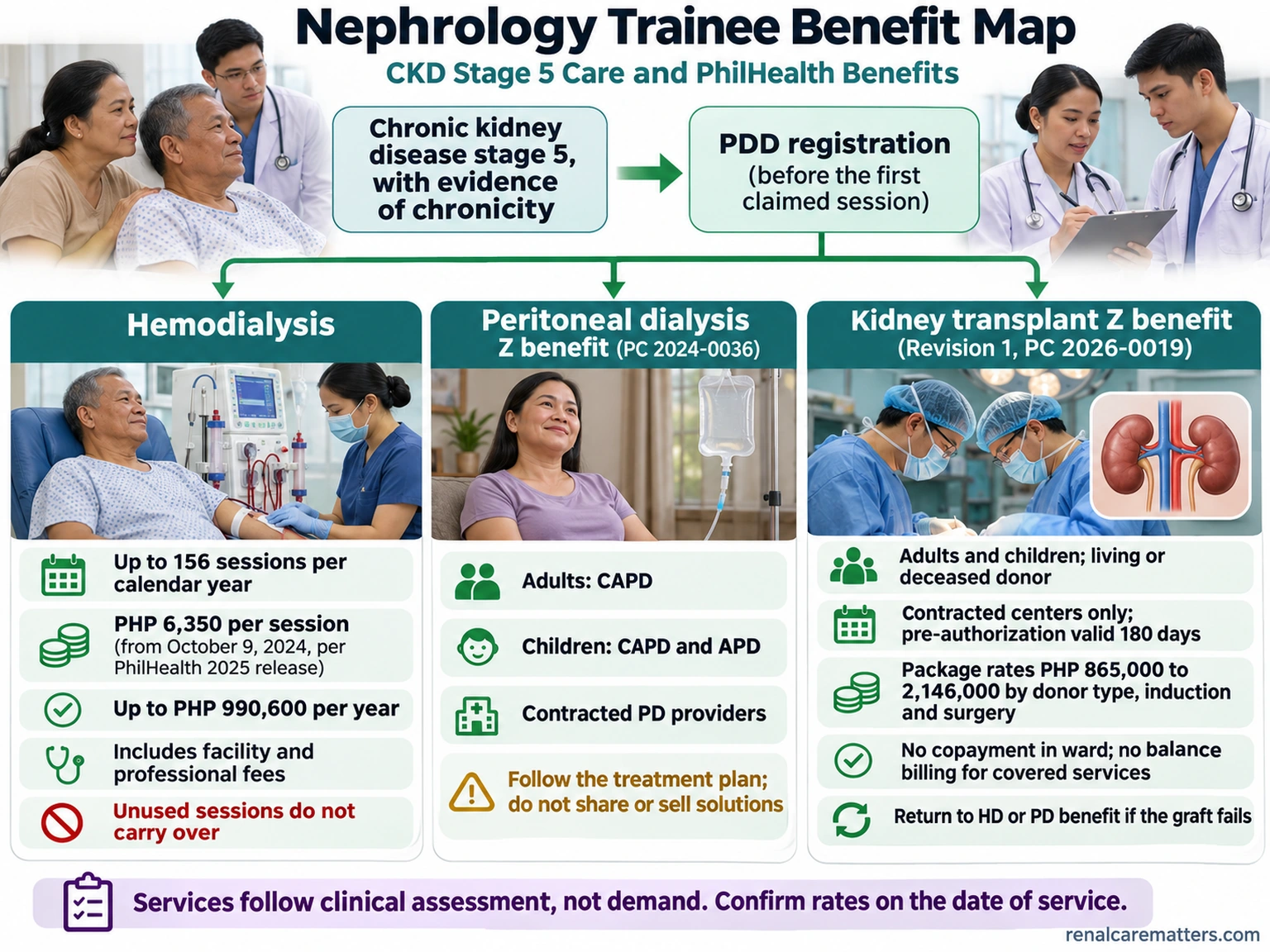
HD sessions covered per calendar yearUp to 156, for patients with chronic kidney disease stage 5 registered in the PDD (PhilHealth circulars 2023-0009 and 2024-0023)
HD package ratePHP 6,350 per session, which PhilHealth’s 2025 release dates from October 9, 2024; includes facility and professional fees
Maximum HD coverage per yearPHP 990,600 (PhilHealth 2025 release)
Unused HD sessionsDo not carry over to the next year (PhilHealth guide to circular 2023-0009)
Discharge summary available at the first post-discharge visit12% to 34% of visits in a systematic review (Kripalani 2007)
Most transitions go smoothly when three things travel with the patient: a true diagnosis of chronic kidney disease stage 5 with its evidence, an active PDD registration, and a complete transfer packet. A few go wrong because one of these is missing, or because someone chose a prescription to fit the benefit. Your work is to make the paper accurate, to make the handoff complete, and to keep the clinical decision clinical.
Opening case · fictional
Case: Going home to Sorsogon
Thursday, 3 p.m., the medicine ward of a tertiary hospital in Quezon City. Mr. Romeo Dizon, 58, a tricycle driver with type 2 diabetes for 15 years, was admitted three weeks ago breathless and vomiting, with a creatinine of 11.8 mg/dL and a potassium of 6.6 mmol/L. A creatinine of 4.1 mg/dL from a clinic visit 14 months ago is on his phone. His kidneys are 8.6 and 8.9 cm and echogenic. He started HD through a right internal jugular tunneled catheter and has had nine sessions. The attending nephrologist has documented chronic kidney disease stage 5 from diabetic kidney disease. He still passes about 500 mL of urine a day.
He will be discharged on Saturday to his family in Sorsogon City, where there is an accredited HD unit about 20 minutes from his home. Dr. Andrea Lim, the second-year resident, is asked to “fix the PhilHealth papers.” His son, Jun, who works in Dubai and is on the phone, asks: “Can Papa do dialysis only twice a week so the 156 sessions last, and so we spend less on the fare?” The unit in Sorsogon has asked for “the usual referral.”
Before reading on, decide:
What must be documented and registered before Saturday so that Mr. Dizon’s benefit works in Sorsogon?
How should the team answer Jun’s request for twice-weekly dialysis?
What goes in the transfer packet, and how should the handoff to the Sorsogon unit be done?
Keep your answers in mind. The lesson gives you what you need, and the case review near the end shows one sound response.
Lesson · part 1
The hemodialysis benefit: 156 sessions and what they require
PhilHealth Circular 2023-0009 institutionalized the expansion of the HD benefit from 90 to 156 sessions a year, explaining the number as three sessions a week for 52 weeks, the frequency it describes as the current standard for adequate HD. It defines the PDD as the system that collects data on members and dependents with chronic kidney disease stage 5.2 PhilHealth’s own guide to the circular states that sessions not used in a year cannot be added to the next.3 Revision 2, Circular 2024-0023, carries the benefit forward with coverage expansion.4
The rate changed twice in 2024. PhilHealth’s 2025 news release states that the package rate became PHP 6,350 per session effective October 9, 2024, that patients with chronic kidney disease stage 5 registered in the PDD can avail of up to 156 sessions a year, and that PhilHealth will therefore shoulder up to PHP 990,600 a year per patient.5 Press reports of the circular gave October 7 as the effective date; if a claim around those days matters, check the circular itself. The patient agreement form states that the PHP 6,350 rate includes the fees of the facility and the professional.6
A 2024 advisory lists the minimum standards of the package: an erythropoiesis-stimulating agent in the vial sizes of the Philippine National Formulary, intravenous iron sucrose as indicated, heparin or enoxaparin as needed, laboratory tests as needed (complete blood count, creatinine, hepatitis profile, alkaline phosphatase, potassium, phosphorus, calcium, iron studies and albumin), low-flux or high-flux dialyzers, and the use of machines, utilities and staff time. It says coverage is subject to the policy’s no-copay provision, that services depend on the patient’s status by the provider’s clinical assessment, and that they are not provided on demand.1 The Philippine Society of Nephrology (PSN) guideline asks the attending nephrologist to comply with the documentary requirements for the patient’s PhilHealth HD benefit.7
Figure 2. The benefit map. Everything starts with a true diagnosis and PDD registration; the prescription still comes from the patient, not the benefit.
The causal chain from paper to dialysis chair is short. No PDD registration, no recognized sessions. No clear diagnosis of chronic kidney disease stage 5, no registration. No signed treatment record for each session, no claim. An error anywhere upstream becomes a family paying out of pocket, or a patient skipping sessions to save money.
What the record must show
Why it matters
Common error
Diagnosis of chronic kidney disease stage 5, with evidence of chronicity (old creatinine values, kidney size, the attending’s assessment)
PDD registration is for stage 5 chronic disease
Registering acute kidney injury that may recover as chronic disease
PDD registration status, before the first claimed session
Registration comes before availment
Assuming the next unit will register him
Each session: date, duration, prescription with the ultrafiltration rate (UFR), the physician present, signatures
The claim rests on the session record
Unsigned sheets; signatures by someone not present (Module 33)
Medicines and laboratory tests given in the session
They are part of the package minimum
Charging the family separately for package items
Signed patient agreement
Documents that the patient was informed of the benefit
Signed without explanation
Sessions used this calendar year
The receiving unit must know what remains
Not counted when the patient moves
Two integrity points deserve to be said plainly. A patient on dialysis for acute kidney injury that may recover is not a patient with chronic kidney disease stage 5, and labeling him so to unlock a benefit is a false record that also closes the door on recovery-focused follow-up (Module 9). And the benefit has no place in deciding how many sessions a patient needs: the prescription comes from residual function, volume, potassium, symptoms and adequacy, as Modules 22 and 23 explain. When a family asks for fewer sessions to save the tickets, the honest answer is that 156 sessions are enough for three a week all year, and that any change in frequency is a clinical decision the attending makes and monitors.
At your stageIntern: write the evidence of chronicity in your notes, with dates. Resident: start the PDD registration with the hospital’s PhilHealth or dialysis staff as soon as the attending documents stage 5, not on the day of discharge. Fellow: check that every prescription change in the chart has a clinical reason written beside it.
RememberRegister the true diagnosis early, document every session, and never let the ticket book write the prescription.
Lesson · part 2
Peritoneal dialysis and its Z benefit
Peritoneal dialysis is underused in the Philippines, and part of the reason is that the patient, the family and often the physician never hear it offered. A benefit exists. PhilHealth Circular 2024-0036 governs the Z benefits package for PD.8 PhilHealth’s January 2025 release describes an expanded package effective January 1, 2025: for adults it covers continuous ambulatory peritoneal dialysis (CAPD) only, at PHP 389,640 or PHP 510,140 a year depending on the daily PD solutions needed; for children it covers CAPD and automated peritoneal dialysis (APD) at higher ranges. Patients must have chronic kidney disease stage 5 and be registered in the PDD first, must meet membership eligibility, must follow their treatment plan including follow-up visits, and must not share, sell or distribute the PD solutions provided to them. The release listed 51 contracted PD providers nationwide.9 PhilHealth has also run a pilot of APD coverage for children under separate advisories; check the current status.
The mechanism behind PD’s value in the provinces is practical. PD runs at home, every day, without a machine for CAPD, without a three-times-weekly trip and without a dialysis chair. For a patient who lives two hours by bus from the nearest HD unit, or who wants to keep working, that changes life more than any laboratory number. It also needs a contracted provider for training, supplies and follow-up, a clean space at home, and someone able to do the exchanges.
Question in the family meeting
What to check
Where the answer comes from
Is PD medically possible?
Abdominal surgery history, hernias, ability to do exchanges, home conditions
Attending nephrologist; Module 27
Is there a contracted PD provider near home?
The current PhilHealth list of contracted providers
PhilHealth list; hospital dialysis coordinator
Is the patient registered in the PDD?
Registration status
Same registration as for HD
Adult or child?
Adult package covers CAPD; pediatric arrangements include APD
Circular 2024-0036 and current advisories
What will the family still pay?
Transport, home preparation, items outside the package
Provider; hospital social service
There is no trial in this module’s sources showing that the PD benefit changes outcomes; what it changes is access. The decision between HD and PD rests on the clinical and personal factors in Module 27, and both should be offered where both are possible.
At your stageIntern: ask every new dialysis patient whether anyone has explained PD. Resident: know the nearest contracted PD provider to your hospital’s catchment. Fellow: offer PD with HD in every modality conversation where it is medically possible, and document that you did.
RememberA benefit no one mentions is a benefit no one uses. Offer PD where it is possible, and know who near the patient’s home can provide it.
Lesson · part 3
The kidney transplant Z benefit, Revision 1
The best treatment for many patients with kidney failure is a transplant, and cost is one of the reasons Filipino families never begin the evaluation. PhilHealth Circular 2024-0035 set the first Z benefits package for kidney transplantation.10 Circular 2026-0019, the Z Benefits Package for Kidney Transplantation (Revision 1), signed on October 26, 2026, amends it and covers both adults and children.11 The circular takes effect 15 days after publication in the Official Gazette or a newspaper of general circulation; the document itself does not state the publication date, so confirm the effective date with PhilHealth. Care after the transplant falls under separate PhilHealth benefits; check the current circulars.
Who and where. All patients with chronic kidney disease stage 5 who meet the clinical criteria are eligible, with a living donor, related or non-related, or a deceased donor, subject to PhilHealth’s membership eligibility rules. Selection follows the circular’s pre-authorization checklist and request form, and the benefit is available only in contracted health facilities. A multidisciplinary team (MDT) that includes the attending nephrologist, a transplant surgeon and, for living-donor procedures, a urologist evaluates donor and recipient and submits the treatment plan. Facilities must follow the ethical guidelines on living donation (Department of Health [Department of Health (DOH)] Administrative Order 2021-0059) and the laws on voluntary donation; deceased donation must be non-commercial, and a deceased-donor claim needs an organ retrieval report from an authorized organ procurement organization.11
Timing. For a living-donor transplant, the facility’s liaison submits the pre-authorization checklist and request form, the Member Empowerment form and the MDT plan before the benefit is used. For a deceased-donor transplant, pre-authorization is submitted within 2 working days after the transplant. An approved pre-authorization is valid for 180 calendar days. Contracted facilities assign a kidney transplantation (KT) registration number and submit a KT Registry form for every patient, and the facility files the claim within 60 days after discharge.11
What it covers. Pre-transplant evaluation; immunosuppressant therapy in the induction phase until one week after discharge from the transplant; the transplant surgery; donor management, donor nephrectomy, and organ retrieval and preservation. The 45-day annual benefit limit does not apply. There is no separate facility and professional fee: PhilHealth pays the facility, which distributes the professional fee. Drugs are reimbursed if they are in the latest Philippine National Drug Formulary (PNDF); otherwise they need a positive health technology assessment recommendation.11
Code
Donor
Induction
Surgery or retrieval
Package rate (PHP)
Z025A1
Living
Basiliximab or equine antithymocyte globulin (ATG)
Laparoscopic donor, open recipient
993,000
Z025A2
Living
Basiliximab or equine ATG
Open surgery for both
865,000
Z025B1
Living
Rabbit ATG
Laparoscopic donor, open recipient
1,045,000
Z025B2
Living
Rabbit ATG
Open surgery for both
918,000
Z026A1
Deceased
Basiliximab or equine ATG
Retrieval with machine perfusion
2,093,000
Z026A2
Deceased
Basiliximab or equine ATG
Retrieval with cold storage
1,583,000
Z026B1
Deceased
Rabbit ATG
Retrieval with machine perfusion
2,146,000
Z026B2
Deceased
Rabbit ATG
Retrieval with cold storage
1,636,000
Rates as printed in the circular signed October 26, 2026; confirm the effective date and current rates with your PhilHealth liaison on the date of service.
What the family pays. There is no copayment in basic or ward accommodation, none for recipients who need special beds such as reverse isolation, and none for managing postoperative complications of donors and recipients. Copayment is allowed only for amenities, the choice of a physician within the MDT, specialist fees in non-basic accommodation, or services the package does not cover, and it must be agreed during the Member Empowerment form discussion. No balance billing beyond the package rate is allowed for covered services.11
If the graft fails. After the Z benefit, patients remain eligible for the HD or PD benefits if they return to dialysis, whether because of graft failure from rejection or infection, acute kidney injury or other complications.11 Tell families this early: fear of losing the dialysis benefit should not be the reason they decline a transplant evaluation.
You can say
You should not say
“PhilHealth has a Z benefit for kidney transplantation, from a living or a deceased donor, for adults and children, at contracted centers.”
“It is covered,” before the transplant center has checked eligibility and pre-authorization
“The package rate depends on the donor type, the induction medicine and the surgical method; the transplant center’s liaison will confirm the current rate.”
A rate as if it were final, without confirming the effective date
“In ward accommodation there is no copayment, and the hospital may not bill beyond the package for covered services.”
Promises about medicines after the induction phase; those fall under other benefits and the formulary
“If the kidney fails, you can return to the dialysis benefit.”
“You will lose PhilHealth dialysis if you get a transplant”
The physician’s job is the same whatever the rate. Refer early to a transplant center when the estimated glomerular filtration rate (eGFR) is falling toward kidney failure (Module 29), identify potential living donors and explain that donation must be voluntary and within the ethical rules, and keep the patient’s records, serologies and dialysis history complete so that the MDT evaluation and pre-authorization are not delayed.
At your stageIntern: record whether transplant has been discussed and whether a living donor has been named. Resident: refer to the transplant center and its PhilHealth liaison, and tell the family about the no-copayment and return-to-dialysis rules. Fellow: know your nearest contracted transplant center, the pre-authorization timing for living and deceased donors, and read the current circular before every benefit conversation.
RememberQuote a benefit only from the circular you have read, with its date, and send the family to the transplant center’s liaison to confirm the effective date and rate on the day.
Lesson · part 4
The transfer packet and the handoff
A dialysis patient who moves from a hospital to an outpatient unit, from one unit to another, or from one province to another carries risk in the move itself. Information gets lost at each transfer. A systematic review of communication at hospital discharge found that direct communication between hospital physicians and primary care physicians happened in only 3% to 20% of discharges, that a discharge summary was available at the first post-discharge visit in only 12% to 34%, and that summaries often lacked test results (missing from 33% to 63%), discharge medicines (2% to 40%), tests pending at discharge (65%) and follow-up plans (2% to 43%).12 Those studies were observational, mostly from North American settings, but every Filipino trainee who has received a patient with “no papers” will recognize them.
Structured handoffs help. In the multicenter study of a structured resident handoff program, medical errors fell from 24.5 to 18.8 per 100 admissions and preventable adverse events from 4.7 to 3.3 per 100 admissions after implementation, without longer handoffs.13 The design was before and after, so it shows association rather than proof; the lesson that a standard structure reduces omissions carries over to a transfer letter.
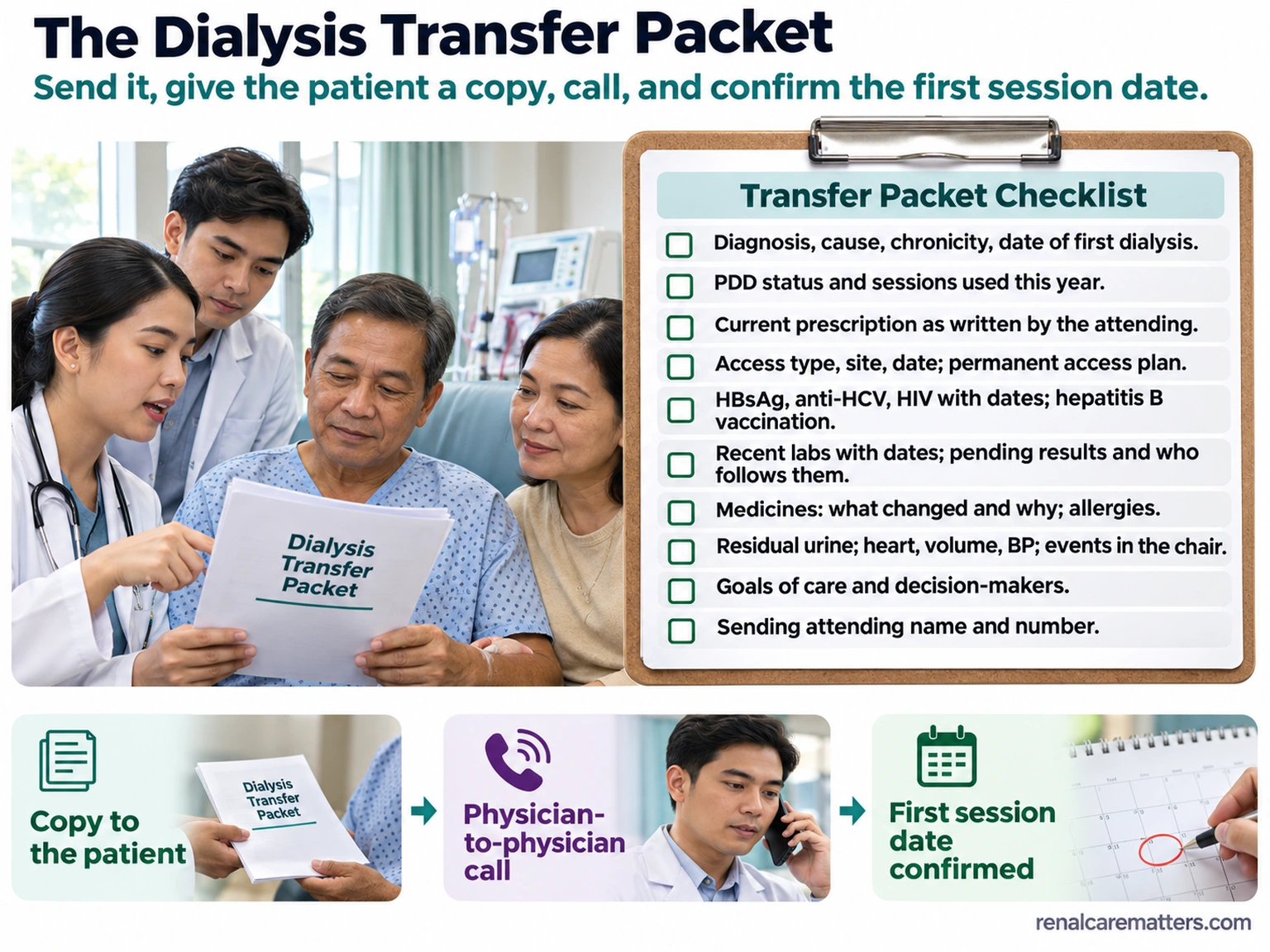
Figure 3. The transfer packet. Send it, give the patient a copy, call, and confirm the first session date.
Transfer packet item
What the receiving unit does with it
Diagnosis, cause of kidney failure, evidence of chronicity, date of first dialysis
Confirms eligibility and plans long-term care
PDD registration status and sessions used this calendar year
Continues the benefit and counts what remains
Current prescription: frequency, duration, dialyzer, target weight and fluid removal limits, anticoagulation approach, as written by the attending
Starts the first session safely
Vascular access: type, site, date placed, problems; plan for permanent access
Protects the access; continues the referral
Hepatitis B surface antigen, hepatitis C antibody and human immunodeficiency virus (HIV) results with dates; hepatitis B vaccination status
Assigns the correct station or machine
Recent laboratory results, with dates; results still pending and who will follow them
Avoids repeating tests; closes loops
Medicine list with what changed and why; allergies
Prevents duplication and omission
Residual urine output; heart, volume and blood pressure issues; intradialytic events so far
Anticipates problems in the chair
Goals of care and who decides with the patient
Respects the family’s decisions
Sending attending’s name and contact number
Lets the receiving physician call
Send the packet through a channel the patient has agreed to, and only to the people who need it; the Data Privacy Act treats health information as sensitive personal information.14 Give the patient and family a copy to carry, because the courier is often the only reliable delivery system across provinces. Then make a telephone call, physician to physician or unit to unit, before the first session. The call is where the receiving physician asks the question your letter did not answer.
Arithmetic illustration, not a target. Sessions remaining = 156 − sessions already claimed this calendar year. A patient who has had 9 sessions in the hospital this year has 147 left for the rest of the calendar year, wherever he dialyzes. A patient who moves in December with 140 sessions used has 16 left, and the count resets on January 1.
Stop and callStop and call the attending nephrologist, per unit protocol, but always ask the attending nephrologist for guidance, when:
a family asks for fewer sessions or a shorter prescription to save money or sessions;
a patient is about to be discharged with no confirmed receiving unit or first session date;
a diagnosis of chronic kidney disease stage 5 is being written mainly to register a patient whose kidneys may recover;
the receiving unit cannot take the patient because of serology status or capacity.
At your stageIntern: draft the packet from the chart and list what you could not find. Resident: complete it, give the family a copy, and confirm the first session date at the receiving unit. Fellow: make the physician-to-physician call and check that the plan is safe for the first week.
RememberA transfer is complete when the receiving physician has the packet, the patient has a copy, someone has called, and the first session has a date.
On the floor
Real situations: problems and solutions
These are fictional but typical. For each one, cover the answer, decide what you would do, then compare. Where a step depends on local rules, your unit’s procedure and your supervisor’s direction come first.
The patient who arrives with no papers
What you see
A 46-year-old woman arrives at a unit in Tuguegarao City for her first session after discharge from a Manila hospital, carrying only a prescription slip and her PhilHealth ID.
What is likely going on
A transfer without a packet; PDD status, serologies and the prescription are unknown.
What to do
Call the sending hospital’s dialysis unit and attending now, get the serology dates and prescription before connecting her, and record what was missing.
Why it matters
Serology status decides her station; a missing prescription makes the first session a guess.
The acute kidney injury that might recover
What you see
A 35-year-old man on dialysis after leptospirosis in Pampanga has started passing more urine; the family asks for PDD registration so the sessions are covered.
What is likely going on
Acute kidney injury in recovery, not chronic kidney disease stage 5.
What to do
Explain that registration is for chronic stage 5 disease, ask the attending to plan dialysis weaning and follow-up, and refer the family to the billing office and social service for current admission coverage.
Why it matters
A false chronic label is a false record and can delay recognition of recovery.
The December move
What you see
A man moving from Cebu City to Bohol in mid-December has used 141 sessions this year.
What is likely going on
Only 15 sessions remain until the count resets on January 1.
What to do
Write the count in the packet, tell the receiving unit and the family, and make sure the plan for the last weeks of December is discussed before he travels.
Why it matters
Families are surprised by the year-end limit when nobody counted.
PD never mentioned
What you see
A schoolteacher in Masbate, two hours by boat from the nearest HD unit, starts HD in Legazpi City and is told she must move.
What is likely going on
A patient for whom home PD might fit better than relocation, and no one has raised it.
What to do
Ask the attending to assess her for PD, find the nearest contracted PD provider, and explain the PD Z benefit conditions to her and her family.
Why it matters
A benefit that nobody mentions is a benefit that nobody uses.
Field notes
Write the date and source of every old creatinine value you find, even if it is a photo on the patient’s phone.
Count PhilHealth sessions used this year at every transfer and write the number in the letter.
Give the family a printed copy of the transfer packet in a plastic folder; it survives rain and long trips.
When a benefit question has no clear answer, refer to the PhilHealth desk instead of guessing an amount.
Write a clinical reason beside every change in dialysis frequency.
Case review
Back to the case: Going home to Sorsogon
Papers before Saturday. The attending has documented chronic kidney disease stage 5 with evidence of chronicity: an old creatinine of 4.1 mg/dL, small echogenic kidneys and long-standing diabetes. Andrea makes sure that evidence is written in the chart with dates, starts the PDD registration now with the hospital’s PhilHealth or dialysis staff, and makes sure each of the nine sessions has a signed treatment record. The family signs the HD benefits agreement after it is explained in Tagalog. She counts the sessions claimed this year so the Sorsogon unit knows what remains.
Twice a week. The team thanks Jun for asking openly. The 156 sessions cover three sessions a week all year, so saving tickets is not a reason to cut sessions, and the PHP 6,350 package includes the facility and professional fees. Whether Mr. Dizon could do fewer sessions is a clinical question: he still passes about 500 mL of urine, but he arrived with hyperkalemia and fluid overload, and any change in frequency would be the attending’s decision with close monitoring of potassium, weight and symptoms. Transport cost is a real burden; the team refers the family to the hospital social service and records the concern. PD is also explained as an option for later, once his access and training can be arranged near home.
The packet and the call. The packet carries the diagnosis and evidence of chronicity, PDD status, sessions used, the attending’s current prescription, the catheter details and the plan for a fistula, dated hepatitis B, hepatitis C and HIV results, recent laboratory results and pending tests, the medicine list with changes, residual urine output, goals of care and the attending’s number. Mr. Dizon carries a copy. The fellow calls the Sorsogon unit’s nephrologist on Friday and confirms the first session for Monday, so no more than one interdialytic interval passes without dialysis.
Skills lab · with your preceptor
Skills checklist: PhilHealth documentation, benefits and transitions
Complete with a preceptor, on a real discharge with consent or on a simulated chart. Sign-off is local. Your preceptor rates each step as satisfactory, needs practice, or not observed. Steps marked Critical must all be satisfactory before sign-off. This checklist supports supervised learning; your unit’s own procedure and competency form are the authority. A printable version of every checklist is on the trainer page.
Documents the evidence of chronicity for chronic kidney disease stage 5 with dates and sources
Explains the 156-session HD benefit, its rate and the PDD requirement to a patient and family in plain language
Identifies the nearest contracted PD provider and explains the PD Z benefit conditions
Completes a transfer packet with every item on the checklist and lists anything missing
Makes a physician-to-physician handoff call and confirms the first session date at the receiving unit
Placement activity. Medicine ward, dialysis unit or discharge planning meeting
Self-assessment
Check your understanding
Each visit draws 5 questions at random from this module’s 5-question bank. Choose the single best answer for each, then select Check answers; an explanation appears under the best answer. Select New set of questions for a different mix. A good target is 4 of 5 on two different sets. Nothing you select is sent anywhere; scoring happens in your browser.
Philippine Health Insurance Corporation. (2026). Z Benefits package for kidney transplantation (Revision 1) (PhilHealth Circular No. 2026-0019). https://www.philhealth.gov.ph/circulars/
Kripalani, S., LeFevre, F., Phillips, C. O., Williams, M. V., Basaviah, P., & Baker, D. W. (2007). Deficits in communication and information transfer between hospital-based and primary care physicians: Implications for patient safety and continuity of care. JAMA, 297(8), 831–841. https://doi.org/10.1001/jama.297.8.831
Starmer, A. J., Spector, N. D., Srivastava, R., West, D. C., Rosenbluth, G., Allen, A. D., Noble, E. L., Tse, L. L., Dalal, A. K., Keohane, C. A., Lipsitz, S. R., Rothschild, J. M., Wien, M. F., Yoon, C. S., Zigmont, K. R., Wilson, K. M., O'Toole, J. K., Solan, L. G., Aylor, M., ... I-PASS Study Group (2014). Changes in medical errors after implementation of a handoff program. The New England Journal of Medicine, 371(19), 1803–1812. https://doi.org/10.1056/NEJMsa1405556
Educational self-study for physicians in training. Clinical tasks need your institution’s authorization and supervision. Completing this track is an Academy learning record only. It does not confer licensure, specialist status, PSN or PNSP membership or board eligibility, procedural privileges, CPD units, or completion of an institutional training program, and it does not replace current guidelines, regulations, your institution’s protocols and formulary, or your supervisor.