Verify registration, appointment, privileges and facility capability before accepting a dialysis panel.
PublishedNailathalaGipatikPepalwal:ReferencesMga SanggunianMga TinubdanReng Reperensya:8Audience: Practicing nephrologists · senior nephrology fellows · internists who share longitudinal kidney care in the clinic, ward, ICU, dialysis unit, and homeRead timeOras ng pagbasaOras sa pagbasaOras ning pamamasa:
Training track for attending nephrologists in adult practice
This module is study material for attending nephrologists and senior fellows in adult practice. It explains the reasoning behind common decisions; it is not a protocol. Doses and thresholds must be checked against current product labels, guidelines, and your institution’s approved protocols. Regulatory and benefit rules change: confirm them on the date of service. Every case is fictional.
Learning objectives
After this module you should be able to
Verify registration, appointment, privileges and facility capability before accepting a dialysis panel.
Name a primary attending, a backup and an after-hours escalation route in writing.
Separate the longitudinal plan, the bedside response and the facility response in every handoff.
Pre-testBefore you read, answer the 5 self-assessment questions and note your score. After the module, select New set of questions and compare. The difference is what you learned; the questions you still miss are what to reread.
Start here
The big picture, in plain words
Your duty · Section 1.2, 2024 hemodialysis guidelinesUnder the Philippine Society of Nephrology (PSN) guidelines: To be an attending nephrologist (AN) of a hemodialysis center (HDC), you must be a physician licensed by the Professional Regulation Commission (PRC) trained in nephrology at a PSN-accredited or recognized institution, practice in the area and be easily reached by the unit, and apply for affiliation with an updated Philippine Health Insurance Corporation (PhilHealth) accreditation and a PSN or chapter endorsement (items a1–a3). You see each patient at least once a month, preferably face to face, or by telemedicine if necessary (b6), and you are paid only the professional fee set in PSN guidelines (b13).
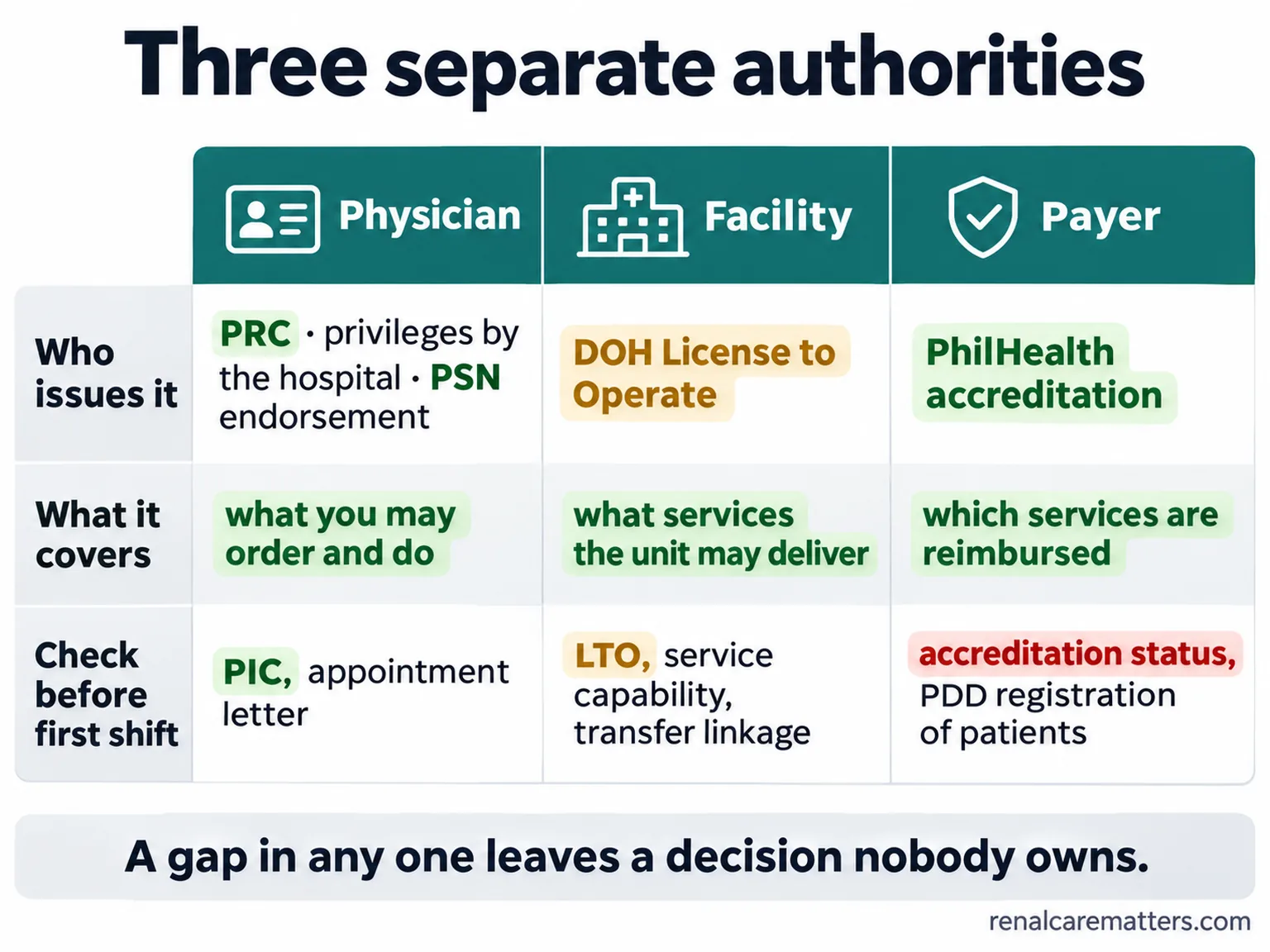
In plain wordsAn attending appointment is a promise that someone with the right authority will answer when a patient deteriorates at 2 a.m. The promise only holds if three separate authorities line up: the doctor’s license, the facility’s license and the payer’s accreditation. Each covers something different, and a gap in any one leaves the night POD (physician on duty) holding a decision nobody owns.
Figure 1 · Key numbers
AN review frequency, maintenance hemodialysis (HD)At least monthly, preferably face to face
Philippine Health Insurance Corporation (PhilHealth) HD sessions per yearUp to 156 (3 per week x 52 weeks)
PhilHealth HD package ratePHP 6,350 per session since October 9, 2024; verify current rate on the date of service
Opening case · fictional
Case: The panel that starts on Monday
Bagong Pag-asa Dialysis Center, a freestanding unit in Bulacan with 18 stations and three shifts, asks you to take over a panel of 22 patients. Their attending nephrologist emigrated last month. The administrator, Ms. Lagman, wants you to start on Monday.
You can round on weekdays. The night shift runs until 11 p.m., and the physician on duty for that shift has been told to “just message the doctor” if something happens. When you ask who covers you when you cannot answer, Ms. Lagman says, “The last doctor never needed a backup.” Nobody can tell you which hospital accepts their emergency transfers. The License to Operate on the wall expired three weeks ago; she says the renewal is “being processed.”
Before reading on, decide:
Would you start on Monday? What must be in writing first?
What will the physician on duty do at 9 p.m. if you do not answer?
Which of these gaps belong to you, and which belong to the facility?
Keep your answers in mind. The lesson gives you what you need, and the case review near the end shows one sound response.
Lesson · part 1
How it works
Treat the care system like a circulation. The license to operate is the vessel wall: it defines what services the unit may safely deliver. Your privileges are the pump: they define what you may order and perform there. The roster and escalation route are the conduction system: they decide whether a signal (the POD’s call) actually reaches a responder in time. Most serious dialysis-unit failures are conduction failures, not knowledge failures. The call went to a phone nobody answered, or the transfer hospital was assumed rather than confirmed. Department of Health (DOH) Administrative Order (AO) 2012-0001 assigns the Medical Director and on-site POD duties and requires a transfer linkage. Section 1.2 of the Philippine Society of Nephrology (PSN) 2024 HD guidelines asks the attending nephrologist (AN) to assess before initiation, document consent, prescribe initial and maintenance HD, coordinate access and emergencies, and see each patient at least monthly. Face to face is preferred, with telemedicine when necessary.
By phone, 9:20 p.m. · fictional
Dr. Salonga, the physician on duty, calls your mobile three times. You are in a cinema with the phone on silent. At 9:35 he messages the clinical head, who is abroad. At 9:50 the patient with chest pain is still on the floor, because nobody told him which hospital accepts the unit’s transfers.
Nobody in this story lacked knowledge. Dr. Salonga knew the patient needed a hospital. The signal simply had nowhere to go.
What this shows. Most night failures are conduction failures. Your job begins before the call: a named backup, a time limit, and a confirmed receiving hospital.
Figure 2. Three separate authorities. Reference card comparing physician credentials, the facility license and payer accreditation: who issues each, what each covers and what to check.
Lesson · part 2
What the evidence shows
This is regulatory and systems guidance, not trial evidence. The supporting literature on handoff failure is strong in the observational sense: communication breakdowns contribute to a large share of serious adverse events in hospital sentinel-event reviews. Structured, closed-loop handoffs are associated with fewer preventable adverse events in multicenter before-and-after studies. Treat the specific Philippine requirements as binding regulation that must be verified locally, not as graded recommendations.
Before your first shift, obtain and file the credential packet: Professional Regulation Commission (PRC) identification card (PIC), facility appointment and privilege letter, PSN or chapter endorsement, PhilHealth accreditation status, and the unit’s current License to Operate. Then map one simulated night call end to end. Who receives it, how long before backup is called, which hospital accepts, and who arranges transport? If the clinic cannot name a backup or an accepting hospital, do not accept the panel. Ask for a written arrangement first, because an unanswerable call puts patients at risk from the first night.
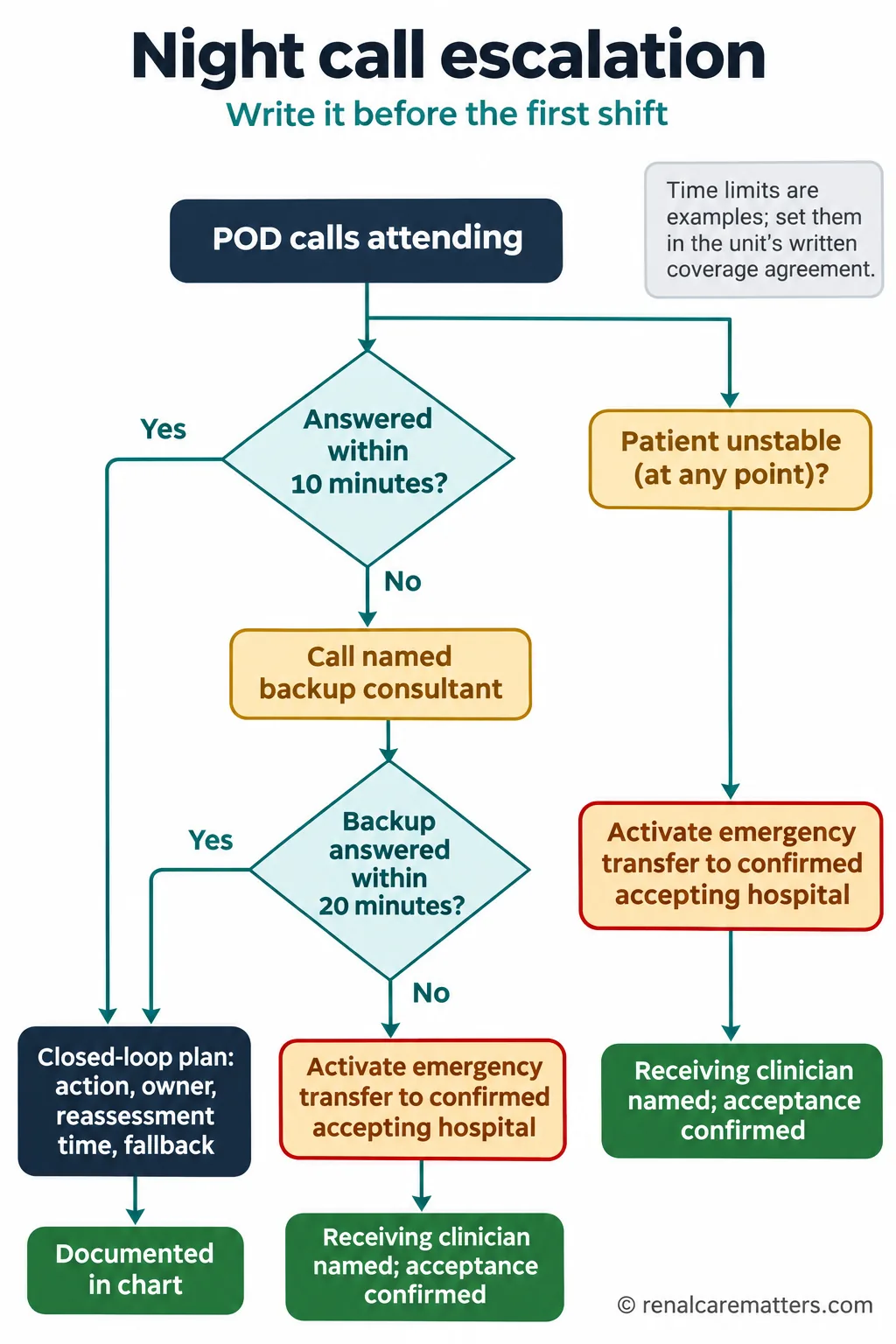
Figure 3. Night call escalation. Flowchart of a night call: if the attending does not answer in time the backup is called, and an unstable patient is transferred to a confirmed hospital.
In the administrator’s office · fictional
Before signing, you ask Ms. Lagman for four things: the current License to Operate, the transfer agreement, the roster for next month, and the escalation sheet posted at the nurses’ station. She finds the first two. The roster lists no backup, and the escalation sheet still carries the name of the attending who emigrated.
You agree on a start date two weeks away, and together you write who the physician on duty calls first, after 10 minutes, and after 20.
What this shows. A two-week delay with a working escalation route is safer than a Monday start without one.
Stop and call
No named backup consultant
No written transfer agreement
POD told to ’message the doctor’ with no time limit before escalation
License to Operate expired or service capability not covering the patients enrolled
On the floor
Real situations: problems and solutions
These are fictional but typical. For each one, cover the answer, decide what you would do, then compare. Where a step depends on local rules, your unit’s procedure and your supervisor’s direction come first.
The roster with your name on two shifts at once
What you see
The unit’s posted coverage list shows you as the covering nephrologist for two units 40 kilometers apart during the same hours.
What is likely going on
Someone filled the roster with your name because no one else was available.
What to do
Ask the medical director to correct the roster today and to name a covering nephrologist for one site, with a telephone number the physician on duty can reach.
Why it matters
A name on a roster is a promise to the physician on duty. A promise you cannot keep is worse than an honest gap.
The new physician on duty who has never met you
What you see
A locum physician on duty starts tonight. He has your number but has never spoken to you.
What is likely going on
Nobody told him what you expect a call to contain or when to call.
What to do
Call him before the shift. Tell him which patients worry you, what you want to hear in a call (vital-sign trends, what he has done, what he is asking for), and that he should call early rather than late.
Why it matters
Most escalation failures start with a physician on duty who was unsure whether a call was welcome.
The transfer hospital that changed its rules
What you see
The ambulance crew is refused at the hospital named in the unit’s transfer agreement; its emergency room now requires a doctor-to-doctor call first.
What is likely going on
The agreement on file is out of date.
What to do
Make the call yourself now, then ask the medical director to update the agreement and the unit’s transfer checklist this week.
Why it matters
A transfer arrangement that has not been tested is an assumption, not an arrangement.
Field notes
Keep your credential packet in one folder, with an expiry date written on the cover for each item.
Once a quarter, ask the unit to run one simulated night call from the floor to an accepting hospital.
Save the covering nephrologist’s number in the unit’s phone, not only in yours.
If you cannot be reached for a weekend, tell the head nurse in writing who is covering.
Case review
Back to the case: The panel that starts on Monday
Would you start on Monday? Not on these terms. Three things must be in writing before you accept a single patient: who covers when you cannot answer, with response times; an escalation rule the physician on duty can follow without you (for example, the backup is called at 10 minutes, and an unstable patient goes to the emergency transfer at 20); and a named accepting hospital with a contact person. Ask to see the renewal application for the License to Operate and the unit’s service capability. File your own credential packet: identification card, appointment and privilege letter, PSN or chapter endorsement, and PhilHealth accreditation status.
What happens at 9 p.m.? As things stand, the physician on duty sends a message and waits. That is the conduction failure this module describes: a call that goes to a phone nobody answers. Before Monday, walk through one simulated night call with the head nurse and the physician on duty, from the first symptom to a patient in an ambulance.
Whose gaps are these? The license and the transfer agreement belong to the facility and its medical director. The coverage arrangement and your credentials belong to you. You can offer to start once both sides are in writing, and you can say why: twenty-two patients are about to depend on a promise that someone will answer.
Skills lab · with your preceptor
Skills checklist: Skills checklist
Complete with a preceptor, in simulation or at your own unit. Sign-off is local. Your preceptor rates each step as satisfactory, needs practice, or not observed. Steps marked Critical must all be satisfactory before sign-off. This checklist supports supervised learning; your unit’s own procedure and competency form are the authority. A printable version of every checklist is on the trainer page.
Verifies the credential packet against originals
Maps a sample after-hours call with time limits
Confirms backup cover and the accepting pathway in writing
States which role is acting (AN, Medical Director or Clinical Head)
Placement activity. Simulation or supervised practice
Self-assessment
Check your understanding
Each visit draws 5 questions at random from this module’s 5-question bank. Choose the single best answer for each, then select Check answers; an explanation appears under the best answer. Select New set of questions for a different mix. A good target is 4 of 5 on two different sets. Nothing you select is sent anywhere; scoring happens in your browser.
Educational material for physicians. Completing it is an Academy learning record only. It does not confer CPD units, PSN certification, privileges, or PhilHealth accreditation, and it does not replace current guidelines, regulations, your institution’s protocols, or clinical judgment.