Supportive kidney care, ethics and serious illness
Talk about prognosis and goals, offer conservative kidney management, and care for patients and families at the end of life.
PublishedNailathalaGipatikPepalwal:ReferencesMga SanggunianMga TinubdanReng Reperensya:11Audience: Adult and pediatric nephrology fellows · internal medicine and pediatric residents · medical interns on medicine, pediatrics, ICU and dialysis rotations, and residents who work shifts as dialysis physicians on dutyRead timeOras ng pagbasaOras sa pagbasaOras ning pamamasa:
Training track for nephrology fellows, residents and medical interns
Study material for medical interns, residents and fellows. It explains the reasoning behind common decisions; it is not a protocol and gives no drug doses. Doses, rates and order sets come from current guidelines, product labels, your institution’s approved protocols and your supervising physician. Benefit rules change: confirm them on the date of service. Every case is fictional.
Learning objectives
After this module you should be able to
Intern: Notice suffering and family distress in a patient with advanced kidney disease, ask about symptoms and worries in plain words, and report what you hear to your resident.
Resident: Hold a goals-of-care conversation with a patient and family using a structured framework, and document the patient’s values, decisions and who should decide if the patient cannot.
Fellow: Offer conservative kidney management (CKM) and time-limited dialysis trials as real options, estimate prognosis honestly with its uncertainty, and lead care when dialysis is withheld or withdrawn.
Pre-testBefore you read, answer the 5 self-assessment questions and note your score. After the module, select New set of questions and compare. The difference is what you learned; the questions you still miss are what to reread.
Start here
The big picture, in plain words
Your role · the doctor who asks what mattersAn intern spends the most time at the bedside and is often the first to hear “pagod na ako” or to see a family arguing in the corridor; noticing and reporting is real care. A resident leads the goals-of-care conversation on most wards. A fellow brings the prognosis, the evidence on dialysis in frail older adults, and the options of conservative kidney management and time-limited trials, and stays with the patient whatever is chosen.
In plain wordsThink of three roads to the same town. One is a highway with tolls and long queues; one is a bridge that only some people may cross; one is a quieter provincial road with fewer stops. All three reach the town. The question is not which road is “correct” but which journey this traveler wants.
The picture has a limit. The three roads (dialysis, transplantation and conservative kidney management) do not always reach the same town at the same time. For a young person, dialysis or a transplant usually adds years. For a very old, frail person with heart failure, dialysis may add little time and may take away independence, while conservative care keeps them at home with symptoms treated. And no one knows the exact length of any road. Prognosis in kidney failure is a range, shaped by age, frailty, comorbidity and function, and it must be offered with honesty about its uncertainty.
The physiology explains why. Dialysis removes solutes and water but does not reverse vascular disease, heart failure, frailty or dementia. Starting it adds a catheter or fistula, three sessions a week, transport, hypotension and post-dialysis fatigue. In a body with little reserve, those burdens can outweigh the clearance gained.
Figure 1 · Key numbers
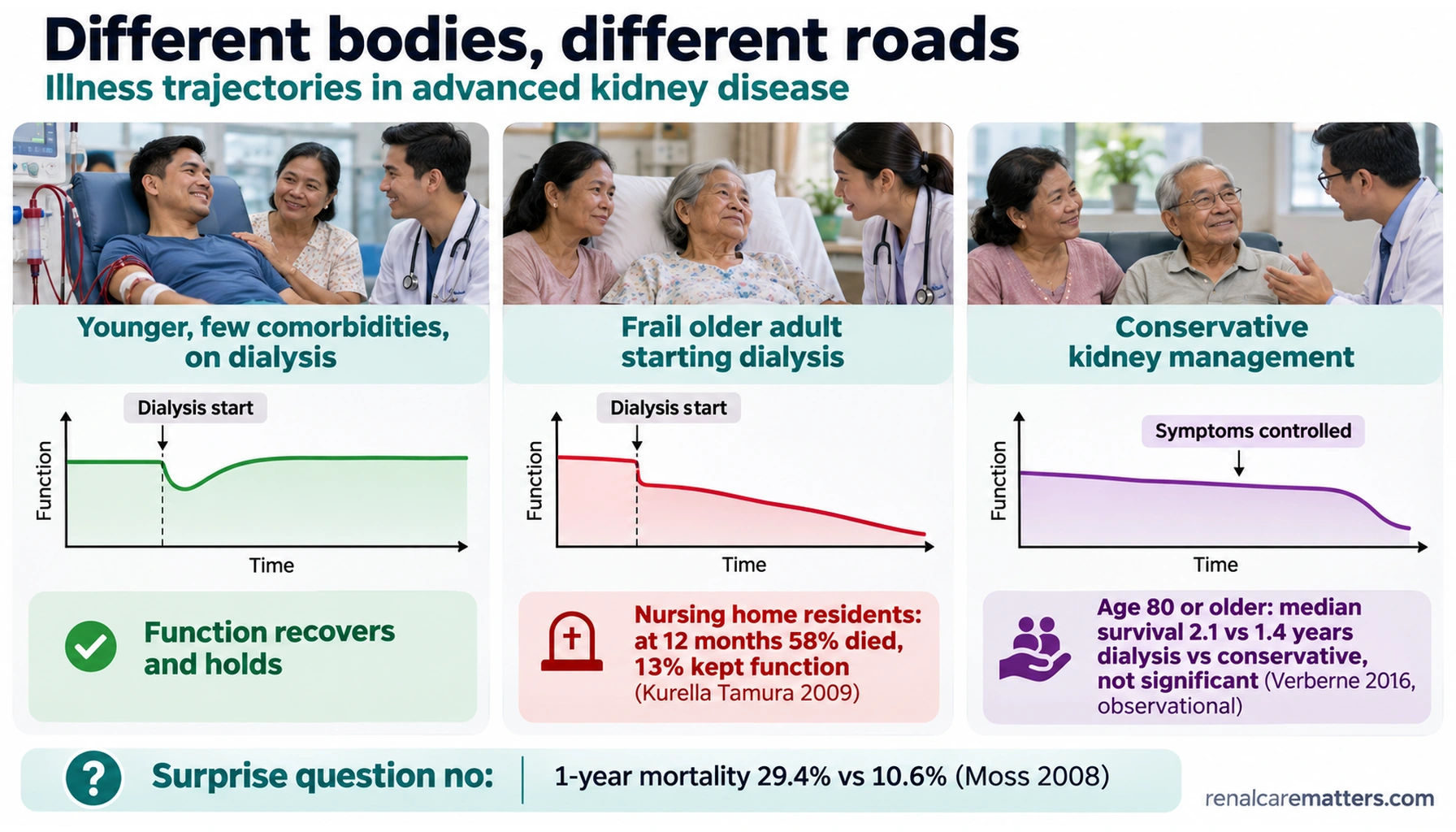
The surprise question (Moss 2008, 147 patients on hemodialysis, prospective)1-year mortality 29.4% when the answer was “no, I would not be surprised” versus 10.6% when “yes” (odds ratio 3.5)
Starting dialysis in nursing home residents (Kurella Tamura 2009, 3,702 US residents)At 12 months, 58% had died and only 13% had kept their pre-dialysis function
Conservative care versus dialysis at 80 or older (Verberne 2016, Dutch single center)Median survival 2.1 versus 1.4 years from the time of choice, not statistically different
After dialysis is stopped (O’Connor 2013, 1,947 hospice patients)Mean survival 7.4 days after hospice enrollment (range 0 to 40)
Philippine Health Insurance Corporation (PhilHealth) hemodialysis benefitUp to 156 sessions a year at PHP 6,350 per session for patients in the PhilHealth Dialysis Database (confirm on the date of service)
Most patients with advanced kidney disease want honest information and a voice in the plan. A few will choose not to start dialysis, or to stop it, and a few families will disagree. Your work is to notice suffering, to give a prognosis people can use, to offer every real option including conservative care, and to keep caring for the patient whatever path is chosen.
Opening case · fictional
Case: The lola who wants to go home
Saturday, 10 a.m., a medicine ward of a provincial hospital in Bacolod. Mrs. Remedios Santos, 84, a retired market vendor, has diabetic kidney disease with an estimated glomerular filtration rate (eGFR) of 8 mL/min per 1.73 m², heart failure with an ejection fraction of 30%, and a stroke two years ago. She needs help to bathe and dress and walks with a cane only inside the house. She was admitted with breathlessness, leg edema and a potassium of 6.1 mmol/L, which improved with treatment. She has lost 6 kg in six months.
Her son Nonoy, who lives with her and takes her to every appointment, says, “Ayaw na niya ng ospital, Doc.” Her daughter Carmela, a nurse in Toronto, says by video call, “Do everything. Start dialysis. We will pay.” When the resident, Dr. Jerome Villanueva, asks Mrs. Santos herself, she says she misses her garden and her chickens and that she is tired, then adds, “Bahala na ang mga anak ko.”
Before reading on, decide:
What is her likely prognosis, and what does the evidence say dialysis would offer her?
How should the team hold the conversation, and who decides?
What would conservative kidney management or a time-limited trial of dialysis look like for her?
Keep your answers in mind. The lesson gives you what you need, and the case review near the end shows one sound response.
Lesson · part 1
Prognosis: estimating it, and saying it
Prognosis matters because it changes what people choose. A patient told only “your kidneys have failed, you need dialysis” has not been given a choice. A patient told “dialysis may give you some more months, mostly spent in hospital and in the unit; without it, we can keep you comfortable at home, and the time may be similar” has.
What predicts a short and difficult road. Advanced age, frailty, dependence in daily activities, heart failure, dementia, weight loss and malnutrition, and a hospital stay that ends in a dialysis start all predict poorer survival and loss of function. Each piece is common; together they define the patient for whom dialysis may add more burden than time.
Tool
What it captures
How to use it
Surprise question: “Would I be surprised if this patient died in the next year?”
The clinician’s integrated judgment
A “no” is a prompt to start a goals-of-care conversation, not a prediction to announce
Comorbidity index (for example, Charlson)
Burden of other disease
Higher scores lower expected survival on any treatment
Frailty and function
Reserve to withstand dialysis
Ask what the patient can do now; dependence predicts further loss
Trajectory
Whether the patient is stable or declining
Recent hospital stays, weight loss and falls signal a downhill course
The evidence. In a prospective study of 147 patients in three hemodialysis units, nephrologists answered the surprise question for each patient. Those in the “no” group were older, sicker and less functional; their 1-year mortality was 29.4% against 10.6% (odds ratio 3.5).1 Note what this shows: seven of ten patients in the “no” group were still alive at a year. The question identifies risk; it does not tell anyone when they will die.
Kurella Tamura and colleagues linked United States dialysis and nursing home registries for 3,702 nursing home residents who started dialysis. A dependence score rose from 12 to 16 points around the start of dialysis; at 3 months function was maintained in 39%, and at 12 months 58% had died and function was maintained in only 13%.2 The study was observational and had no comparison group managed without dialysis, so it cannot say that dialysis caused the decline. It does describe what usually follows for people like Mrs. Santos who start dialysis.
Verberne and colleagues compared 107 patients aged 70 or older who chose conservative management with 204 who chose dialysis at one Dutch hospital. Overall, median survival from the time of choice was 3.1 years with dialysis versus 1.5 years with conservative management. At age 80 or older, the difference shrank and was not statistically significant (2.1 versus 1.4 years), and it was substantially reduced in patients with high comorbidity.3 This was a small, single-center, observational study; patients who chose conservative care were older, and choice was not randomized. It is the kind of evidence you have, and you should say so.
Saying it. Give prognosis as ranges and scenarios: the best case, the most likely case and the worst case, with dialysis and without. Use the patient’s words: “If we start dialysis, the most likely course is more time in hospital and in the unit, and you may not get back to your garden.” Check what was heard.
Figure 2. Different bodies, different roads. In nursing home residents starting dialysis, 58% had died and only 13% kept their function at 12 months (Kurella Tamura 2009, observational).
RememberGive prognosis as honest ranges and scenarios, with and without dialysis, and never present dialysis as the only option.
Lesson · part 2
The goals-of-care conversation, in a Filipino family
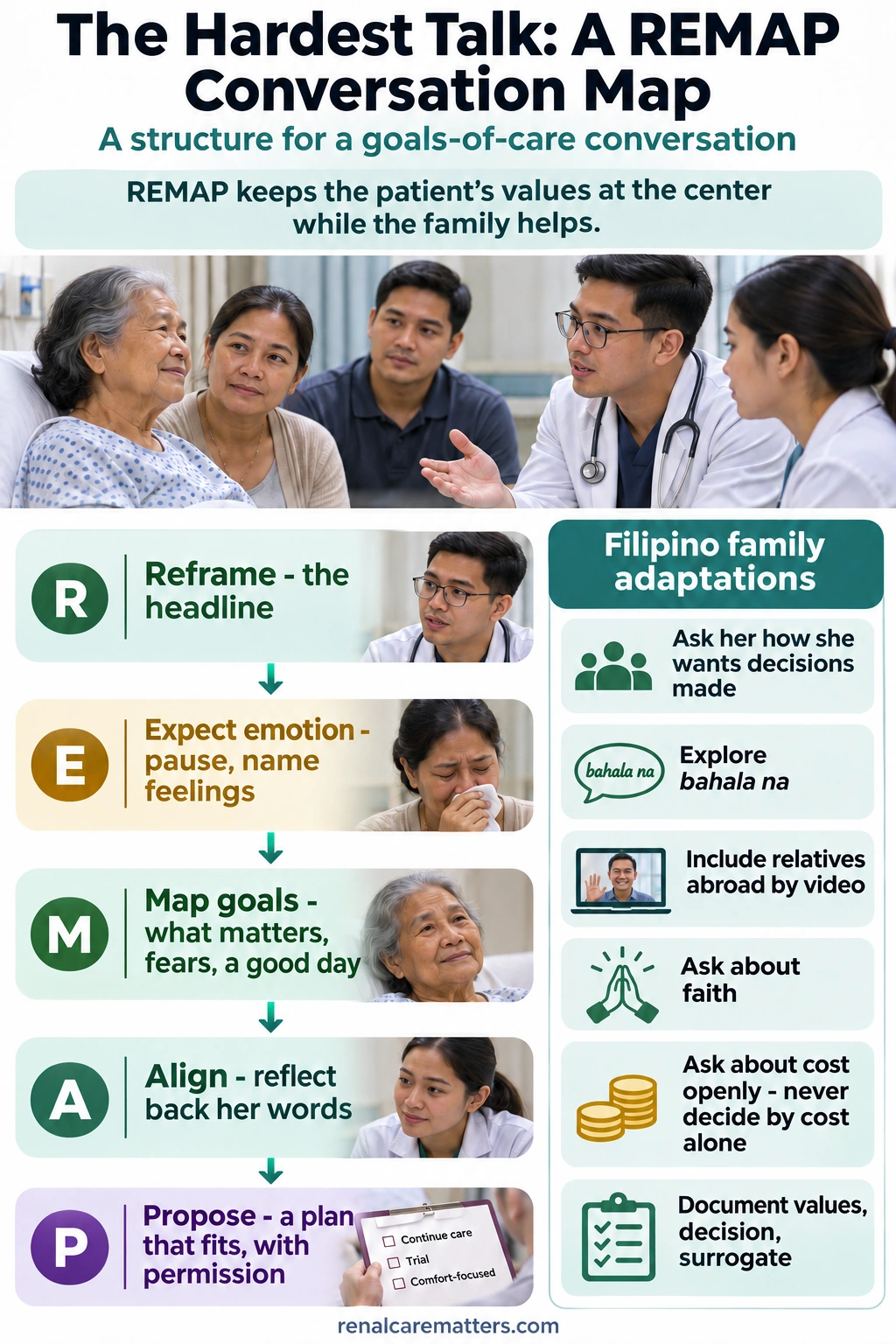
A goals-of-care conversation is a structured talk in which the clinician learns what matters most to the patient and recommends care that fits. It is a skill, not a talent. The REMAP framework, developed for oncology and now widely taught, has five steps: Reframe, Expect emotion, Map out goals, Align with goals, and Propose a plan.4 It travels well to nephrology.
Step
What you do
What it can sound like on a Philippine ward
Reframe
Give a headline that the situation has changed
“Lola, your kidneys have become very weak, and your heart is weak too. We are at a point where we need to talk about what kind of care is best for you.”
Expect emotion
Pause; name and respond to feelings before facts
“This is hard to hear.” Silence. Let the family cry or argue a little.
Map goals
Ask open questions about values, fears, hopes
“What matters most to you now? What are you most afraid of? What would a good day look like?”
Align
Reflect back what you heard
“I hear that being at home with your garden and your son matters most, and that you are tired of hospitals.”
Propose
With permission, recommend a plan that fits
“Based on what you told us, I would recommend care at home that treats your breathlessness and keeps you comfortable, without dialysis. We would still see you and adjust your medicines.”
Who decides. A patient with capacity decides for herself. Many Filipino elders prefer to decide with their children, or to let them decide. That is a legitimate choice, but it must be her choice. Ask directly: “Lola, do you want to decide this yourself, or do you want Nonoy and Carmela to decide with you?” If she says “bahala na ang mga anak ko,” explore it gently; it may mean trust, or it may mean she does not want to burden them with her real wish. Ask what she would want them to choose.
The distant child. Children working abroad often carry guilt and want “everything done.” Bring them into the meeting by video, give them the same prognosis and the same options, and acknowledge their love. Do not let the conversation turn into a contest between the child at home and the child abroad; return it to the patient’s own words.
Faith and money. Ask about faith and whether a priest, pastor, imam or other religious leader should be present. Ask about costs openly, because they shape choices quietly. PhilHealth covers up to 156 hemodialysis sessions a year at PHP 6,350 per session for patients registered in the PhilHealth Dialysis Database (confirm on the date of service), but transport, medicines and lost work remain.5,6 A choice of conservative care must never be made for a poor patient because of cost alone, and dialysis must never be pressed on a frail patient because it is covered.
Documentation and law. Write the patient’s values in her words, the options discussed, the decision, who was present, and whom she wants to decide if she cannot. The Philippines has no standalone palliative care law; palliative care provisions sit in broader statutes, including the Universal Health Care Act of 2019.7 Follow your hospital’s policy on advance directives and do-not-resuscitate orders, and ask its legal or ethics office when unsure.
Figure 3. A structure for the hardest talk. REMAP keeps the patient’s values at the center while the family helps.
RememberAsk the patient how she wants decisions made, map what matters to her, and recommend a plan that fits it; the family helps, but the patient’s values lead.
Lesson · part 3
Conservative kidney management and time-limited trials
What it is. An International Society of Nephrology consensus, developed with a Filipino nephrologist among its authors, defines conservative kidney management as planned, holistic, patient-centered care for people with kidney failure who choose not to receive dialysis or a transplant, and kidney supportive care as care that addresses symptoms, psychological, social and spiritual needs across every treatment path, including dialysis and transplantation. It stresses that both are active treatments, not the absence of treatment, and gives considerations for low-resource settings where dialysis access is limited.8 The earlier Kidney Disease: Improving Global Outcomes (KDIGO) Controversies Conference on supportive care set out a roadmap for prognosis, shared decision-making, symptom management and end-of-life care in chronic kidney disease (CKD).9 Both are conference and consensus statements, not graded recommendations.
Medicines that slow decline when they still help; diuretics; diet adjusted to comfort; potassium managed without rigid restriction late in illness
Fellow and attending
Advance care planning
Preferred place of care and death, resuscitation preferences, surrogate decision-maker
Resident and fellow
Family and spiritual support
Caregiver strain, finances, faith
Social worker, chaplain, nurse
End-of-life care
Recognizing the last weeks; comfort at home or in hospital
Whole team
What it is not. It is not abandonment. A patient on CKM still has clinic visits, blood tests when they change care, medicines adjusted to kidney function, and a phone number to call. Doses of symptom medicines must account for the low glomerular filtration rate (GFR); the attending and the formulary set them.
The time-limited trial. When the outcome is uncertain, or when a family cannot accept CKM yet, a time-limited trial of dialysis can help. Scherer and Holley describe its elements for critically ill patients with acute kidney injury (AKI), and the same logic applies to frail patients with kidney failure: an honest assessment of prognosis, elicitation of the patient’s values, a defined duration, agreed markers of success and failure, clear documentation and, often, palliative care involvement. A well-run trial can prevent conflict among clinicians and support the patient, family and staff.10
Figure 4 · Setting up a time-limited trial of dialysis
Agree the goal“We will try dialysis to see whether Lola can breathe more easily and go home, able to sit in her garden.”
Set the timeA defined period agreed with the family, for example a set number of weeks, written in the chart.
Name successSpecific markers the family understands, such as going home, eating, recognizing family, tolerating sessions.
Name failureRepeated hospital stays, distress during sessions, loss of consciousness, no return home.
Review on the dateMeet again on the agreed date with the same family members.
DecideContinue if the goals are being met; if not, stop dialysis and continue comfort-focused care.
In childrenDecisions about dialysis for infants and children with severe comorbidities are made with parents, and older children and adolescents should have a voice matched to their maturity. Conservative and palliative pathways exist for neonates with very poor prognosis, and pediatric palliative care teams support families through them. See Attending Pediatric Nephrologist, Module 19.
Philippine practice. Specialist palliative care teams are concentrated in large hospitals, and home hospice services are limited outside cities. A nephrology team often provides primary palliative care itself, with the barangay health worker, the family and the parish. Teach the family how to recognize breathlessness, how to give the medicines prescribed for it, and whom to call at night.
RememberOffer conservative kidney management as active treatment, and when the future is uncertain, propose a time-limited dialysis trial with written goals and a review date.
Lesson · part 4
Stopping dialysis and caring for the dying
Stopping dialysis is ethically accepted when a patient with capacity, or a surrogate acting on the patient’s known wishes, decides that its burdens outweigh its benefits. It is not suicide and not euthanasia; it is the withdrawal of a treatment that no longer serves the patient’s goals. Death follows from the underlying kidney failure.
What happens next. In a study of 1,947 patients admitted to ten United States hospices after stopping dialysis, mean survival was 7.4 days, with a range from 0 to 40 days. Shorter survival was associated with male sex, referral from a hospital, lower functional status and peripheral edema.11 Families need this range: “usually about a week, sometimes a few days, occasionally several weeks.” Patients with some residual kidney function may live longer.
The mechanism of the last days. Without dialysis, potassium, acid and uremic toxins accumulate and fluid builds up. Most patients become drowsy and then unconscious; some develop breathlessness from fluid, agitation, twitching or itch. Each symptom has a cause the team can treat for comfort, not to prolong life.
Symptom
Likely cause
Comfort approach (medicines and doses per palliative team and formulary)
Breathlessness
Fluid in the lungs, acidosis, anxiety
Sit up, fan, oxygen if it helps, medicines for breathlessness chosen for low kidney function
Agitation, confusion
Uremia, retention, pain
Check bladder and pain first; calm environment; family presence
Twitching (myoclonus)
Uremia; accumulating drugs and metabolites
Review and stop drugs that accumulate; treat per palliative team
Pain
Underlying disease, immobility
Analgesics chosen with kidney failure in mind, because some opioid metabolites accumulate
Secretions, mouth dryness
Weakness, mouth breathing
Positioning, mouth care
Stop what no longer helps. Daily blood tests, blood pressure targets, phosphate binders, erythropoiesis-stimulating agents and many other medicines add burden without benefit at this stage. The decision is the attending’s, with the family, and it should be written.
Dying at home. Many Filipino families want their lola to die at home, surrounded by relatives and neighbors, with prayers and the rites of their faith. Plan for it: transport, equipment, medicines in hand, a family member taught to give them, a contact number, and clear instructions about who will certify death and how. A resident who arranges a good home death has done important work.
Stop and callStop and call the attending nephrologist, per unit protocol, but always ask the attending nephrologist for guidance, when:
A patient asks to stop dialysis or not to start it, or a family asks you to stop or withhold it
You doubt the patient’s capacity to decide, or the patient and family disagree
Symptoms such as breathlessness, pain or agitation are not controlled
A resuscitation decision is unclear or undocumented at night
A family member abroad asks you to override the decision made by the patient and the family at the bedside
RememberWhen dialysis stops, care does not. Tell the family what to expect in days, treat every symptom for comfort, and help them be present at the end.
On the floor
Real situations: problems and solutions
These are fictional but typical. For each one, cover the answer, decide what you would do, then compare. Where a step depends on local rules, your unit’s procedure and your supervisor’s direction come first.
The quiet patient in chair 7
What you see
A moonlighting resident in a Tarlac dialysis unit notices a 79-year-old woman who no longer talks during sessions and has missed two this month. Her daughter says she “cries before every session.”
What is likely going on
Possible depression, symptom burden or a wish to stop dialysis.
What to do
Ask her privately how she is and what she wants, screen for symptoms and low mood, and tell the attending nephrologist so a goals-of-care conversation can be arranged.
Why it matters
Missed sessions and withdrawal can be the first sign of unspoken suffering.
The 2 a.m. code question
What you see
A night resident in Cagayan de Oro is called for an 88-year-old man on CKM with sudden breathlessness. No resuscitation decision is documented. His wife says he never wanted a tube.
What is likely going on
End-stage disease with an undocumented decision.
What to do
Treat breathlessness for comfort now, call the attending about the resuscitation decision, and document the wife’s report of his wishes.
Why it matters
Undocumented decisions turn the night into a crisis; planning belongs in daytime.
The trial that is not working
What you see
A 76-year-old man started a time-limited trial of dialysis six weeks ago in Legazpi. He has been readmitted three times and is now delirious during sessions.
What is likely going on
The agreed failure markers have been met.
What to do
Convene the review meeting with the same family members, revisit the written goals, and propose comfort-focused care without dialysis if the goals are not being met.
Why it matters
A trial only helps if it has an end date and someone keeps it.
The daughter abroad
What you see
A nurse working in Dubai calls the ward demanding that her father, who chose CKM with his wife and son, be started on dialysis “immediately.”
What is likely going on
Distress and guilt at a distance, conflicting with the patient’s decision.
What to do
Acknowledge her love, offer a video meeting with the attending and the family, explain the prognosis and the patient’s own words, and do not change the plan by phone.
Why it matters
The patient’s values lead; distant relatives need information and time, not a reversal at night.
Field notes
Ask every advanced CKD patient: “What matters most to you now?”
Give prognosis as best case, most likely case and worst case.
Write the patient’s values in her own words in the chart.
Put the review date of any time-limited trial in the chart and the family’s calendar.
Before a home death, make sure the family knows who will certify death and how.
Case review
Back to the case: The lola who wants to go home
Prognosis and what dialysis offers. Mrs. Santos is 84, dependent in daily activities, with heart failure, a past stroke and weight loss. Most clinicians would not be surprised if she died within a year, the “no” answer that Moss associated with 29.4% one-year mortality in dialysis patients. Kurella Tamura’s data on nursing home residents suggest that after starting dialysis, most similar patients lose function and many die within a year. Verberne’s observational data show no significant survival advantage for dialysis over conservative management at age 80 or older, especially with heavy comorbidity. Dialysis might add some time, likely spent in hospital and in the unit, and is unlikely to return her to her garden. Say this honestly, as ranges.
The conversation and who decides. Arrange a family meeting with Mrs. Santos, Nonoy and Carmela by video, using REMAP: reframe, expect emotion, map her goals, align, and propose. She has capacity, so she decides; ask whether she wants to decide herself or with her children, and what she would want them to choose. Her own words, home, garden, tired of hospitals, point toward comfort-focused care. Acknowledge Carmela’s love and guilt, and give her the same information. Document values, options, decision and surrogate.
CKM or a trial. Conservative kidney management would mean going home with diuretics, potassium control, symptom medicines dosed for low kidney function, regular contact with the team, an advance care plan, and support for Nonoy as caregiver. If the family cannot yet accept that, a time-limited trial of dialysis could be offered: a defined period, written goals such as going home and tolerating sessions, failure markers such as repeated admissions or distress, and a review meeting on a set date with the same family members. Either path continues with the nephrology team.
Interactive case · fictional
Interactive case: “Pagod na ako”
Work through a shift one decision at a time. The panel at the top changes with what you choose. After each choice you see why it is, or is not, the best move; after a weaker one you can try again or carry on and see where it leads. Your first choice at each step is scored. The score stays on this device and nothing is sent anywhere. In real practice, your unit’s protocol and the people responsible for each decision come first.
Skills lab · with your preceptor
Skills checklist: Supportive kidney care and serious illness
Complete with a preceptor, in simulation or at your own unit. Sign-off is local. Your preceptor rates each step as satisfactory, needs practice, or not observed. Steps marked Critical must all be satisfactory before sign-off. This checklist supports supervised learning; your unit’s own procedure and competency form are the authority. A printable version of every checklist is on the trainer page.
Screens a patient with advanced CKD for symptoms and family distress and reports them
Uses the surprise question and functional status to identify patients who need a goals-of-care conversation
Leads a simulated family meeting using REMAP, including a relative joining by video
Explains conservative kidney management and a time-limited trial with written goals and a review date
Documents values, decision, surrogate and resuscitation preference clearly
Placement activity. Medicine ward, nephrology clinic, dialysis unit or simulation
Self-assessment
Check your understanding
Each visit draws 5 questions at random from this module’s 5-question bank. Choose the single best answer for each, then select Check answers; an explanation appears under the best answer. Select New set of questions for a different mix. A good target is 4 of 5 on two different sets. Nothing you select is sent anywhere; scoring happens in your browser.
Moss, A. H., Ganjoo, J., Sharma, S., Gansor, J., Senft, S., Weaner, B., Dalton, C., MacKay, K., Pellegrino, B., Anantharaman, P., & Schmidt, R. (2008). Utility of the “surprise” question to identify dialysis patients with high mortality. Clinical Journal of the American Society of Nephrology, 3(5), 1379–1384. https://doi.org/10.2215/CJN.00940208
Kurella Tamura, M., Covinsky, K. E., Chertow, G. M., Yaffe, K., Landefeld, C. S., & McCulloch, C. E. (2009). Functional status of elderly adults before and after initiation of dialysis. New England Journal of Medicine, 361(16), 1539–1547. https://doi.org/10.1056/NEJMoa0904655
Verberne, W. R., Geers, A. B. M. T., Jellema, W. T., Vincent, H. H., van Delden, J. J. M., & Bos, W. J. W. (2016). Comparative survival among older adults with advanced kidney disease managed conservatively versus with dialysis. Clinical Journal of the American Society of Nephrology, 11(4), 633–640. https://doi.org/10.2215/CJN.07510715
Childers, J. W., Back, A. L., Tulsky, J. A., & Arnold, R. M. (2017). REMAP: A framework for goals of care conversations. Journal of Oncology Practice, 13(10), e844–e850. https://doi.org/10.1200/JOP.2016.018796
Monzón-Llamas, L., Carpen, T., Hamzah, E., Wang, Y., Corvera, R., Bausa-Claudio, A. B., Kim, S., & Centeno, C. (2026). How national laws enhance palliative care integration: Lessons from the Philippines, South Korea, and Taiwan. Journal of Global Health, 16, 04230. https://doi.org/10.7189/jogh.16.04230
Davison, S. N., Pommer, W., Brown, M. A., Douglas, C. A., Gelfand, S. L., Gueco, I. P., Hole, B. D., Homma, S., Kazancıoğlu, R. T., Kitamura, H., Koubar, S. H., Krause, R., Li, K. C., Lowney, A. C., Nagaraju, S. P., Niang, A., Obrador, G. T., Ohtake, Y., Schell, J. O., ... Brennan, F. P. (2024). Conservative kidney management and kidney supportive care: Core components of integrated care for people with kidney failure. Kidney International, 105(1), 35–45. https://doi.org/10.1016/j.kint.2023.10.001
Davison, S. N., Levin, A., Moss, A. H., Jha, V., Brown, E. A., Brennan, F., Murtagh, F. E. M., Naicker, S., Germain, M. J., O’Donoghue, D. J., Morton, R. L., Obrador, G. T., & Kidney Disease: Improving Global Outcomes (KDIGO). (2015). Executive summary of the KDIGO Controversies Conference on Supportive Care in Chronic Kidney Disease: Developing a roadmap to improving quality care. Kidney International, 88(3), 447–459. https://doi.org/10.1038/ki.2015.110
Scherer, J. S., & Holley, J. L. (2016). The role of time-limited trials in dialysis decision making in critically ill patients. Clinical Journal of the American Society of Nephrology, 11(2), 344–353. https://doi.org/10.2215/CJN.03550315
O’Connor, N. R., Dougherty, M., Harris, P. S., & Casarett, D. J. (2013). Survival after dialysis discontinuation and hospice enrollment for ESRD. Clinical Journal of the American Society of Nephrology, 8(12), 2117–2122. https://doi.org/10.2215/CJN.04110413
Educational self-study for physicians in training. Clinical tasks need your institution’s authorization and supervision. Completing this track is an Academy learning record only. It does not confer licensure, specialist status, PSN or PNSP membership or board eligibility, procedural privileges, CPD units, or completion of an institutional training program, and it does not replace current guidelines, regulations, your institution’s protocols and formulary, or your supervisor.