Heat-index days and the trip to the unit, volcanic ashfall and the water and air intakes, and an infectious outbreak treated as a disaster.
PublishedNailathalaGipatikPepalwal:ReferencesMga SanggunianMga TinubdanReng Reperensya:2Audience: Every member of the dialysis unit: hemodialysis, charge, head and safety nurses, physicians-on-duty, the Dialysis Clinical Head and attending nephrologists, dialysis, water treatment, biomedical and reprocessing technicians, nurse assistants and support staff, social workers, records officers, dietitians, unit managers and ownersRead timeOras ng pagbasaOras sa pagbasaOras ning pamamasa:
This module is study material for dialysis teams. It explains the reasoning behind disaster decisions; it is not a unit protocol or an order set. Early dialysis, shortened sessions, priority rosters and emergency diets are decisions of the attending nephrologist and the Dialysis Clinical Head. Escalation follows your unit protocol, and you always ask the attending nephrologist for guidance. Every case, name, and identifier is fictional.
Learning objectives
After this module you should be able to
Protect patients on high heat-index days, from the trip to the unit to the waiting area, without loosening fluid limits.
Protect the building, the water and air intakes, staff and patients during volcanic ashfall.
Treat an infectious outbreak as a disaster: cohorting, staff shortage and supply strain.
Know which agency warns for each hazard, and who decides each clinical change.
Classroom 1 hSkills lab 0.5 hSupervised placement 0 h
Pre-testBefore you read, answer the 5 self-assessment questions and note your score. After the module, select New set of questions and compare. The difference is what you learned; the questions you still miss are what to reread.
Start here
The big picture, in plain words
In plain wordsSome disasters do not arrive in one night. Heat, ashfall and outbreaks come slowly, stay for days or weeks, and wear a unit down. They are less like a storm and more like a long drought: the danger is not one moment but the slow loss of what the unit runs on.
The picture has a limit. A drought only takes water; these hazards take different things. Heat works through the patient’s trip and the waiting room. Ash works through the air and water intakes, the roads and the lungs. An outbreak works through staff and supplies, and through the risk that the unit itself spreads infection. Each needs its own small plan, built on the same unit plan (Module 3).
The site’s El Niño and heat guide explains for patients why heat is hard on people on dialysis.
Figure 1 · Key terms for this module
Heat indexHow hot it feels when humidity is added to the air temperature; Philippine Atmospheric, Geophysical and Astronomical Services Administration (PAGASA) publishes daily forecasts.
AshfallFine volcanic rock and glass that falls after an eruption; it is abrasive, slippery and harmful to breathe.
Volcano alert levelPhilippine Institute of Volcanology and Seismology (PHIVOLCS)’s scale for a volcano’s activity.
CohortingGrouping patients with the same infection status by shift, zone or staff to limit spread.
Backup rosterA list of staff who can be called in when others are absent.
IntakeThe opening through which the building draws outside air or the water system draws water.
Opening case · fictional
Case: Ash on the windshield
At dawn after an eruption, fine gray ash covers the cars and roads around a 12-station unit in Tanauan, Batangas. PHIVOLCS has raised the volcano’s alert level. The first shift begins at 6:00 a.m. Patients arrive with ash on their clothes and hair; one older patient with chronic lung disease is coughing.
The windows of the waiting area are open, as usual, for ventilation. The water treatment room draws from a rooftop storage tank with a loose cover. Two staff call to say the roads from their towns are slippery and visibility is poor.
Before reading on, decide:
What do you close, cover and clean before the first patient is connected?
What does the water treatment technician check?
How do you decide whether the coughing patient dialyzes as usual?
Keep your answers in mind. The lesson gives you what you need, and the case review near the end shows one sound response.
Lesson · part 1
Heat-index days and the trip to the unit
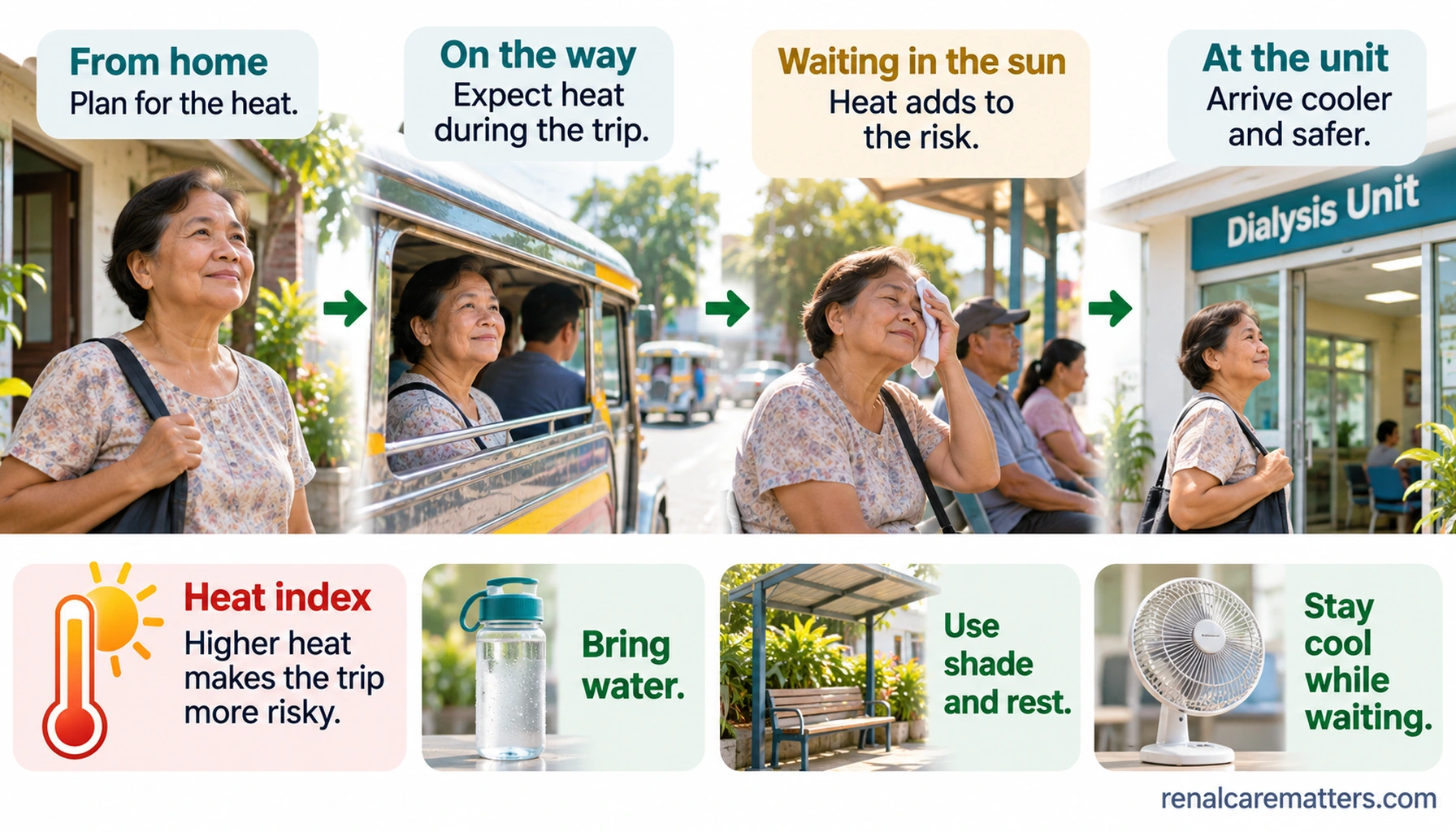
On hot days, the danger is often on the way to the unit: a jeepney ride, a walk in the sun, a long wait outside. Many dialysis patients are older, have heart disease, and cannot simply “drink more water.”
Figure 2. On heat-index days, the trip to the unit is part of the risk: shade, rest and timing matter.
From home and on the way: travel in the cooler part of the day where the schedule allows; shade, a hat or umbrella, a light towel.
Waiting: a cool, shaded waiting area inside, with seats; nobody waits in the sun outside the unit.
Fluid: the patient’s fluid limit does not change on its own. Ice chips or sips from the measured cup help; any change to the fluid goal or prescription is the attending nephrologist’s decision.
Watch for heat illness: dizziness, confusion, cramps or hot dry skin on arrival are reported to the physician-on-duty before connection.
Heat is not a minor hazard for this group. In a 2026 scoping review, extreme heat events were associated with 9% to 45% higher mortality among patients on kidney replacement therapy, across the studies that measured it.1 PAGASA publishes daily heat index forecasts with danger levels; the unit checks them in the hot dry season and reminds patients on the riskiest days.
Lesson · part 2
Volcanic ashfall
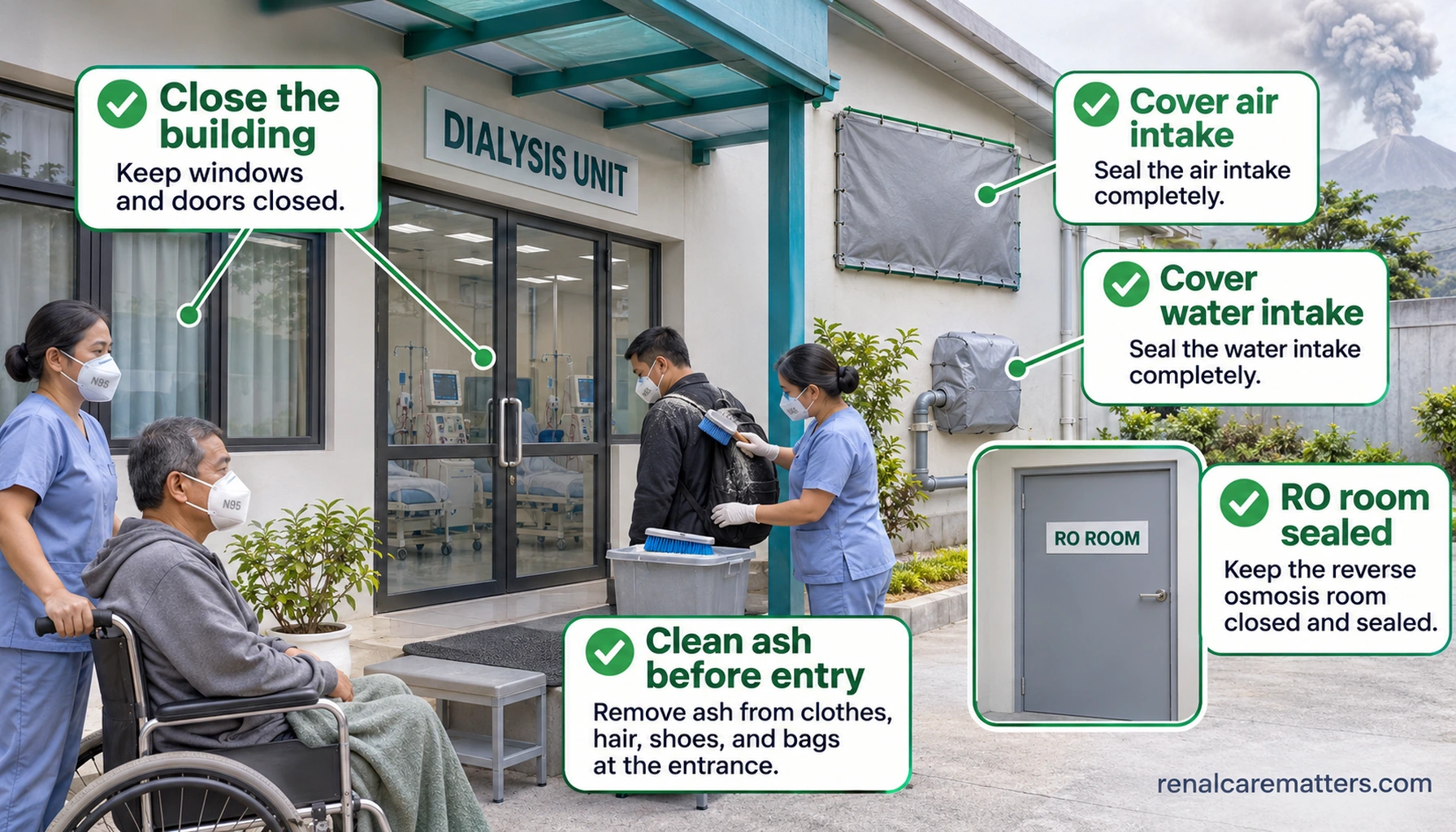
Ash is abrasive, conducts electricity when wet, clogs filters, and irritates eyes and lungs. It reaches a dialysis unit through the air, the water, the roads and people’s clothes.
Figure 3. Ashfall: close the building, protect air and water intakes, mask people, clean ash before entry.
Close the building: keep windows and doors closed; cover outside air intakes as the building engineer advises.
Protect the water: cover storage tanks and water intakes; the water treatment technician checks pre-filters and sediment filters more often, watches for falling pressure, and tests before treatments continue if ash may have entered the water.
Seal the reverse osmosis (RO) room: keep it closed; ash on equipment is removed as the manufacturer advises, not with water on live electrical parts.
Clean ash before entry: a place at the entrance to remove ash from clothes, hair, shoes and bags.
Masks: staff and patients outdoors wear well-fitting masks (N95 where available), especially those with lung disease.
Transport: ash makes roads slippery and reduces visibility; staff travel only when safe, and the plan’s staff call-down applies (Module 3).
PHIVOLCS raises and lowers the volcano alert level and advises on danger zones; the local disaster risk reduction and management office (LDRRMO) orders evacuations. A unit inside or near a danger zone uses those orders as triggers in its plan.
Lesson · part 3
An infectious outbreak as a disaster
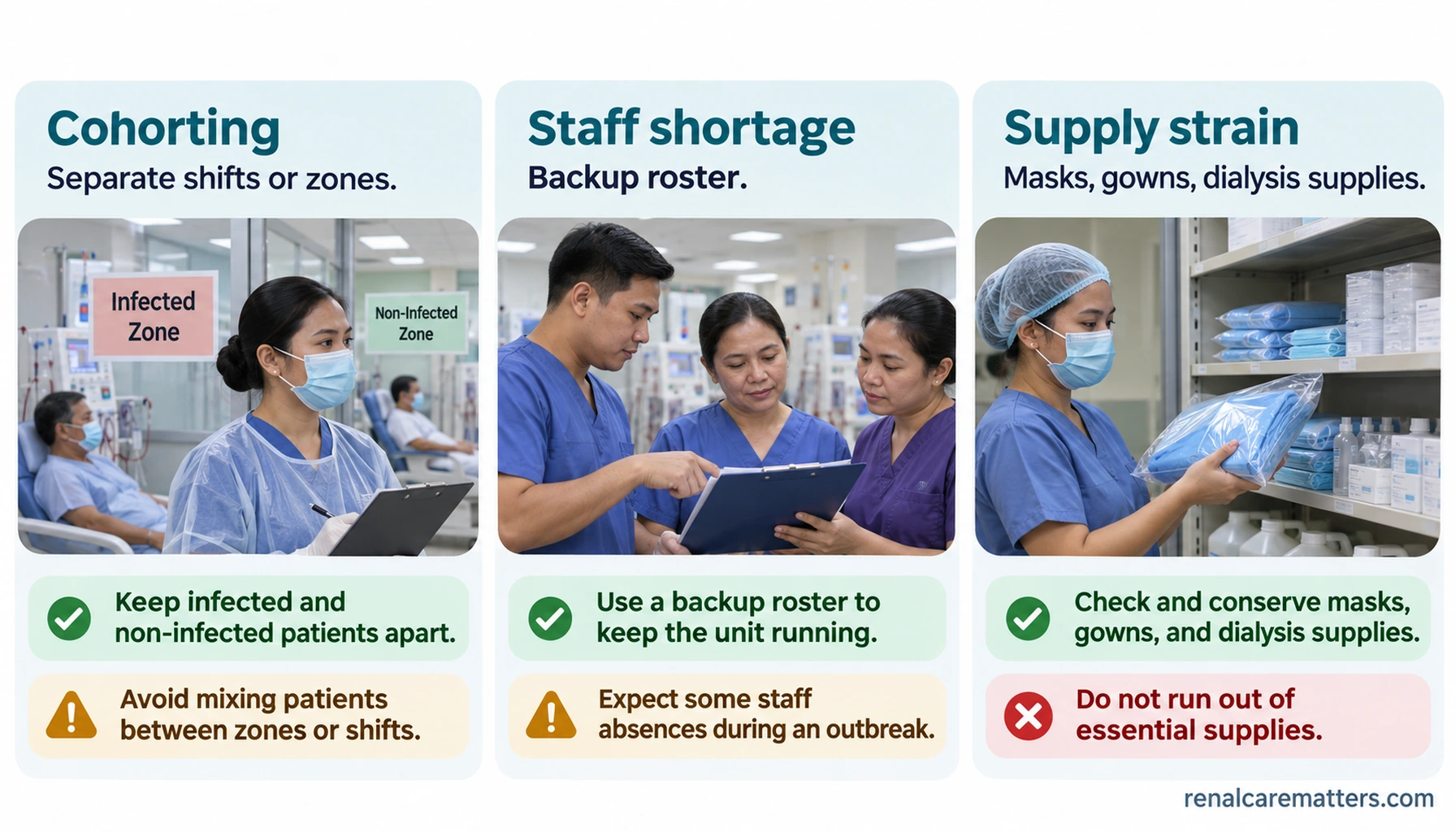
An outbreak does not knock down the building, but it can stop a unit as surely as a flood: staff fall ill or must isolate, supplies of masks and gowns run short, and patients who cannot be dialyzed elsewhere must be treated without spreading infection. Reviews of disasters and kidney care stress the same answer for every kind of event: preparation and training before it, and a plan applied during and after it.2
Figure 4. An outbreak is a slow disaster: cohort patients, protect the roster, and watch supplies.
Cohorting: separate infected and non-infected patients by shift or zone, with dedicated staff where possible, as the infection control protocol and the Department of Health’s guidance direct.
Staff shortage: a backup roster; minimum staffing for a safe shift; staff who are ill stay home.
Supply strain: count and conserve personal protective equipment (PPE) and dialysis supplies; order early; do not run out of essentials.
Outbreak rules change with each infection, so this module gives the frame and leaves the details to the unit’s infection control nurse and the Department of Health’s current guidance.
Stop and callA patient arriving with signs of heat illness, breathing difficulty after ash exposure, or fever during an outbreak: tell the physician-on-duty before connection. Follow your unit protocol, and always ask the attending nephrologist for guidance on any change to treatment.
On the floor
Real situations: problems and solutions
These are fictional but typical. For each one, cover the answer, decide what you would do, then compare. Where a step depends on local rules, your unit’s procedure and your supervisor’s direction come first.
The queue in the sun
What you see
On an April afternoon, six patients wait outside the unit door in full sun for the second shift.
What is likely going on
The waiting area is full or closed.
What to do
Bring them into a shaded indoor area and stagger arrival times.
Why it matters
Heat illness often starts before the patient reaches the chair.
Ash in the pre-filter
What you see
During ashfall, the pre-filter pressure drop rises quickly.
What is likely going on
Ash is entering the water system.
What to do
Stop new starts, tell the water technician, and follow the water failure steps until released.
Why it matters
Ash in the water affects every patient on the loop.
Half the staff out
What you see
During an outbreak, four of nine staff are ill on the same day.
What is likely going on
The backup roster has not been used.
What to do
Call the backup roster, set minimum staffing, and ask the attending nephrologist about the priority roster if the shift still cannot run.
Why it matters
An outbreak is a staffing disaster.
Field notes
Keep a stock of masks for patients during ashfall season.
Check the heat index forecast during the hot dry season.
Case review
Back to the case: Ash on the windshield
Close, cover, clean. Close the waiting-area windows and doors; set up an ash-cleaning point at the entrance; cover outside air intakes as the engineer advises; check that the rooftop tank cover is secure.
The water. The technician checks the tank, the pre-filters and the pressures, and tests before treatments continue if ash may have entered the water. If the water is in doubt, Module 8’s water failure steps apply: no new starts until the water is released.
The coughing patient. The physician-on-duty examines him before connection (breathing, oxygen saturation) and calls the attending nephrologist if he is unwell. He wears a mask, and the decision to dialyze as usual or send him to the hospital is clinical. The two staff with unsafe roads do not travel; the call-down and minimum staffing decide the shift.
Interactive case · fictional
Interactive case: Ash on the windshield
Work through a shift one decision at a time. The panel at the top changes with what you choose. After each choice you see why it is, or is not, the best move; after a weaker one you can try again or carry on and see where it leads. Your first choice at each step is scored. The score stays on this device and nothing is sent anywhere. In real practice, your unit’s protocol and the people responsible for each decision come first.
In a tabletop (the ashfall or outbreak scenario on the practice page) or on a real hot-season day. Your preceptor rates each step as satisfactory, needs practice, or not observed. Steps marked Critical must all be satisfactory before sign-off. This checklist supports supervised learning; your unit’s own procedure and competency form are the authority. A printable version of every checklist is on the trainer page.
Names the agency that warns for heat, ashfall and outbreaks.
CriticalKeeps waiting patients out of the sun and does not change fluid limits without the nephrologist.
Lists the ashfall steps: close, cover intakes, protect water, seal the RO room, clean ash at entry, masks.
CriticalAsks the water technician to check and test before continuing treatments when ash may have entered the water.
Describes cohorting, a backup roster and supply counts for an outbreak.
Placement activity. Find your unit’s air and water intakes with the building engineer and agree how each is covered during ashfall.
Self-assessment
Check your understanding
Each visit draws 5 questions at random from this module’s 10-question bank. Choose the single best answer for each, then select Check answers; an explanation appears under the best answer. Select New set of questions for a different mix. A good target is 4 of 5 on two different sets. Nothing you select is sent anywhere; scoring happens in your browser.
Glossary & abbreviationsTalahulugan at mga daglatTalaan sa mga pulong ug daglatTalatinigan ampo reng daglatterms used on this page
Abbreviations
DOH
Department of Health — Philippines.
LDRRMO
Local disaster risk reduction and management office — The city or municipal office for warnings, evacuation and local response.
PAGASA
Philippine Atmospheric, Geophysical and Astronomical Services Administration — The national weather agency; it raises the tropical cyclone wind signals.
PhilHealth
Philippine Health Insurance Corporation.
PHIVOLCS
Philippine Institute of Volcanology and Seismology — The agency that reports earthquakes, volcanic activity and tsunami warnings.
PPE
Personal protective equipment.
RO
Reverse osmosis.
Terms in plain words
Heat index
How hot it feels when humidity is added to the air temperature.
Ashfall
Fine volcanic rock and glass that falls after an eruption.
Volcano alert level
PHIVOLCS’s scale for a volcano’s activity.
Cohorting
Grouping patients with the same infection status by shift, zone or staff.
Backup roster
Staff who can be called in when others are absent.
Intake
The opening through which the building draws air or the system draws water.
Sandal, S., Clarke, A., Le, A., Paparella, A. N., Berry, W. A. D., & Vanholder, R. (2026). Disasters and hazard exposure in end-stage kidney disease: A scoping review of patient outcomes. Clinical Kidney Journal, 19(10), sfag318. https://doi.org/10.1093/ckj/sfag318
Sever, M. S., Vanholder, R., & Lameire, N. (2024). Disaster preparedness for people with kidney disease and kidney healthcare providers. Current Opinion in Nephrology and Hypertension, 33(6), 613–620. https://doi.org/10.1097/MNH.0000000000001014
Educational course and drill resource for dialysis units. It is not a hospital disaster plan, a licensing requirement, or a substitute for your unit’s approved protocol, the machine manufacturer’s instructions, or instructions from PAGASA, PHIVOLCS, the Bureau of Fire Protection or your local disaster office. Clinical decisions in a disaster (early dialysis, shortened sessions, priority, diet) belong to the attending nephrologist.