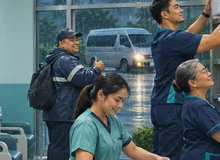
Protect in place, the checks after the shaking, when to take patients off, the emergency take-off, and joining the quarterly earthquake drill.
PublishedNailathalaGipatikPepalwal:ReferencesMga SanggunianMga TinubdanReng Reperensya:2Audience: Every member of the dialysis unit: hemodialysis, charge, head and safety nurses, physicians-on-duty, the Dialysis Clinical Head and attending nephrologists, dialysis, water treatment, biomedical and reprocessing technicians, nurse assistants and support staff, social workers, records officers, dietitians, unit managers and ownersRead timeOras ng pagbasaOras sa pagbasaOras ning pamamasa:
This module is study material for dialysis teams. It explains the reasoning behind disaster decisions; it is not a unit protocol or an order set. Early dialysis, shortened sessions, priority rosters and emergency diets are decisions of the attending nephrologist and the Dialysis Clinical Head. Escalation follows your unit protocol, and you always ask the attending nephrologist for guidance. Every case, name, and identifier is fictional.
Learning objectives
After this module you should be able to
Protect patients in place during shaking: patients stay connected and covered; staff duck, cover and hold without leaving a patient.
Check every patient, line, needle and machine after the shaking, in a set order.
Decide when patients stay and when they come off, and perform the emergency take-off with the blood rule.
Explain why the building is checked before anyone stays, and how aftershocks change the plan.
Secure equipment before an earthquake, and join the quarterly Nationwide Simultaneous Earthquake Drill.
Classroom 1 hSkills lab 1 hSupervised placement 0 h
Pre-testBefore you read, answer the 5 self-assessment questions and note your score. After the module, select New set of questions and compare. The difference is what you learned; the questions you still miss are what to reread.
Start here
The big picture, in plain words
In plain wordsWhen the ground shakes, a connected patient is like a passenger strapped into a seat on a bumpy flight. Unbuckling and walking the aisle is far more dangerous than staying put and holding on. The crew does not open the doors mid-air; they wait until it is safe, then help everyone off in order.
The picture has a limit. A seatbelt keeps a passenger safe; a dialysis circuit does not. Shaking can pull a needle, kink or separate a line, tip a machine or a pole, and send equipment sliding. That is why staff stay close during the shaking, and why the checks afterward start with the needles and lines.
The national advice is “duck, cover and hold,” practiced each quarter in the Nationwide Simultaneous Earthquake Drill (NSED).1 For a person who cannot drop to the floor, such as a patient in a recliner, the advice is to stay put, cover the head and neck with the arms or a pillow, and hold on until the shaking stops.2 Philippine Institute of Volcanology and Seismology (PHIVOLCS) reports the magnitude and location after the event.
Figure 1 · Key terms for this module
Protect in placeStaying where you are during shaking and protecting the head, neck and access, instead of moving.
Duck, cover and holdThe Philippine earthquake drill action: get low, cover the head, hold on until the shaking stops.
Emergency take-offEnding treatments quickly, by staff, because the unit must be evacuated or cannot continue.
Blood ruleThe one rule for returning circuit blood in any emergency, shared with the Resuscitation Lab.
AftershockA smaller earthquake after the main one, which can come minutes to days later.
Structural checkAn inspection of the building by a qualified engineer or building official.
Opening case · fictional
Case: Magnitude 6.8 at 9:40 a.m.
At 9:40 a.m. a strong earthquake shakes a second-floor unit in Lipa, Batangas, for about 40 seconds. Sixteen patients are connected. Five staff are on the floor: the charge nurse, three nurses and a technician. Ceiling panels fall near Station 4; a saline pole tips over at Station 9; the lights flicker but stay on.
When the shaking stops, a patient at Station 12 is pulling at his lines and shouting, “Take me off, I want to go down!” Another nurse says, “Let us disconnect everyone and go down to the street.” PHIVOLCS later reports a magnitude 6.8 event.
Before reading on, decide:
What should staff and patients have done during the 40 seconds of shaking?
In what order do you check after the shaking?
Who decides whether the unit evacuates, and what has to be true before patients stay?
Keep your answers in mind. The lesson gives you what you need, and the case review near the end shows one sound response.
Lesson · part 1
Protect in place
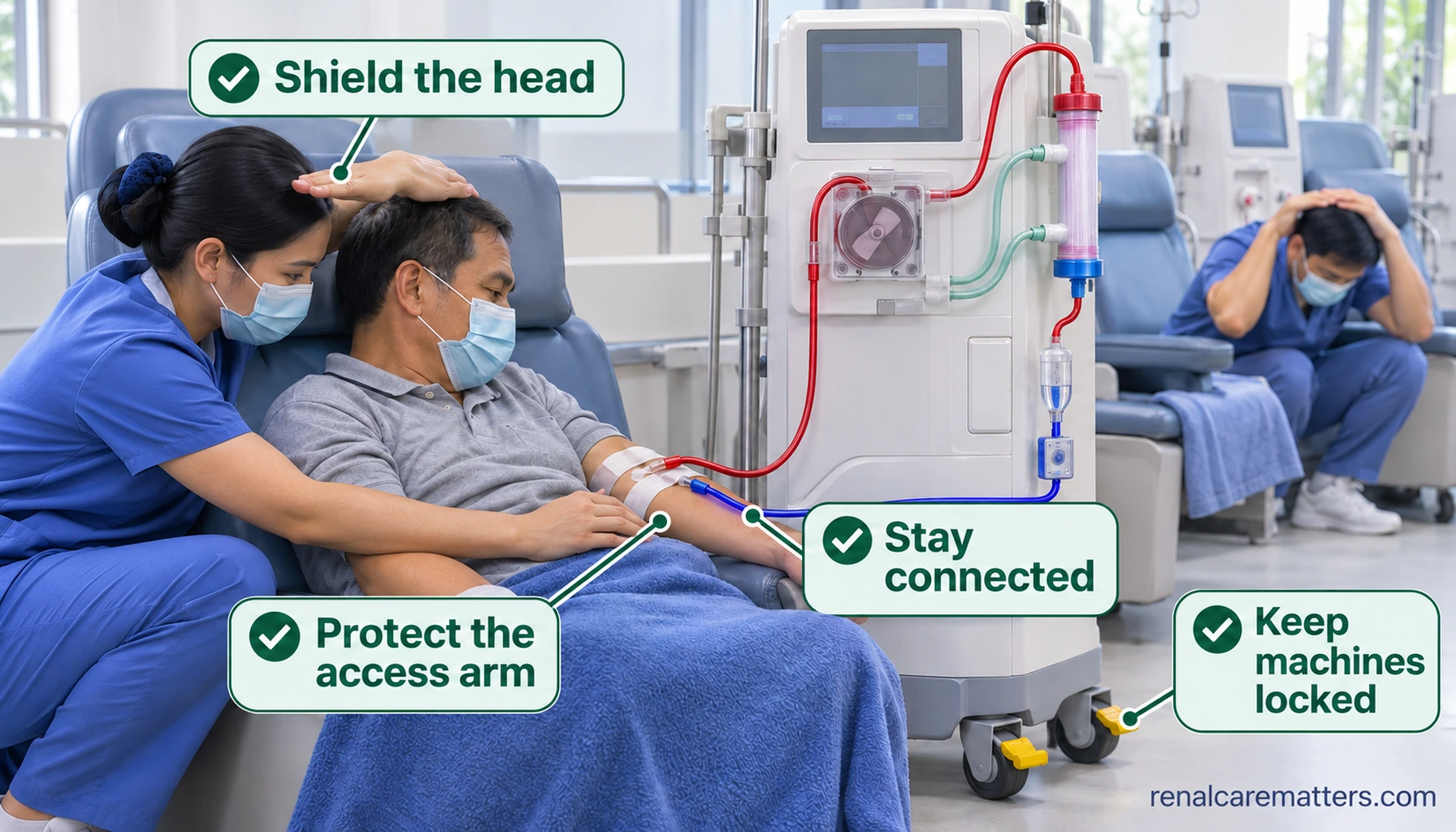
Patients stay connected. Disconnecting during shaking is more dangerous than staying: hands are unsteady, the patient may fall, and an open line or catheter can bleed or draw in air. The patient stays seated, covers the head and neck with the free arm or a pillow, and keeps the access arm still.
Figure 2. During the shaking: protect in place. Patients stay connected; staff shield heads and access arms; machines stay locked.
Staff duck, cover and hold, without leaving a patient. A nurse within reach of a patient crouches beside the recliner, shields the patient’s head and steadies the access arm if it is safe to do so, and holds on. Staff do not run across the floor during shaking, and nobody runs for the stairs.
Shaking usually lasts seconds to about a minute. Count, stay low, and wait until it stops.
RememberDuring shaking: patients stay connected and covered; staff stay low beside the patients; nobody disconnects and nobody runs.
Lesson · part 2
The checks after the shaking
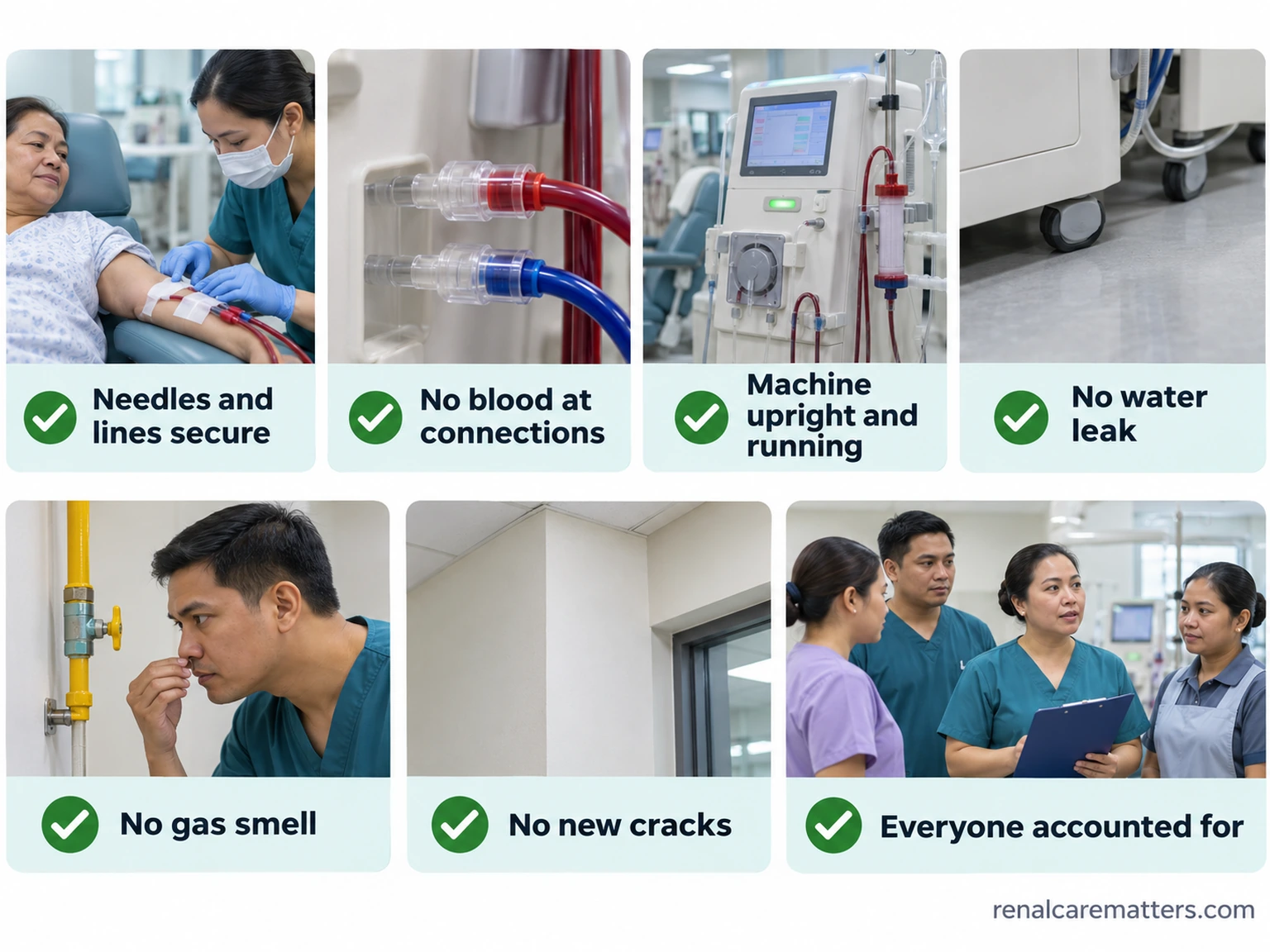
When the shaking stops, the charge nurse calls for the checks in a set order. The patients come first, the building second.
Figure 3. After the shaking: check people, lines, machines and the building before deciding what comes next.
Every patient: conscious, breathing, not injured; needles and lines secure; no blood at the connections. A dislodged needle is pressed and clamped at once (the same first aid as any needle dislodgement).
Every machine: upright, running, no alarm that stops treatment; no water leak.
The room: no gas smell, no fire, no new cracks in walls or columns, exits clear.
Everyone accounted for: patients, staff, companions and visitors.
The technician checks the water room and the power; the physician-on-duty examines any patient who was hurt or became unwell. Expect aftershocks: repeat the protect-in-place step with each one.
Lesson · part 3
Stay, end the session, or take everyone off
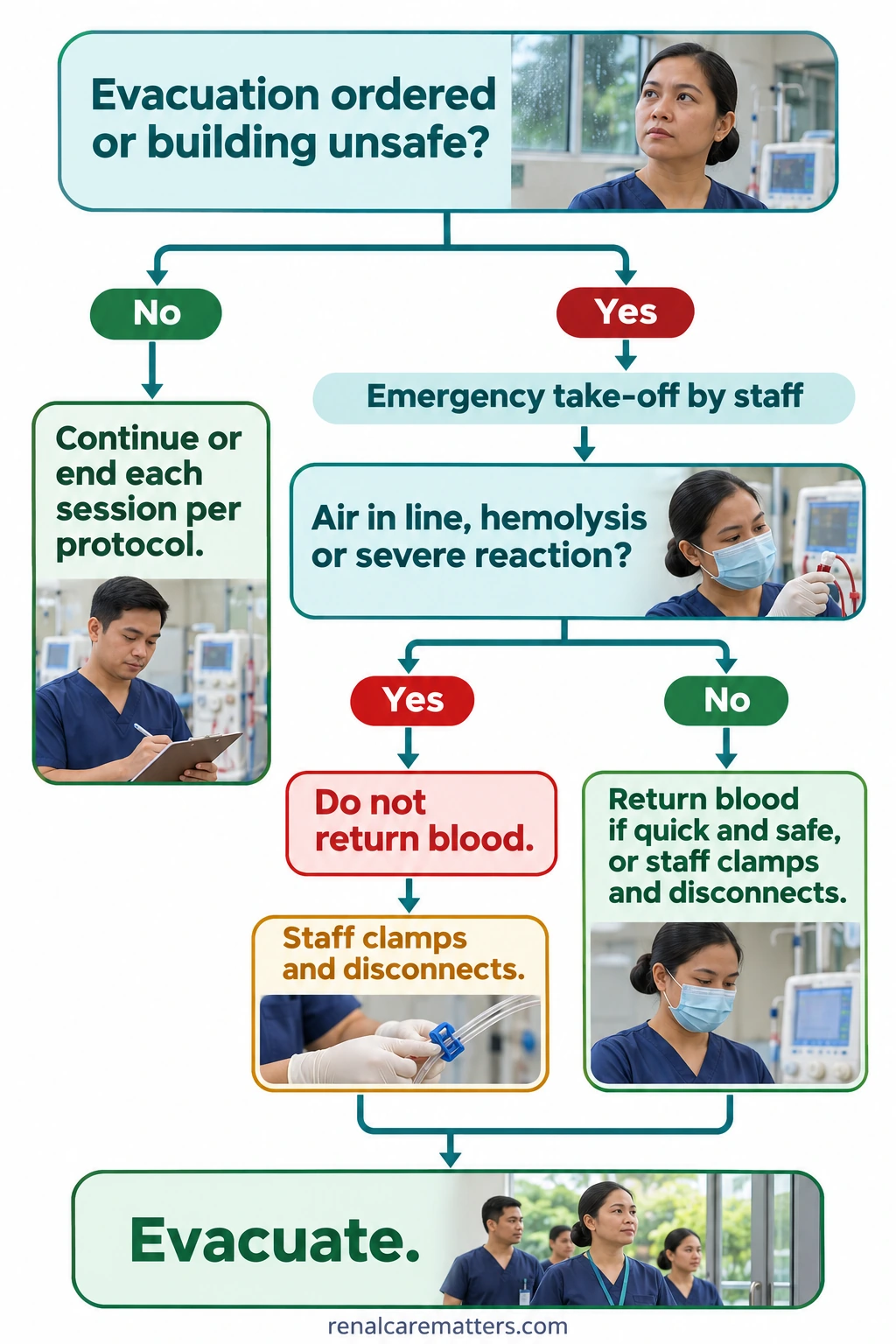
Most strong earthquakes do not end the shift. The decision has one main question: has evacuation been ordered, or is the building unsafe?
Figure 4. Take off or stay. Never return blood that may hold air, is hemolyzed or follows a severe reaction.
No: continue or end each session per protocol, patient by patient, as the physician and charge nurse decide. Patients who are frightened, hurt or unwell may end early.
Yes: emergency take-off by staff, then evacuate (Module 7).
The blood rule (the same rule as the Resuscitation Lab). Blood that may contain air, is hemolyzed, or follows a severe reaction is never returned. Otherwise, return the blood if it is quick and safe, or clamp and disconnect. A central venous catheter’s own clamps are closed before its lines are separated. This is the circuit decision taught in Resuscitation Lab, Module 7; the two modules give one rule.
Who decides about the building. Visible damage (cracks in columns or beams, a leaning structure, a gas smell, fire) means evacuate; the incident lead decides with the building or facilities officer. Before the unit treats patients again after a strong quake, a qualified engineer or building official checks the structure; for a hospital-based unit, the hospital’s plan decides. The unit does not stay in a damaged building to finish a schedule.
Stop and callEvacuation ordered, visible structural damage, gas smell or fire: emergency take-off by staff with the blood rule, then evacuate (Module 7). Follow your unit protocol, and always ask the attending nephrologist for guidance on ending or resuming treatment.
Lesson · part 4
Securing the unit, and the quarterly drill
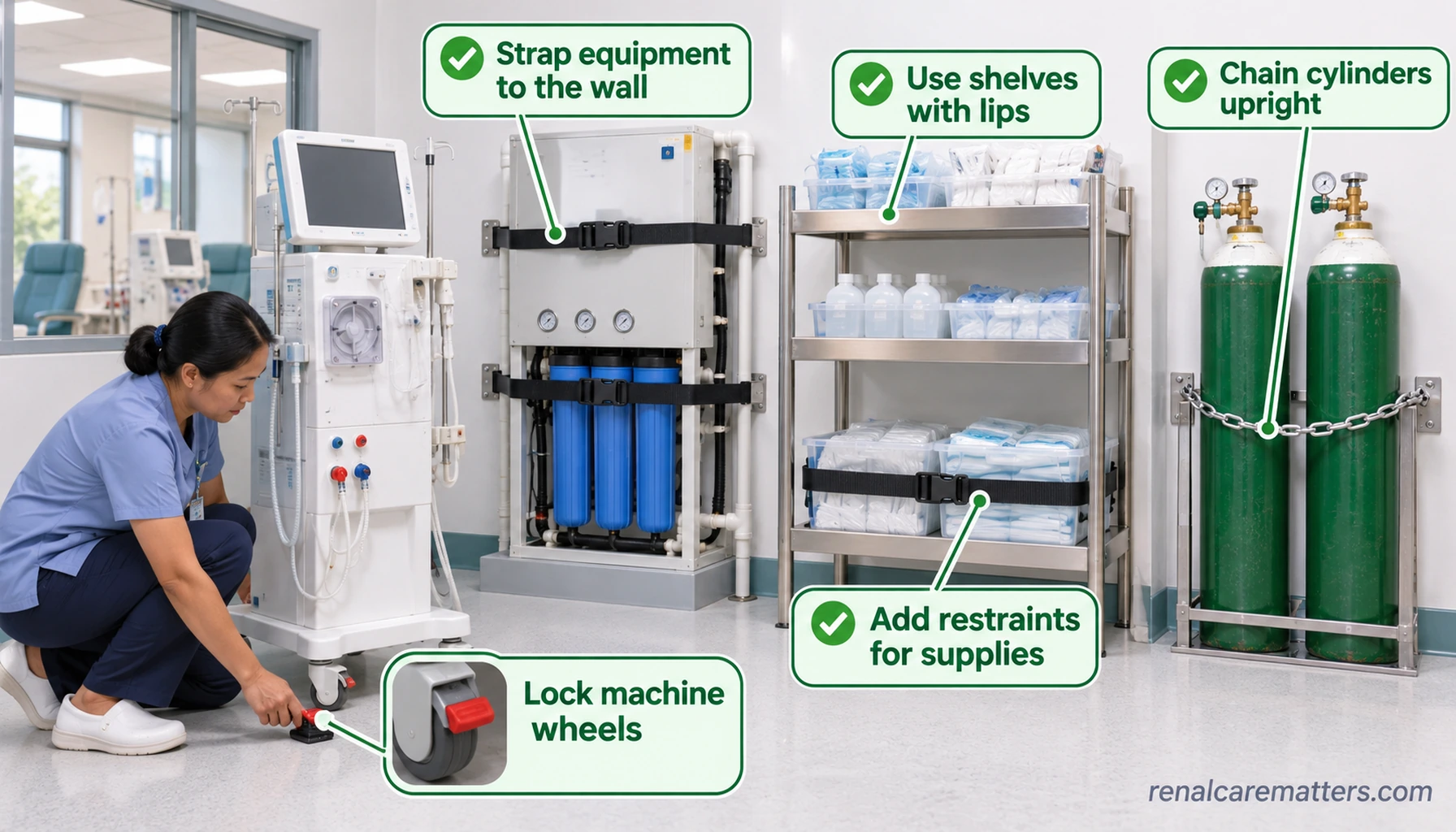
Most earthquake injuries indoors come from falling and sliding objects. Secure them before the next quake.
Figure 5. Secure equipment before the earthquake: locks, straps, shelf lips and chained cylinders.
Lock machine and recliner wheels during treatment.
Strap tall equipment and water treatment components to the wall, as the manufacturer and the engineer advise.
Use shelves with lips or restraints for supplies; keep heavy items low.
Chain oxygen cylinders upright.
Join the NSED. The Office of Civil Defense holds the Nationwide Simultaneous Earthquake Drill each quarter (in 2026, on March 12, June 18, September 10 and November 5).1 A dialysis unit can join it with the whole shift. Patients take part only in the protect-in-place step, and only if they agree; nobody is disconnected or moved for a drill, and a named watcher stays with the patients.
🧒
Units that dialyze children
A small child may not stay still. The caregiver or nurse holds and shields the child in the bed or chair, keeping the access steady. A child’s circuit holds a larger share of the blood volume, so the blood rule and the pediatric nephrologist’s instructions matter even more in a take-off.
On the floor
Real situations: problems and solutions
These are fictional but typical. For each one, cover the answer, decide what you would do, then compare. Where a step depends on local rules, your unit’s procedure and your supervisor’s direction come first.
The patient who pulls his lines
What you see
After shaking, a frightened patient starts tugging at his needles to leave.
What is likely going on
Fear, and no one has told him what happens next.
What to do
Hold his access arm, check the needles, and tell him staff will take him off if the unit leaves.
Why it matters
Calm, specific words stop the most dangerous self-disconnection.
Everyone off, at once
What you see
A nurse begins disconnecting every patient without checking whether evacuation was ordered.
What is likely going on
Panic, not a decision.
What to do
Stop, call the incident lead, and ask the stay-or-go question; take off only on that decision, with the blood rule.
Why it matters
A rushed take-off of 16 patients causes more harm than the quake.
The aftershock
What you see
Ten minutes after the main quake, while checks are underway, an aftershock hits.
What is likely going on
Aftershocks are expected.
What to do
Repeat protect in place; resume checks afterward.
Why it matters
The same rule applies to every shaking.
Field notes
Lock wheels at every connection, every shift.
Join the next NSED; note how long the checks take.
Case review
Back to the case: Magnitude 6.8 at 9:40 a.m.
During the shaking. Patients stay connected, covering head and neck and keeping the access arm still. The five staff stay low beside patients, shielding heads and access arms where they can; nobody crosses the floor or disconnects anyone.
After. The charge nurse calls the checks: every patient and every access first (Station 12’s lines, the patients near the fallen panels at Station 4 and the pole at Station 9), then the machines, the room (gas, fire, cracks, exits), then a count of everyone. The technician checks water and power. The man at Station 12 is calmed by a nurse who checks his needles and explains that staff will take him off if the unit leaves.
Stay or go. The incident lead decides with the building or facilities officer. Visible structural damage means emergency take-off with the blood rule and evacuation down the stairs, never the elevator. Without damage, sessions continue or end per protocol, patient by patient, with protect-in-place repeated in aftershocks, and the building is checked before the next shift.
Interactive case · fictional
Interactive case: Magnitude 6.8 at 9:40 a.m.
Work through a shift one decision at a time. The panel at the top changes with what you choose. After each choice you see why it is, or is not, the best move; after a weaker one you can try again or carry on and see where it leads. Your first choice at each step is scored. The score stays on this device and nothing is sent anywhere. In real practice, your unit’s protocol and the people responsible for each decision come first.
🚨 Emergency quick card:Earthquake on the machine. One screen each, saved for use with no signal. Print a copy for the crash cart.
Skills lab · with your preceptor
Skills checklist: Protect in place and the emergency take-off
At an empty station with a manikin in a recliner connected to a training circuit, during a facilitated earthquake drill. Your preceptor rates each step as satisfactory, needs practice, or not observed. Steps marked Critical must all be satisfactory before sign-off. This checklist supports supervised learning; your unit’s own procedure and competency form are the authority. A printable version of every checklist is on the trainer page.
CriticalDuring the simulated shaking, stays low beside the patient, shields the head and steadies the access arm.
CriticalDoes not disconnect during shaking.
After the shaking, checks the patient, needles and lines, then the machine, then the room, in order.
States the stay-or-go question and who decides it.
CriticalPerforms the emergency take-off with the blood rule: never returns blood after air, hemolysis or a severe reaction.
CriticalCloses a central catheter’s own clamps before separating the lines.
Confirms everyone is accounted for before leaving the floor.
Placement activity. Join the next quarterly NSED with your shift, with a named watcher for the patients.
Self-assessment
Check your understanding
Each visit draws 5 questions at random from this module’s 10-question bank. Choose the single best answer for each, then select Check answers; an explanation appears under the best answer. Select New set of questions for a different mix. A good target is 4 of 5 on two different sets. Nothing you select is sent anywhere; scoring happens in your browser.
Glossary & abbreviationsTalahulugan at mga daglatTalaan sa mga pulong ug daglatTalatinigan ampo reng daglatterms used on this page
Abbreviations
NSED
Nationwide Simultaneous Earthquake Drill — The quarterly national earthquake drill led by the Office of Civil Defense.
PAGASA
Philippine Atmospheric, Geophysical and Astronomical Services Administration — The national weather agency; it raises the tropical cyclone wind signals.
PHIVOLCS
Philippine Institute of Volcanology and Seismology — The agency that reports earthquakes, volcanic activity and tsunami warnings.
Terms in plain words
Protect in place
Staying where you are during shaking and protecting the head, neck and access.
Duck, cover and hold
Get low, cover the head, hold on until the shaking stops.
Emergency take-off
Ending treatments quickly, by staff, because the unit must be evacuated.
Blood rule
Never return blood after air, hemolysis or a severe reaction; otherwise return if quick and safe, or clamp and disconnect.
Office of Civil Defense & National Disaster Risk Reduction and Management Council. (2026). Nationwide Simultaneous Earthquake Drill [Quarterly national campaign; 2026 drills held March 12, June 18, September 10 and November 5]. Republic of the Philippines.
Educational course and drill resource for dialysis units. It is not a hospital disaster plan, a licensing requirement, or a substitute for your unit’s approved protocol, the machine manufacturer’s instructions, or instructions from PAGASA, PHIVOLCS, the Bureau of Fire Protection or your local disaster office. Clinical decisions in a disaster (early dialysis, shortened sessions, priority, diet) belong to the attending nephrologist.