A hazard assessment for a dialysis unit, the dependency map (power, water, staff, supplies, transport, records, communications), and the single points of failure.
PublishedNailathalaGipatikPepalwal:ReferencesMga SanggunianMga TinubdanReng Reperensya:1Audience: Every member of the dialysis unit: hemodialysis, charge, head and safety nurses, physicians-on-duty, the Dialysis Clinical Head and attending nephrologists, dialysis, water treatment, biomedical and reprocessing technicians, nurse assistants and support staff, social workers, records officers, dietitians, unit managers and ownersRead timeOras ng pagbasaOras sa pagbasaOras ning pamamasa:
This module is study material for dialysis teams. It explains the reasoning behind disaster decisions; it is not a unit protocol or an order set. Early dialysis, shortened sessions, priority rosters and emergency diets are decisions of the attending nephrologist and the Dialysis Clinical Head. Escalation follows your unit protocol, and you always ask the attending nephrologist for guidance. Every case, name, and identifier is fictional.
Learning objectives
After this module you should be able to
Rate your unit’s hazards by likelihood and impact, and explain why the rating is a local judgment, not a national standard.
Draw your unit’s dependency map: power, water, staff, supplies, transport, records and communications.
Find the dependencies that fail together and the single points of failure, and propose a fix for each.
Explain who owns the dependency map and when it is reviewed.
Classroom 1 hSkills lab 0.5 hSupervised placement 0 h
Pre-testBefore you read, answer the 5 self-assessment questions and note your score. After the module, select New set of questions and compare. The difference is what you learned; the questions you still miss are what to reread.
Start here
The big picture, in plain words
In plain wordsA dialysis unit is like a jeepney that needs fuel, a road, a driver and a working engine all at once. Lose any one and the trip stops. A hazard is whatever takes one of them away: a typhoon floods the road, a brownout empties the fuel, a fever outbreak keeps the drivers home.
The picture has a limit: a jeepney has four needs, a dialysis unit has at least seven, and they are wired together in ways nobody sees until something fails. The water booster pump needs power. The generator needs diesel, which needs a truck, which needs a road. Staff need transport and, in a long event, somewhere to sleep. This module is about drawing those wires before a disaster draws them for you.
The work is owned by the Dialysis Clinical Head and the unit manager, with the safety nurse (or head nurse) running it. The Dialysis Clinical Head, Module 7 teaches the map at leadership level; this module is how the whole team builds and checks it.
Figure 1 · Key terms for this module
HazardSomething that can cause harm: a typhoon, flood, earthquake, fire, outage or outbreak.
VulnerabilityHow easily your unit is harmed by a hazard, given where it is and how it is built and run.
DependencySomething the unit cannot treat patients without, such as power, treated water or staff.
Single point of failureOne part whose failure stops the whole service.
Fail togetherTwo dependencies that the same event takes away at the same time.
BufferStored capacity that buys time: fuel, water, supplies, spare staff.
Opening case · fictional
Case: The map that missed the pump
A 20-station unit in San Fernando, Pampanga, has a standby generator that starts within a minute and passes its monthly test. During a two-hour brownout in July, the generator starts on time, the machines keep running, and then, eleven minutes later, every machine alarms for low water pressure.
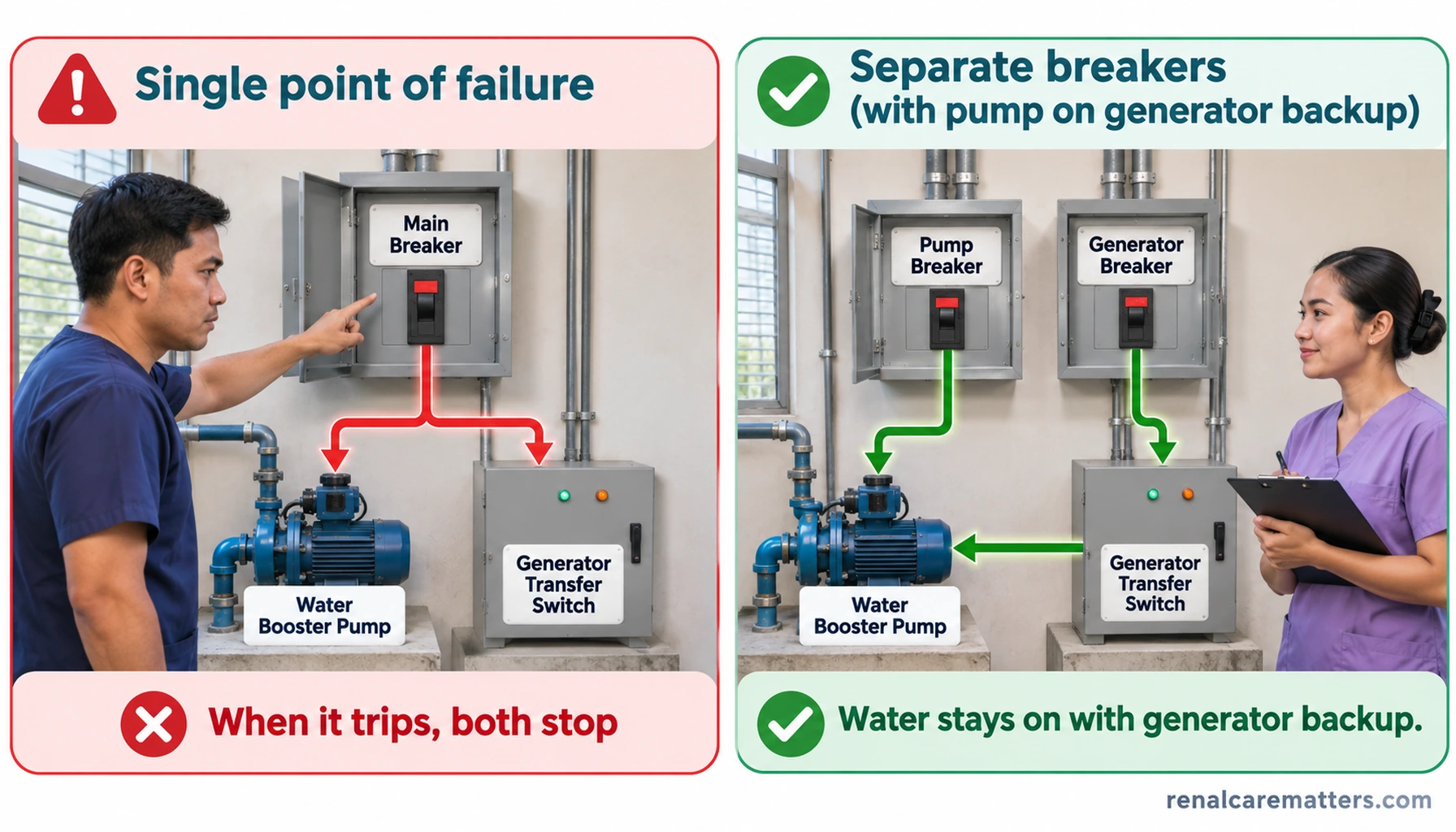
The water treatment technician finds the cause: the water booster pump that feeds the reverse osmosis system is on the same breaker as the main supply, not on the generator circuit. The generator ran the machines but not the water that the machines needed. The storage tank had carried the unit for eleven minutes.
Before reading on, decide:
Which two dependencies failed together, and why did nobody notice in the monthly generator test?
What should the generator test include from now on?
Who in your unit owns finding this kind of problem?
Keep your answers in mind. The lesson gives you what you need, and the case review near the end shows one sound response.
Lesson · part 1
Which hazards matter most for your unit?
A hazard and vulnerability assessment asks two questions about each hazard: how likely is it here, and how much would it hurt this unit if it happened? A unit beside a river in Marikina rates floods differently from a unit on the fourth floor of a hospital in Baguio.
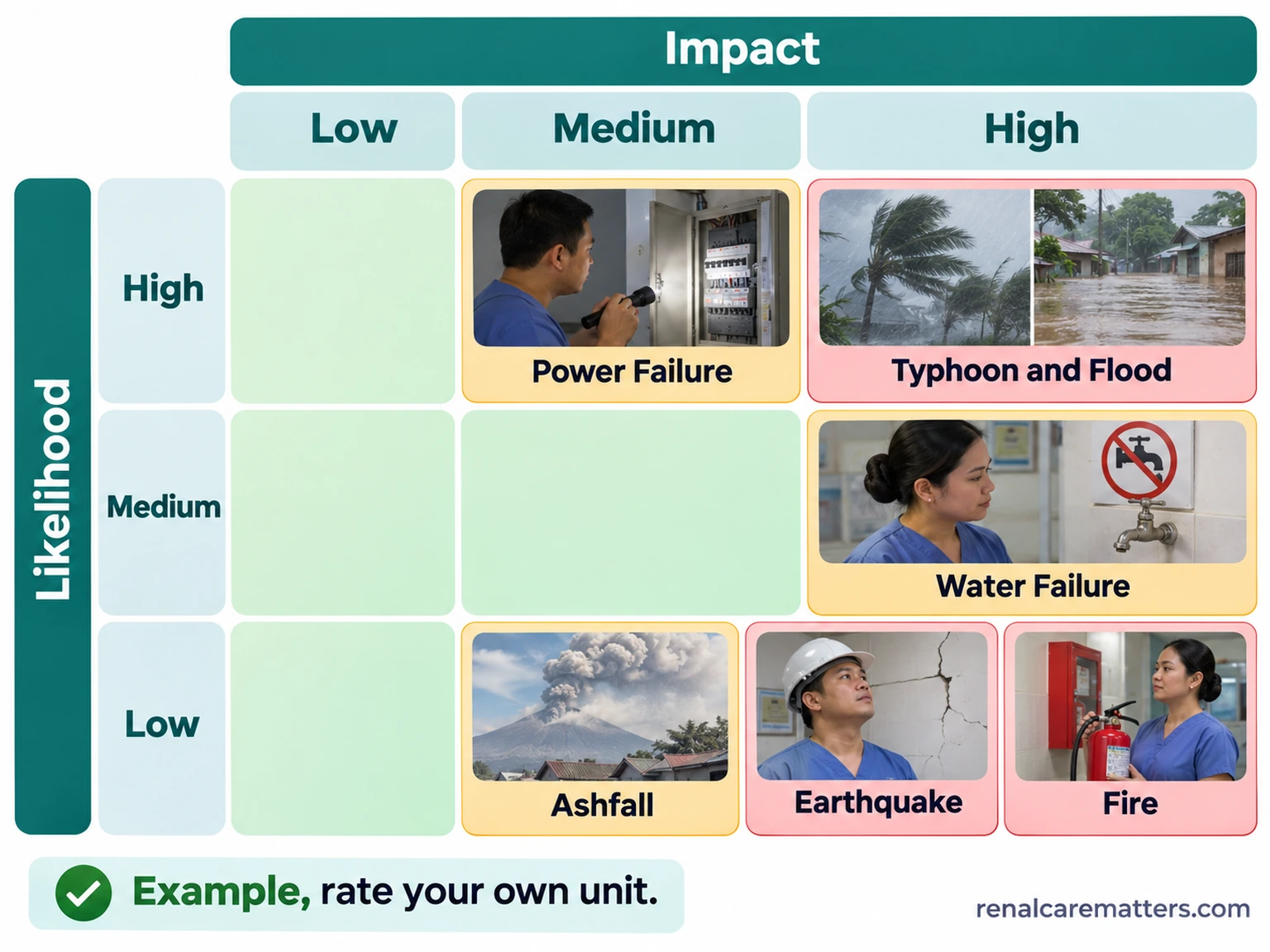
Figure 2. A simple hazard grid. Plan first for what is likely and severe; rate your own unit, not this example.
The matrix in the figure is an example, not a rating for your unit. Fill it in as a team once a year, before typhoon season, with what you know: past floods on your street, the age of the building, the reliability of your power line, the distance to the nearest unit that could take your patients. Two hazards in the top-right corner get a written action plan first.
The ratings are a local judgment. No Philippine regulation gives a dialysis-specific scoring method, and this course does not invent one. What matters is that the team agrees on the list and acts on the top of it.
RememberRate likelihood and impact for your own unit, once a year, as a team. Act first on what is both likely and damaging.
Lesson · part 2
Seven things your unit runs on
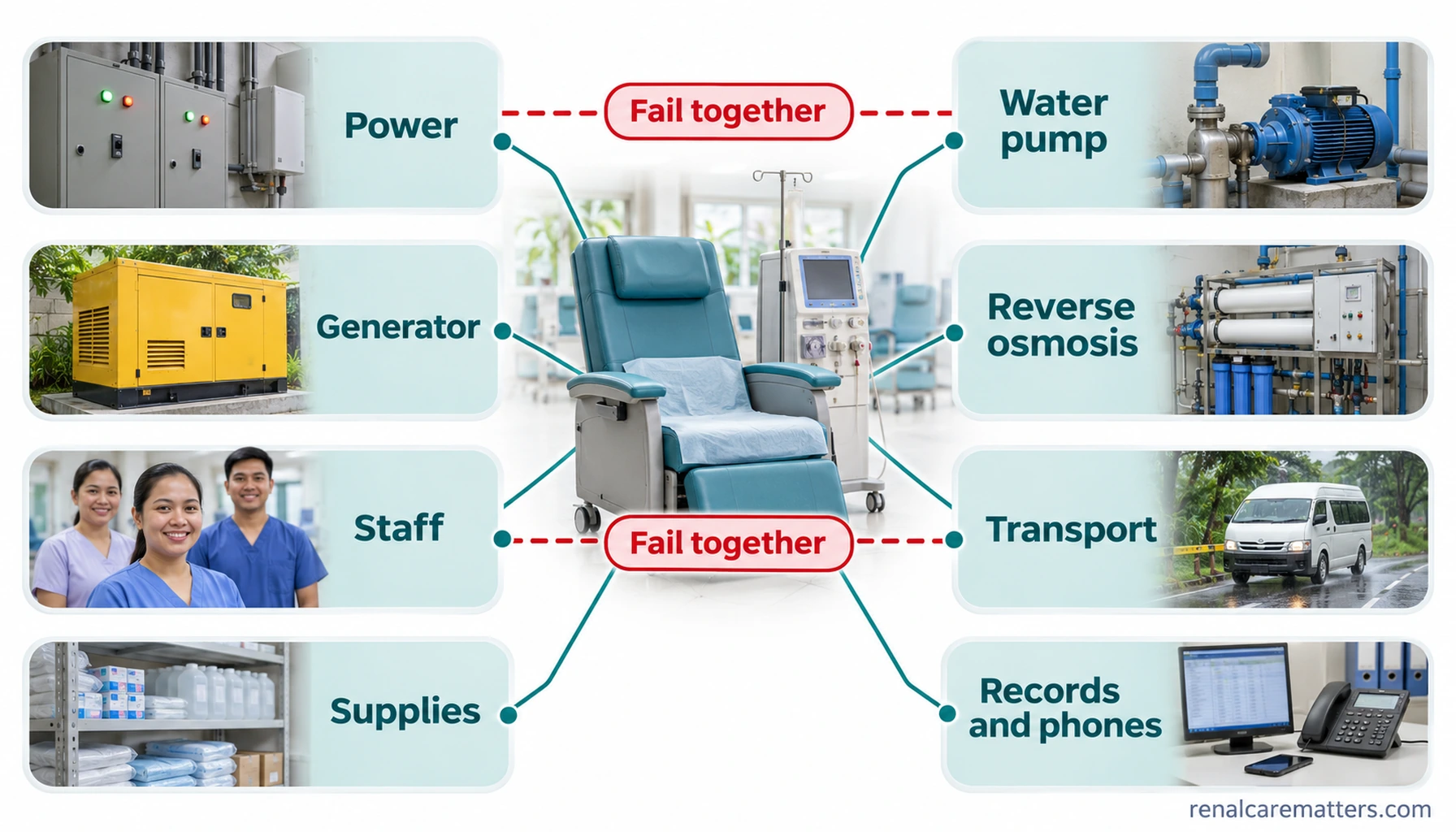
Every hazard reaches the patients through the same few dependencies. Draw them on one page with the chair in the middle.
Figure 3. Every chair depends on a web of services. Some fail together, so plan for both at once.
Dependency
What to write on the map
Ask
Power
Utility line, generator, transfer switch, uninterruptible power supply (UPS) outlets, fuel
How many days of treatment are on the shelf, and above the flood line?
Transport
How patients come (tricycle, jeepney, family car), the unit van, ambulance access
Which patients cannot reach the unit if public transport stops?
Records
Electronic records, paper downtime forms, the patient list, prescriptions
Can another unit get a patient’s prescription if your system is down?
Communications
Mobile networks, landline, messaging groups, two-way radio
How do you reach staff and patients when calls fail?
The map is a unit document. The patient list and staff addresses on it are personal data under the Data Privacy Act (Republic Act No. 10173): keep them with the unit’s records, share them only with the people who need them, and do not post them in open group chats.1
Lesson · part 3
Dependencies that fail together, and single points of failure
The most dangerous lines on the map are the ones that connect two dependencies, because one event then takes both away. Power and water fail together when the booster pump is on mains power only. Staff and transport fail together when the same flooded road blocks both. Records and communications fail together when the electronic system and the phone system share one internet line.
Figure 4. A single point of failure: one breaker that stops both water and backup power. Find them before a disaster does.
A single point of failure is one part whose loss stops the whole service: one booster pump, one transfer switch, one person who knows the generator, one copy of the patient list. Each needs a fix, and the fixes are usually simple: put the pump on the generator circuit, train a second person, print the list, store fuel and supplies above the flood line.
On the floor · Testing the whole chainAfter the Pampanga case, the unit changed its monthly generator test. The technician now runs it with the machines in rinse mode and the water system running for 30 minutes, and checks the water pressure at the loop, not just the generator’s voltage.
Illustrative scenario. Names and details are invented.
A dependency map is only as good as its last test. The biomedical and water treatment technicians check the power and water lines on the map against what is really wired (the Unit Manager, Module 12 turns the map into a business continuity plan, with an outage autonomy calculation). The water capacity calculator shows whether the water system can meet peak demand.
RememberLook for the lines between dependencies. Fix the single points of failure, and test the whole chain, not one machine.
Lesson · part 4
Who owns it and when it is checked
The unit manager owns the map and its fixes; the Dialysis Clinical Head approves the clinical parts (which patients are most at risk when transport fails); the safety nurse (or head nurse) runs the review; the technicians check the power and water lines; the social worker and records officer check the patient and contact lists. The unit owner receives the list of fixes that need money.
Review it once a year before typhoon season, after any building or equipment change, and after any real disruption. The annual hazard review is the first drill on the drill table (Module 12).
Stop and callA single point of failure that could stop treatment for every patient (water, power, the only generator) is reported to the unit manager and the Dialysis Clinical Head the day it is found, with an interim plan. Follow your unit protocol, and always ask the attending nephrologist for guidance on any change to treatment.
On the floor
Real situations: problems and solutions
These are fictional but typical. For each one, cover the answer, decide what you would do, then compare. Where a step depends on local rules, your unit’s procedure and your supervisor’s direction come first.
Supplies in the basement
What you see
The unit stores three weeks of dialyzers and concentrate in a ground-floor room that flooded two years ago.
What is likely going on
A buffer below the flood line is not a buffer.
What to do
Move the buffer above the past flood height and mark that height on the wall.
Why it matters
Supplies are a dependency only if they survive the event.
One phone list
What you see
The only up-to-date patient phone list is on the head nurse’s phone.
What is likely going on
A person and a phone are a single point of failure for the call-down.
What to do
Keep a printed copy in the unit’s grab bag and a protected copy with the records officer.
Why it matters
The call-down works only if someone can open the list.
The map on the wall
What you see
The dependency map was drawn three years ago, before a second RO unit was installed.
What is likely going on
The map no longer matches the wiring.
What to do
Review it with the technicians after every equipment change.
Why it matters
An old map gives false confidence.
Field notes
Ask the technicians to show you what runs on the generator, by walking the panel.
Write the past flood height on the storage room wall.
Case review
Back to the case: The map that missed the pump
What failed together. Power and water: the generator powered the machines, but the booster pump stayed on the utility line. The monthly test checked the generator alone, with no load on the water system, so the gap never showed.
What the test should include. A run under real load: machines in rinse or a planned test, the water system running, and the loop pressure checked for at least as long as the storage tank lasts. Then the transfer back to utility power.
Who owns it. The unit manager owns the fix; the water treatment and biomedical technicians find and test it; the safety nurse (or head nurse) puts it on the annual review. A dependency map drawn on paper without walking the wiring would have missed this pump too.
Interactive case · fictional
Interactive case: The map that missed the pump
Work through a shift one decision at a time. The panel at the top changes with what you choose. After each choice you see why it is, or is not, the best move; after a weaker one you can try again or carry on and see where it leads. Your first choice at each step is scored. The score stays on this device and nothing is sent anywhere. In real practice, your unit’s protocol and the people responsible for each decision come first.
Skills lab · with your preceptor
Skills checklist: Building your unit's dependency map
With the technicians and the head nurse, build or update the unit’s one-page dependency map. Your preceptor rates each step as satisfactory, needs practice, or not observed. Steps marked Critical must all be satisfactory before sign-off. This checklist supports supervised learning; your unit’s own procedure and competency form are the authority. A printable version of every checklist is on the trainer page.
CriticalLists all seven dependencies with the specific equipment, people or suppliers behind each.
CriticalWalks the power and water lines with the technicians and confirms what runs on the generator.
Marks at least two pairs of dependencies that fail together.
Names each single point of failure with a proposed fix and an owner.
Keeps the patient and staff lists on the map as unit records under the Data Privacy Act.
Rates the unit’s hazards by likelihood and impact with the team.
Placement activity. Present the map and the top three fixes to the unit manager and the Dialysis Clinical Head.
Self-assessment
Check your understanding
Each visit draws 5 questions at random from this module’s 10-question bank. Choose the single best answer for each, then select Check answers; an explanation appears under the best answer. Select New set of questions for a different mix. A good target is 4 of 5 on two different sets. Nothing you select is sent anywhere; scoring happens in your browser.
Glossary & abbreviationsTalahulugan at mga daglatTalaan sa mga pulong ug daglatTalatinigan ampo reng daglatterms used on this page
Abbreviations
DOH
Department of Health — Philippines.
DRRM
Disaster risk reduction and management.
PAGASA
Philippine Atmospheric, Geophysical and Astronomical Services Administration — The national weather agency; it raises the tropical cyclone wind signals.
RO
Reverse osmosis.
UPS
Uninterruptible power supply — A battery unit that keeps equipment running briefly when power fails.
Terms in plain words
Hazard
Something that can cause harm, such as a typhoon or an outage.
Vulnerability
How easily the unit is harmed by a hazard.
Dependency
Something the unit cannot treat patients without.
Single point of failure
One part whose failure stops the whole service.
Buffer
Stored capacity that buys time.
Transfer switch
The switch that moves the unit’s load from the utility line to the generator.
Educational course and drill resource for dialysis units. It is not a hospital disaster plan, a licensing requirement, or a substitute for your unit’s approved protocol, the machine manufacturer’s instructions, or instructions from PAGASA, PHIVOLCS, the Bureau of Fire Protection or your local disaster office. Clinical decisions in a disaster (early dialysis, shortened sessions, priority, diet) belong to the attending nephrologist.