After this module you should be able to
- Explain why germicide must fill every space, stay for a minimum contact time, and be proven present.
- Calculate the usable window from fill time, minimum contact time and maximum storage time, all taken from the instructions for use (IFU).
- Store processed dialyzers so they stay identified, capped, filled and separate.
- Explain why rinsing and a residual test protect the patient, and read the test exactly as its instructions require.
- Hand off a dialyzer with two-person verification of identity, use number and test results.
The big picture, in plain words
The picture has a limit. Too much salt on a vegetable only spoils the taste. Germicide left in a dialyzer goes straight into the patient’s blood. Germicide that did not reach every corner leaves bacteria alive. So each part of the pickling idea becomes a gate with a proof: full, long enough, not too long, rinsed, and tested before the blood touches it.
Figure 1 · Key terms for this module
The technician owns the fill, the storage and the record. The rinse and the residual test at the chair are done by whoever your program assigns, often the nurse. Either way, the patient is protected only if every gate is proven before the blood pump starts.
Case: The strip at the wrong minute
At 6:55 on a Tuesday, the nurse, Mr. Joel Ramos, is priming Mrs. Felicidad Navarro’s reprocessed dialyzer for her 7:00 start. He finishes the rinse and dips the residual test strip. The strip instructions say to read the color at a fixed number of seconds after dipping. Busy with another alarm, he reads it after about two minutes. It shows a faint color he judges “close enough to negative.”
The reprocessing technician, Ms. Mylene Torres, brings the next dialyzer and notices the strip on the tray. The dialyzer label shows it was filled with germicide 30 hours ago; the program’s minimum contact time is shorter than that, and its maximum storage time is longer.
Before reading on, decide:
- Is this dialyzer proven safe to connect?
- What should Ms. Torres say, and to whom?
- What does the storage time on the label tell you?
Keep your answers in mind. The lesson gives you what you need, and the case review near the end shows one sound response.
Fill, contact time and proof of presence
Germicide works only where it touches. An air pocket in a header or a partly filled dialysate compartment is a place where bacteria survive. The reprocessor or the manual procedure fills both compartments until no air remains, then caps all four ports.
Germicides also need time. Each product has a minimum contact time at a stated temperature, printed in its IFU and confirmed in your validated procedure. Before that time has passed, the dialyzer is not yet disinfected, even if it looks ready.
A presence test on each filled dialyzer, where the program requires it, proves that germicide actually went in at adequate strength. The 1988 outbreak in Module 6 is the reason: stored dialyzers held from 0.9% to 4.2% of a germicide meant to be 2.5%.1
Contact time, storage and expiry
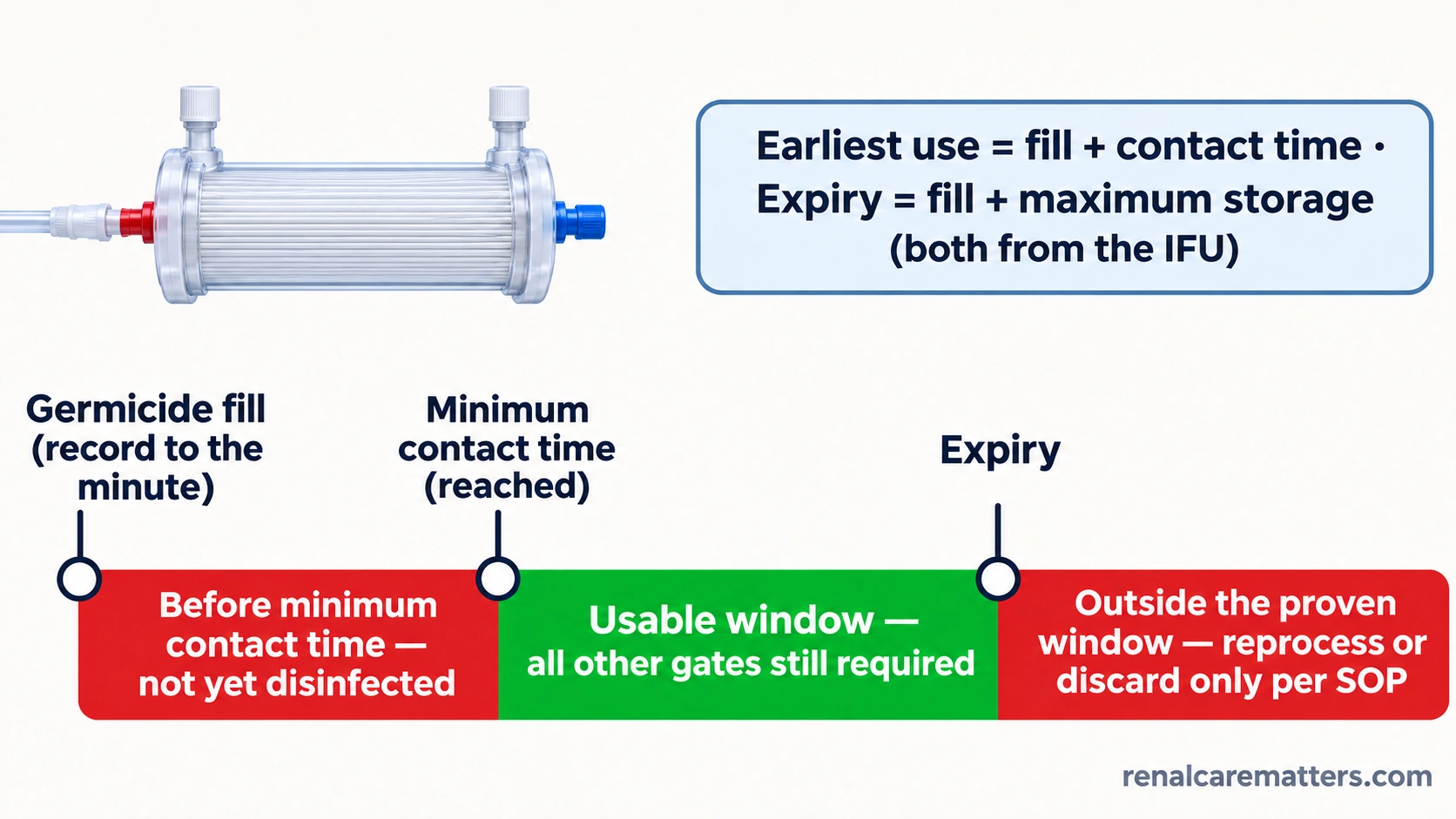
Each processed dialyzer has a usable window. It opens when the minimum contact time has passed and closes at the maximum storage time. Both come from the germicide IFU, the dialyzer IFU and the program. Outside the window, the dialyzer is reprocessed or discarded as the procedure directs.
Record the fill time on the label and in the log, to the minute. A dialyzer whose fill time is missing has no window, and is held.
Storage that keeps it proven
| Storage rule | Why |
|---|---|
| Individual labeled position for each patient | Picks by label, not by location; Malaysian standards require individually labeled storage2 |
| Ports capped; dialyzer upright or as the procedure sets | Germicide stays in; contaminants stay out |
| Within the temperature range the IFU sets, away from sunlight and heat | Some germicides break down with heat and light |
| Separate from used dialyzers and from any dedicated hepatitis program’s dialyzers | Clean and dirty never mix (Module 4) |
| Daily check for leaks, missing caps, and expiry | A leaking dialyzer has lost its germicide and its proof |
Rinse and residual test
Before the dialyzer meets blood, the germicide is rinsed out with the volume and method the procedure sets, usually during priming of the circuit. Then a residual test confirms that germicide has fallen below the safe threshold printed on the test kit and in the procedure. Germicide entering a patient’s bloodstream is a chemical injury that the rinse and the residual test exist to prevent.
| Common error | Why it matters |
|---|---|
| Reading the strip later or earlier than its instructions say | Colors keep changing; the result no longer means anything |
| Using a strip for a different germicide | Each germicide needs its own test |
| Using expired strips or strips stored open | They may not change color |
| Testing at the wrong port or before the rinse is complete | The sample does not represent what reaches the blood |
| Judging a faint color as “close enough” | A doubtful result is a failed result: rinse again as the procedure allows and retest |
Two-person verification at the chair

Figure 4 · Two-person verification
- IdentityBoth read the label aloud: full name and second identifier, matched to the patient’s record and wristband or verbal confirmation.
- HistoryUse number within the limit; processing date within the window.
- ResultsVolume, integrity and presence results recorded as passed.
- ResidualRinse complete; residual test read at the correct time and below threshold.
- SignBoth sign or initial the treatment record.
Two people catch errors that one person, rushed and sure, will miss. Each must check independently; a second person who only watches the first is not a second check.
Back to the case: The strip at the wrong minute
Is the dialyzer proven safe? No. The residual strip was read at about two minutes instead of the time its instructions set, so the color means nothing, and a faint color is a doubtful result in any case. The fill time is inside the window: the contact time has passed and storage has not expired. That gate is proven. The residual gate is not.
What should Ms. Torres say? Politely and directly, to Mr. Ramos before connection: “The strip was read late. Can we rinse again as the procedure allows and retest at the right time?” If he disagrees, the charge nurse decides; the dialyzer is not connected while the result is doubtful. Speaking up across roles is part of the job (Module 1).
What does the storage time tell you? Thirty hours is after the minimum contact time and before the maximum storage, so the germicide has had time to work and the dialyzer is within its window. Had it been filled only two hours earlier, it would not yet be disinfected.
Skills checklist: Storage, residual testing and handoff
Practice on training dialyzers filled with water, then observe and perform under supervision. Your preceptor rates each step as satisfactory, needs practice, or not observed. Steps marked Critical must all be satisfactory before sign-off. This checklist supports supervised learning; your unit’s own procedure and competency form are the authority. A printable version of every checklist is on the trainer page.
- CriticalChecks that both compartments are full, without air, and all four ports are capped.
- CriticalRecords the fill time to the minute on the label and in the log.
- CriticalCalculates the earliest-use time and expiry from IFU values.
- Places the dialyzer in the patient’s labeled position and performs the daily storage check.
- CriticalUses the correct, in-date residual strip for the germicide.
- CriticalReads the residual test at the exact time its instructions set.
- CriticalTreats a doubtful color as a failed result.
- CriticalCompletes a two-person verification, each person checking independently.
Check your understanding
Each visit draws 5 questions at random from this module’s 12-question bank. Choose the single best answer for each, then select Check answers; an explanation appears under the best answer. Select New set of questions for a different mix. A good target is 4 of 5 on two different sets. Nothing you select is sent anywhere; scoring happens in your browser.
Read next on this site
- Dialyzer Reprocessing and ReuseStorage, rinsing and residual testing.