After this module you should be able to
- Tell apart a licensing order, a payer condition, professional guidance, device and germicide instructions, and a local procedure.
- State the Philippine requirements that shape reuse: Department of Health (DOH) duties and water monitoring, PSN eligibility guidance, Philippine Health Insurance Corporation (PhilHealth) use limits and volume floor.
- Count uses correctly: five uses is the first treatment plus up to four reuses.
- Compare Philippine rules with United States and Malaysian rules without exporting one country’s rule to another.
- Apply the strictest rule that applies to a dialyzer, and hold when rules conflict.
The big picture, in plain words
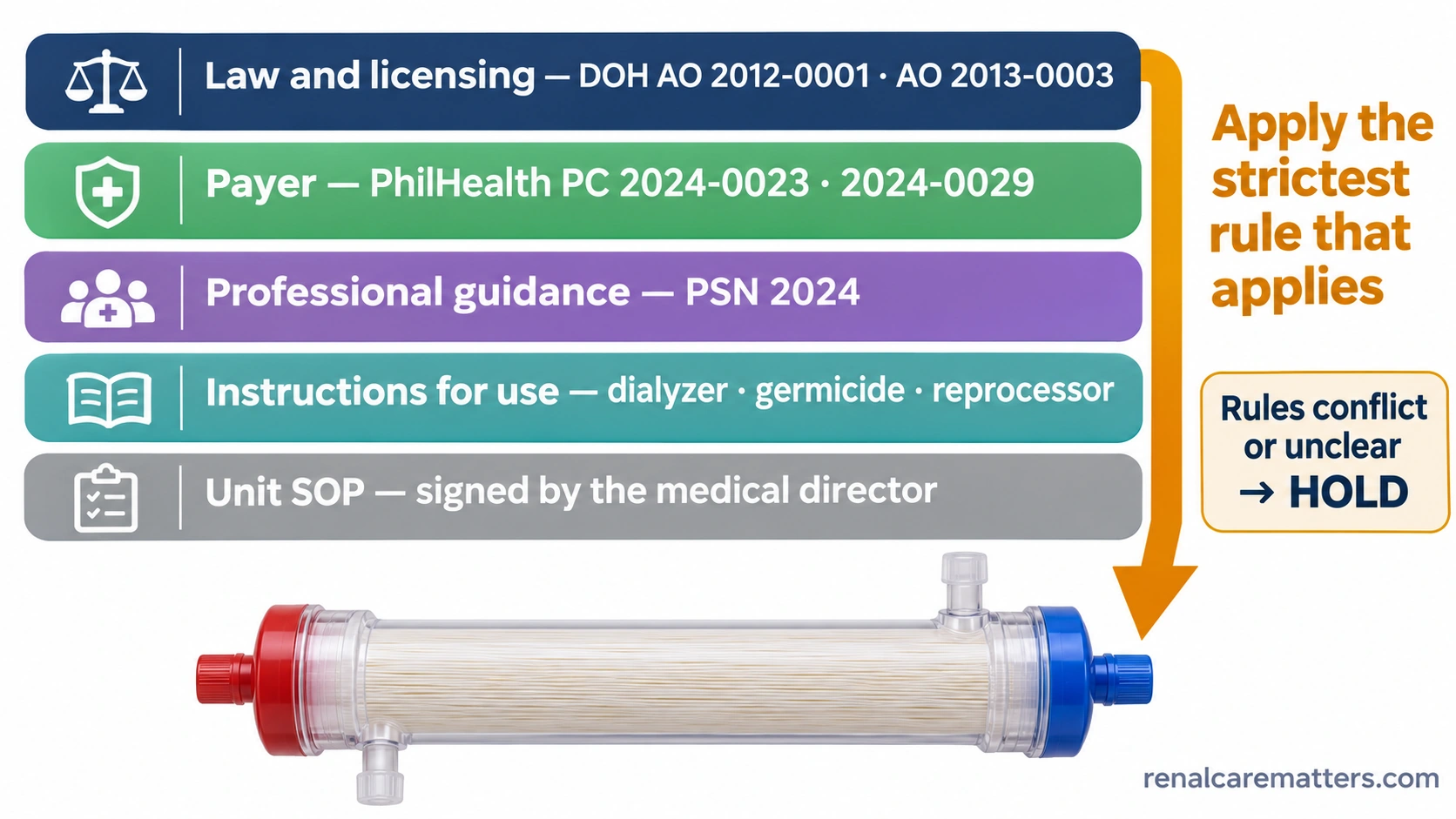
The picture has a limit. Traffic rules are mostly about the driver. Reuse rules are about a patient who cannot see the reuse room and has to trust that every rulebook was followed. So the reprocessing technician cannot pick the convenient rule. The working principle is the strictest rule that applies to this dialyzer, and a hold when two rules conflict and nobody has decided.
Figure 1 · Key terms for this module
You do not need to memorize every rule. You need to know which rulebook answers which question, where to find the current version, and what to do when they disagree.
Case: The transfer patient
Mr. Danilo Reyes, 47, transfers from a unit in Cavite to your unit in Quezon City. He arrives with his own reprocessed dialyzer in a sealed bag, labeled “Reuse 4” in his old unit’s handwriting. His transfer papers list his hepatitis B surface antigen (HBsAg) as negative, tested seven months ago; his hepatitis C antibody result is not in the folder.
The technician on duty, Ms. Arlene Bautista, has to decide what to do with the dialyzer before the 1 p.m. shift. The charge nurse says, “Use it; it only has one use left.”
Before reading on, decide:
- What does “Reuse 4” mean, and how many uses has the dialyzer had?
- Which rules decide whether this dialyzer may be used in your unit?
- What should Ms. Bautista do before 1 p.m.?
Keep your answers in mind. The lesson gives you what you need, and the case review near the end shows one sound response.
Which rulebook answers which question
| Source | Kind | Question it answers | Example for reuse |
|---|---|---|---|
| DOH AO 2012-0001 | Licensing regulation | What must a licensed dialysis facility have and do? | Technician duties include daily reprocessor calibration, reprocessing, acceptance testing, labeling, records and storage1 |
| DOH AO 2013-0003 | Licensing regulation | How must dialysis water be monitored? | Microbiology at least monthly; chemical analysis at least every six months; weekly product-water total dissolved solids (TDS)2 |
| PSN Hemodialysis Guidelines, 2024 | Professional guidance | What do nephrologists consider sound practice? | Reuse in hepatitis B or C only with separate areas and machines; no dialyzer reuse in human immunodeficiency virus (HIV)3 |
| PhilHealth Circular 2024-0023 | Payer condition | What will the hemodialysis package pay for? | Up to five uses per dialyzer, up to 32 dialyzers a year within the package4 |
| PhilHealth Circular 2024-0029 | Payer quality condition | What must a facility show to qualify? | An established reuse protocol and total cell volume (TCV) of at least 80%5 |
| Dialyzer, germicide and reprocessor IFUs | Manufacturer instructions | How may this product be used? | Whether the dialyzer may be reprocessed at all; germicide concentration and contact time |
| Unit SOP | Local procedure | How does this unit do it? | The exact steps, tests and records, and often a lower use limit |
A payer rule is about money, not safety. PhilHealth paying for up to five uses does not mean a dialyzer may be used five times. It means the package will not pay for more. A lower limit in the IFU or the SOP comes first.
Five uses is not five reuses
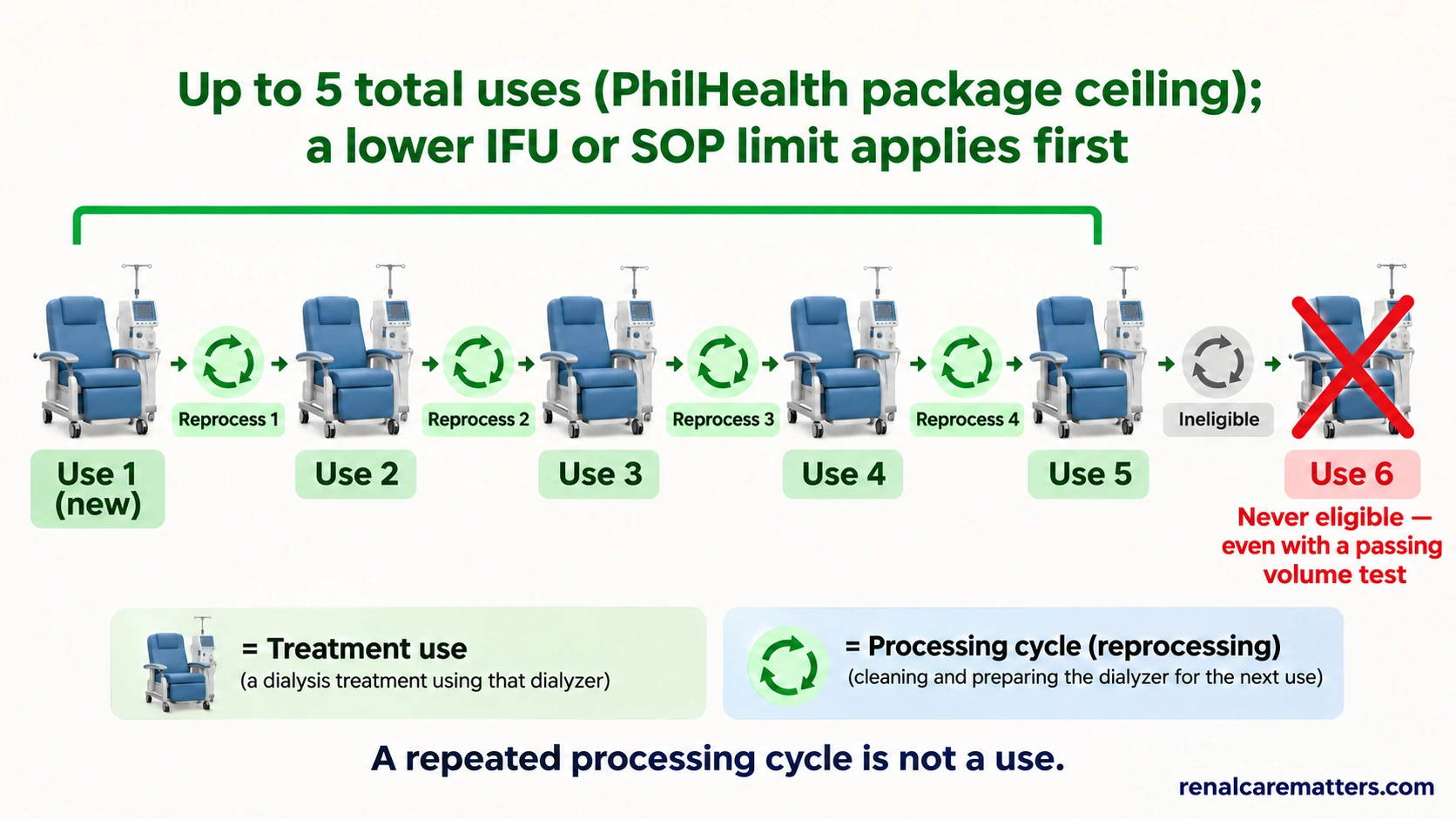
The PhilHealth package counts uses: the first treatment plus up to four more after reprocessing.4 Some units count reuses instead, starting from zero after the first treatment. The same dialyzer can be “use 5” in one system and “reuse 4” in another. Confusing the two gives a patient a sixth use.
| Treatment | Use number | Reprocessing cycles completed before it | Eligible under a five-use ceiling? |
|---|---|---|---|
| First treatment, new dialyzer | 1 | 0 | Yes |
| Second | 2 | 1 | Yes, if every gate passes |
| Fifth | 5 | 4 | Yes, if every gate passes |
| Sixth | 6 | 5 | No, even with a passing volume test |
A processing cycle is not a use. A dialyzer that is reprocessed twice because the first cycle failed has had one more processing cycle, not one more use. Your unit’s record must keep both counts, labeled.
Infection status and reuse: three countries, three answers
Countries handle blood-borne infection and reuse differently. Each rule must keep its country label.
| Topic | Philippines (PSN 2024) | United States (federal rule) | Malaysia (2026 standards) |
|---|---|---|---|
| Same patient only | Patient-specific labeling and matching | Required6 | Individually labeled storage7 |
| Hepatitis B positive | Only with a separate area and machine; otherwise single use3 | Reuse not permitted6 | Single use mandatory7 |
| Hepatitis C positive | Only with a separate area and machine; otherwise single use3 | Federal rule does not exclude it; follow the facility program | Single use mandatory7 |
| HIV positive | No dialyzer reuse3 | Not addressed by the same exclusion; do not export the PSN rule | Confirm the full local policy |
This track teaches a conservative academy default for Philippine units: single use for hepatitis B and HIV; hepatitis C on hold unless the medical director approves a documented pathway with dedicated facilities; unknown or conflicting status always on hold. It is a teaching default, not a national rule. Your unit’s program decides.
Is the rule current?
Rules change. A photocopy in a drawer may be two versions old. Before you rely on a rule, check four things: who issued it, its number and date, whether it has been amended or replaced, and whether it applies to your type of facility.
The Malaysian standards show why. Their 2026 edition replaced the 2018 edition; a statement in the older edition about reusing dialyzers many times should not be quoted as current, and it was never a Philippine rule.7 PhilHealth circulars are amended often; the medical director or compliance officer confirms which apply.
Figure 4 · Where to find the current version
Back to the case: The transfer patient
What does “Reuse 4” mean? If his old unit counted reuses, the dialyzer has had five uses already: the first treatment plus four reuses. Its next use would be the sixth, which no five-use ceiling allows. If the old unit counted uses, it has had four. Ms. Bautista cannot tell from a handwritten label alone, so the count is unproven.
Which rules decide? Your unit’s program, which follows the strictest applicable rule. The dialyzer arrives without your unit’s processing record, with no proof of how it was cleaned, tested or stored, and with an incomplete infection workup. Under most programs, a dialyzer from another facility is not accepted for reuse.
What should she do? Hold the dialyzer, label it as quarantined, and tell the charge nurse that Mr. Reyes needs a new dialyzer today. She reports the missing hepatitis C result so the nurse can raise it with the nephrologist, who decides his eligibility. “Only one use left” is an assumption, and assumptions are not evidence.
Skills checklist: Rule-finding and use-count drill
Use printed copies of your unit’s SOP, the relevant issuances, and five synthetic dialyzer records with mixed counting systems. Your preceptor rates each step as satisfactory, needs practice, or not observed. Steps marked Critical must all be satisfactory before sign-off. This checklist supports supervised learning; your unit’s own procedure and competency form are the authority. A printable version of every checklist is on the trainer page.
- Names the source that answers each of five questions (licensing, water, eligibility, payment, product use).
- CriticalConverts each record to a use number and identifies the one that would reach a sixth use.
- CriticalDistinguishes a processing cycle from a use.
- CriticalApplies the stricter of an IFU limit and the payer ceiling.
- CriticalHolds a dialyzer whose infection eligibility is unknown or conflicting.
- Checks the issue date and current status of one rule.
Check your understanding
Each visit draws 5 questions at random from this module’s 12-question bank. Choose the single best answer for each, then select Check answers; an explanation appears under the best answer. Select New set of questions for a different mix. A good target is 4 of 5 on two different sets. Nothing you select is sent anywhere; scoring happens in your browser.
Read next on this site
- Dialyzer Reprocessing and ReuseBackground on reuse rules and practice.