Nephrology Nursing Track · By Role · Module 8 of 18
Watching Every Access on the Floor
Why the alarm misses a dislodged needle, the first minute of bleeding, findings that mean do not needle today, and catheters on a busy floor.
PublishedNailathalaGipatikPepalwal:ReferencesMga SanggunianMga TinubdanReng Reperensya:6Audience: Experienced hemodialysis nurses who take charge of a shift · nurses being prepared for charge duty · head nurses and educators who orient themRead timeOras ng pagbasaOras sa pagbasaOras ning pamamasa:
This module is study material for charge nurses in hemodialysis units. It explains the reasoning behind common decisions; it is not a protocol. On the floor, follow your unit’s protocol and always ask the attending nephrologist for guidance. Doses, limits, and cut-off values are set by your unit. Every case is fictional.
Learning objectives
After this module you should be able to
Keep every access on the floor visible and secured, every session.
Explain why the venous pressure alarm can miss a dislodged needle.
Lead the first minute of access bleeding and of needle dislodgement.
Recognize findings that mean a fistula or graft should not be needled today.
Keep catheter connections safe on a floor with several catheters.
Pre-testBefore you read, answer the 8 self-assessment questions and note your score. After the module, select New set of questions and compare. The difference is what you learned; the questions you still miss are what to reread.
Start here
The big picture, in plain words
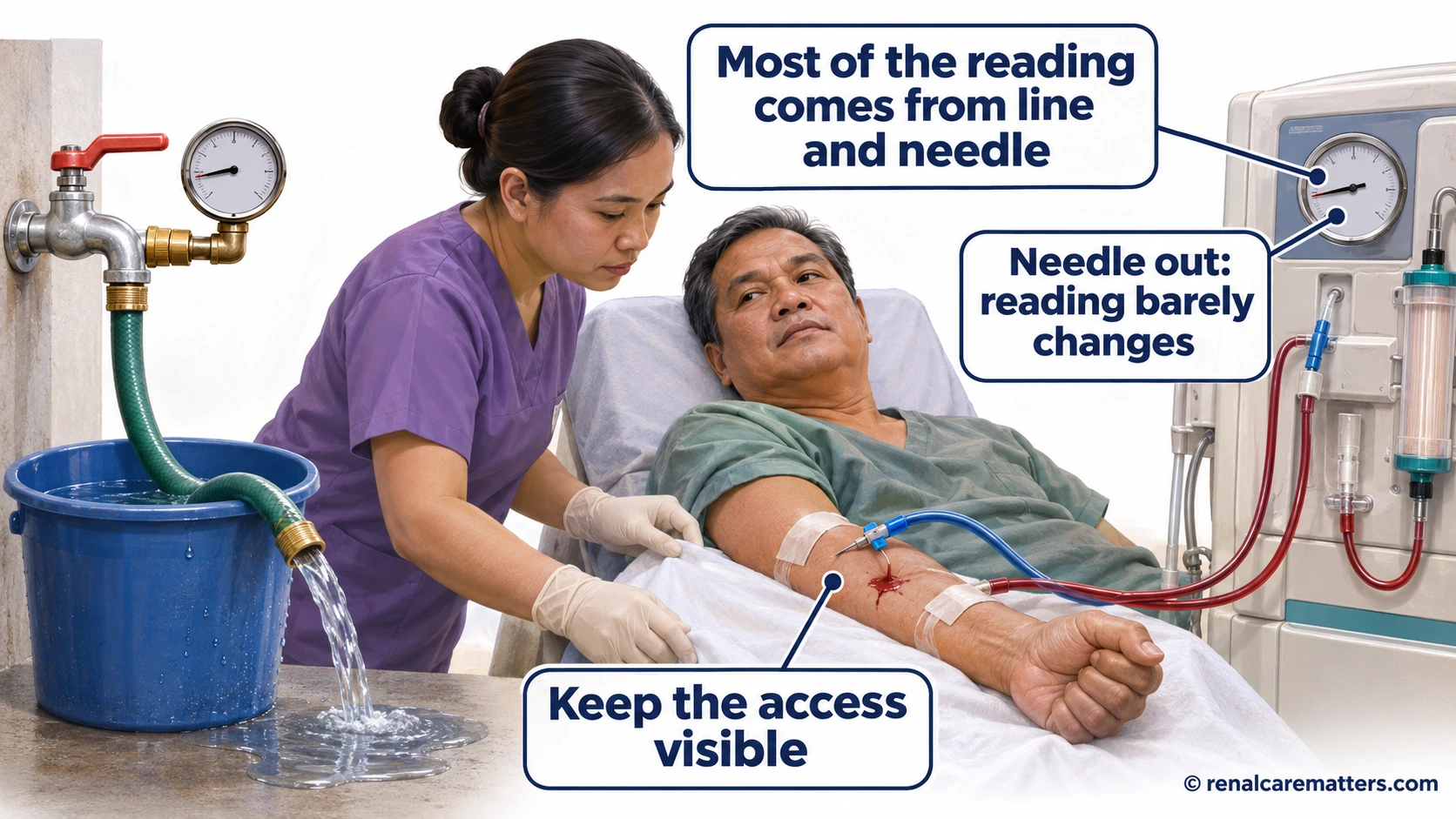
In plain wordsPicture a garden hose with its nozzle resting in a bucket. If the nozzle slips out, the pump keeps running and the water pours onto the floor. The pressure gauge at the tap barely moves.
That is venous needle dislodgement. Blood keeps returning from the blood pump, often 300 mL a minute, but now onto the bed or floor. The machine reads venous pressure mostly from the resistance of the line and the needle, not the vein. When the needle slips out, the reading may fall only a little and stay inside the alarm window. The alarm is a backup; the eyes are the main safeguard.
Figure 1 · Key terms for this module
Arteriovenous fistula (AVF)A vein joined to an artery in the arm, which enlarges so it can be needled.
GraftA tube joining an artery and a vein, used like a fistula.
Tunneled catheterA tube in a large neck or chest vein, tunneled under the skin.
Venous needle dislodgementThe return needle coming out while the pump runs.
ThrillThe buzzing felt over a working fistula or graft.
BruitThe whooshing sound heard over a working fistula or graft.
Opening case · fictional
Case: Under the blanket
At 9:15 the unit is cold. Mr. Arturo Gomez, 55, who has a left forearm fistula, pulls his blanket up to his chin and falls asleep. Blood flow is 300 mL a minute.
At 9:40, the patient in the next chair calls out that the floor under Bed 5 is wet. The venous pressure alarm never sounded. The charge nurse, Benjie Ocampo, is at Bed 12.
Before reading on, decide:
Why did the alarm not sound?
What are the first sixty seconds?
What floor-wide rule prevents this from happening again?
Keep your answers in mind. The lesson gives you what you need, and the case review near the end shows one sound response.
Lesson · part 1
Why the alarm can miss a dislodged needle
In a bench simulation of 19 needle dislodgements, the machine’s venous pressure alarm sounded in only 8, or 42%.1 A review of needle dislodgement and line separation recommends that the access be visible at all times, that lines be taped securely with a loop, and that wetness detectors be used where available.2
Figure 2. Why the alarm can miss a dislodged needle: most of the venous reading comes from the line and needle, not the vein.
The rule that follows is simple: the access is never covered. If the patient is cold, give a second blanket under the access arm, or keep the arm on top of the blanket. The charge nurse checks this on every round.
RememberNever covered. The alarm is a backup; your eyes are the safeguard.
Lesson · part 2
The first minute of access bleeding
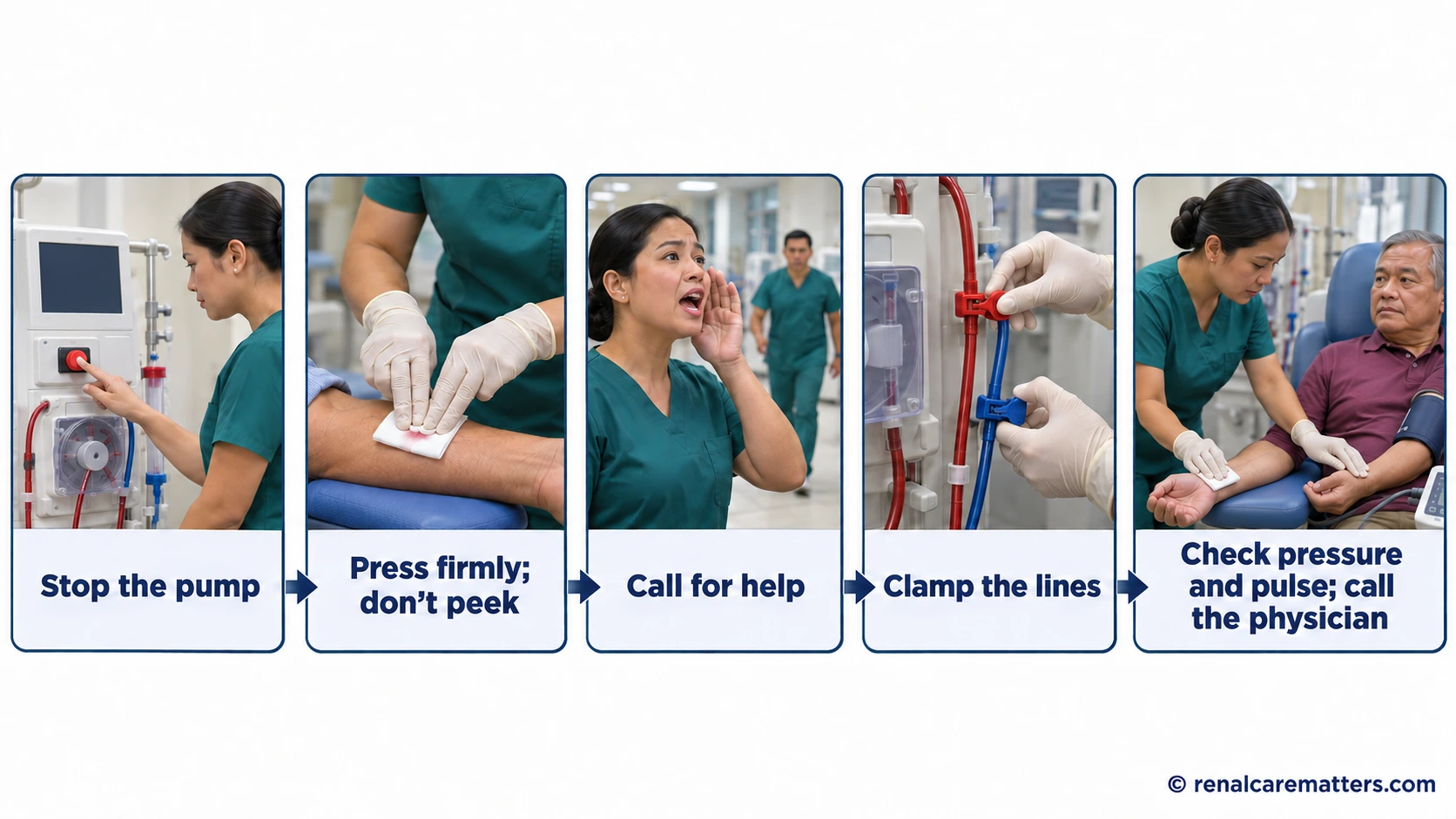
Figure 3. The first minute of access bleeding: stop, press, call, clamp, check.
Figure 4 · The first minute
Stop the blood pumpEvery second the pump runs, blood leaves the patient.
Press firmly on the siteFor a dislodged needle, press the hole in the skin and the vessel with gauze. Do not lift to look.
Call for helpOne nurse keeps pressing; another brings what is needed.
Clamp the linesStop any flow from the circuit.
Check the patient, then callPressure, pulse, and consciousness; estimate the loss; call the physician before any decision about reconnection.
In a review of 88 deaths from access bleeding in Australia and New Zealand, 78% of the deaths with a known location happened at home or in a nursing home, not in the dialysis unit.3 Teach every patient and family member to press firmly and call for help. The charge nurse makes sure that teaching happens, even on busy days.
Lesson · part 3
Findings that mean do not needle today
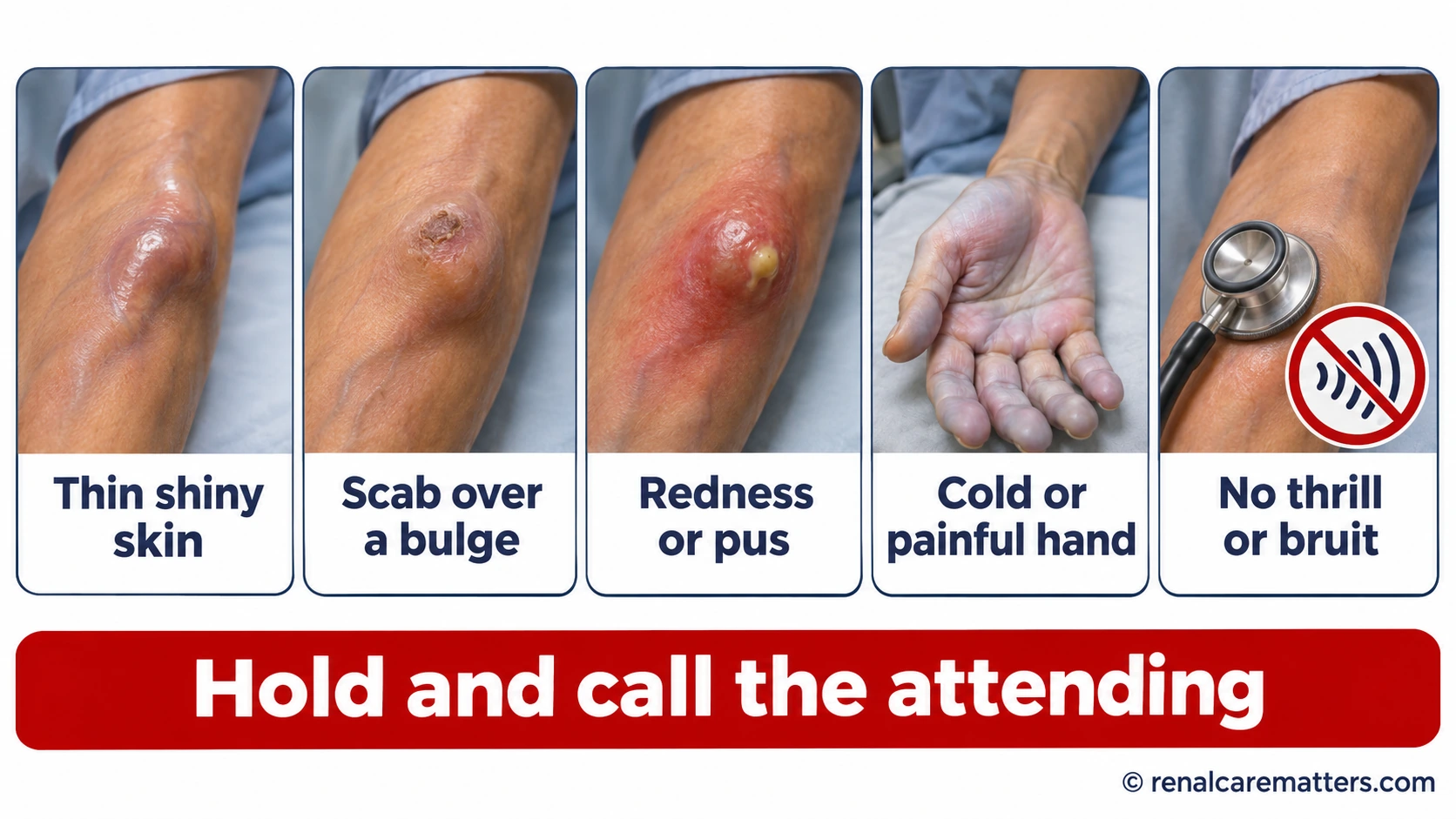
Look, listen, and feel before needling. Some findings mean hold and call, not “needle somewhere else”:
Figure 5. Findings that mean do not needle today. Hold and call the attending.
Thin, shiny skin over a bulge (aneurysm), or a scab on it
Spontaneous bleeding from the access
Redness, warmth, pus, or a fever
No thrill or bruit, or a change in the sound
A cold, pale, or painful hand on the access side
Guidance from the Kidney Disease Outcomes Quality Initiative (KDOQI) advises urgent surgical assessment for skin erosion over an access, because it can rupture.4 These are hold-and-call findings for the attending nephrologist and, through them, the access surgeon.
Lesson · part 4
Catheters on a busy floor
Catheters carry the highest infection risk of any access, and patients who start dialysis with a catheter do worse than those who start with a fistula.5 On a floor with several catheter patients, the charge nurse plans connections so each one is a protected, uninterrupted task (Module 4): mask, hand hygiene, hub scrub, a fresh cap, and the hub never left open to the air.
Air embolism is a catheter emergency. If air enters the line: clamp, place the patient on the left side with the head down if your protocol says so, give oxygen, and call.6
On the floor · Three catheters at 6:00
A Monday morning has three catheter patients in one pod. Instead of three nurses rushing three connections at once, the charge nurse staggers them: Arnel connects Bed 2 at 6:00, Bed 4 at 6:10, Bed 6 at 6:20, each with the do-not-interrupt apron on. The fistula patients in the next pod are connected meanwhile by Kris and Mika. The schedule runs ten minutes longer and nobody’s hub is open while an alarm calls the nurse away.
Illustrative scenario. Names and details are invented.
Lesson · part 5
Arm rules for everyone
No blood pressure cuff, tight sleeve, wristwatch, intravenous line, or blood draw on the access arm, and no sleeping on it. Patients know this; ward nurses, phlebotomists, and relatives often do not. The charge nurse makes sure the rule travels with the patient: on the board, on the transfer summary (Module 16), and in a sentence to anyone who reaches for that arm.
On the floor
Real situations: problems and solutions
These are fictional but typical. For each one, cover the answer, decide what you would do, then compare. Where a step depends on local rules, your unit’s procedure and your supervisor’s direction come first.
“I’m cold”
What you see
A patient insists on covering his access arm.
What is likely going on
A reasonable wish that hides the access.
What to do
Offer a blanket under the arm or a second blanket, and explain the hose picture.
Why it matters
Warmth and visibility can both be met.
The phlebotomist at the fistula arm
What you see
A laboratory staff member reaches for the access arm.
What is likely going on
She does not know which arm holds the fistula.
What to do
Stop her politely and redirect to the other arm.
Why it matters
One stick can damage an access that took months to mature.
A scab on an aneurysm
What you see
Thin shiny skin over a bulge with a scab on top.
What is likely going on
Skin erosion that can rupture.
What to do
Hold needling and call the attending today for urgent surgical assessment.
Why it matters
Rupture can be fatal at home.
Field notes
Never covered.
Press, don’t peek.
Every minute is up to 300 mL.
Case review
Back to the case: Under the blanket
Why no alarm. The alarm did not fail. It was never designed to catch dislodgement reliably: most of the venous reading comes from the line and the needle. The blanket hid the site.
The first sixty seconds. Benjie stops the blood pump, presses firmly on the site, calls for help, has the lines clamped, and checks the patient: pressure 98/60, pulse 112, awake. He estimates the loss from the soaked linen at roughly 400 to 600 mL and calls the physician, who orders a hemoglobin and holds reconnection. How much could have been lost? At 300 mL a minute, every unwatched minute risks up to 300 mL (Head Nurse toolkit #c7). Partial dislodgement, clotting, and pump pauses usually reduce the real loss, but the arithmetic is the reason for the rule.
The floor-wide rule. From today, blankets go under the access arm or the arm stays outside; venous lines are taped with a loop; every round checks every access by sight. Benjie writes it up as an incident with the system fix, not a blame note about the sleeping patient.
Skills lab · with your preceptor
Skills checklist: Access oversight
Round a real floor checking every access, then lead a simulated dislodgement on a training arm. Your preceptor rates each step as satisfactory, needs practice, or not observed. Steps marked Critical must all be satisfactory before sign-off. This checklist supports supervised learning; your unit’s own procedure and competency form are the authority. A printable version of every checklist is on the trainer page.
CriticalChecks that every access is visible and every venous line is taped with a loop.
Explains why the venous pressure alarm can miss dislodgement.
CriticalLeads the first minute of bleeding: stop, press, call, clamp, check.
CriticalDoes not return blood or reconnect without the physician’s decision after a bleed.
CriticalLists five findings that mean do not needle today.
Plans catheter connections as protected, staggered tasks.
CriticalStates the first steps for air embolism.
Teaches a patient and a relative to press and call at home, using teach-back.
Placement activity. For one week, count on each round how many accesses were covered or poorly taped, and what you did.
Self-assessment
Check your understanding
Each visit draws 8 questions at random from this module’s 15-question bank. Choose the single best answer for each, then select Check answers; an explanation appears under the best answer. Select New set of questions for a different mix. A good target is 7 of 8 on two different sets. Nothing you select is sent anywhere; scoring happens in your browser.
Frinak, S., Kennedy, J., Zasuwa, G., Passalacqua, K. D., & Yee, J. (2023). Detection of hemodialysis venous needle dislodgment using venous access pressure measurements: A simulation study. Kidney360, 4(4), e476–e485. https://doi.org/10.34067/KID.0000000000000093
Speranza-Reid, J., Brouwer-Maier, D., Cruz, C. M., & Inglese, M. (2021). Venous needle dislodgement and access-bloodline separation. Nephrology Nursing Journal, 48(4), 347–365.
Jose, M. D., Marshall, M. R., Read, G., Lioufas, N., Ling, J., Snelling, P., & Polkinghorne, K. R. (2017). Fatal dialysis vascular access hemorrhage. American Journal of Kidney Diseases, 70(4), 570–575. https://doi.org/10.1053/j.ajkd.2017.05.014
Lok, C. E., Huber, T. S., Lee, T., Shenoy, S., Yevzlin, A. S., Abreo, K., Allon, M., Asif, A., Astor, B. C., Glickman, M. H., Graham, J., Moist, L. M., Rajan, D. K., Roberts, C., Vachharajani, T. J., & Valentini, R. P. (2020). KDOQI clinical practice guideline for vascular access: 2019 update. American Journal of Kidney Diseases, 75(4, Suppl. 2), S1–S164. https://doi.org/10.1053/j.ajkd.2019.12.001
Ravani, P., Palmer, S. C., Oliver, M. J., Quinn, R. R., MacRae, J. M., Tai, D. J., Pannu, N. I., Thomas, C., Hemmelgarn, B. R., Craig, J. C., Manns, B., Tonelli, M., Strippoli, G. F. M., & James, M. T. (2013). Associations between hemodialysis access type and clinical outcomes: A systematic review. Journal of the American Society of Nephrology, 24(3), 465–473. https://doi.org/10.1681/ASN.2012070643
McCarthy, C. J., Behravesh, S., Naidu, S. G., & Oklu, R. (2016). Air embolism: Practical tips for prevention and treatment. Journal of Clinical Medicine, 5(11), Article 93. https://doi.org/10.3390/jcm5110093
Educational study material for nurses. Does not replace the attending nephrologist’s orders, the unit’s protocols, required training and certification, or supervised practice.