After this module you should be able to
- Recognize vascular problems in access patients that need a different pathway: limb ischemia, renal artery and transplant vascular questions.
- Plan imaging and procedures that protect residual kidney function and fluid balance.
- Explain the training and privileging boundaries between access surgery, general vascular surgery and transplant surgery.
- Stabilize, route and hand off a non-access problem with confirmed receipt.
The big picture, in plain words
The picture has a limit. A mechanic can usually fix the engine too. Access experience does not make a surgeon competent in every vascular or transplant operation, and dialysis patients carry the heaviest burden of arterial disease, calcification and wound failure of any group. Noticing the engine is the obligation; fixing it may belong to someone else.
Figure 1 · Key terms for this module
Your work is to identify the principal problem, judge its urgency, protect kidney function in the investigations you order, and route it to a qualified service.
Case: The toe at the fistula visit
Mr. Crisanto Valdez, 67, comes for a routine six-month fistula review. The fistula is working well. As he leaves he mentions that his right foot has hurt at night for three weeks; he sleeps with his leg hanging off the bed. A small black wound on his second toe has not healed. He has diabetes and has been on hemodialysis for two years; he still passes about 600 mL of urine a day.
The clinic is running late. The resident suggests, “Let us note it and tell him to see his doctor.”
Before reading on, decide:
- How urgent is this, and what is the likely problem?
- What would you consider before ordering contrast imaging?
- Who should take this on, and how do you hand it over?
Keep your answers in mind. The lesson gives you what you need, and the case review near the end shows one sound response.
Recognizing problems that are not the access
Patients with kidney failure have accelerated, often heavily calcified, arterial disease. Rest pain relieved by hanging the leg down, a non-healing toe wound, or gangrene suggest chronic limb-threatening ischemia, a threat to the leg that needs prompt vascular assessment. Calcified arteries make the ankle–brachial index unreliable (often falsely normal or high), so toe pressures or imaging may be needed.
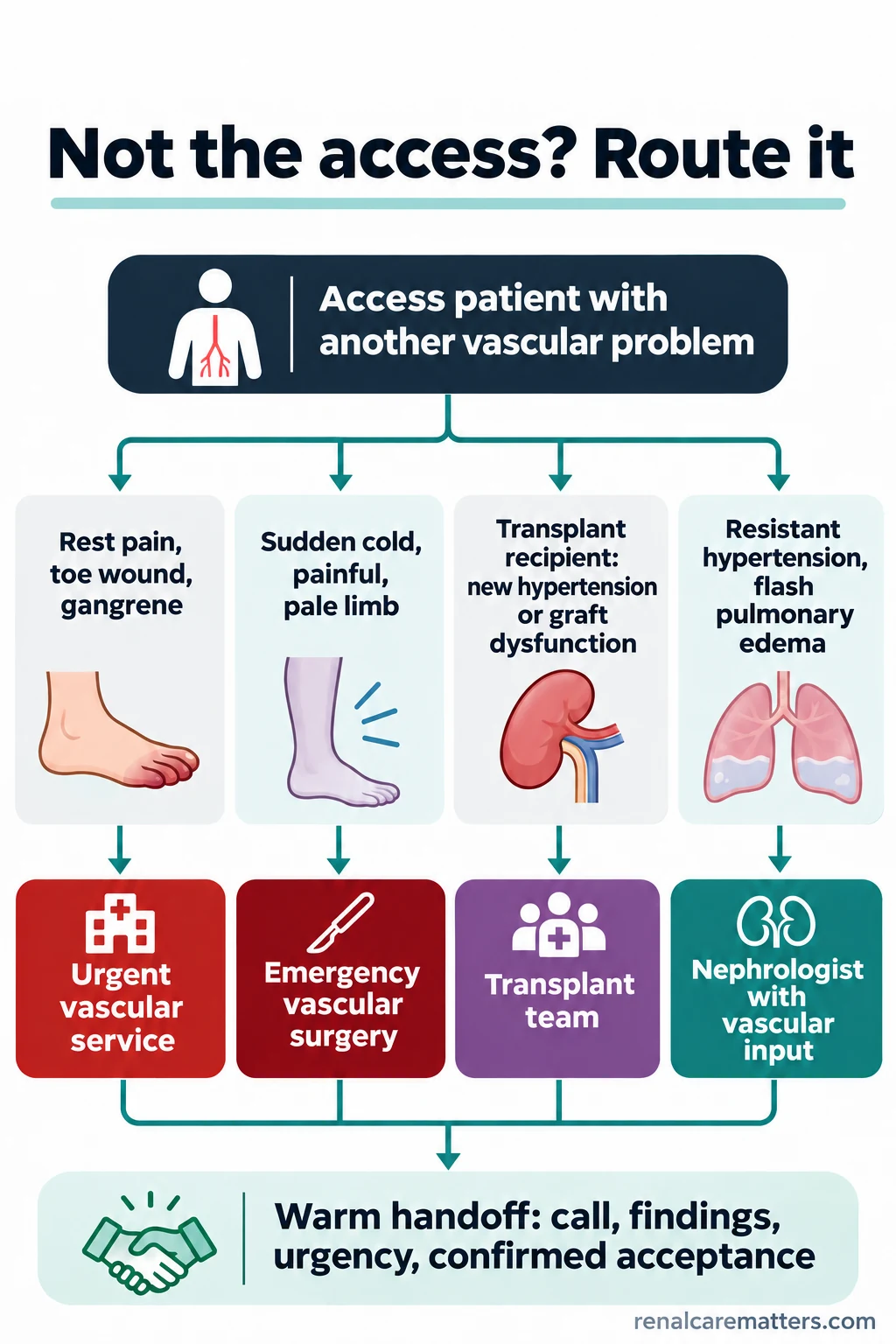
Other interfaces include renal artery disease in a patient with resistant hypertension or flash pulmonary edema, vascular questions in a transplant recipient (such as a transplant renal artery stenosis), and aortic disease found incidentally. Each has its own pathway and specialists. Clarify whether the problem in front of you is the access, systemic vascular disease, or another service’s domain.
| Presentation | Possible problem | Pathway |
|---|---|---|
| Rest pain, toe wound, gangrene | Chronic limb-threatening ischemia | Urgent vascular service |
| Sudden cold, painful, pale limb | Acute limb ischemia | Emergency vascular surgery |
| New hypertension or graft dysfunction after transplant | Transplant vascular problem | Transplant team |
| Resistant hypertension, flash pulmonary edema | Renal artery stenosis | Nephrologist with vascular input |
Investigations that protect residual function
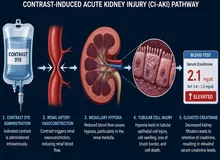
Residual kidney function matters even on dialysis: it helps control fluid, potassium and phosphate, and its preservation is associated with better outcomes. A patient still passing 600 mL a day has something to protect. Iodinated contrast, hypotension, and nephrotoxic drugs can all reduce it; contrast-associated acute kidney injury (AKI) is the usual worry. Plan the minimum useful investigation with the renal and imaging teams: duplex first where it answers the question, the lowest effective contrast volume where angiography is needed, timing relative to dialysis, and attention to fluid balance and allergies.
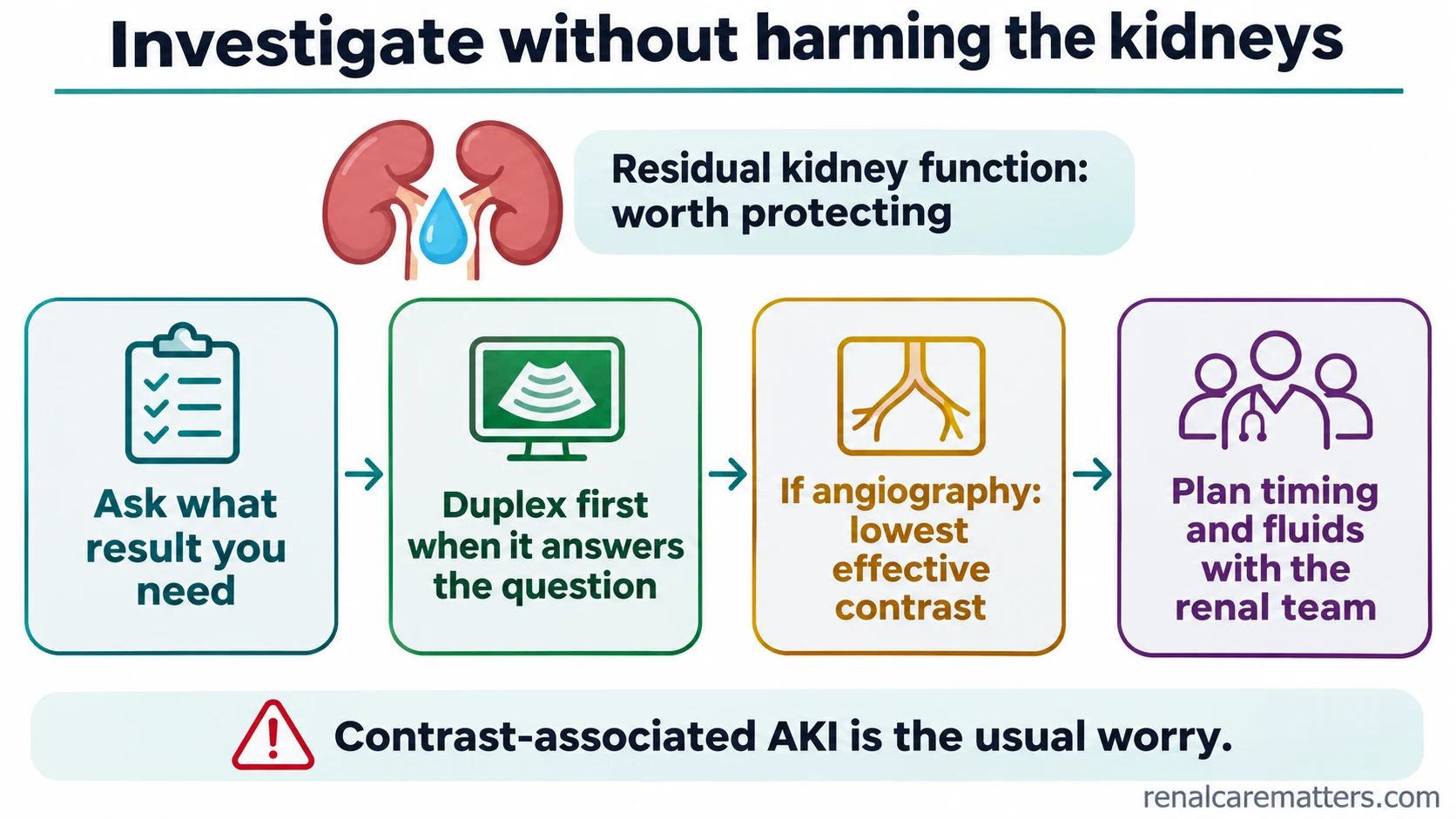
The same thinking applies to patients with chronic kidney disease (CKD) not yet on dialysis who need access mapping or angiography: the investigation that answers today’s question should not hasten tomorrow’s dialysis.
Training, scope and the safest contribution
Access surgery is a distinct skill set. Board certification in vascular surgery follows defined training and examination pathways; in the United States these are set by the Accreditation Council for Graduate Medical Education (ACGME) and the American Board of Surgery (ABS).1,2 In the Philippines, the Philippine Association of Thoracic and Cardiovascular Surgery, Inc. (PATACSI) lists accredited thoracic and cardiovascular surgery (TCVS) training programs, including a post-residency vascular pathway; that directory helps verify training but does not by itself define every eligibility rule.3 Completing this Academy track adds no transplant, aortic or peripheral arterial privileges.
The safest contribution to a problem outside your scope is an accurate assessment, timely referral, and a warm handoff: a direct call, the key findings, the urgency, and confirmation that the receiving service has accepted the patient.
During an access review, a transplant recipient mentions that her graft function has fallen and her blood pressure has risen. You do not order renal artery imaging yourself. You call her transplant nephrologist, who arranges a duplex the same week, and you write the call in her notes.
What this shows. Recognizing a problem and handing it to the right team is part of good access care.
Illustrative scenario. Names and details are invented.
Back to the case: The toe at the fistula visit
Urgency. Three weeks of rest pain relieved by dependency and a black, non-healing toe wound in a patient with diabetes on dialysis suggest chronic limb-threatening ischemia. This needs urgent vascular assessment, not a note to see his doctor.
Before contrast. He still passes 600 mL a day. Discuss with his nephrologist and the vascular team: start with clinical examination and duplex or toe pressures (his ankle–brachial index may be falsely reassuring from calcification), and if angiography is needed, minimize contrast and coordinate timing and fluid balance.
Handoff. If you are privileged and equipped for peripheral arterial work, take it on; if not, call the vascular service directly today, give the findings and urgency, and confirm acceptance. Tell his nephrologist and document the handoff.
Skills checklist: Scope decision and urgent routing
Case discussion or supervised clinic. Your preceptor rates each step as satisfactory, needs practice, or not observed. Steps marked Critical must all be satisfactory before sign-off. This checklist supports supervised learning; your unit’s own procedure and competency form are the authority. A printable version of every checklist is on the trainer page.
- CriticalIdentifies the principal problem beyond the access
- CriticalStates urgency correctly
- Explains investigation trade-offs for residual kidney function
- CriticalRefers to a qualified service with a warm handoff and confirms receipt
Check your understanding
Each visit draws 5 questions at random from this module’s 5-question bank. Choose the single best answer for each, then select Check answers; an explanation appears under the best answer. Select New set of questions for a different mix. A good target is 4 of 5 on two different sets. Nothing you select is sent anywhere; scoring happens in your browser.
Read next on this site
- Contrast and the Kidneys: Understanding Contrast-Associated AKI Without Delaying Needed CareContrast and the kidney.
- Cardiovascular Disease & Sudden Death in DialysisVascular disease in dialysis patients.
- Kidney TransplantThe transplant pathway.