After this module you should be able to
- Write an operative and follow-up record that makes the clinical decision understandable, separate from claim paperwork.
- Distinguish a procedure code, payer classification, eligibility and payable amount.
- Define access outcomes with explicit numerators, denominators and follow-up, using the Society for Vascular Surgery (SVS) reporting standards.
- Separate technical patency from functional use, and turn an audit into a testable change.
The big picture, in plain words
The picture has a limit. A bus company can count passengers easily. Access outcomes are harder: patients move between units, die, receive transplants or switch modality, and each of these removes them from follow-up in a different way. A measure is only honest if its definition, denominator, time window and missing data are stated.
Figure 1 · Key terms for this module
Your work is to keep the clinical record, the claim and the audit separate and accurate, and to report outcomes in a way that helps the team improve rather than look good.
Case: The dashboard that counts everything
Your hospital’s new quality dashboard reports “fistula success: 92%.” It counts every fistula that had a thrill at the six-week clinic visit. Of last year’s 118 fistulas, 21 patients never returned to clinic. Of those who did, the dialysis units report that 34 fistulas were still not being used at six months, and those patients remained on catheters.
At the same meeting, the billing officer asks you to write the Philippine Health Insurance Corporation (PhilHealth) package amount for fistula creation into the access lesson for residents, “so they know what to expect.”
Before reading on, decide:
- What is wrong with the 92% figure, and how would you report outcomes instead?
- What should the residents’ lesson say about codes and payment?
- What would you propose as the team’s first improvement?
Keep your answers in mind. The lesson gives you what you need, and the case review near the end shows one sound response.
A record that explains the decision
The clinical record exists so the next clinician understands what happened and why: the indication and the Life-Plan behind it, the consent discussion, findings, the procedure, the immediate result, complications, restrictions, follow-up owner and warning signs. The dialysis unit needs a timely handoff even when claim paperwork is still in progress; a delayed claim must never delay the clinical message.
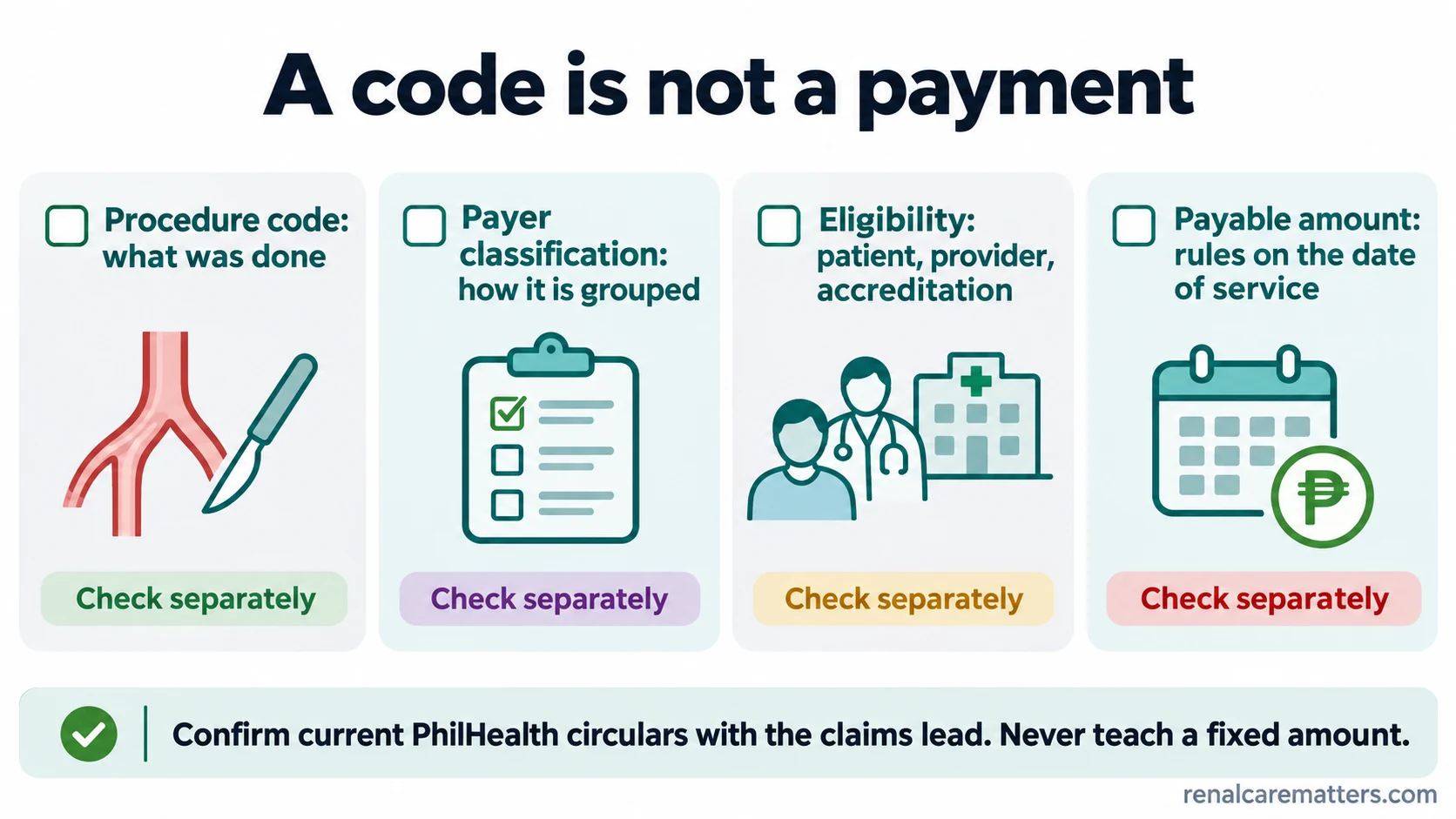
Philippine regulation and payer policy shape the paperwork around the record. The Department of Health (DOH) licenses dialysis facilities and sets their records and referral requirements.1 PhilHealth publishes quality standards for maintenance hemodialysis (Circular 2024-0029) and its hemodialysis coverage rules (Circular 2024-0023).2,3 These rules change. Check the circulars in force on the date of service with your claims lead before quoting any requirement or amount.
| Question | What answers it | What it does not establish |
|---|---|---|
| What procedure was done? | The operative note and procedure code | Eligibility or payment |
| How does the payer classify it? | The payer’s current classification annex | That a specific amount is payable |
| Is this patient and provider eligible? | Current circulars, membership and accreditation | The clinical indication |
| What will be paid? | The package rules in force on the date of service | Anything in a teaching module |
Defining outcomes honestly
The Society for Vascular Surgery (SVS) reporting standards define primary, assisted primary and secondary patency so that results can be compared between services.4 Each needs a clear start (the day of creation, not the day of first use, unless stated), clear events, and clear censoring: death, transplant, modality change and loss to follow-up handled the same way every time. Patency is still a surrogate. The UK Kidney Association (UKKA) 2025 guideline emphasizes outcomes such as functional use and catheter-free dialysis, and Hemodialysis Fistula Maturation (HFM) reported functional patency alongside maturation.5,6
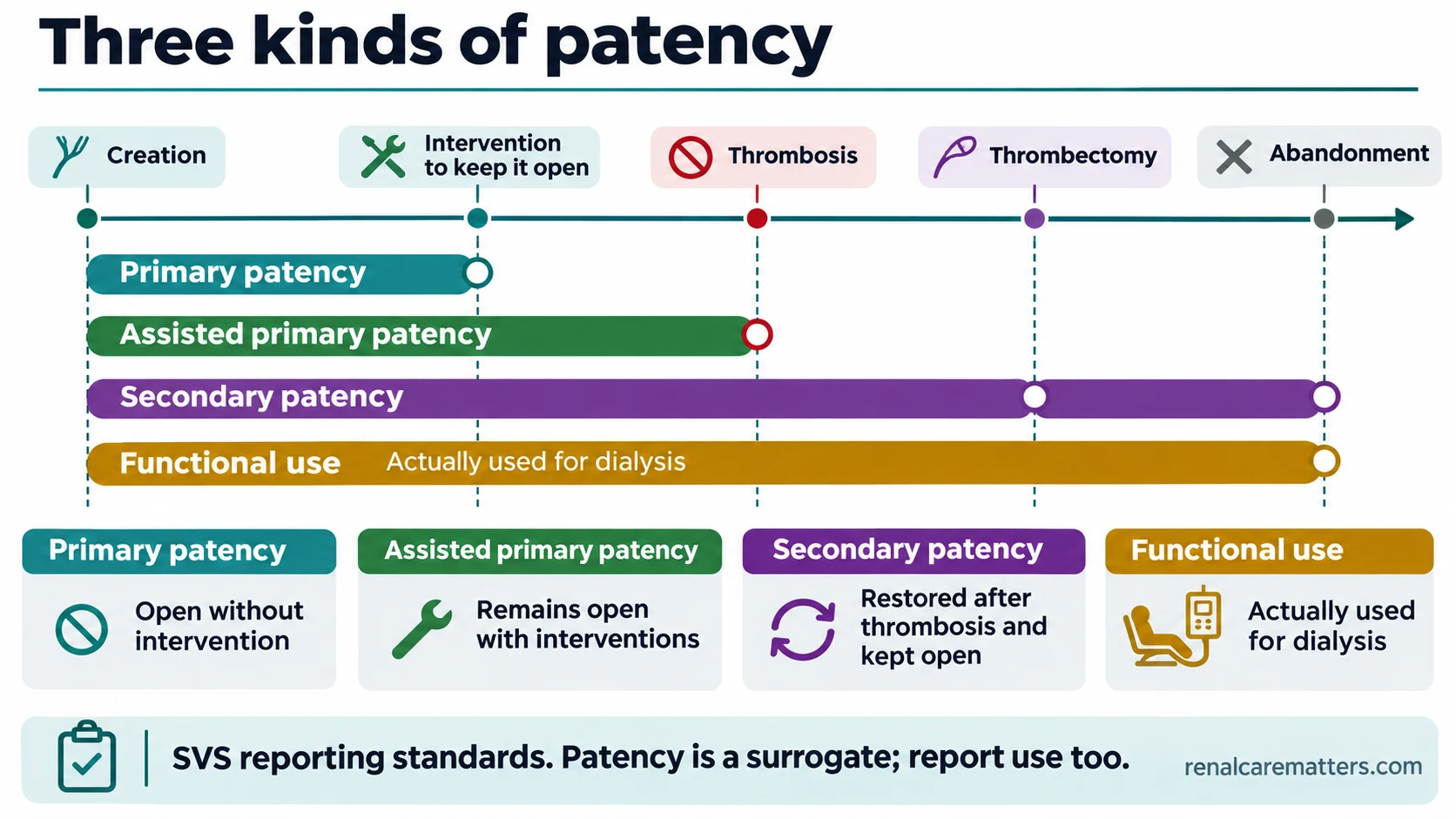
Report counts beside rates, show the follow-up interval, and state how many patients are missing. For infection, a rate per 1,000 catheter-days and the National Healthcare Safety Network (NHSN) rate per 100 patient-months are different measures; do not compare them without reconciling definitions. Small services should show confidence intervals, because a single event can swing a rate dramatically.
Figure 4 · A defensible access audit
- Define the cohortWho, created when, by whom.
- Define the outcomePrimary failure, functional use, catheter-free days, interventions per year.
- Define follow-upWindow, censoring for death, transplant and modality change.
- Count missing dataReport it; do not drop it.
- Show uncertaintyCounts, rates and confidence intervals.
- Choose a changeA specific process to test, with a review date.
From audit to improvement
An audit is useful only if it leads to a change the team can test. Track a small set of measures: referral-to-assessment time, the proportion with a documented first-use handoff, functional use within a set window, catheter days, unplanned procedures, major bleeding, and patient-reported burden. Compare like with like, and avoid punishing services that take the hardest patients.
A service finds that 40% of patients with mature fistulas still dialyze through catheters three months after maturation. The cause is a missing first-use handoff. The team introduces a one-page handoff and a phone call to the unit at maturation; three months later the proportion falls to 22%.
What this shows. The biggest gains often come from closing a handoff, not from changing the operation.
Illustrative scenario. Names and details are invented.
Back to the case: The dashboard that counts everything
The 92%. It counts technical patency at six weeks, excludes the 21 patients lost to follow-up, and ignores the 34 fistulas not used by six months. Report separately: primary failure, functional use at a stated interval (for example, the proportion used successfully for dialysis by six months), catheter-free dialysis, with the denominator of 118, the number missing, and confidence intervals.
Codes and payment. The lesson should explain that a procedure code, a payer classification, eligibility and a payable amount are separate, and that amounts must be checked on the date of service with the claims lead. Do not copy a historical amount into a permanent lesson.
First improvement. Find out why 34 fistulas were not used. If, as often, first-use handoffs were missing or maturation was not assessed, introduce a structured handoff and a maturation visit at four to six weeks, and re-measure functional use in three months.
Skills checklist: Documentation bundle and audit design
Use a fictional documentation set and audit dataset. Your preceptor rates each step as satisfactory, needs practice, or not observed. Steps marked Critical must all be satisfactory before sign-off. This checklist supports supervised learning; your unit’s own procedure and competency form are the authority. A printable version of every checklist is on the trainer page.
- Reconciles a fictional operative record and dialysis handoff
- CriticalDistinguishes code, classification, eligibility and payment
- CriticalDefines an outcome with numerator, denominator, window and censoring
- Reports missing follow-up and confidence intervals
- Proposes a measurable improvement with a review date
Check your understanding
Each visit draws 5 questions at random from this module’s 5-question bank. Choose the single best answer for each, then select Check answers; an explanation appears under the best answer. Select New set of questions for a different mix. A good target is 4 of 5 on two different sets. Nothing you select is sent anywhere; scoring happens in your browser.
Read next on this site
- Dialysis Center Quality ManagementQuality assurance and improvement in dialysis units.
- Hemodialysis Access: A Lifeline for a LifetimeWhy functional access matters to patients.