After this module you should be able to
- Explain why synthetic grafts and catheters are hard to cure of infection, using biofilm and tissue incorporation.
- Put sepsis care first, then decide what source control the access needs.
- State what the evidence shows for catheter lock solutions and unit-wide prevention bundles.
- Hand off antimicrobial treatment, culture review and dialysis access across transitions.
The big picture, in plain words
The picture has a limit. A splinter is inert; a graft or catheter is coated within days by biofilm, a matrix in which bacteria grow slowly and are shielded from antibiotics and white cells. A living fistula can often clear infection with antibiotics because its wall has a blood supply and immune cells. Synthetic material cannot. The organism, the extent of infection and the patient’s condition decide whether the foreign material must go.
Figure 1 · Key terms for this module
A patient with an infected access and low blood pressure is a sepsis patient first. Your work is to make sure sepsis care starts now, then to decide with the team whether the access stays, is revised, or is removed, and who owns the antibiotics.
Case: The draining graft
Mrs. Aurora Fernandez, 64, has a left forearm loop graft placed 14 months ago. For a week the skin over the arterial limb has been red and tender, and two days ago it began draining pus. The dialysis unit prescribed oral antibiotics, but the prescription was never filled. She arrives at your hospital’s emergency department febrile at 39.0 °C, with a blood pressure of 84/52 mm Hg and a heart rate of 118 per minute. The graft still has a thrill. The emergency resident asks whether this can wait for your Thursday wound clinic.
Before reading on, decide:
- What happens in the first hour?
- Will the graft stay?
- What must be handed over when she leaves the emergency department?
Keep your answers in mind. The lesson gives you what you need, and the case review near the end shows one sound response.
Why access infections persist
Bacteria from the skin reach an access through needle sites, the incision or, for catheters, the hub and the exit site. On synthetic surfaces they form biofilm within days. Antibiotic concentrations that kill free-floating bacteria often fail inside biofilm, and the bacteria shed into the blood intermittently. This is why a catheter infection with the same organism recurs after treatment, and why an infected graft, especially with an exposed segment, an abscess, or bleeding, usually needs removal of the infected material.
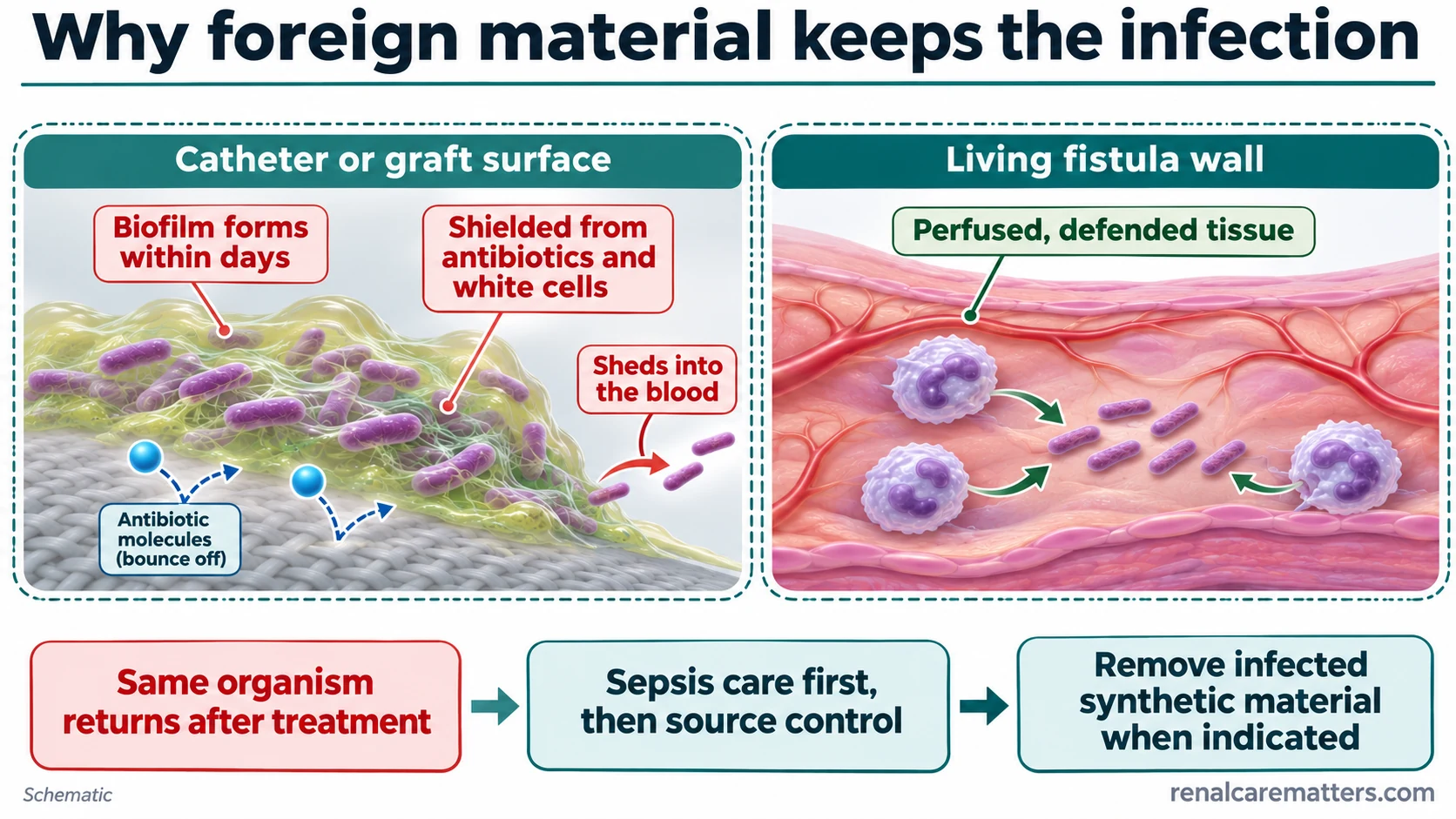
Fistulas behave differently. Their walls are living tissue, perfused and defended, and localized fistula infections often respond to antibiotics, though infection at an anastomosis or with bleeding is dangerous in any access. The UK Kidney Association (UKKA) 2025 guideline suggests systemic antibiotics without catheter replacement for exit-site infection without bacteremia (statement 6.4, grade 1D), antibiotics without replacement as the initial strategy for uncomplicated coagulase-negative staphylococcal bacteremia (6.5, grade 2C), and favoring catheter replacement when bacteremia is recurrent, severe, or due to Staphylococcus aureus (6.6, grade 2C).1
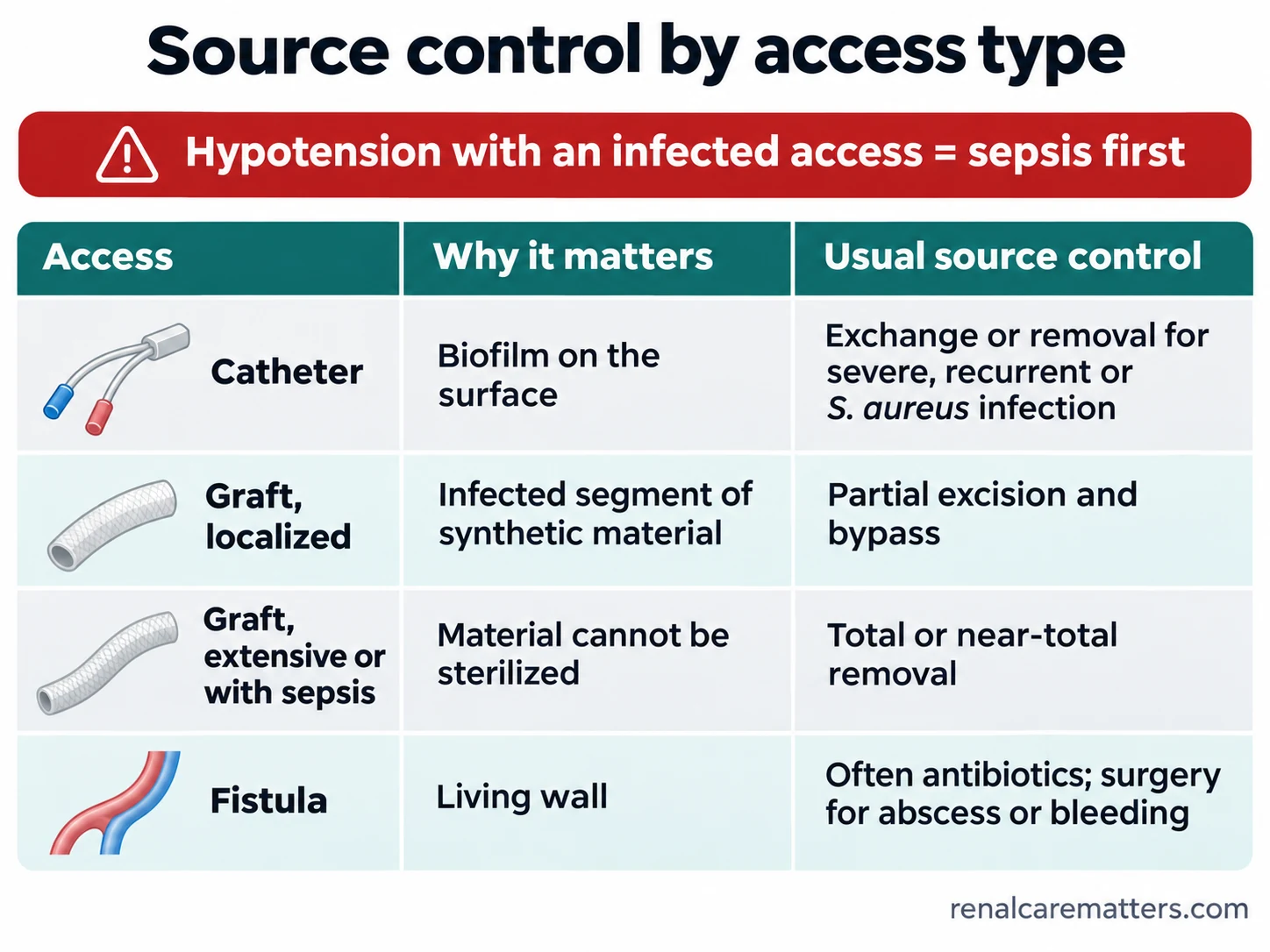
| Access | Why it matters | Usual source control |
|---|---|---|
| Catheter | Biofilm on the surface | Exchange or removal for severe, recurrent or S. aureus infection |
| Graft, localized | Infected segment of synthetic material | Partial excision and bypass of the infected segment |
| Graft, extensive, anastomotic, or with sepsis | Material cannot be sterilized | Total or near-total removal |
| Fistula | Living wall | Often antibiotics; surgery for abscess, bleeding or anastomotic involvement |
Sepsis first, then the access
Hypotension, tachycardia and fever with an infected access are sepsis until proven otherwise. Start the institution’s sepsis pathway: resuscitate, take blood cultures (and wound cultures) without delaying treatment, and give empiric antibiotics chosen from the local antibiogram, dosed for dialysis. The question of preserving the access waits until the patient is stable.
Then decide on source control with the nephrologist and, where available, infectious disease colleagues. An unstable patient with an infected graft generally needs the infected material removed urgently. Plan the next dialysis route before you take the graft out. Make sure one named clinician reviews culture results, adjusts antibiotics and sets the duration, and that the plan travels with the patient to the ward and back to the dialysis unit. The Centers for Disease Control and Prevention (CDC) stewardship core elements stress training in sepsis recognition, appropriate dosing, microbiology review and communication at transitions.2
Figure 4 · Infected access with sepsis
- RecognizeFever, hypotension, tachycardia, pus, a red tender access.
- Resuscitate and cultureSepsis pathway; blood and wound cultures without delay.
- TreatEmpiric antibiotics from the local antibiogram, dosed for dialysis.
- Source controlSurgical review now; remove infected synthetic material when indicated.
- BridgeTemporary dialysis access chosen to protect future sites.
- Hand offNamed owner for cultures, antibiotic duration and follow-up.
Preventing access infection: what the evidence shows
Unit-wide practice matters. In a CDC collaborative of outpatient hemodialysis facilities implementing core interventions (surveillance, hand hygiene and catheter-care audits, chlorhexidine skin antisepsis, staff education), modeled access-related bloodstream infection rates fell 54% at the start of the intervention period.3 There was no control group, so part of the improvement may reflect other changes, but the effect was large and sustained. The CDC core interventions remain the reference bundle.4
For catheters, the LOCK IT-100 trial randomized 795 patients to a taurolidine-heparin lock or heparin alone. Catheter-related bloodstream infection occurred at 0.13 versus 0.46 per 1,000 catheter-days (hazard ratio 0.29), with similar safety; 9 versus 32 patients had an infection.5 Whether the product is registered and available in the Philippines needs checking before it enters a local protocol. Check product compatibility before applying any agent to a catheter.
Back to the case: The draining graft
The first hour. This is septic shock, not a wound-clinic problem. Start the sepsis pathway now: resuscitation, blood and wound cultures without delay, empiric antibiotics covering Staphylococcus aureus including resistant strains per the local antibiogram, dosed for dialysis. Call the nephrologist about dialysis and the surgeon about source control.
The graft. Once she is stabilized, an infected synthetic graft with pus and sepsis generally needs the infected material removed; extent determines whether partial excision is possible or the whole graft must go. Plan a temporary dialysis catheter that protects her future sites, ideally a right internal jugular line placed when blood cultures are clearing, as the team judges.
The handoff. Name who reviews cultures and sets the antibiotic course, how antibiotics will be given at dialysis, when she is reviewed, and what her new access plan is. Report the missed prescription as a system failure so the unit can fix how outpatient antibiotics are started.
Skills checklist: Sepsis recognition and source-control handoff
Emergency station simulation or supervised emergency case. Your preceptor rates each step as satisfactory, needs practice, or not observed. Steps marked Critical must all be satisfactory before sign-off. This checklist supports supervised learning; your unit’s own procedure and competency form are the authority. A printable version of every checklist is on the trainer page.
- CriticalRecognizes instability and activates sepsis care before discussing the access
- Ensures cultures are taken without delaying antibiotics
- CriticalArranges urgent source-control review
- Plans a bridge dialysis route that protects future sites
- CriticalNames the owner of culture review, antibiotic duration and follow-up
Check your understanding
Each visit draws 5 questions at random from this module’s 5-question bank. Choose the single best answer for each, then select Check answers; an explanation appears under the best answer. Select New set of questions for a different mix. A good target is 4 of 5 on two different sets. Nothing you select is sent anywhere; scoring happens in your browser.
Read next on this site
- Dialysis Access InfectionWhen the access gets infected, for patients and clinicians.
- Fever and Kidney Injury in the Tropics: Scrub Typhus, Malaria, Leptospirosis and DengueInfection and the kidney in the Philippine setting.