After this module you should be able to
- Explain how an access adds to cardiac work, and when access flow may contribute to heart failure.
- Formulate a differential for breathlessness or arm swelling in a patient with an access before choosing an intervention.
- Interpret the evidence on access flow thresholds and central venous stenosis management, with its limits.
- Weigh how reducing flow, restoring outflow or abandoning access would affect symptoms, dialysis and future options.
The big picture, in plain words
The picture has a limit. A pump either copes or fails. The heart adapts: it increases output, and the chambers can enlarge. Most patients tolerate an access well, and breathlessness in a dialysis patient has many causes, fluid above all. An access contributes to heart failure only in some patients, usually with high flow, and proving that it does requires evidence, not assumption.
Figure 1 · Key terms for this module
Your work is to state the mechanism you suspect, gather the evidence that would support or refute it, and avoid both automatic ligation and automatic dismissal of the access.
Case: Breathless despite dry weight
Mr. Lorenzo Pineda, 55, has a left brachiocephalic fistula created four years ago. Over six months he has become breathless climbing one flight of stairs, despite his nephrologist lowering his target weight twice. He has no chest pain. His echocardiogram shows a dilated left ventricle with normal ejection fraction and moderate pulmonary hypertension. A duplex reports access flow of 2.8 L/min. His left arm is not swollen.
His nephrologist writes: “Fistula too big? Please ligate.” Mr. Pineda is on the transplant waiting list and would like to keep the fistula.
Before reading on, decide:
- What mechanisms could explain his breathlessness?
- What evidence would support an access contribution?
- What options exist short of ligation, and what would each cost him?
Keep your answers in mind. The lesson gives you what you need, and the case review near the end shows one sound response.
How an access loads the heart
Blood flowing through an access bypasses the arteriolar resistance of the arm, so systemic vascular resistance falls and venous return rises. The heart responds by increasing stroke volume and rate; over time, the left ventricle and atria can enlarge. The UK Kidney Association (UKKA) 2025 guideline notes that an access usually increases cardiac output by at least 15%, most markedly with larger, usually upper-arm, fistulas, but that most of these changes cause no symptoms.1
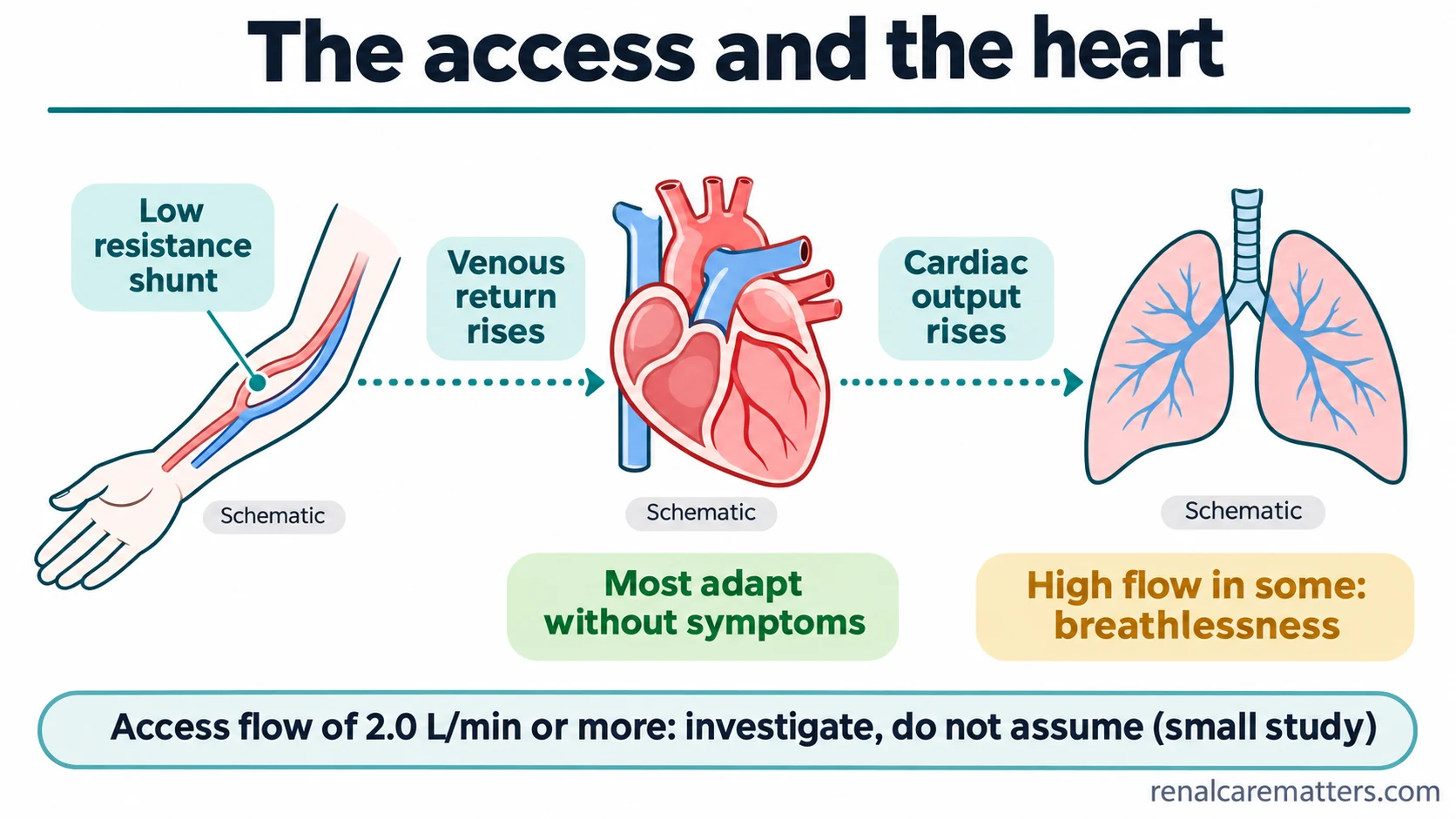
Basile and colleagues measured access flow and cardiac output in 96 patients. Upper-arm fistulas had higher flow (mean 1.58 L/min versus 0.95 for forearm fistulas) and were associated with high-output heart failure. Access flow of 2.0 L/min or more predicted high-output failure with a sensitivity of 89% and specificity of 100% in that cohort.2 It was a small single-center study with ten cases of heart failure, so treat 2.0 L/min as a prompt to investigate, not a diagnosis.
| Possible cause of breathlessness | Supporting clues |
|---|---|
| Volume overload | Weight above target, edema, improves with fluid removal |
| Access-related high output | High access flow, high cardiac output, dilated chambers, symptoms improve with brief access compression |
| Ischemic or valvular heart disease | Angina, wall-motion abnormality, valve lesion |
| Anemia | Low hemoglobin |
| Lung disease, pulmonary hypertension from other causes | History, imaging, lung function |
Central venous stenosis: anatomy versus illness
Central venous stenosis usually follows catheters or device leads (Modules 3 and 8). In an access arm it causes swelling of the arm, breast or face, venous collaterals, prolonged bleeding and high venous pressures. It may also be found on imaging in a patient with no symptoms. UKKA suggests a multidisciplinary approach that considers symptoms, access function, preference and the kidney replacement journey (statement 7.2, grade 2C), and that asymptomatic central venous stenosis be managed conservatively (7.3, grade 2C).1 Treating a lesion that is not causing a problem can injure the vein and accelerate restenosis.
When stenosis is symptomatic, options include angioplasty with or without a stent, reducing access flow to lower the venous load, surgical bypass, devices that bypass central obstruction (for example a graft connected to a catheter ending in the right atrium), or moving the access. Each has a cost to the future.
Weighing interventions with the team
Before any irreversible step, define what result would support the working diagnosis. For high-output failure: does brief manual compression of the access slow the heart rate and lower cardiac output? Do symptoms improve after flow reduction? A multidisciplinary discussion with cardiology and nephrology avoids one specialty’s fix becoming another’s problem.
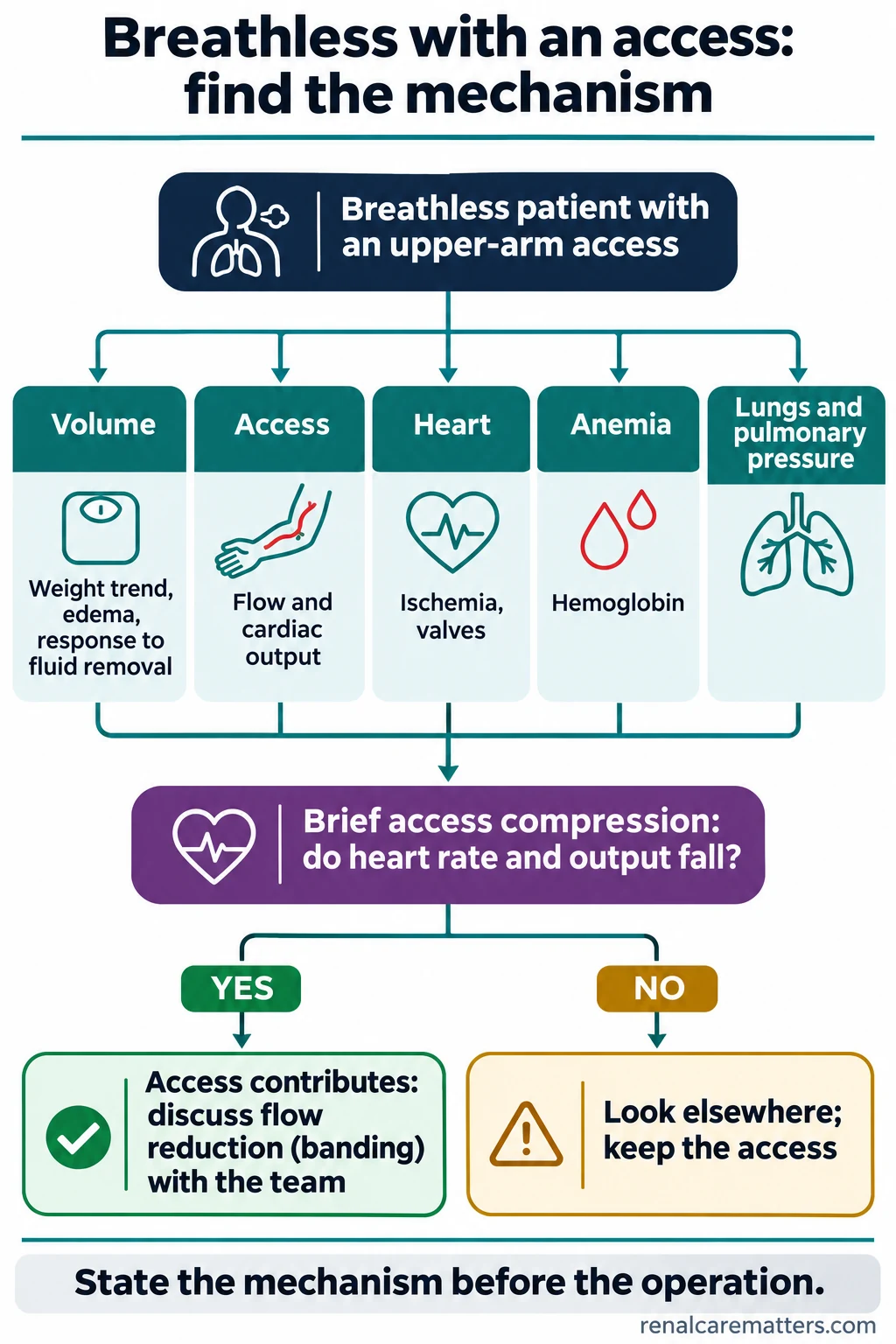
Flow reduction (banding) aims to keep a usable access at lower flow. In a small series, banding in nine patients with cardiac overload lowered access flow from about 3.2 to 1.2 L/min, and accesses stayed functional over a mean of 30 months.3 It is a case series without controls. Ligation removes the load completely but sacrifices the access and may require a catheter, a cost that matters more for a patient awaiting transplant.
A patient with a 3.1 L/min upper-arm fistula and breathlessness undergoes echocardiography during brief access compression: the heart rate falls by 12 beats per minute and cardiac output drops substantially. The team agrees on banding with a target flow, and to re-measure symptoms and output at three months.
What this shows. A test that predicts the effect of the operation turns a guess into a plan.
Illustrative scenario. Names and details are invented.
Back to the case: Breathless despite dry weight
Mechanisms. Volume overload despite target-weight changes, access-related high output (flow 2.8 L/min, dilated left ventricle with preserved ejection fraction), pulmonary hypertension from other causes, coronary or valve disease, and anemia. They can coexist.
Supporting evidence. A measured cardiac output and the ratio of access flow to cardiac output; the response of heart rate and output to brief access compression; exclusion of anemia and ischemia; and a review of volume status by bioimpedance or clinical trend. Access flow over 2.0 L/min prompts this work-up but does not settle it.
Options. If the work-up supports an access contribution, banding to reduce flow could relieve symptoms while keeping a usable fistula until transplant. Ligation would remove the load but leave him needing other access. Present both to Mr. Pineda with the team’s view, and agree on measures of success at follow-up.
Skills checklist: Multidisciplinary problem formulation
Case conference with cardiology and nephrology input. Your preceptor rates each step as satisfactory, needs practice, or not observed. Steps marked Critical must all be satisfactory before sign-off. This checklist supports supervised learning; your unit’s own procedure and competency form are the authority. A printable version of every checklist is on the trainer page.
- Builds a differential for breathlessness or swelling
- CriticalStates the evidence needed to support an access contribution
- Compares the consequences of flow reduction, outflow treatment and ligation
- CriticalAvoids irreversible access loss without adequate assessment, outside emergencies
- Names review and follow-up owners and the measures of success
Check your understanding
Each visit draws 5 questions at random from this module’s 5-question bank. Choose the single best answer for each, then select Check answers; an explanation appears under the best answer. Select New set of questions for a different mix. A good target is 4 of 5 on two different sets. Nothing you select is sent anywhere; scoring happens in your browser.
Read next on this site
- Heart Failure & Chronic Kidney DiseaseHeart failure in kidney disease.
- Heart & Kidney Connection — When Protecting One Saves BothHow the heart and kidney influence each other.
- Cardiovascular Disease & Sudden Death in DialysisWhy cardiovascular disease dominates dialysis outcomes.