Registries and their purposes, the restricted donor record, defining measures, and equity review.
PublishedNailathalaGipatikPepalwal:ReferencesMga SanggunianMga TinubdanReng Reperensya:4Audience: Clinical transplant coordinators (usually registered nurses) and coordination-support staff in Philippine kidney transplant programs · Z Benefits coordinators · transplant and dialysis staff who refer, prepare, or follow recipients and living donorsRead timeOras ng pagbasaOras sa pagbasaOras ning pamamasa:
Training track for the people who navigate kidney recipients and living donors
This module is study material for kidney transplant coordinators and coordination-support staff. It explains the reasoning behind coordination decisions; it is not a hospital protocol, legal advice, or a benefits ruling. Rules and rates change: confirm every rule against the current issuance and your facility’s approved policy. Medical decisions belong to the transplant team, donation ethics to the ethics committee, and benefits to PhilHealth. Every case, name, and identifier is fictional.
Learning objectives
After this module you should be able to
Explain the purpose, owner, and authorized users of each registry and report a transplant program feeds.
Protect the restricted donor record and apply Data Privacy Act principles to everyday coordination.
Define a quality measure with numerator, denominator, time window, and exclusions before counting.
Report a rate with its uncertainty and compare it across groups for equity.
Classroom 2 hSkills lab 2 hSupervised placement 2 h
Pre-testBefore you read, answer the 5 self-assessment questions and note your score. After the module, select New set of questions and compare. The difference is what you learned; the questions you still miss are what to reread.
Start here
The big picture, in plain words
In plain wordsData in a transplant program are like the instruments in a cockpit. The national registry, the Philippine Health Insurance Corporation (PhilHealth) registry, and the program’s own logs each show something different. If the instruments are wrong, the pilot flies confidently in the wrong direction. If too many people can see and touch the instruments, someone eventually bumps a switch.
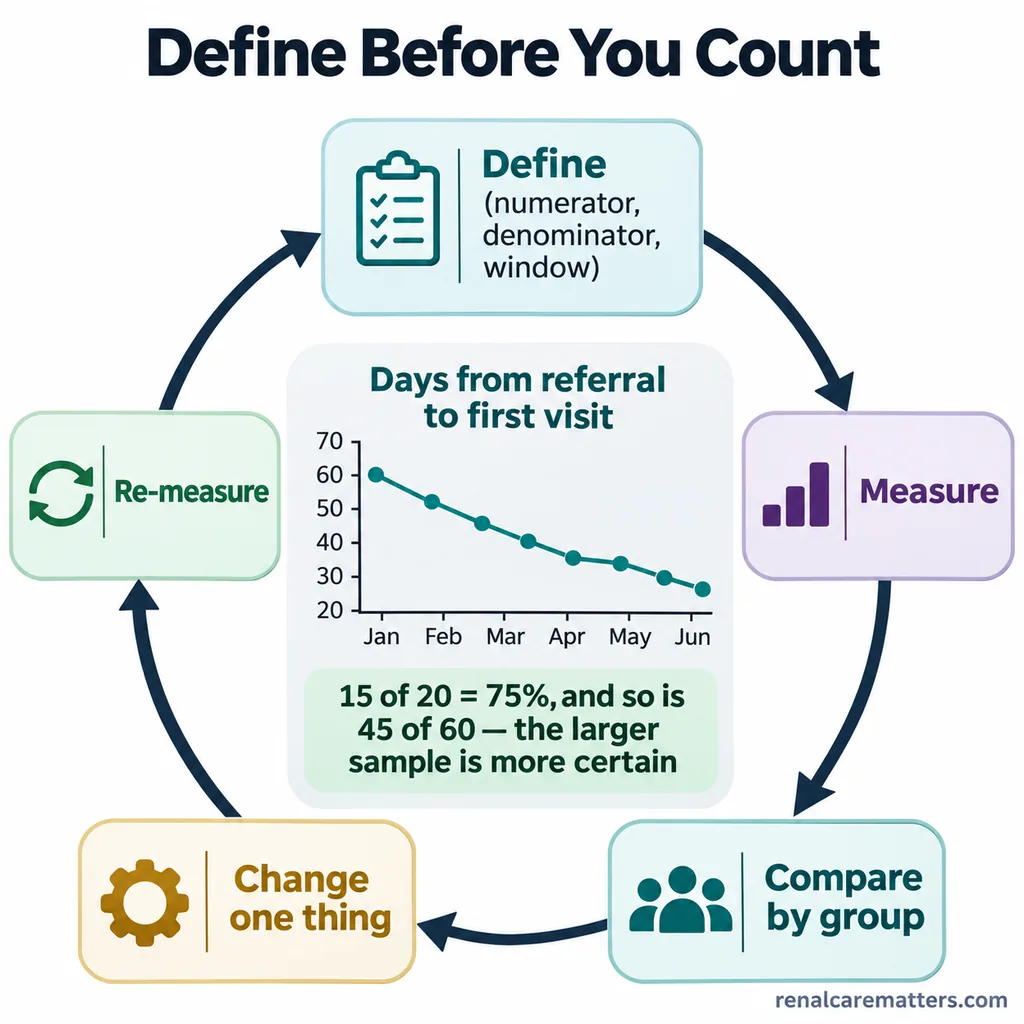
Figure 1. Define the measure before you count, compare across groups for equity, and re-measure after a change.
The picture has a limit. Cockpit instruments measure the plane. A transplant program’s data describe people who trusted it with very private facts: a donor’s reasons for stopping, a recipient’s depression, a family’s debts. So this module has two halves that support each other. Privacy keeps the data safe enough that people keep telling the truth. Good measurement makes the data accurate enough to improve the service.
The Data Privacy Act treats health information as sensitive personal information, with stricter rules for collecting, sharing, and keeping it.1 Registries have their own legal bases and owners: PhilHealth’s kidney transplantation (KT) Data Registry for pre-authorized patients,2 the national waiting list,3 and the Department of Health (DOH) annual reporting of transplant facilities.4 Your job is to enter only what is needed, through authorized users, and to turn the program’s own logs into honest measures.
Figure 2 · Key terms for this module
RegistryA database kept for a defined purpose by a defined owner.
Authorized userA person trained and designated to enter or view data in a system.
Restricted recordThe part of a record open only to those who need it, such as a donor’s private reasons.
Numerator and denominatorThe count of events and the count of people who could have had them.
Confidence intervalA range that shows how uncertain a rate is.
Equity reviewComparing measures across groups to find unfair gaps.
Opening case · fictional
Case: The dashboard and the drawer
The program director asks you for a dashboard for the annual review. She wants “donor follow-up rate,” “time from referral to first visit,” and “how many claims were denied.”
While gathering data, you notice that the shared drive folder “Transplant 2026” holds scanned donor psychiatric reports, open to everyone in the department, including billing staff. In a desk drawer at the nurses’ station you find a printed list of wait-listed candidates with phone numbers and blood groups.
Your first count shows “donor follow-up: 15 of 20 (75%)” for one year, but you are not sure whether donors who moved abroad were included.
Before reading on, decide:
What privacy problems do you see, and what do you do today?
How should “donor follow-up rate” be defined before you count?
How do you report 15 of 20 honestly, and what equity check would you add?
Keep your answers in mind. The lesson gives you what you need, and the case review near the end shows one sound response.
Lesson · part 1
Enter what is needed, through the right person
System
Purpose
Who enters data
PhilHealth KT Data Registry
A package requirement for all pre-authorized patients; electronic from May 1, 2026
Program logs (referrals, register, claims, recalls)
Running and improving the service
Coordinators and program staff
Each system has its own owner and its own definitions. Reconcile them on a schedule (Module 12), correct errors through each system’s process, and never share login credentials: one person, one account, so the audit trail means something.
RememberEach registry has a purpose, an owner, and authorized users. Enter only what that purpose needs, under your own account.
Lesson · part 2
Privacy in everyday coordination
Most privacy failures are ordinary: a shared folder with the wrong permissions, a printed list left in a drawer, a group chat used for patient details, a family member told something the person did not authorize.
Principle
What it means for a coordinator
Purpose
Collect and use information only for the reason it was given
Minimum necessary
Share only what the receiver needs; the billing office does not need psychiatric reports
Access control
The restricted donor record is open only to named roles; access is reviewed
Security
Approved systems only; no personal messaging apps for patient details; locked storage for paper
Incidents
Report a possible breach to the data protection officer at once and preserve evidence
Stop and callIf personal information has been exposed — a misdirected message, an open folder, a lost list — report it to the data protection officer within the hour of discovery, contain what you can (for example, ask IT to restrict the folder), and do not delete evidence. The controller decides on any notification.
RememberMinimum necessary, named access, approved systems, and an immediate report when something leaks.
Lesson · part 3
A measure is a definition first
“Donor follow-up rate” sounds simple until you ask who counts. Write the definition before touching the data.
Part
Example: donor follow-up at 1 year
Numerator
Donors with a recorded blood pressure, kidney function, and urine albumin within 10 to 14 months after donation
Denominator
All donors who donated 10 to 14 months before the review date
Exclusions
Donors who died (reported separately); stated in advance
Special handling
Donors who moved abroad stay in the denominator; results from their own doctor count if received
Data source
The donor follow-up log, checked against clinic records
Report every rate with its numerator and denominator, and with its uncertainty. Fifteen of 20 is 75%, and so is 45 of 60, but the first is much less certain; with 20 donors, the true rate could plausibly be anywhere from the low 50s to around 90 percent. A small program should be cautious about month-to-month changes and should prefer run charts over single numbers.
Measure
Why it matters
Days from referral receipt to first visit
Access and loop closure (Module 3)
Donor follow-up completeness at 1 year
The program’s duty to donors (Module 17)
Pre-authorizations that expired before surgery
Coordination of clocks (Module 10)
Claims returned or denied, by reason
Evidence that follows care (Module 11)
Barrier register rows overdue
Follow-through (Module 1)
RememberDefine the numerator, denominator, window, and exclusions first. Report the count and the uncertainty with every rate.
Lesson · part 4
Fairness you can measure
An overall average can look fair while one group falls behind. Once a year at least, split the main access measures by sex, age group, province or distance, income proxy (for example, PhilHealth membership category), and language. If people from far provinces take twice as long to reach a first visit, or women make up most of your donors but few of your recipients, that is a finding to act on (Module 3).
Then close the loop on your own improvement work: define, measure, compare, change one thing, and measure again with the same definition.
On the floor · The province that waited longest
A program’s median time from referral to first visit is 21 days. Split by province, it is 14 days for Metro Manila referrals and 49 days for referrals from two northern provinces, where letters were carried by patients.
The program asks those dialysis units to send referrals by secure email with a same-day acknowledgment. Six months later, the northern median is 20 days.
The average hid the gap; the split found it; the same definition proved the fix worked.
Illustrative scenario. Names and details are invented.
RememberSplit every access measure by group at least once a year, act on the gaps, and re-measure with the same definition.
On the floor
Real situations: problems and solutions
These are fictional but typical. For each one, cover the answer, decide what you would do, then compare. Where a step depends on local rules, your unit’s procedure and your supervisor’s direction come first.
The group chat
What you see
Coordinators share candidate details in a messaging group.
What is likely going on
A privacy risk.
What to do
Move the work to the approved system; report to the data protection officer.
Why it matters
Messaging apps are not secure clinical systems.
The shared login
What you see
Two coordinators share one registry account.
What is likely going on
Audit trail broken.
What to do
Request a separate account; stop sharing.
Why it matters
Each entry must be traceable to a person.
The impressive rate
What you see
A report shows 100% donor follow-up from 4 donors.
What is likely going on
A small denominator.
What to do
Report the counts and the uncertainty.
Why it matters
Small numbers can mislead decisions.
Field notes
Share the minimum necessary.
One person, one account.
Define the measure before counting.
Split measures by group yearly.
Case review
Back to the case: The dashboard and the drawer
Privacy today. Report the open folder of donor psychiatric reports to the data protection officer within the hour and ask IT to restrict access to the named roles; do not delete anything. Secure the printed wait-list in locked storage or return it to the system owner for proper disposal, and report it as well. Remind the team that patient details belong only in approved systems.
Defining the rate. Write the definition first: numerator, denominator, time window, exclusions stated in advance, and how donors abroad are handled (kept in the denominator; results from their own doctor count if received). Then recount.
Reporting. Report “15 of 20 (75%)” with a note that, with 20 donors, the uncertainty is wide, and show the trend over time rather than one number. Add an equity split for donors living far from the center or abroad, since distance is a common barrier to follow-up.
Skills lab · with your preceptor
Skills checklist: Privacy check and a defined measure
Audit a mock program folder for privacy problems and build one defined measure while your preceptor observes. Your preceptor rates each step as satisfactory, needs practice, or not observed. Steps marked Critical must all be satisfactory before sign-off. This checklist supports supervised learning; your unit’s own procedure and competency form are the authority. A printable version of every checklist is on the trainer page.
CriticalIdentifies minimum-necessary and access-control failures in a mock shared folder.
CriticalReports a simulated privacy incident to the data protection officer within the hour without deleting evidence.
CriticalWrites a measure definition with numerator, denominator, window, and exclusions before counting.
Reports a rate with counts and a statement of uncertainty.
Splits a measure by at least two groups and states one finding.
Placement activity. Run an access review of your program’s restricted donor records with the data protection officer.
Self-assessment
Check your understanding
Each visit draws 5 questions at random from this module’s 10-question bank. Choose the single best answer for each, then select Check answers; an explanation appears under the best answer. Select New set of questions for a different mix. A good target is 4 of 5 on two different sets. Nothing you select is sent anywhere; scoring happens in your browser.
Educational material for transplant coordination staff. Completing it is an Academy learning record only. It is not a DOH-recognized training credit, a PhilHealth requirement, a certification, or CPD units, and it does not appoint anyone as a donor advocate or confer any clinical authority.