A whole case from referral to follow-up, and what to borrow (and not borrow) from the United States, the United Kingdom, and Australia.
PublishedNailathalaGipatikPepalwal:ReferencesMga SanggunianMga TinubdanReng Reperensya:7Audience: Clinical transplant coordinators (usually registered nurses) and coordination-support staff in Philippine kidney transplant programs · Z Benefits coordinators · transplant and dialysis staff who refer, prepare, or follow recipients and living donorsRead timeOras ng pagbasaOras sa pagbasaOras ning pamamasa:
Training track for the people who navigate kidney recipients and living donors
This module is study material for kidney transplant coordinators and coordination-support staff. It explains the reasoning behind coordination decisions; it is not a hospital protocol, legal advice, or a benefits ruling. Rules and rates change: confirm every rule against the current issuance and your facility’s approved policy. Medical decisions belong to the transplant team, donation ethics to the ethics committee, and benefits to PhilHealth. Every case, name, and identifier is fictional.
Learning objectives
After this module you should be able to
Coordinate one recipient and one donor from referral to follow-up, applying the four gates at every step.
Handle simultaneous problems in the right order: safety first, then deadlines, then routine.
Recognize and avoid the critical failures that cannot be averaged away in assessment.
Compare Philippine practice with United States, United Kingdom, and Australian practice, and decide what to borrow and what needs local legal review.
Classroom 2 hSkills lab 2 hSupervised placement 2 h
Pre-testBefore you read, answer the 5 self-assessment questions and note your score. After the module, select New set of questions and compare. The difference is what you learned; the questions you still miss are what to reread.
Start here
The big picture, in plain words
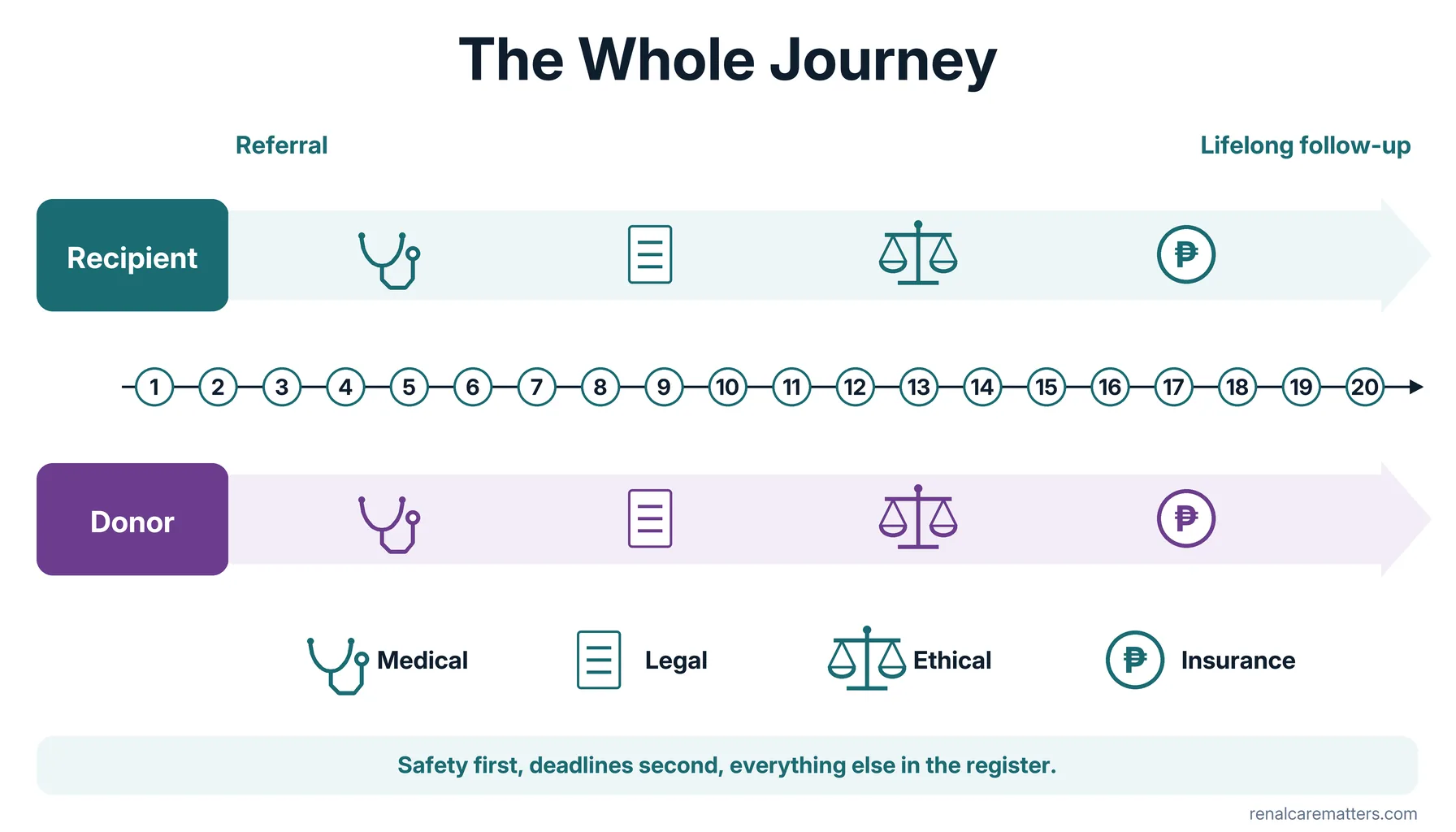
In plain wordsUp to now each module has been one stretch of road. The capstone drives the whole route in one go, at night, in the rain, with two passengers who each need something different. The skill being tested is not knowing each stretch; it is knowing which problem to handle first when three arrive at once.
Figure 1. The whole journey on one page. Each module is one stretch of road.
The picture has a limit. A real case is never driven in one sitting; it unfolds over months, with weeks of quiet between bursts of urgency. The capstone compresses that into a two-hour simulation so that a preceptor can see how you sort, route, and close. It also asks you to look outward: other countries have built coordinator roles, donor advocates, and independent checks that are worth learning from — and rules that do not apply here.
Use the same sorting rule as on any busy shift. First, anything that could harm a person now: a safety signal, a sensitizing event before an offer, a discrepancy, a donor in distress. Second, anything with a deadline that cannot be recovered: a pre-authorization about to lapse, a claim window closing, a courier leaving. Third, everything else, in the register with an owner and a date.
Figure 2 · Key terms for this module
CapstoneA simulated integrated case scored by a preceptor.
Critical failureAn action so unsafe that it fails the capstone regardless of the total score.
Independent living donor advocate (ILDA)A US role that represents only the donor; a comparison, not Philippine law.
Independent assessmentA UK process in which an independent assessor checks a living donation for consent and reward; a comparison.
JurisdictionThe legal system a rule belongs to.
Opening case · fictional
Case: The capstone: four problems, one evening
You are the on-call coordinator from 5 p.m. to 8 a.m. Your caseload includes this pair: Mr. Ruben Garcia, 48, wait-listed and also awaiting a living donation from his friend of twenty years, Mr. Alvin Torres, 46, who is in evaluation.
5:20 p.m. Mr. Torres calls privately: he wants to withdraw, and he does not want Mr. Garcia to know why.
6:05 p.m. The Z Benefits lead emails that Mr. Garcia’s pre-authorization, approved for the planned living-donor transplant, expires in nine days.
9:30 p.m. Mr. Garcia’s wife messages that he received two units of blood at a local hospital yesterday after a fall.
1:45 a.m. The procurement team calls with a deceased-donor kidney offer for Mr. Garcia.
Before reading on, decide:
In what order do you handle the four events, and why?
What exactly do you say to Mr. Garcia about the living donation?
What does the offer call require, given yesterday’s transfusion?
Keep your answers in mind. The lesson gives you what you need, and the case review near the end shows one sound response.
Lesson · part 1
The capstone method
Event
Category
Action
Owner
Donor withdraws privately
Safety and rights
Thank him; confirm he may stop; record in his restricted record; inform his advocate and donor team; agree neutral wording
Donor advocate and donor team
Transfusion yesterday
Safety (sensitizing event)
Report tonight to the transplant physician and human leukocyte antigen (HLA) laboratory; request the transfusion record
Transplant physician
Night offer
Safety and time
Structured call with read-back; tell the decision maker about the transfusion before any decision
Transplant surgeon or physician on call
Pre-authorization expiring
Deadline
Flag to the Z Benefits lead; the living-donor plan has closed, and a deceased-donor transplant follows its own pre-authorization rule (within two working days after the procedure)
Z Benefits lead
The scoring has five dimensions, each 0 to 4: separation and privacy; routing to decision owners; timeliness; communication with each person; and documentation and loop closure. A pass needs 16 of 20, every dimension at least 2, and no critical failure.
RememberSafety first, unrecoverable deadlines second, everything else into the register. Every action names its owner.
Lesson · part 2
What cannot be averaged away
Some actions fail the capstone regardless of the score, because in real life they can cause harm that no amount of good work elsewhere undoes.
Disclosing a donor’s private reasons to the recipient or family.
Presenting a payment approval or a test result as clinical or ethical clearance.
Advancing a case with an unresolved coercion, identity, or document concern.
Letting a pre-authorization lapse without flagging it.
Accepting offer details without read-back, or passing over a discrepancy.
Failing to report a sensitizing event before a compatibility decision.
Giving medicine advice outside protocol.
Treating a sent message as a closed loop on an urgent matter.
RememberA critical failure fails the capstone, because in practice it can cause harm no total score can repair.
Lesson · part 3
Borrow principles, not laws
Other countries have built transplant coordination over decades. Their experience is useful; their rules are theirs.
Country or body
What it does
What to borrow
What needs Philippine legal review
United States: Organ Procurement and Transplantation Network (OPTN)
Requires an independent living donor advocate (ILDA) and sets donor follow-up reporting points1
A person who represents only the donor; structured follow-up
US advocate qualifications, reporting deadlines, and allocation scores
United States: American Board for Transplant Certification (ABTC)
Separate certification paths for clinical and procurement coordinators, with experience requirements2
Clear separation of clinical and procurement roles
A US credential is not a Philippine qualification
United Kingdom: Human Tissue Authority
Independent assessment of living donations for consent and absence of reward3
An independent check outside the transplant team
UK law and processes; the Philippine safeguard is the Department of Health (DOH) order and the Hospital Transplant Ethics Committee (HTEC)
Australia: state health services
Advanced nursing coordinator roles that include education, case conferences, and quality work
Coordinators who lead improvement, not only tasks
One employer’s grade is not a national qualification
Kidney Disease: Improving Global Outcomes (KDIGO) and World Health Organization (WHO)
Global frameworks for candidates, donors, recipients, and ethical donation4,5,6
Evidence-based pathways; voluntariness and financial neutrality
Guidelines do not override Philippine law or authorize independent clinical acts
RememberBorrow principles that fit Philippine safeguards; never apply a foreign deadline, credential, or allocation rule as if it were local law.
Lesson · part 4
Keeping it current
The rules in this course will change. Philippine Health Insurance Corporation (PhilHealth) Circular 2026-0019 was published days before this course was written;7 DOH orders are revised; KDIGO updates its guidelines. Keep your source register current (Module 2), read every new circular for its effective date and legacy rule, and ask your program to review its role charter yearly.
Completing the course is an Academy learning record. It is not certification, continuing professional development (CPD) units, or a DOH or PhilHealth qualification. Competence is shown in practice, signed off by your preceptor, on your program’s own procedures.
RememberKeep the source register current, read every rule for its effective date, and let practice, not paperwork, show competence.
On the floor
Real situations: problems and solutions
These are fictional but typical. For each one, cover the answer, decide what you would do, then compare. Where a step depends on local rules, your unit’s procedure and your supervisor’s direction come first.
The foreign form
What you see
A colleague brings a US donor follow-up form to use as is.
What is likely going on
A useful template with foreign rules.
What to do
Adapt the structure; remove US-specific deadlines; align with Philippine rules.
Why it matters
Foreign rules are not Philippine law.
Three things at once
What you see
A withdrawal, an expiring authorization, and an offer arrive in one hour.
What is likely going on
Competing priorities.
What to do
Safety first, unrecoverable deadlines second, the rest to the register.
Why it matters
Order prevents harm.
The credential question
What you see
A learner asks if completing the course makes her certified.
What is likely going on
A misunderstanding.
What to do
Explain that it is a learning record, not certification.
Why it matters
Overstated credentials mislead employers and patients.
Field notes
Sort by safety, deadline, routine.
Know the critical failures.
Borrow principles, not laws.
Keep the source register current.
Case review
Back to the case: The capstone: four problems, one evening
Order. At 5:20 p.m., the donor’s withdrawal (his rights and safety) and, as soon as you learn of it at 9:30 p.m., the transfusion (a sensitizing event) come first; both are routed the same evening. At 1:45 a.m., the offer call follows the script, and the transfusion is told to the decision maker before any decision. The pre-authorization flag goes to the Z Benefits lead the same evening; the living-donor plan has closed, so the team and lead decide what applies next.
What Mr. Garcia hears. Only the neutral wording agreed with Mr. Torres and his team: “The team is not able to proceed with this donor.” Then support Mr. Garcia: he remains on the waiting list, and the team will talk with him about other options.
The offer. Structured call with read-back of identifiers, blood group, and times; immediate escalation to the on-call surgeon or physician with the transfusion information; the HLA laboratory informed so it can advise on the crossmatch. If the transplant proceeds, the deceased-donor pre-authorization is due within two working days after the procedure, and two separate journeys continue: his, and Mr. Torres’s, who still deserves the program’s support and respect.
Skills lab · with your preceptor
Skills checklist: Capstone simulation
Complete the 120-minute capstone with injected events while your preceptor scores five dimensions. Your preceptor rates each step as satisfactory, needs practice, or not observed. Steps marked Critical must all be satisfactory before sign-off. This checklist supports supervised learning; your unit’s own procedure and competency form are the authority. A printable version of every checklist is on the trainer page.
CriticalSorts simultaneous events by safety, unrecoverable deadline, and routine, and explains the order.
CriticalHandles a private donor withdrawal without disclosure, using agreed neutral wording.
CriticalReports a sensitizing event to the physician and HLA laboratory before a compatibility decision.
CriticalRuns an offer call with read-back and escalation.
CriticalFlags an expiring pre-authorization to the correct owner.
Documents every action with time, owner, and closure evidence.
Compares one foreign practice with Philippine safeguards and states what to borrow and what needs legal review.
Placement activity. Present one real (de-identified) case from your program as a journey map, marking each gate and who closed it.
Self-assessment
Check your understanding
Each visit draws 5 questions at random from this module’s 10-question bank. Choose the single best answer for each, then select Check answers; an explanation appears under the best answer. Select New set of questions for a different mix. A good target is 4 of 5 on two different sets. Nothing you select is sent anywhere; scoring happens in your browser.
Go deeper
Read next on this site
Kidney TransplantThe patient guide, to revisit the whole journey from the patient’s side.
Chadban, S. J., Ahn, C., Axelrod, D. A., Foster, B. J., Kasiske, B. L., Kher, V., Kumar, D., Oberbauer, R., Pascual, J., Pilmore, H. L., Rodrigue, J. R., Segev, D. L., Sheerin, N. S., Tinckam, K. J., Wong, G., & Knoll, G. A. (2020). KDIGO clinical practice guideline on the evaluation and management of candidates for kidney transplantation. Transplantation, 104(4S1 Suppl 1), S11–S103. https://doi.org/10.1097/TP.0000000000003136
Lentine, K. L., Kasiske, B. L., Levey, A. S., Adams, P. L., Alberú, J., Bakr, M. A., Gallon, L., Garvey, C. A., Guleria, S., Li, P. K., Segev, D. L., Taler, S. J., Tanabe, K., Wright, L., Zeier, M. G., Cheung, M., & Garg, A. X. (2017). KDIGO clinical practice guideline on the evaluation and care of living kidney donors. Transplantation, 101(8S Suppl 1), S1–S109. https://doi.org/10.1097/TP.0000000000001769
Educational material for transplant coordination staff. Completing it is an Academy learning record only. It is not a DOH-recognized training credit, a PhilHealth requirement, a certification, or CPD units, and it does not appoint anyone as a donor advocate or confer any clinical authority.