Making barriers speakable, money and mental health, overseas workers and foreign nationals, children, and pregnancy.
PublishedNailathalaGipatikPepalwal:ReferencesMga SanggunianMga TinubdanReng Reperensya:6Audience: Clinical transplant coordinators (usually registered nurses) and coordination-support staff in Philippine kidney transplant programs · Z Benefits coordinators · transplant and dialysis staff who refer, prepare, or follow recipients and living donorsRead timeOras ng pagbasaOras sa pagbasaOras ning pamamasa:
Training track for the people who navigate kidney recipients and living donors
This module is study material for kidney transplant coordinators and coordination-support staff. It explains the reasoning behind coordination decisions; it is not a hospital protocol, legal advice, or a benefits ruling. Rules and rates change: confirm every rule against the current issuance and your facility’s approved policy. Medical decisions belong to the transplant team, donation ethics to the ethics committee, and benefits to PhilHealth. Every case, name, and identifier is fictional.
Learning objectives
After this module you should be able to
Ask about money, work, family, fear, and mood in ways that make barriers speakable.
Route psychosocial concerns to the social worker, psychologist, or psychiatrist, and keep them in the right record.
Adapt the pathway for overseas workers, foreign nationals, children, and pregnancy questions without lowering any safeguard.
Respond to a disclosed medicine stop or a crisis safely and within scope.
Classroom 2 hSkills lab 2 hSupervised placement 2 h
Pre-testBefore you read, answer the 5 self-assessment questions and note your score. After the module, select New set of questions and compare. The difference is what you learned; the questions you still miss are what to reread.
Start here
The big picture, in plain words
In plain wordsSome barriers are like rocks on a road: you can see them and drive around them. Others are like potholes filled with rainwater: they look like the road until a wheel goes in. Money worries, fear, shame, depression, and family conflict are potholes. People rarely mention them until someone asks in a way that makes it safe to answer.
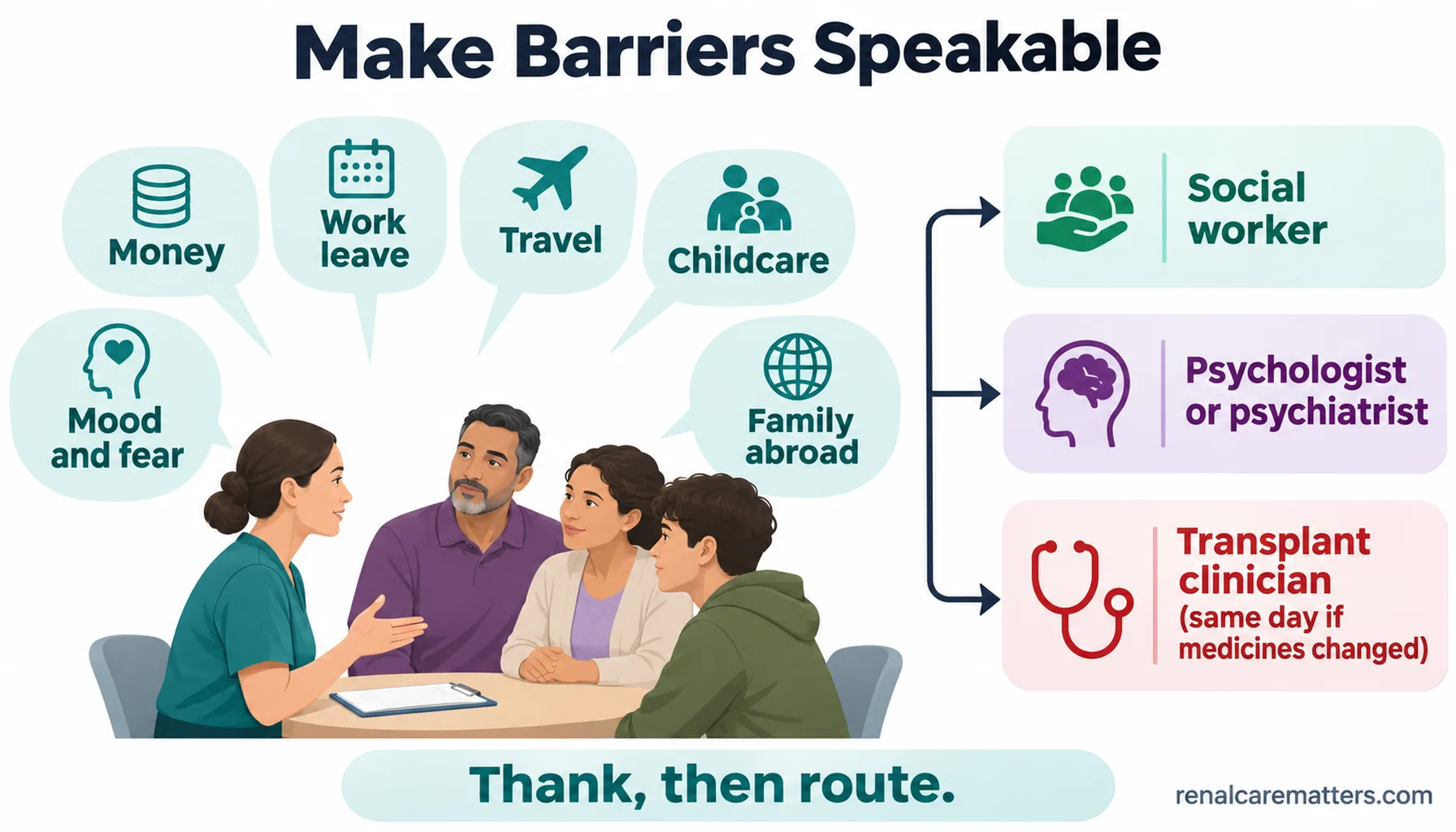
Figure 1. Make barriers speakable. People share worries when someone asks plainly and listens.
The picture has a limit. A pothole stays where it is. Psychosocial barriers move: a job is lost, a marriage strains, a donor’s family turns against the donation, a recipient becomes depressed after a long wait. Kidney Disease: Improving Global Outcomes (KDIGO) advises a psychosocial assessment of every candidate by an experienced professional,1 and the Department of Health (DOH) order requires psychiatric or psychological and social-work evaluation of every living donor.2 Those assessments happen once or twice. The coordinator is in contact far more often, and is often the first to hear that something has changed.
Money and mental health are linked in the evidence. In a Canadian cohort of 821 living donors, those with higher donation-related expenses had worse mental health-related quality of life three months after donation, after adjusting for their mental health before donation.3 The study was observational and cannot prove cause, but it fits what coordinators see: unresolved practical problems weigh on people.
Figure 2 · Key terms for this module
PsychosocialThe mental, emotional, social, and practical parts of a person’s situation.
Overseas Filipino worker (OFW)A Filipino working abroad; a frequent donor or recipient situation in Philippine programs.
Pediatric recipientA child receiving a kidney; with its own Philippine Health Insurance Corporation (PhilHealth) post-transplant package.
Safety concernAny sign that a person may harm themself or others, or is being harmed.
Opening case · fictional
Case: The quiet signs
Mr. Edwin Salazar, 39, received a kidney from his sister ten months ago. At a routine clinic visit he mentions, almost in passing, that he lost his job three months ago, has been “stretching” one of his medicines by taking it every other day because it is expensive, and has not been sleeping. He says he feels he has “wasted” his sister’s kidney.
In the same week, a potential donor for another recipient, Mr. Jeric Bautista, 30, an overseas Filipino worker in Qatar, tells you he must fly back in four weeks and asks whether the evaluation “can be finished faster.” His mother, the recipient, has been calling him daily.
Before reading on, decide:
What does Mr. Salazar need today, and from whom?
How do you plan Mr. Bautista’s evaluation without pressure in either direction?
What goes in which record?
Keep your answers in mind. The lesson gives you what you need, and the case review near the end shows one sound response.
Lesson · part 1
Ask plainly, listen fully
Ask the same plain questions at regular contacts, in the person’s language, in private:
“Has anything changed at work or at home since we last spoke?”
“Are any of your medicines or tests hard to pay for right now?”
“How have you been feeling in yourself: sleep, mood, worries?”
“Is there anything you’ve stopped or changed because it was too hard?”
When someone answers, thank them before anything else. People who are scolded for a disclosure stop disclosing. Then route: medicine changes to the transplant clinician the same day; money and work problems to the social worker; mood, sleep, and distress to the psychologist or psychiatrist the program uses.
Stop and callIf a person says anything suggesting they may harm themself or that they are not safe, stay with them (in person or on the phone), and contact the on-call clinician or the hospital’s crisis pathway at once. Do not end the call to “pass a message.” Local protocol sets the exact steps; when unsure, treat it as urgent.
RememberThank, then route. A disclosure is a gift of trust; handle it so the next one comes too.
Lesson · part 2
Practical help is psychological help
Cost-driven medicine changes are common and dangerous (Module 15). The fix is rarely a lecture; it is a route to the medicine. With the team and social worker, check the post-transplant package coverage,4 where the medicine is dispensed, whether the team can consider an alternative it judges safe, and other assistance (local government, Philippine Charity Sweepstakes Office (PCSO), Medical Assistance for Indigent and Financially Incapacitated Patients (MAIFIP)). The coordinator never decides which medicine to drop or swap.
What you hear
Route today
“I’m taking it every other day to make it last.”
Transplant clinician (dose and levels); social worker (cost)
“I lost my job.”
Social worker; check PhilHealth membership status
“I can’t sleep and I feel I wasted the kidney.”
Psychologist or psychiatrist; clinician if safety is in question
“My family is angry I’m not donating.”
Donor advocate; social worker; restricted record
RememberA cost problem is a medical risk and a mental-health risk. Route all three sides the same day.
Lesson · part 3
Special situations, same safeguards
Situation
What to plan
What never changes
Overseas Filipino worker as donor or recipient
An honest timeline for evaluation, surgery, and recovery; follow-up abroad or remote, agreed with the team
No shortcuts to fit a flight; no pressure from the recipient’s side
Foreign national donor or recipient
The additional review the DOH order and hospital policy require; independent interpretation
Escalation to the ethics committee; document verification at source
Child as recipient
Parent or guardian consent and the child’s own understanding; the pediatric post-transplant package (PC 2025-0011)5
Children are not living donors
Pregnancy questions after donation or transplant
A discussion with the person’s nephrologist and obstetric team
No absolute statements from the coordinator either way
Faith, cultural, or family concerns
Time, a chaplain or trusted adviser if the person wishes, a family meeting the person agrees to
The person’s own decision
On the floor · The donor with a flight
A potential donor working in Saudi Arabia must return in three weeks. The recipient’s family asks coordinator Ms. Pia Santos to “rush” his tests.
Ms. Santos lays out the realistic timeline with the donor team. The donor decides, privately, to plan the evaluation during his next vacation in six months, and the program sets reminders. The recipient continues on the waiting list.
Fitting the pathway to the person meant changing the date, not the safeguards.
Illustrative scenario. Names and details are invented.
RememberChange the timing, the language, the place, or the support. Never change the safeguards.
Lesson · part 4
The right record, the right reader
Psychosocial information is among the most sensitive in a transplant program. A donor’s reasons, a recipient’s depression, a family conflict, a debt — each belongs in the person’s own record, and the most sensitive in the restricted part, open only to those who need it. Health information is sensitive personal information under the Data Privacy Act.6 Record facts and words, not judgments (“said he takes the tablet every other day because of cost,” not “noncompliant patient”).
RememberFacts in the person’s own record, the most sensitive in the restricted part. Words, not labels.
On the floor
Real situations: problems and solutions
These are fictional but typical. For each one, cover the answer, decide what you would do, then compare. Where a step depends on local rules, your unit’s procedure and your supervisor’s direction come first.
The guilt
What you see
A donor feels guilty because the recipient’s kidney is failing.
What is likely going on
Grief and misplaced responsibility.
What to do
Listen; route to psychology; involve the donor’s team.
Why it matters
Donors can carry the outcome as their own.
The job loss
What you see
A recipient lost his job and PhilHealth status is unclear.
What is likely going on
A financial and coverage risk.
What to do
Social worker referral; check membership the same day.
Why it matters
Coverage gaps can stop medicines.
The worried teenager
What you see
A 17-year-old offers to donate to her mother.
What is likely going on
A minor volunteer.
What to do
Thank her; explain kindly that donors must be adults under the DOH order; support the family.
Why it matters
Children are protected from donation.
Field notes
Ask about mood, money, and medicines.
Thank before you route.
Change dates, not safeguards.
Record words, not labels.
Case review
Back to the case: The quiet signs
Mr. Salazar today. Thank him for telling you. Because he has been taking an immunosuppressant every other day, contact the transplant clinician the same day; the team decides on levels and medicines. Refer him to the social worker for the job loss and medicine costs, and check his PhilHealth membership. His sleep, low mood, and guilt go to the psychologist or psychiatrist; ask directly whether he feels safe, and if there is any doubt, use the crisis pathway at once.
Mr. Bautista. Meet him privately. Lay out a realistic timeline with the donor team, including recovery and follow-up abroad. Tell him he may pause, postpone, or stop, and that the timeline will not be shortened by skipping safeguards. Do not pass messages from his mother about the decision; his advocate is there for him.
Records. Mr. Salazar’s disclosures go in his own record, with the mood and safety details where the program keeps sensitive notes. Mr. Bautista’s concerns about timing and family pressure go in his restricted donor record. Nothing crosses between donor and recipient records.
Skills lab · with your preceptor
Skills checklist: Psychosocial check-in and routing
Conduct two simulated check-ins, one with a recipient and one with a donor, while your preceptor observes. Your preceptor rates each step as satisfactory, needs practice, or not observed. Steps marked Critical must all be satisfactory before sign-off. This checklist supports supervised learning; your unit’s own procedure and competency form are the authority. A printable version of every checklist is on the trainer page.
Asks plain questions about work, home, cost, mood, and changes to medicines.
Thanks the person for a disclosure before responding.
CriticalRoutes a cost-driven medicine change to the clinician the same day and to the social worker.
CriticalRecognizes a possible safety concern and uses the crisis pathway without ending contact.
CriticalPlans a special-situation timeline (overseas worker, foreign national, child) without changing safeguards.
Records facts and words in the correct record, without labels.
Placement activity. Shadow the transplant social worker for half a day and list the barriers families raised.
Self-assessment
Check your understanding
Each visit draws 5 questions at random from this module’s 10-question bank. Choose the single best answer for each, then select Check answers; an explanation appears under the best answer. Select New set of questions for a different mix. A good target is 4 of 5 on two different sets. Nothing you select is sent anywhere; scoring happens in your browser.
Chadban, S. J., Ahn, C., Axelrod, D. A., Foster, B. J., Kasiske, B. L., Kher, V., Kumar, D., Oberbauer, R., Pascual, J., Pilmore, H. L., Rodrigue, J. R., Segev, D. L., Sheerin, N. S., Tinckam, K. J., Wong, G., & Knoll, G. A. (2020). KDIGO clinical practice guideline on the evaluation and management of candidates for kidney transplantation. Transplantation, 104(4S1 Suppl 1), S11–S103. https://doi.org/10.1097/TP.0000000000003136
Barnieh, L., Arnold, J. B., Boudville, N., Cuerden, M. S., Dew, M. A., Dipchand, C., Feldman, L. S., Gill, J. S., Karpinski, M., Klarenbach, S., Knoll, G., Lok, C., Miller, M., Monroy, M., Nguan, C., Prasad, G. V. R., Sontrop, J. M., Storsley, L., & Garg, A. X. (2021). Living kidney donors’ financial expenses and mental health. Transplantation, 105(6), 1356–1364. https://doi.org/10.1097/TP.0000000000003401
Educational material for transplant coordination staff. Completing it is an Academy learning record only. It is not a DOH-recognized training credit, a PhilHealth requirement, a certification, or CPD units, and it does not appoint anyone as a donor advocate or confer any clinical authority.