Readiness as a convergence of gates, holds tracked explicitly, and separate handoffs for each person.
PublishedNailathalaGipatikPepalwal:ReferencesMga SanggunianMga TinubdanReng Reperensya:1Audience: Clinical transplant coordinators (usually registered nurses) and coordination-support staff in Philippine kidney transplant programs · Z Benefits coordinators · transplant and dialysis staff who refer, prepare, or follow recipients and living donorsRead timeOras ng pagbasaOras sa pagbasaOras ning pamamasa:
Training track for the people who navigate kidney recipients and living donors
This module is study material for kidney transplant coordinators and coordination-support staff. It explains the reasoning behind coordination decisions; it is not a hospital protocol, legal advice, or a benefits ruling. Rules and rates change: confirm every rule against the current issuance and your facility’s approved policy. Medical decisions belong to the transplant team, donation ethics to the ethics committee, and benefits to PhilHealth. Every case, name, and identifier is fictional.
Learning objectives
After this module you should be able to
Reconcile all four gates for both people into a single readiness view before surgery.
Track holds explicitly, each with an owner, a condition, and the evidence that releases it.
Run or support a readiness huddle that ends in a recorded go, hold, or stop decision by the authorized lead.
Give separate, structured handoffs for the recipient and the donor.
Classroom 2 hSkills lab 2 hSupervised placement 2 h
Pre-testBefore you read, answer the 5 self-assessment questions and note your score. After the module, select New set of questions and compare. The difference is what you learned; the questions you still miss are what to reread.
Start here
The big picture, in plain words
In plain wordsReadiness for surgery is like the last check before a rocket launch. Each station — fuel, weather, guidance, crew — reports “go” or “no go” in turn. The launch director does not count votes. One “no go” holds the launch until that station is fixed.
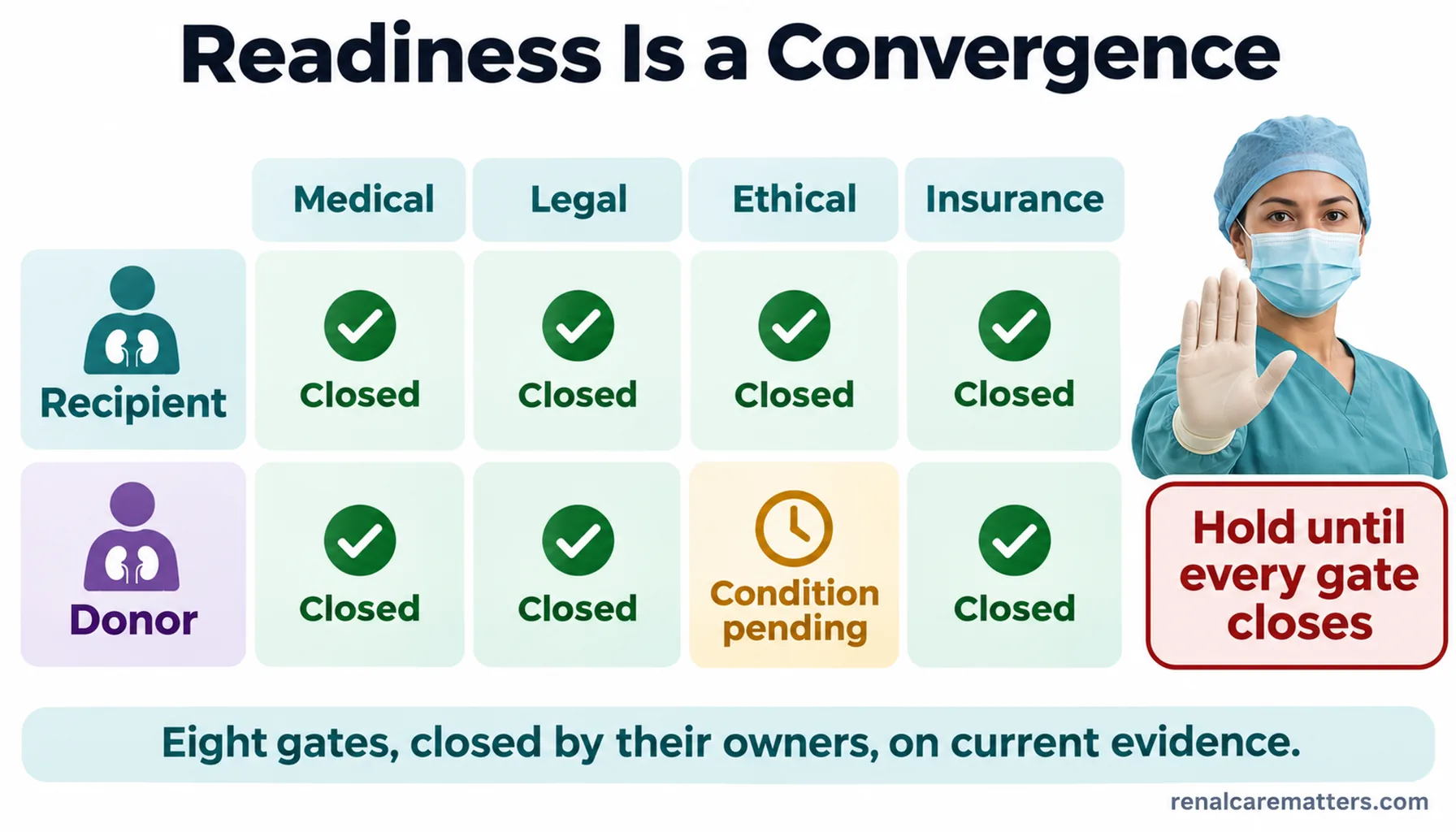
Figure 1. Readiness is a convergence. Every gate, for each person, closed by the person who owns it.
The picture has a limit. A rocket has one crew. A living-donor transplant has two people on two operating tables, each with their own four stations: medical, legal, ethical, and insurance. That makes eight gates, owned by different people, closing on different days. Readiness is the moment they all converge, and it is also the moment pressure peaks: the operating room is booked, families are waiting, and everyone wants the last item to be a formality.
Recall why this matters. Surgery carries a real early risk for the recipient — in a large registry study, death risk in the first two weeks after transplant was 2.8 times that of wait-listed patients before falling far below it1 — and the donor accepts surgical risk with no medical benefit (Module 7). The readiness check is where those risks are accepted deliberately, on current evidence, or not at all.
Figure 2 · Key terms for this module
ReadinessAll gates closed, for both people, by the people who own them, on current evidence.
HoldA stated condition that must be met before surgery, with an owner and release evidence.
HuddleA short structured meeting that ends in a go, hold, or stop decision.
Authorized leadThe person the program designates to make the final go or stop decision.
HandoffThe structured transfer of responsibility from one team to another, with read-back.
Opening case · fictional
Case: The Monday morning list
Mr. Francisco Manalo, 55, is scheduled for a living-donor transplant on Monday at 7:30 a.m. from his son, Mr. Paolo Manalo, 28. It is Friday afternoon.
Your readiness board shows: recipient medical cleared; donor medical cleared; legal packet complete; Hospital Transplant Ethics Committee (HTEC) approved with one condition, “independent interpreter at consent” — done, documented; donor consent signed Wednesday; Philippine Health Insurance Corporation (PhilHealth) pre-authorization valid until next March.
One hold remains: “Final crossmatch within 7 days of surgery.” The last crossmatch was done 9 days before Monday. The laboratory’s weekend courier leaves at 5 p.m. today. Also, the son mentioned on Wednesday that he “felt a bit feverish” and has not been asked about it since.
Before reading on, decide:
Which gates are closed, and which are open?
What do you do before 5 p.m.?
What will the Monday huddle need to see?
Keep your answers in mind. The lesson gives you what you need, and the case review near the end shows one sound response.
Lesson · part 1
Eight gates, one view
Build one readiness view with two columns, one per person, and four rows. Each cell shows the status, the owner, and the evidence.
Gate
Recipient: closed by
Donor: closed by
Medical
Transplant team decision on current results; final compatibility results reviewed
Donor clinicians’ decision on current results; fit for surgery today
Legal
Identity confirmed; recipient consent
Legal packet complete; donor consent by the surgeon with independent witnessing
Ethical
Not usually a separate gate, unless the team raised one
HTEC decision with every condition closed; donor confirms continuing wish
Insurance
Pre-authorization valid on the surgery date; kidney transplantation (KT) registry entry confirmed
Coverage within the package confirmed; no donation-related charges
The four-gate readiness board in the toolkit turns these statuses into a single view that stays “not ready” until every cell is closed. The tool is a display; the people who own each gate close it.
RememberReadiness is eight gates closed by their owners on current evidence. One open gate means not ready.
Lesson · part 2
Every hold has a release
A hold is a condition someone with authority set: “repeat crossmatch within 7 days,” “potassium below a level the team sets on the morning of surgery,” “dental clearance before listing.” Treat each as a register row with four fields: the condition, the owner, the deadline, and the evidence that releases it.
Only the person who set a hold, or their delegate, releases it. A coordinator never releases a hold because the result “was fine last time” or because the date is close. If a hold cannot be met in time, the decision to postpone, proceed with a different plan, or stop belongs to the team; your job is to make the gap visible early, with an Situation, Background, Assessment, Recommendation (SBAR), while there is still time to fix it.
Watch for new information that should become a hold. A donor who mentions a fever, a recipient who missed two dialysis sessions, a new medicine, a family conflict that surfaces late — record it and route it to the gate owner the same day.
On the floor · The crossmatch and the courier
On Thursday afternoon coordinator Ms. Belen Cruz sees that a pre-surgery crossmatch will be 8 days old on the surgery date against a 7-day hold. The laboratory’s last courier leaves in three hours.
She calls the transplant nephrologist, who orders a repeat; Ms. Cruz arranges collection at the patient’s dialysis session that evening and a special courier. The result is reviewed Saturday morning.
The hold was met because the gap was seen while there was still a courier to catch.
Illustrative scenario. Names and details are invented.
RememberEvery hold has an owner and a release. Only the owner releases it; you make the gap visible in time.
Lesson · part 3
Go, hold, or stop, on the record
A huddle the day before or the morning of surgery brings the gate owners together: transplant surgeon, anesthesia, transplant nephrologist, nursing, and the coordinator, with the donor’s team for the donor. Keep it short and structured.
Figure 3 · A readiness huddle
IdentityBoth people, two identifiers each.
GatesEach of the eight gates read aloud with its status and evidence.
HoldsEach hold with its release evidence, or stated as open.
New informationAnything since the last review, for each person.
DecisionGo, hold, or stop, stated by the authorized lead and recorded with the time.
The coordinator presents the board; the authorized lead decides. If anyone in the huddle says they are not satisfied, the lead hears them before deciding. Record the decision, who made it, and any conditions.
RememberThe huddle ends with one recorded decision by the authorized lead. Silence is not agreement.
Lesson · part 4
Two teams, two handoffs
On the day of surgery, the donor and recipient often go to different theaters and different wards, under different teams. Hand each one over separately, to their own receiving team, with read-back.
Identity and the procedure.
Gates and their evidence, with any conditions still to be met.
Allergies, medicines, and anything the team flagged.
Contact preferences: who may receive updates for this person, and who may not.
For the donor: the donor’s own follow-up contact and the plan beyond discharge.
Never combine the two into one family update. The family waiting room is not a handoff channel, and each person’s updates go only to the people they named.
RememberTwo people, two handoffs, two update lists. Read back each one.
On the floor
Real situations: problems and solutions
These are fictional but typical. For each one, cover the answer, decide what you would do, then compare. Where a step depends on local rules, your unit’s procedure and your supervisor’s direction come first.
The new medicine
What you see
The recipient started a new medicine from another doctor last week.
What is likely going on
Unreviewed information.
What to do
Route to the transplant team before surgery.
Why it matters
Some medicines interact with surgery or immunosuppressants.
“It’s just a formality”
What you see
A surgeon wants to skip the huddle.
What is likely going on
Time pressure.
What to do
Offer a two-minute huddle; escalate per program policy if needed.
Why it matters
The huddle is where open gates are caught.
The shared waiting room
What you see
Both families wait together for updates.
What is likely going on
Risk of disclosure.
What to do
Give updates separately to each person’s named contacts.
Why it matters
Each person controls their own information.
Field notes
Read all eight gates aloud.
Only the owner releases a hold.
Record the go or stop decision and time.
Give two separate handoffs.
Case review
Back to the case: The Monday morning list
Closed and open. Recipient medical, donor medical (as of the last review), legal, ethics (condition closed), consent, and insurance are closed with evidence. Open: the crossmatch hold, which the 9-day-old result does not meet. New information not yet routed: the son’s possible fever, which belongs to the donor’s medical gate.
Before 5 p.m. SBAR to the transplant nephrologist about the crossmatch hold, and arrange collection and the courier if a repeat is ordered. Call Mr. Paolo Manalo privately about the fever and route what he says to his donor clinicians today; they decide whether his medical gate stays closed. Update the board.
Monday’s huddle. Both identities, all eight gates with evidence, the crossmatch result and who reviewed it, the donor’s fever review, any new information since Friday, and a go, hold, or stop decision by the authorized lead, recorded with the time. Then two separate handoffs.
Skills lab · with your preceptor
Skills checklist: Readiness board and huddle
Build a readiness board for a fictional pair, run a simulated huddle, and give two handoffs while your preceptor observes. Your preceptor rates each step as satisfactory, needs practice, or not observed. Steps marked Critical must all be satisfactory before sign-off. This checklist supports supervised learning; your unit’s own procedure and competency form are the authority. A printable version of every checklist is on the trainer page.
CriticalBuilds an eight-gate readiness view with owner and evidence for each gate.
CriticalIdentifies a hold that a stale result does not meet and routes it by SBAR in time.
CriticalRoutes new information (for example, a donor’s fever) to the right gate owner the same day.
CriticalPresents the board at a huddle without making the go or stop decision.
Gives separate structured handoffs for donor and recipient with read-back.
Placement activity. Attend one pre-surgery huddle. Record whether every gate was stated with its evidence and who made the final decision.
Self-assessment
Check your understanding
Each visit draws 5 questions at random from this module’s 10-question bank. Choose the single best answer for each, then select Check answers; an explanation appears under the best answer. Select New set of questions for a different mix. A good target is 4 of 5 on two different sets. Nothing you select is sent anywhere; scoring happens in your browser.
Wolfe, R. A., Ashby, V. B., Milford, E. L., Ojo, A. O., Ettenger, R. E., Agodoa, L. Y., Held, P. J., & Port, F. K. (1999). Comparison of mortality in all patients on dialysis, patients on dialysis awaiting transplantation, and recipients of a first cadaveric transplant. The New England Journal of Medicine, 341(23), 1725–1730. https://doi.org/10.1056/NEJM199912023412303
Educational material for transplant coordination staff. Completing it is an Academy learning record only. It is not a DOH-recognized training credit, a PhilHealth requirement, a certification, or CPD units, and it does not appoint anyone as a donor advocate or confer any clinical authority.