The cheaper brand
- What you see
- A recipient plans to buy a cheaper brand of tacrolimus.
- What is likely going on
- Cost pressure.
- What to do
- Route to the team before any switch; explore funding.
- Why it matters
- Product switches can change blood levels.
Continuity starts before leaving, teaching actions not names, a feasible discharge, and the medicine supply runway.

This module is study material for kidney transplant coordinators and coordination-support staff. It explains the reasoning behind coordination decisions; it is not a hospital protocol, legal advice, or a benefits ruling. Rules and rates change: confirm every rule against the current issuance and your facility’s approved policy. Medical decisions belong to the transplant team, donation ethics to the ethics committee, and benefits to PhilHealth. Every case, name, and identifier is fictional.
The picture has a limit. A dog lunges at once; rejection usually builds silently over days to weeks, often without symptoms, and shows up first as a change in blood tests. That silence is the danger: a recipient who feels well may decide the medicines are no longer needed, or may run out over a holiday and think a few missed days are harmless.
The evidence says nonadherence is common and dangerous. A meta-analysis of 147 studies found that immunosuppressant nonadherence was highest among kidney recipients, about 36 cases per 100 patient-years.1 A systematic review found a median of 22% of kidney recipients nonadherent, that a median of 36% of graft losses were associated with prior nonadherence, and that the odds of graft failure were about sevenfold higher in nonadherent recipients.2 These are observational findings, and adherence was often self-reported, but the direction is consistent. Your job is to make adherence possible: supply, money, understanding, and a plan for the days things go wrong.
Figure 2 · Key terms for this module
Mr. Jose Ramos, 42, a public school teacher, is being discharged on the Friday before a four-day holiday weekend, eight days after his transplant. His wife, Mrs. Elena Ramos, donated the kidney and was discharged two days earlier.
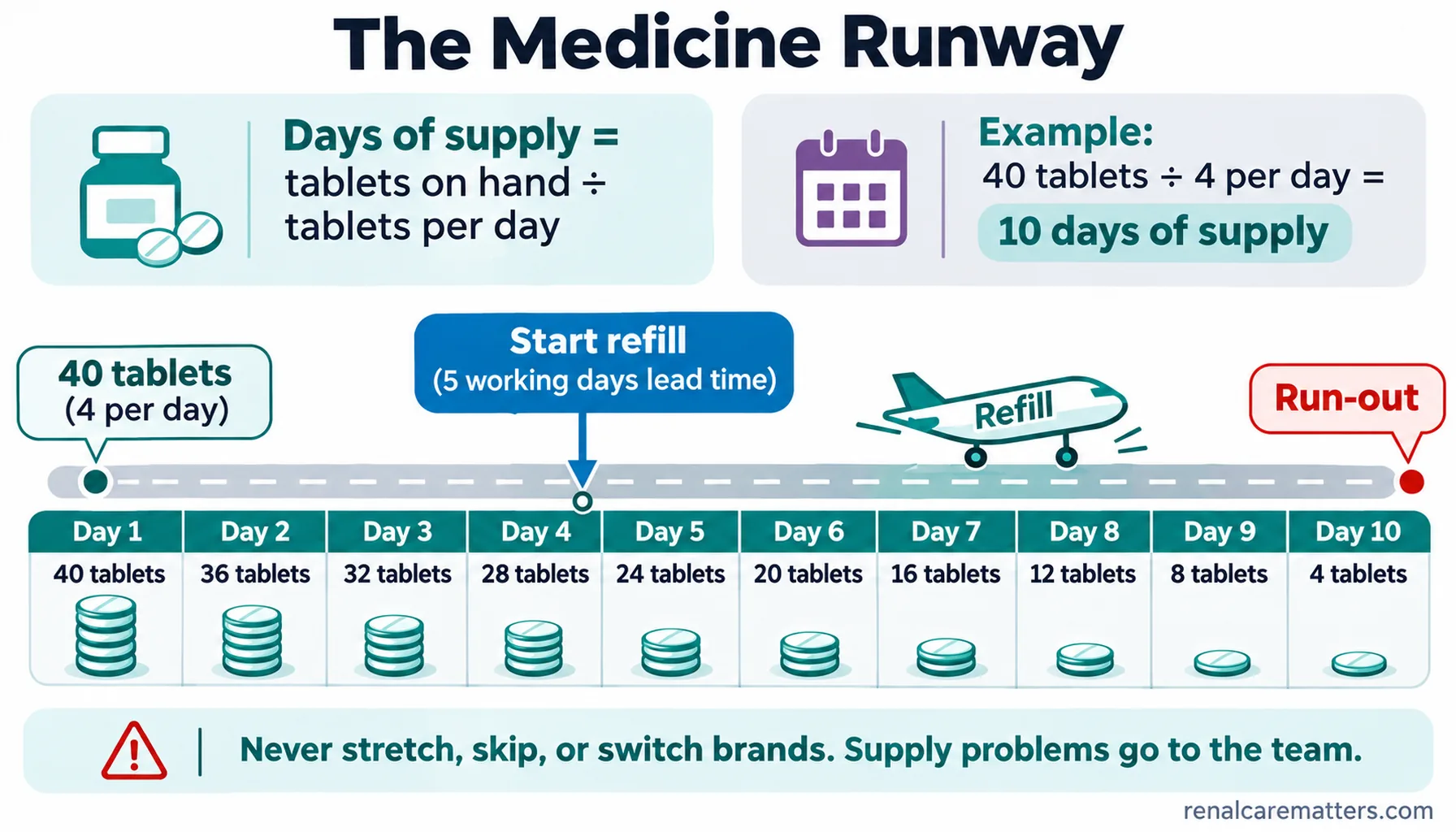
Mr. Ramos has 40 tablets of one immunosuppressant and takes 4 a day. The outpatient pharmacy that dispenses under the post-transplant package needs 5 working days to restock and is closed for the holiday.
When you ask whether he understands his medicines, he says, “Yes, the nurse explained.” Asked to show you which tablets he takes at 8 p.m., he picks up the wrong box. Mrs. Ramos has not had a follow-up appointment booked.
Before reading on, decide:
Keep your answers in mind. The lesson gives you what you need, and the case review near the end shows one sound response.
A discharge plan that lists medicines but does not confirm where the next box comes from is a plan to run out. Check four things before discharge, and write them on the discharge plan.
| Check | Question | Evidence |
|---|---|---|
| Supply | How many days of each medicine are on hand? | Counted, and the runway calculated |
| Refill route | Where will the next supply come from, and how long does it take? | Named pharmacy, lead time, and opening days |
| Funding | Who pays for the next supply? | The post-transplant package or other source confirmed3 |
| Contact | Whom does the recipient call when supply is at risk? | A named number, including after hours |
The medicine supply runway tool does this arithmetic. The coordinator never changes doses or substitutes brands; switching between products of the same immunosuppressant can change blood levels, so any switch goes through the team.
“Do you understand?” invites a polite yes. Teach-back asks the person to show what they will actually do: pick the 8 p.m. tablets, set an alarm, say what they will do if they vomit a dose, say whom they will call. If they cannot, the fault is in the teaching, not in the person; teach again, differently, and check again.
Clinical coordinators may do medicine teaching if assigned. Support staff arrange it with the pharmacist or nurse and check that it happened.
A recipient has two immunosuppressants in similar white boxes. At teach-back he confuses them. Coordinator Ms. Karen Dela Cruz, with the pharmacist, puts a colored sticker on each box matching a column in his written schedule.
He repeats the teach-back correctly twice, and his daughter repeats it once.
The fix was not more explaining. It was making the right action easy to see.
Illustrative scenario. Names and details are invented.
A discharge plan has to fit the person’s life: clinic visits and blood tests often several times a week at first, transport, cost, work, and family. Ask what will make the first month hard, and solve what you can before they leave.
| Item | Confirm before discharge |
|---|---|
| First clinic and laboratory visits | Dates, times, place, and transport |
| Drug-level tests | When to take the blood test in relation to the dose, as the team instructs |
| Urgent symptoms | What to watch for and whom to call (Module 16) |
| Holiday and weekend coverage | Pharmacy, laboratory, and contact numbers that work on those days |
| Transfers | If care continues elsewhere, an accepted handoff to that service |
The site’s tacrolimus level check is a clinician tool; coordinators make sure the level is drawn at the right time and the result reaches the team.
Donors are often discharged first, quietly, while attention is on the recipient. Before a donor leaves, confirm their own plan: wound care, pain relief, activity limits, warning signs, their own follow-up appointment, the donor team’s contact number, and that donation-related care will not be charged to them.4 The long-term follow-up plan begins here (Module 17).
These are fictional but typical. For each one, cover the answer, decide what you would do, then compare. Where a step depends on local rules, your unit’s procedure and your supervisor’s direction come first.
The runway. 40 tablets ÷ 4 a day = 10 days. With a 5-working-day lead time and a four-day closure, the refill must be arranged before he leaves. Ask the team and pharmacy for an adequate discharge supply or a dispensing arrangement that covers the holiday, confirm the funding route under the post-transplant package, and write the next refill date on his plan. Never suggest skipping or stretching doses.
Teach-back. He picked the wrong box, so he cannot yet take his medicines safely. Re-teach with his own boxes, a pill organizer, and visual cues; include a caregiver with his consent; repeat teach-back until he does it correctly. If he is not ready, tell the discharging physician before he goes.
Mrs. Ramos. She has no follow-up appointment. Book it with the donor team, give her the donor team’s contact number, confirm she has not been charged for donation-related care, and start her long-term follow-up plan.
Prepare a simulated recipient and donor for discharge while your preceptor observes. Your preceptor rates each step as satisfactory, needs practice, or not observed. Steps marked Critical must all be satisfactory before sign-off. This checklist supports supervised learning; your unit’s own procedure and competency form are the authority. A printable version of every checklist is on the trainer page.
Each visit draws 5 questions at random from this module’s 10-question bank. Choose the single best answer for each, then select Check answers; an explanation appears under the best answer. Select New set of questions for a different mix. A good target is 4 of 5 on two different sets. Nothing you select is sent anywhere; scoring happens in your browser.

Internal Medicine · Nephrology · Nutrition · Philippines · PRC 0105184
Educational material for transplant coordination staff. Completing it is an Academy learning record only. It is not a DOH-recognized training credit, a PhilHealth requirement, a certification, or CPD units, and it does not appoint anyone as a donor advocate or confer any clinical authority.

Scan and save