Three different databases, active waiting, sensitizing updates, and the boundary with organ procurement.
PublishedNailathalaGipatikPepalwal:ReferencesMga SanggunianMga TinubdanReng Reperensya:7Audience: Clinical transplant coordinators (usually registered nurses) and coordination-support staff in Philippine kidney transplant programs · Z Benefits coordinators · transplant and dialysis staff who refer, prepare, or follow recipients and living donorsRead timeOras ng pagbasaOras sa pagbasaOras ning pamamasa:
Training track for the people who navigate kidney recipients and living donors
This module is study material for kidney transplant coordinators and coordination-support staff. It explains the reasoning behind coordination decisions; it is not a hospital protocol, legal advice, or a benefits ruling. Rules and rates change: confirm every rule against the current issuance and your facility’s approved policy. Medical decisions belong to the transplant team, donation ethics to the ethics committee, and benefits to PhilHealth. Every case, name, and identifier is fictional.
Learning objectives
After this module you should be able to
Distinguish the national waiting list, the Philippine Health Insurance Corporation (PhilHealth) kidney transplantation (KT) Data Registry, and the hospital’s own transplant list.
Keep a wait-listed candidate “ready to be called”: contact details, readiness, and sensitizing events current.
Explain why the period on the list matters to survival, with the evidence and its limits.
State the boundary between transplant coordination and organ procurement, including who determines death.
Classroom 2 hSkills lab 2 hSupervised placement 2 h
Pre-testBefore you read, answer the 5 self-assessment questions and note your score. After the module, select New set of questions and compare. The difference is what you learned; the questions you still miss are what to reread.
Start here
The big picture, in plain words
In plain wordsBeing on a waiting list is like being on a standby list for a flight. You only get the seat if the airline can find you the moment it opens up, if your documents are still valid, and if you are actually at the airport. Being on the list is not the same as being ready to board.
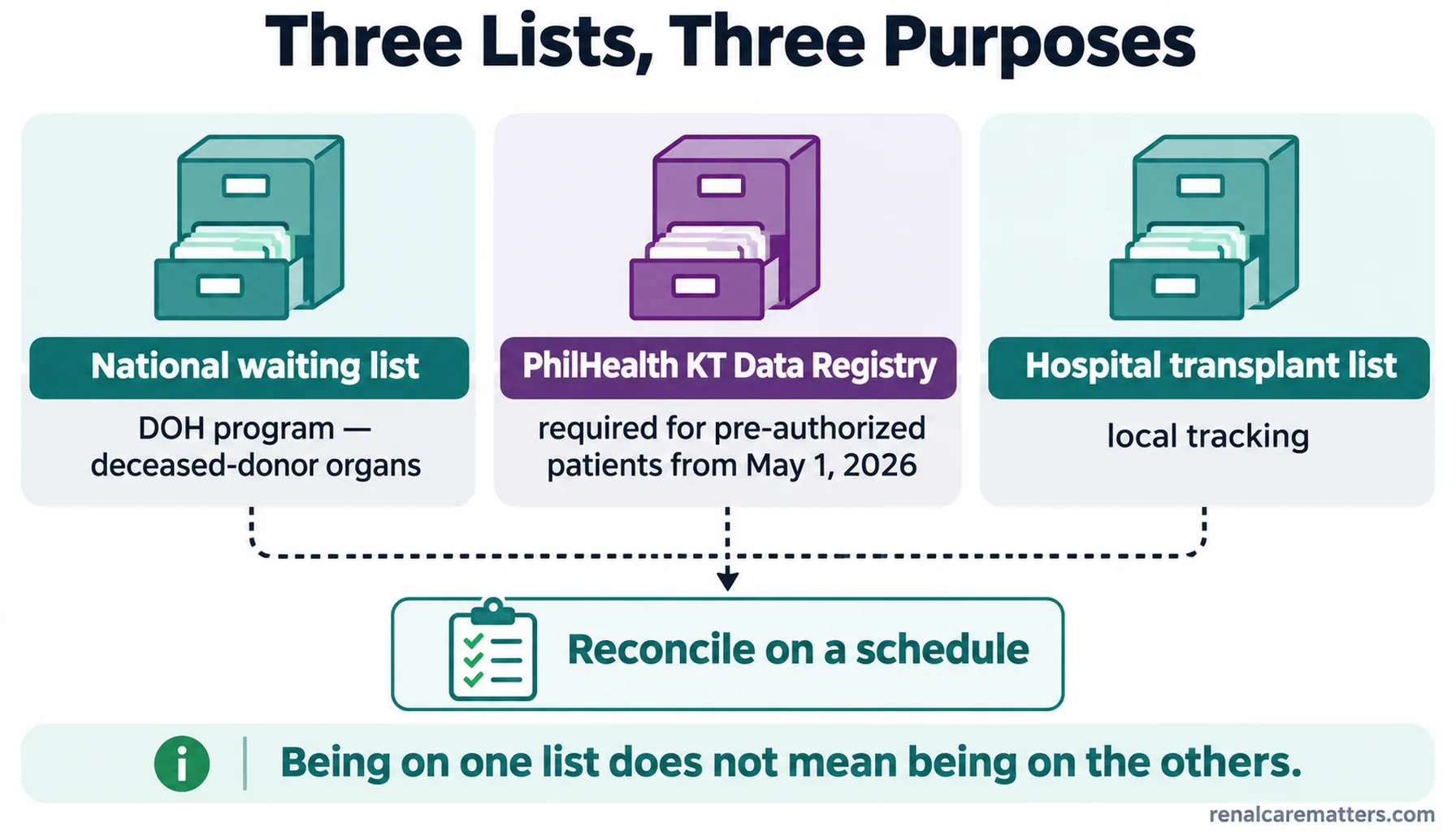
Figure 1. Three lists, three purposes. Being on one does not mean being on the others.
The picture has a limit. A standby list belongs to one airline. A Philippine transplant candidate may appear in three different databases, each with its own owner and purpose: the national waiting list for deceased-donor organs, set up under Department of Health (DOH) policy;1 PhilHealth’s KT Data Registry, mandatory for patients pre-authorized for the package;2 and the hospital’s own list. Being on one does not put a person on the others.
And unlike a flight, waiting is not neutral time. In a large United States registry study, people on dialysis who were wait-listed had annual death rates of about 6.3 per 100 patient-years, and transplant recipients, after an early period of higher risk, had much lower death rates than those still waiting.3 The study was observational, so part of the difference reflects who gets transplanted. But it is a reason to treat waiting as active work: keep the person ready, reachable, and as healthy as possible.
Figure 2 · Key terms for this module
National waiting listThe DOH-governed list of candidates for deceased-donor organs.
KT Data RegistryPhilHealth’s registry for patients pre-authorized for the kidney transplant package.
Active statusReady to receive an offer now.
Temporarily inactiveOn the list but not able to accept an offer for a stated reason and period.
Philippine Network for Organ Sharing (PhilNOS)The national program that coordinates deceased organ donation and sharing.
Organ procurement organization (OPO)The service that manages deceased donors and organ retrieval.
Opening case · fictional
Case: The candidate who moved
Ms. Angelica Reyes, 36, has been on the national waiting list for 19 months and on hemodialysis for four years. Her husband was ruled out as a donor. Last month she moved to Cebu for work, changed her mobile number, and started dialysis at a new unit there. She had a blood transfusion during a hospital stay in Cebu three weeks ago.
The PhilHealth KT Data Registry shows her as “registered.” Her mother asks you, “Since she’s in the registry, she’s next in line, right?”
That evening, a family member of a brain-injured patient in your hospital’s intensive care unit asks a nurse whether “the transplant coordinator” can tell them if their relative is dead.
Before reading on, decide:
Which records need updating, and who owns each?
What is true and untrue in her mother’s statement?
How do you answer the family in the intensive care unit?
Keep your answers in mind. The lesson gives you what you need, and the case review near the end shows one sound response.
Lesson · part 1
Which list is which
Database
Owner
Purpose
What being on it does not mean
National waiting list
DOH and its designated program, through authorized users
Candidates for deceased-donor organs
A guaranteed or imminent offer
PhilHealth KT Data Registry
PhilHealth and the reference facility
A package requirement; from May 1, 2026 all pre-authorized patients are registered electronically
Being on the national waiting list, or being pre-authorized
Hospital transplant list
The transplant program
Local tracking of candidates and status
Entry on either national system
PhilHealth Advisory 2026-0026 made electronic KT registry registration mandatory for patients pre-authorized for the package from May 1, 2026, with manual forms accepted until April 30, 2026; registration is a condition of the benefit, and missing registration is a ground for claim denial.2,4 Only trained, designated users enter data. Reconcile the three databases regularly: same person, same status, same contact details.
RememberThree lists, three owners. Confirm each entry separately and reconcile them on a schedule.
Lesson · part 2
Ready, reachable, and current
An offer for a deceased-donor kidney leaves little time. A candidate who cannot be reached, or who is not ready, misses it. Keep a waiting-list contact at a regular interval your program sets, and use the same questions every time.
Reachable: current phone numbers (two if possible), address, dialysis unit and its contact, who may be told of an offer.
Ready: any new illness, admission, infection, surgery, or change in medicines; any reason they could not come in today.
Sensitizing events: transfusion, pregnancy, or surgery since the last contact (Module 5), reported the same day to the team and the human leukocyte antigen (HLA) laboratory.
Funding: pre-authorization status and validity, and any change in PhilHealth membership.
Changes in readiness go to the transplant physician, who decides whether status changes. Results that expire while waiting (Module 4) are flagged before they lapse.
On the floor · The number nobody updated
Coordinator Ms. Rina Castillo does a quarterly contact with a wait-listed candidate and finds that his number has changed and that he started dialysis at a different unit after a move.
She updates the hospital list, asks the designated user to update the national entry, and gives the new dialysis unit her direct number for transfusions and admissions.
The candidate had not missed an offer yet. The point of the call was to make sure he never would.
Illustrative scenario. Names and details are invented.
RememberOn the list is not the same as ready. Contact, readiness, sensitizing events, and funding: check all four on every waiting-list call.
Lesson · part 3
What the transplant coordinator never does
Deceased donation has its own law, rules, and people. The Organ Donation Act governs donation after death;5 DOH rules define the roles of procurement and clinical transplant coordinators, separately.6 Three acts belong to others:
Act
Who does it
Why the transplant coordinator does not
Determining and declaring death
Physicians authorized under the law and hospital protocol, independent of the transplant team
Separating death determination from transplantation protects public trust
Approaching the family about donation
Trained requesters or the procurement team, under protocol
A request from the recipient’s side creates a conflict of interest
Managing the deceased donor and retrieval
The OPO or procurement team, with PhilNOS
A different role with its own training
If a family in an intensive care unit asks you about death or donation, respond with compassion, do not discuss donation or the transplant waiting list, and connect them with the attending physician and, through protocol, with the procurement team.
RememberThe transplant coordinator never determines death, never asks a grieving family for organs, and never mixes the recipient’s interests into a donor family’s decision.
Lesson · part 4
Know what you are looking at
This site hosts calculators for the Kidney Donor Profile Index (KDPI) and the Estimated Post-Transplant Survival (EPTS) score. They are tools from United States allocation policy and are shown for comparison and learning.7 Philippine allocation follows Philippine rules; coordinators do not accept or rank offers by any score. If a family brings a score from the internet, explain gently that the team and the national program apply local rules.
RememberForeign allocation scores are for learning, not for deciding Philippine offers.
On the floor
Real situations: problems and solutions
These are fictional but typical. For each one, cover the answer, decide what you would do, then compare. Where a step depends on local rules, your unit’s procedure and your supervisor’s direction come first.
“Number 3 on the list”
What you see
A candidate says a friend told him he is “number 3.”
What is likely going on
A misunderstanding of how allocation works.
What to do
Explain that offers depend on many factors, not a queue number.
Why it matters
False expectations cause distress and mistrust.
The inactive candidate
What you see
A candidate on temporary inactive status has recovered.
What is likely going on
A status that should be reviewed.
What to do
Route to the transplant physician to review status.
Why it matters
An unneeded inactive status can cost an offer.
The ICU question
What you see
A nurse asks you to “talk to the family about donation.”
What is likely going on
A role confusion.
What to do
Decline politely; refer to the procurement team’s protocol.
Why it matters
Keeping the transplant side out of donor-family requests protects trust.
Field notes
Reconcile the three lists on a schedule.
Ask for two phone numbers.
Report sensitizing events while waiting.
Never approach a donor family yourself.
Case review
Back to the case: The candidate who moved
Records. Update the hospital list (new number, new address, new dialysis unit). Ask the designated user to update the national waiting-list entry and the KT registry contact data as each system allows. Report the transfusion today to the transplant physician and the HLA laboratory; the team decides whether a new antibody sample is needed and whether her status changes. Give the Cebu unit your direct number.
Her mother’s statement. True: she is in PhilHealth’s registry. Untrue: the registry is not the waiting list, and neither means “next in line.” Explain the difference kindly, and that offers depend on many factors the national program and the team apply.
The family in the intensive care unit. Express sympathy, explain that the doctors caring for their relative are the ones who can answer, and help them reach the attending physician now. Do not mention donation or the waiting list; if donation is relevant, the procurement team approaches through protocol.
Skills lab · with your preceptor
Skills checklist: Waiting-list contact and reconciliation
Conduct a simulated waiting-list call and reconcile three mock database entries while your preceptor observes. Your preceptor rates each step as satisfactory, needs practice, or not observed. Steps marked Critical must all be satisfactory before sign-off. This checklist supports supervised learning; your unit’s own procedure and competency form are the authority. A printable version of every checklist is on the trainer page.
CriticalExplains the difference between the national waiting list, the KT registry, and the hospital list.
Asks about contact details, readiness, sensitizing events, and funding in one call.
CriticalReports a sensitizing event and a readiness change to the transplant physician the same day.
Finds and routes a discrepancy between database entries to the designated user.
CriticalResponds to a simulated grieving family without discussing donation, and routes to the attending physician.
Placement activity. Reconcile ten candidates across your hospital list and the systems you can see; list every mismatch and its owner.
Self-assessment
Check your understanding
Each visit draws 5 questions at random from this module’s 10-question bank. Choose the single best answer for each, then select Check answers; an explanation appears under the best answer. Select New set of questions for a different mix. A good target is 4 of 5 on two different sets. Nothing you select is sent anywhere; scoring happens in your browser.
Wolfe, R. A., Ashby, V. B., Milford, E. L., Ojo, A. O., Ettenger, R. E., Agodoa, L. Y., Held, P. J., & Port, F. K. (1999). Comparison of mortality in all patients on dialysis, patients on dialysis awaiting transplantation, and recipients of a first cadaveric transplant. The New England Journal of Medicine, 341(23), 1725–1730. https://doi.org/10.1056/NEJM199912023412303
Department of Health. (2010). Administrative Order No. 2010-0019 on deceased organ donation, including procurement and clinical transplant coordinators, as amended by Administrative Order No. 2010-0019-A. https://elibrary.judiciary.gov.ph/thebookshelf/showdocs/10/52063
Educational material for transplant coordination staff. Completing it is an Academy learning record only. It is not a DOH-recognized training credit, a PhilHealth requirement, a certification, or CPD units, and it does not appoint anyone as a donor advocate or confer any clinical authority.