Claims Evidence, Denials, and Financial Protection
The 60-day window, returns versus denials, evidence that follows care, and protecting the donor from cost.
PublishedNailathalaGipatikPepalwal:ReferencesMga SanggunianMga TinubdanReng Reperensya:6Audience: Clinical transplant coordinators (usually registered nurses) and coordination-support staff in Philippine kidney transplant programs · Z Benefits coordinators · transplant and dialysis staff who refer, prepare, or follow recipients and living donorsRead timeOras ng pagbasaOras sa pagbasaOras ning pamamasa:
Training track for the people who navigate kidney recipients and living donors
This module is study material for kidney transplant coordinators and coordination-support staff. It explains the reasoning behind coordination decisions; it is not a hospital protocol, legal advice, or a benefits ruling. Rules and rates change: confirm every rule against the current issuance and your facility’s approved policy. Medical decisions belong to the transplant team, donation ethics to the ethics committee, and benefits to PhilHealth. Every case, name, and identifier is fictional.
Learning objectives
After this module you should be able to
Keep claim evidence aligned with the care actually delivered, starting from admission.
Calculate the 60-day filing deadline and track it with the claims team.
Distinguish a returned claim from a denied claim and route each correctly.
Protect the donor and the recipient from avoidable charges, using the Department of Health (DOH) donor expense rule.
Explain what the evidence shows about donor costs and why it matters.
Classroom 2 hSkills lab 2 hSupervised placement 2 h
Pre-testBefore you read, answer the 5 self-assessment questions and note your score. After the module, select New set of questions and compare. The difference is what you learned; the questions you still miss are what to reread.
Start here
The big picture, in plain words
In plain wordsA claim is like a receipt you must show to be reimbursed for a business trip. The receipt has to match the trip: right dates, right person, right items, filed before the deadline. A missing boarding pass or a receipt filed late can cost the whole reimbursement, even though the trip really happened.
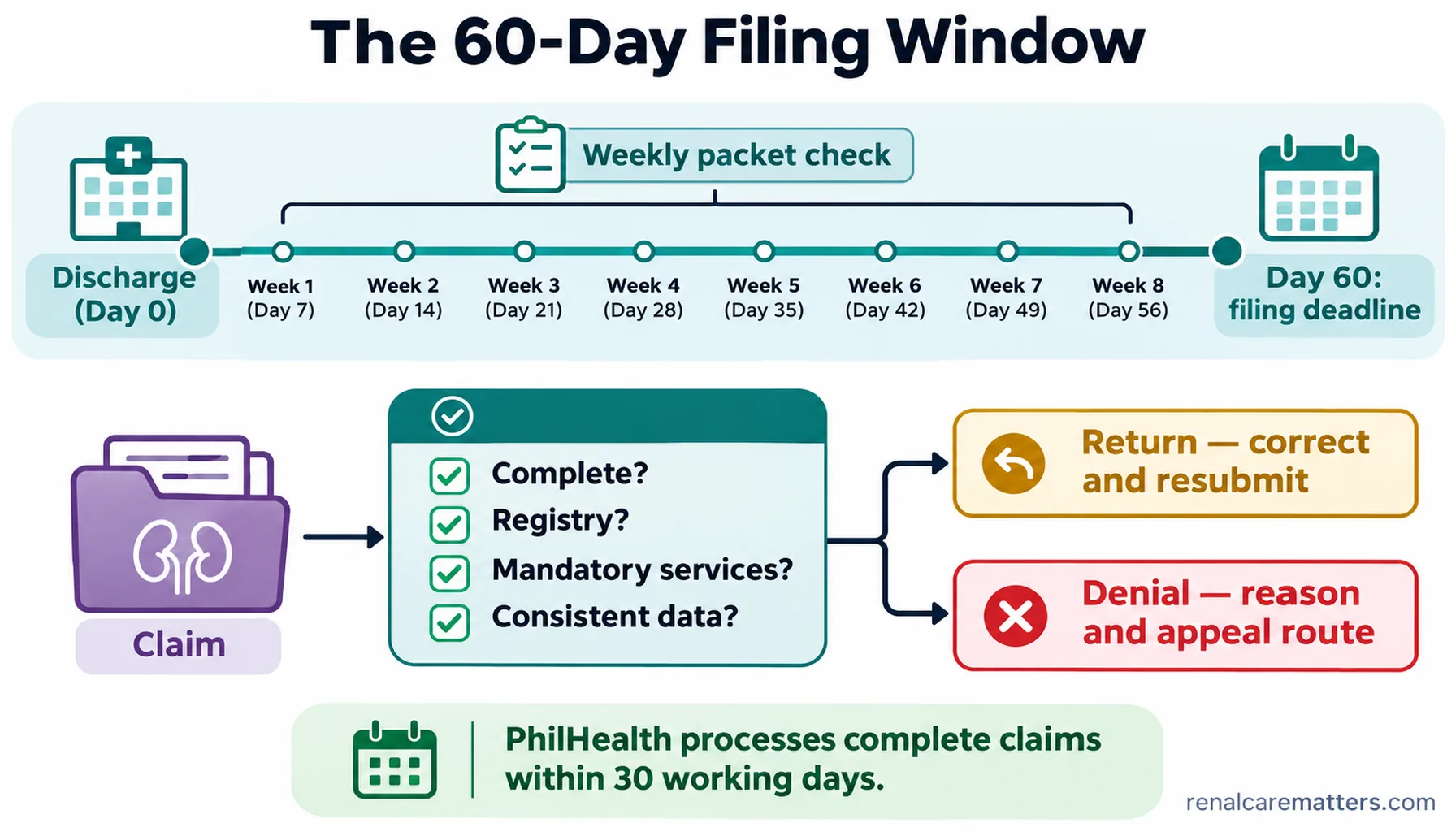
Figure 1. The 60-day window. A return can be fixed; a denial is a decision with its own route.
The picture has a limit. A traveler pays first and gets reimbursed later. In the Z Benefits package the hospital files the claim, and if it is denied, the risk is that the cost lands on a family who was told it was covered — or, worse, on a donor who should never pay for donating. So claims work is not just paperwork. It is financial protection for two people.
Philippine Health Insurance Corporation (PhilHealth)’s kidney transplant circular sets the rules: the facility files within 60 days after discharge; PhilHealth processes complete claims within 30 working days; and claims are denied for late filing, missing kidney transplant (KT) registry registration or form, mandatory services not provided, or inconsistent data.1 Your part is to make sure the evidence exists, matches the care, and reaches the claims team in time.
Figure 2 · Key terms for this module
ClaimThe hospital’s request to PhilHealth for payment under the package.
Filing windowThe period in which a claim must be filed: 60 days after discharge for this package.
ReturnA claim sent back for correction or completion; it can be fixed and resubmitted.
DenialA decision not to pay, with a stated reason and an appeal route.
Mandatory servicesServices the package requires to be provided and documented.
Financial neutralityThe donor neither gains nor loses money because of donation.
Opening case · fictional
Case: Day 52
Mrs. Erlinda Bautista, 50, received a kidney from her husband, Mr. Felix Bautista, 53. Both were discharged on July 1. It is now August 22, day 52 after discharge.
The claims clerk tells you the claim cannot be filed: the KT registry entry for Mrs. Bautista was never completed, and the essential-services checklist is missing the donor’s postoperative visit.
Meanwhile, Mr. Bautista shows you a bill from the hospital’s outpatient laboratory for 6,800 pesos for his two-week post-donation blood tests. “They said donor tests are not covered.”
Before reading on, decide:
What is the filing deadline, and what has to happen before it?
Is the donor’s bill correct? Whom do you involve?
What would have prevented both problems?
Keep your answers in mind. The lesson gives you what you need, and the case review near the end shows one sound response.
Lesson · part 1
Build the claim from admission, not at discharge
The safest claim is assembled as care happens. When evidence is gathered after discharge, people are hard to reach, results are scattered, and the 60-day window is already running.
Evidence
When to check it
Owner
Pre-authorization and its validity
Before admission
Z Benefits coordinator
KT registry registration and form
Before admission; confirm the entry exists
Designated registry user
Essential-services checklist entries
Daily during admission; before discharge
Clinical teams, collected by the coordinator
Consistent identifiers and dates across forms
Before filing
Claims team
Discharge summary and statement of account
At discharge
Attending team; billing
Never create evidence for a service that did not happen, and never alter a clinical record to fit a claim. If a mandatory service was not provided, the claims lead decides how to report it; the clinical record stays true.
RememberBuild the claim as care happens. A claim assembled after discharge starts its race already behind.
Lesson · part 2
Sixty days after discharge
The filing deadline is counted from discharge. Put it in the register the day the patient goes home, with weekly checks.
Filing deadline = discharge date + 60 days
For a discharge on July 1, the deadline is August 30. The claim filing window tool calculates the date and the days left. Existing late-filing rules apply, with special consideration for natural calamities or fortuitous events; ask the claims lead before relying on any exception.1
On the floor · Two weeks of quiet
At a Cavite hospital, coordinator Ms. Mylene Torres sets a weekly claim check every Monday after each transplant discharge. On day 14 she finds that the donor’s anesthesia record is missing from the packet.
She asks anesthesia the same day; the record arrives on day 16. The claim is filed on day 30 with 30 days to spare.
The fix took two days because it was found on day 14, not day 58.
Illustrative scenario. Names and details are invented.
RememberEnter the 60-day deadline on the day of discharge and check the packet weekly.
Lesson · part 3
Different problems, different routes
Return
Denial
What it is
The claim is incomplete or needs correction
A decision not to pay, with a reason
Common causes
Missing attachment, unclear entry
Late filing, missing KT registry, mandatory services not provided, inconsistent data
What to do
Correct and resubmit within the allowed time
The claims lead reviews; appeal or reconsideration through PhilHealth’s process if grounds exist
Coordinator’s role
Find the missing evidence fast
Supply the facts and timeline; never alter records
Keep a simple log of returns and denials by reason. If the same reason keeps appearing — registry entries, a particular form — fix the upstream step, not each claim.
RememberA return is a task; a denial is a decision. Fix returns fast, and route denials to the claims lead with the facts.
Lesson · part 4
The donor never pays for donating
The DOH living-donor order states that donation-related medical expenses, donor care, and follow-up must not be charged to the donor by the transplant facility.2 PhilHealth’s package covers donor evaluation, management, and nephrectomy, and the post-transplant packages list donor monitoring.1,3 When a donor receives a bill for donation-related care, the coordinator’s job is to stop it reaching the donor and to route it to billing and the program manager to resolve.
Charges are only part of the burden. The evidence on donor costs is consistent, though none of it comes from the Philippines:
A Canadian prospective cohort of 821 donors found median out-of-pocket costs of 1,254 Canadian dollars, with total costs (including lost productivity) above 5,500 Canadian dollars for 25% of donors.4
A US survey of 796 donors found that 26% rated their financial burden at 5 or more out of 10, including some with no out-of-pocket costs, because of lost wages and continuing expenses.5
In the Canadian cohort, donors with higher expenses had worse mental health-related quality of life at three months, after adjustment for their pre-donation mental health.6
These studies are observational and from high-income countries. They do not tell us the size of the burden here, but they do show that “covered” and “cost-free” are different things, and that cost is associated with harm beyond money.
RememberThe donor never pays for donation-related care. Stop the bill, route it, and ask about the costs no bill shows.
On the floor
Real situations: problems and solutions
These are fictional but typical. For each one, cover the answer, decide what you would do, then compare. Where a step depends on local rules, your unit’s procedure and your supervisor’s direction come first.
The missing signature
What you see
The essential-services checklist lacks a physician signature on day 40.
What is likely going on
A return risk.
What to do
Ask the physician to sign for services actually provided; recheck the packet.
Why it matters
Small gaps cause returns late in the window.
The donor’s pharmacy bill
What you see
A donor is charged for pain medicines after discharge.
What is likely going on
A donation-related charge.
What to do
Route to billing and the program manager to cancel; tell the donor not to pay.
Why it matters
Donors must not pay for donation-related care.
The denial letter
What you see
A claim is denied for inconsistent data.
What is likely going on
A decision, not a return.
What to do
Give the claims lead the facts and timeline; never alter records to fit.
Why it matters
Altering records turns a denial into misconduct.
Field notes
Build the claim from admission.
Enter the 60-day deadline on discharge day.
Log returns and denials by reason.
Flag every donor account in billing.
Case review
Back to the case: Day 52
The deadline. July 1 plus 60 days is August 30; eight days remain. Today, ask the designated registry user to complete Mrs. Bautista’s KT registry entry, and ask the donor’s surgical clinic to document the postoperative visit that was actually done, if it was done. If it was not done, the claims lead decides how to report it; nothing is backfilled. Recheck daily until filing.
The donor’s bill. Not correct. Post-donation tests are donation-related care that the facility must not charge to the donor. Apologize, take the bill, and route it to billing and the program manager to cancel or redirect. Tell Mr. Bautista he does not need to pay it, and confirm in writing once it is resolved.
Prevention. Registry entry confirmed before admission, the essential-services checklist kept daily, a weekly claim check from discharge, and a billing flag on every donor account so donation-related charges never reach the donor.
Skills lab · with your preceptor
Skills checklist: Claim readiness and donor charge protection
Prepare a mock claim packet from admission to filing and resolve a mock donor charge while your preceptor observes. Your preceptor rates each step as satisfactory, needs practice, or not observed. Steps marked Critical must all be satisfactory before sign-off. This checklist supports supervised learning; your unit’s own procedure and competency form are the authority. A printable version of every checklist is on the trainer page.
CriticalConfirms pre-authorization validity and KT registry entry before admission.
Calculates the filing deadline and sets weekly checks.
Distinguishes a return from a denial and routes each correctly.
CriticalRefuses to create or alter evidence to fit a claim.
CriticalStops a donation-related charge from reaching a simulated donor and routes it.
Asks a donor privately about indirect costs: lost income, travel, childcare.
Placement activity. With the claims team, review returns and denials for transplant claims in the last year and group them by reason.
Self-assessment
Check your understanding
Each visit draws 5 questions at random from this module’s 10-question bank. Choose the single best answer for each, then select Check answers; an explanation appears under the best answer. Select New set of questions for a different mix. A good target is 4 of 5 on two different sets. Nothing you select is sent anywhere; scoring happens in your browser.
Przech, S., Garg, A. X., Arnold, J. B., Barnieh, L., Cuerden, M. S., Dipchand, C., Feldman, L., Gill, J. S., Karpinski, M., Knoll, G., Lok, C., Miller, M., Monroy, M., Nguan, C., Prasad, G. V. R., Sarma, S., Sontrop, J. M., Storsley, L., & Klarenbach, S. (2018). Financial costs incurred by living kidney donors: A prospective cohort study. Journal of the American Society of Nephrology, 29(12), 2847–2857. https://doi.org/10.1681/ASN.2018040398
Wiseman, J. F., Jacobs, C. L., Larson, D. B., Berglund, D. M., Garvey, C. A., Ibrahim, H. N., & Matas, A. J. (2017). Financial burden borne by laparoscopic living kidney donors. Transplantation, 101(9), 2253–2257. https://doi.org/10.1097/TP.0000000000001568
Barnieh, L., Arnold, J. B., Boudville, N., Cuerden, M. S., Dew, M. A., Dipchand, C., Feldman, L. S., Gill, J. S., Karpinski, M., Klarenbach, S., Knoll, G., Lok, C., Miller, M., Monroy, M., Nguan, C., Prasad, G. V. R., Sontrop, J. M., Storsley, L., & Garg, A. X. (2021). Living kidney donors’ financial expenses and mental health. Transplantation, 105(6), 1356–1364. https://doi.org/10.1097/TP.0000000000003401
Educational material for transplant coordination staff. Completing it is an Academy learning record only. It is not a DOH-recognized training credit, a PhilHealth requirement, a certification, or CPD units, and it does not appoint anyone as a donor advocate or confer any clinical authority.