Different approvals, the Z Benefits package by version, pre-authorization timing, and planning affordability across time.
PublishedNailathalaGipatikPepalwal:ReferencesMga SanggunianMga TinubdanReng Reperensya:6Audience: Clinical transplant coordinators (usually registered nurses) and coordination-support staff in Philippine kidney transplant programs · Z Benefits coordinators · transplant and dialysis staff who refer, prepare, or follow recipients and living donorsRead timeOras ng pagbasaOras sa pagbasaOras ning pamamasa:
Training track for the people who navigate kidney recipients and living donors
This module is study material for kidney transplant coordinators and coordination-support staff. It explains the reasoning behind coordination decisions; it is not a hospital protocol, legal advice, or a benefits ruling. Rules and rates change: confirm every rule against the current issuance and your facility’s approved policy. Medical decisions belong to the transplant team, donation ethics to the ethics committee, and benefits to PhilHealth. Every case, name, and identifier is fictional.
Learning objectives
After this module you should be able to
Explain the difference between clinical clearance, ethics approval, and payer pre-authorization.
Identify the Philippine Health Insurance Corporation (PhilHealth) kidney transplant package code and rate that matches a case, under the correct circular version.
Track the 180-day pre-authorization validity and the deceased-donor two-working-day rule.
Estimate the out-of-pocket gap and plan other confirmed assistance, without promising coverage.
Plan affordability across time, including the post-transplant packages and donor monitoring.
Classroom 2 hSkills lab 2 hSupervised placement 2 h
Pre-testBefore you read, answer the 5 self-assessment questions and note your score. After the module, select New set of questions and compare. The difference is what you learned; the questions you still miss are what to reread.
Start here
The big picture, in plain words
In plain wordsA pre-authorization is like a confirmed hotel booking. It tells you the room is reserved and roughly what you will pay. It does not tell you that your flight will leave on time, that your passport is valid, or that you are well enough to travel. And the booking expires if you arrive too late.
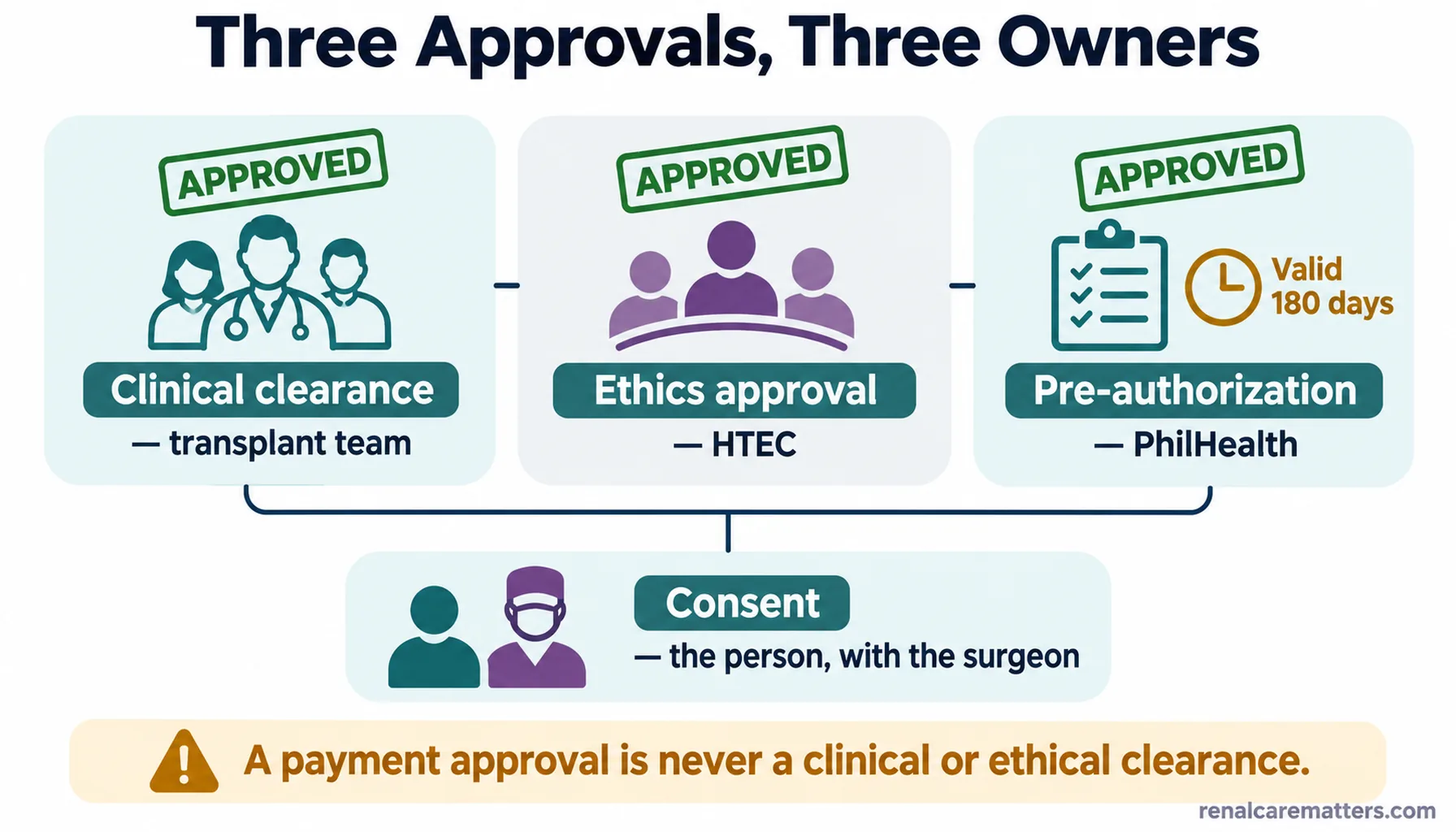
Figure 1. Three approvals, three owners. A payment approval is never a clinical or ethical clearance.
The picture has a limit. A hotel charges one guest. A living-donor transplant involves two people, and the PhilHealth kidney transplant package covers the donor’s evaluation, management, and nephrectomy within the recipient’s package.1 At the same time, the Department of Health (DOH) living-donor order says the transplant facility must not charge the donor for donation-related medical care and follow-up.2 So the coordinator plans two people’s costs: what the package pays, what the recipient may still owe, and what must never reach the donor.
Your job in this module is to read the package by version, keep its clocks, and help families plan honestly. You do not decide what PhilHealth pays. You make sure the request is complete, on time, and under the right circular, and that nobody mistakes a payment approval for anything else.
Figure 2 · Key terms for this module
Z BenefitsPhilHealth packages for medically and economically catastrophic conditions, including kidney transplantation.
Contracted facilityA hospital PhilHealth has contracted to provide a Z Benefits package.
Pre-authorizationPhilHealth’s approval, before the service, that a case qualifies for the package.
Package codeThe code for a specific variant of the package, such as Z025A1.
Co-paymentAny amount the patient may be charged beyond the package, under the contract’s terms.
Post-KT packagePhilHealth’s separate packages for care after transplant, including immunosuppressants and donor monitoring.
Opening case · fictional
Case: The estimate and the calendar
Mr. Rommel Aquino, 45, a jeepney operator from Batangas, will receive a kidney from his sister, Ms. Liza Aquino, 40. The team plans laparoscopic donor surgery and basiliximab induction. The hospital’s written estimate for the whole admission is 1,200,000 pesos.
The pre-authorization was approved on March 1. Because the donor’s psychiatric review was delayed, surgery is now planned for September 15.
Ms. Aquino asks you privately whether she will have to pay for her own tests and operation. Mr. Aquino has a promise of 100,000 pesos from his local government and has applied to the Philippine Charity Sweepstakes Office (PCSO).
Before reading on, decide:
Which package code applies, and what is the estimated gap before assistance?
What is wrong with the calendar, and what do you do now?
What do you tell Ms. Aquino about her costs?
Keep your answers in mind. The lesson gives you what you need, and the case review near the end shows one sound response.
Lesson · part 1
Payment is not permission
Families hear “approved” once and assume everything is approved. Name each approval and its owner every time.
Approval
Owner
What it means
What it does not mean
Clinical clearance
Transplant team; donor clinicians
Transplant is medically appropriate for this person
Payment, consent, or ethics approval
Ethics approval
Hospital Transplant Ethics Committee (HTEC)
The donation is voluntary and unrewarded, with conditions met
Medical fitness or payment
Pre-authorization
PhilHealth
The case qualifies for the package, within its validity
Medical or ethical clearance; a fixed surgery date
Consent
The person, with the surgeon
The person agrees, after understanding
Any of the above
RememberName the approval and its owner every time you say “approved.” A payment approval is never a clinical or ethical clearance.
Lesson · part 2
Codes, rates, and clocks
PhilHealth’s kidney transplant package has eight variants, defined by donor type, induction medicine, and surgical approach. The rates below are in PC 2024-0035 and are unchanged in Revision 1, PC 2026-0019 (published November 21, 2026; effective 15 days after publication).3,1
Donor
Induction
Surgical approach
Code
Package rate (PHP)
Living
Basiliximab or equine antithymocyte globulin (eATG)
Laparoscopic donor, open recipient
Z025A1
993,000
Living
Basiliximab or eATG
Open donor and recipient
Z025A2
865,000
Living
rabbit antithymocyte globulin (rATG)
Laparoscopic donor, open recipient
Z025B1
1,045,000
Living
rATG
Open donor and recipient
Z025B2
918,000
Deceased
Basiliximab or eATG
Machine perfusion
Z026A1
2,093,000
Deceased
Basiliximab or eATG
Cold storage
Z026A2
1,583,000
Deceased
rATG
Machine perfusion
Z026B1
2,146,000
Deceased
rATG
Cold storage
Z026B2
1,636,000
(eATG and rATG are equine and rabbit antithymocyte globulin, two induction medicines; the team chooses the medicine, and the code follows the choice.)
Two clocks start with the package. An approved pre-authorization is valid for 180 calendar days. For a living donor, the request is submitted before the package is availed; for a deceased donor, within two working days after the procedure.1 When a surgery date moves, check it against the expiry at once. The pre-authorization timer in the toolkit does the date arithmetic.
Two rules about people sit around the package. Each contracted facility must have at least one Z Benefits Coordinator, and each may handle at most three Z packages; and cases pre-authorized and performed under PC 2024-0035 are claimed under PC 2024-0035.1
RememberMatch the code to the team’s plan, record the circular version, and put the 180-day expiry in the register the day approval arrives.
Lesson · part 3
What the package does not cover
A package rate is not the bill. Facility estimates vary with room choice, specialist fees, complications, and length of stay, and the contract may allow co-payment for amenities or upgrades.1 Give families a written estimate, show the package code and rate beside it, subtract only assistance that is confirmed in writing, and say clearly that the remaining figure is an estimate.
Amount, purpose, and when it is released, in writing
PCSO medical assistance
Approval letter, amount, and to whom it is paid
DOH Medical Assistance for Indigent and Financially Incapacitated Patients (MAIFIP)
Eligibility and the hospital’s process
Health maintenance organization (HMO) or employer coverage
What is covered alongside PhilHealth, and the approval
Promised money is not confirmed money. Count it only when the letter arrives. The out-of-pocket gap estimator lays this out and reminds you that the donor’s donation-related care is not a cost to the donor.
RememberSubtract only assistance confirmed in writing, and label the result as an estimate.
Lesson · part 4
The operation is the first bill, not the last
The transplant package covers the operation and its admission. Life afterward has its own costs: immunosuppressants every day, prophylaxis, drug-level monitoring, laboratory tests, and sometimes a graft biopsy. PhilHealth’s post-kidney transplantation packages for adults (PC 2025-0012) and children (PC 2025-0011) cover these services and list living donor monitoring among them.4,5 Help families see the year ahead: what the post-transplant package covers, where medicines will be dispensed, and what may still be paid out of pocket.
The donor needs the same foresight. Costs for living donors are common: a systematic review of 16 studies found that about 80% of donors had some financial loss, mostly lost income and travel.6 Ask the donor privately about time off work, travel, and childcare, and link them to support the program can offer. Module 11 covers protection from donation-related charges.
RememberPlan the first year after transplant and the donor’s costs before surgery, not after discharge.
On the floor
Real situations: problems and solutions
These are fictional but typical. For each one, cover the answer, decide what you would do, then compare. Where a step depends on local rules, your unit’s procedure and your supervisor’s direction come first.
The induction change
What you see
The team switches induction from basiliximab to rATG after pre-authorization.
What is likely going on
A change in the package code.
What to do
Tell the Z Benefits lead at once to check what the circular requires.
Why it matters
The code must match the care delivered.
Promised assistance
What you see
A family counts a mayor’s verbal promise in their budget.
What is likely going on
Unconfirmed money.
What to do
Help them request it in writing; leave it out of the gap until confirmed.
Why it matters
Verbal promises often shrink or vanish.
The moved surgery
What you see
Surgery moves two months later for donor reasons.
What is likely going on
A validity risk.
What to do
Recheck the 180-day expiry the same day.
Why it matters
An expired authorization can stop the case or the claim.
Field notes
Record the circular version on every case.
Put the 180-day expiry in the register on approval day.
Subtract only confirmed assistance.
Plan the first post-transplant year before surgery.
Case review
Back to the case: The estimate and the calendar
The code and the gap. Living donor, basiliximab, laparoscopic donor surgery: Z025A1, 993,000 pesos. Before assistance, the estimated gap is 1,200,000 minus 993,000, or 207,000 pesos. The local government’s 100,000 pesos counts only when confirmed in writing; the PCSO application counts only when approved. Give Mr. Aquino the estimate in writing, labeled as an estimate.
The calendar. March 1 plus 180 calendar days is August 28. September 15 falls after the pre-authorization expires. Flag it today to the Z Benefits lead and the surgeon by Situation, Background, Assessment, Recommendation (SBAR), and find out from the lead what the circular allows (a new request or an extension). Do not move the surgery date yourself, and do not tell the family the benefit is lost.
Ms. Aquino. Tell her, privately, that her evaluation and operation are covered within her brother’s package and that the facility does not charge donors for donation-related medical care and follow-up. Ask what other costs worry her — travel, time off work — and link her to support.
Skills lab · with your preceptor
Skills checklist: Package selection and cost plan
Prepare a package selection, a pre-authorization timeline, and a written cost plan for a fictional pair while your preceptor observes. Your preceptor rates each step as satisfactory, needs practice, or not observed. Steps marked Critical must all be satisfactory before sign-off. This checklist supports supervised learning; your unit’s own procedure and competency form are the authority. A printable version of every checklist is on the trainer page.
CriticalExplains clinical clearance, ethics approval, pre-authorization, and consent as four separate approvals.
Selects the package code from the team’s plan and records the circular version.
CriticalCalculates the 180-day expiry and flags a surgery date that falls after it.
Calculates an estimated gap using only confirmed assistance and labels it as an estimate.
CriticalExplains to a simulated donor, privately, that donation-related care is not charged to the donor.
Outlines the first year’s post-transplant costs and the post-KT package.
Placement activity. With the Z Benefits lead, review two recent pre-authorizations. Record the approval date, expiry, and surgery date for each.
Self-assessment
Check your understanding
Each visit draws 5 questions at random from this module’s 10-question bank. Choose the single best answer for each, then select Check answers; an explanation appears under the best answer. Select New set of questions for a different mix. A good target is 4 of 5 on two different sets. Nothing you select is sent anywhere; scoring happens in your browser.
Fu, R., Sekercioglu, N., Hishida, M., & Coyte, P. C. (2021). Economic consequences of adult living kidney donation: A systematic review. Value in Health, 24(4), 592–601. https://doi.org/10.1016/j.jval.2020.10.005
Educational material for transplant coordination staff. Completing it is an Academy learning record only. It is not a DOH-recognized training credit, a PhilHealth requirement, a certification, or CPD units, and it does not appoint anyone as a donor advocate or confer any clinical authority.