Submitting for a real decision, support versus persuasion, trafficking and inducement, and communicating decisions safely.
PublishedNailathalaGipatikPepalwal:ReferencesMga SanggunianMga TinubdanReng Reperensya:3Audience: Clinical transplant coordinators (usually registered nurses) and coordination-support staff in Philippine kidney transplant programs · Z Benefits coordinators · transplant and dialysis staff who refer, prepare, or follow recipients and living donorsRead timeOras ng pagbasaOras sa pagbasaOras ning pamamasa:
Training track for the people who navigate kidney recipients and living donors
This module is study material for kidney transplant coordinators and coordination-support staff. It explains the reasoning behind coordination decisions; it is not a hospital protocol, legal advice, or a benefits ruling. Rules and rates change: confirm every rule against the current issuance and your facility’s approved policy. Medical decisions belong to the transplant team, donation ethics to the ethics committee, and benefits to PhilHealth. Every case, name, and identifier is fictional.
Learning objectives
After this module you should be able to
Prepare an ethics committee submission that asks a real question and includes the evidence, including concerns.
Distinguish supporting a donor from persuading one, and recognize persuasion in your own words.
Recognize when a concern may be trafficking under Philippine law and route it through safeguarding and legal pathways.
Track conditional approvals to documented closure and communicate decisions without disclosing private reasons.
Classroom 2 hSkills lab 2 hSupervised placement 2 h
Pre-testBefore you read, answer the 5 self-assessment questions and note your score. After the module, select New set of questions and compare. The difference is what you learned; the questions you still miss are what to reread.
Start here
The big picture, in plain words
In plain wordsAn ethics committee is like an independent building inspector who signs off before people move in. The builder may be honest and skilled, but nobody wants the builder to inspect their own work. The inspector’s value comes from seeing everything, including the cracks, and from being free to say “not yet.”
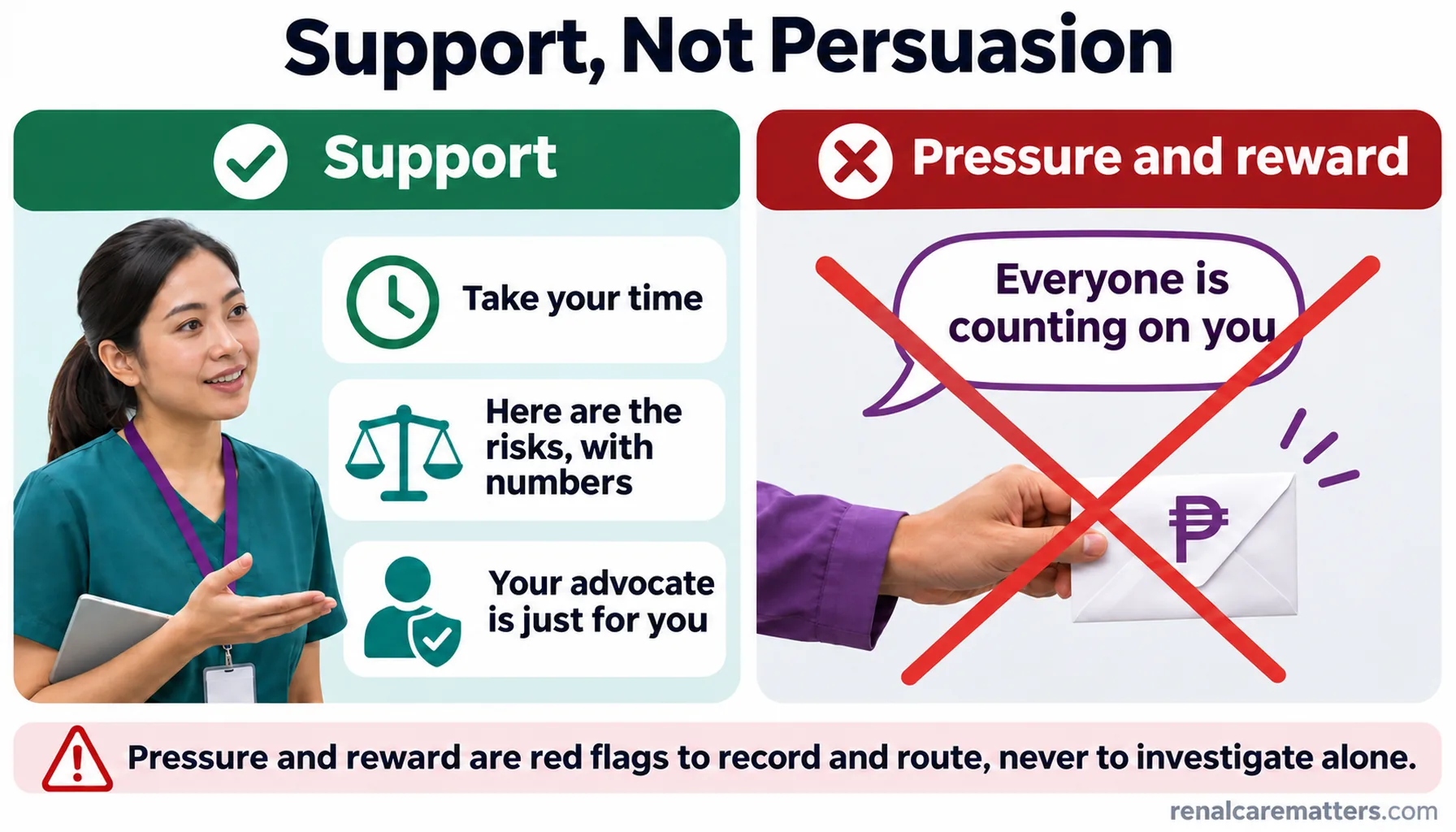
Figure 1. Support, not persuasion. Pressure and reward are red flags to route, not problems to solve alone.
The picture has a limit. A building inspector checks materials against a code. The Hospital Transplant Ethics Committee (HTEC) weighs something harder to measure: whether a gift between two people is free, informed, and unrewarded, in a family it has never met. It can only do that with an honest file. A submission that leaves out a concern to “keep things moving” turns the committee into a rubber stamp and leaves the donor unprotected.
The Department of Health (DOH) living-donor order places HTEC review among the donor’s safeguards.1 Philippine anti-trafficking law treats recruitment by coercion, deceit, or intimidation for the removal or sale of organs as trafficking.2 And the Declaration of Istanbul, an international professional statement, defines organ trafficking and transplant tourism and calls for donation that is financially neutral.3 Your job is to prepare the committee to decide, to keep your own support from sliding into persuasion, and to route real danger quickly.
Figure 2 · Key terms for this module
Hospital Transplant Ethics Committee (HTEC)The hospital committee that reviews living donation for voluntariness and ethics.
SubmissionThe file the committee reviews: the question, the evidence, and open concerns.
Conditional approvalAn approval that takes effect only when stated conditions are met and documented.
Safeguarding pathwayThe hospital’s route for concerns about coercion, exploitation, or trafficking.
Financial neutralityThe donor neither gains nor loses money because of donation.
Opening case · fictional
Case: “Just send it, they always approve”
Ms. Rhea Mercado, 33, is being evaluated as a donor for Mr. Victor Lim, 61, a businessman in Makati. Their documents describe “established emotional ties”: she has worked as his family’s housekeeper for six years.
The social worker’s home-visit report notes that Ms. Mercado’s family recently moved into a new house “provided by the employer.” The psychologist’s report describes her as “eager, somewhat anxious about job security.”
The recipient’s nephrologist tells you, “Just send the file to HTEC with the consent. They always approve. We don’t need to attach every report.”
Before reading on, decide:
What must the submission include, and what question is the committee being asked?
Is there a safeguarding concern, and what do you do about it now?
If the committee approves with conditions, when may the case proceed?
Keep your answers in mind. The lesson gives you what you need, and the case review near the end shows one sound response.
Lesson · part 1
What a complete submission contains
A committee decides well when the question is clear and the evidence is complete, including the parts that worry you.
Figure 3 · A complete ethics submission
The questionFor example, “Is this donation voluntary, informed, and free of reward, given the employment relationship?”
Relationship evidenceThe legal packet manifest and any discrepancies (Module 8).
Donor protectionsOrientation record, advocate review, psychiatric or psychological report, social-work report with home-visit findings.
Medical summaryThe donor clinicians’ decision and risk discussion, without unnecessary detail.
Open concernsEvery concern recorded in the donor’s restricted record, stated factually.
Recipient summaryOnly what the committee needs to understand the request.
The coordinator prepares the file; the committee decides. Do not add a recommendation to approve, and do not leave out a report because it is inconvenient. If someone asks you to send only the consent, explain that the committee needs the whole file to make the decision the DOH order assigns it, and escalate to the program manager if the request continues.
RememberSend the committee the question and all the evidence, including the concerns. An incomplete file makes the safeguard decorative.
Lesson · part 2
Watch your own words
Coordinators care about recipients, and recipients are often visibly suffering. That care can leak into donor conversations without anyone intending it. Learn to hear the difference.
Support sounds like
Persuasion sounds like
“Take the time you need. You can stop at any point.”
“Your sister doesn’t have much time.”
“Here are the risks, with numbers.”
“Don’t worry, it’s very safe.”
“What questions do you have?”
“Everyone in your family is counting on you.”
“Your advocate is there just for you.”
“The doctor already scheduled the operation.”
Pressure also travels through the recipient and family. Never pass messages from the recipient to the donor about the donor’s decision, and never ask a family member to “talk to” a hesitant donor.
RememberSupport gives information and time. Persuasion gives urgency and obligation. If your words lean on the donor, stop.
Lesson · part 3
Record, protect, route
Some situations need more than an ethics review. Philippine law names the removal or sale of organs among the exploitative purposes of trafficking in persons.2 Signs that should go to the hospital’s safeguarding and legal pathway at once include a broker or agent arranging contact; a donor who does not know basic facts about the recipient; documents that do not hold together; a donor who seems controlled by someone else; payment, housing, a job, or debt relief tied to donation; and a donor from a background of serious economic dependence on the recipient.
Record the facts you observed in the restricted record: words, dates, who was present.
Protect the donor’s privacy and safety. Do not confront anyone or reveal the concern to the recipient’s side.
Pause the elective progression of the donor pathway.
Escalate through the safeguarding pathway, the program manager, and the HTEC; the hospital decides whether to involve legal counsel or authorities.
Do not investigate alone: no bank records, no home visits of your own, no questioning the employer. Investigation needs authority and training, and an amateur inquiry can put a donor at risk.
On the floor · The agent at the door
A man who introduces himself as a “facilitator” brings a potential donor to the transplant clinic and asks to sit in on her intake. She says little and looks to him before answering.
Coordinator Mr. Ramil Garcia politely holds the intake alone with the donor. Afterward he records what he saw, pauses the donor pathway, and calls the safeguarding lead the same hour.
The coordinator’s job was not to decide whether this was trafficking. It was to make sure the people who decide knew within the hour.
Illustrative scenario. Names and details are invented.
RememberSuspected trafficking: record, protect, pause, and escalate within the hour. Never investigate alone.
Lesson · part 4
Conditions, closure, and privacy
Committee decisions often carry conditions: a second psychiatric review, a cooling-off period, an independent interpreter, further document verification. A conditional approval is open until every condition is met, documented, and accepted by the committee or its delegate. Put each condition in the register with its owner and date.
When you communicate the decision, separate the two people. The donor hears the decision and the reasons the committee shares with the donor. The recipient hears only that the donor pathway is proceeding, pending, or closed, in the neutral wording agreed with the donor (Module 6). A committee decision never travels to the recipient with the donor’s private reasons attached.
RememberA conditional approval is a closed gate only when its last condition is closed. Tell each person only what is theirs.
On the floor
Real situations: problems and solutions
These are fictional but typical. For each one, cover the answer, decide what you would do, then compare. Where a step depends on local rules, your unit’s procedure and your supervisor’s direction come first.
“They always approve”
What you see
A colleague says the committee is a formality.
What is likely going on
A culture that weakens the safeguard.
What to do
Send complete files anyway; raise the culture issue with the program manager.
Why it matters
A safeguard is only as strong as its file.
The anonymous tip
What you see
An anonymous caller says a donor is being paid.
What is likely going on
Possibly true, possibly malicious.
What to do
Record the call factually; escalate to safeguarding; do not confront anyone.
Why it matters
The people with authority decide how to assess it.
The conditional approval
What you see
Surgery is booked before the committee’s condition is met.
What is likely going on
A gate assumed closed.
What to do
Flag to the surgeon and program manager; the gate stays open until the condition closes.
Why it matters
Conditions exist because the committee had a concern.
Field notes
State the committee’s question in one sentence.
Include every concern in the file.
Escalate suspected trafficking within the hour.
Track every condition to closure.
Case review
Back to the case: “Just send it, they always approve”
The submission. The question is whether a donation from an employee to her employer, with recent employer-provided housing and anxiety about job security, is voluntary and free of reward. Include the full legal packet, the advocate review, the psychologist’s report, the social worker’s home-visit report (including the house), the donor clinicians’ decision, and every recorded concern. Decline politely to send only the consent, and escalate if pressed.
Safeguarding. Yes: housing provided by the recipient and economic dependence are possible inducement and possible coercion. Record the facts in her restricted record, pause the elective progression, and escalate through the safeguarding pathway and the program manager now, not only through the routine committee schedule. Do not question the employer.
Conditions. If the committee approves with conditions, the ethics gate stays open until each condition is completed, documented, and accepted. The case proceeds to readiness only then (Module 14). Ms. Mercado keeps the right to withdraw throughout.
Skills lab · with your preceptor
Skills checklist: Ethics submission and safeguarding escalation
Prepare a mock ethics submission and escalate a mock safeguarding concern while your preceptor observes. Your preceptor rates each step as satisfactory, needs practice, or not observed. Steps marked Critical must all be satisfactory before sign-off. This checklist supports supervised learning; your unit’s own procedure and competency form are the authority. A printable version of every checklist is on the trainer page.
States the question for decision in one sentence.
CriticalIncludes all required reports and every recorded concern, without a recommendation.
Identifies persuasive language in a scripted donor conversation and rewrites it as support.
CriticalEscalates a simulated trafficking concern within the hour without investigating or confronting.
CriticalTracks conditional approval items to documented closure in the register.
CriticalCommunicates a decision separately to donor and recipient without disclosing private reasons.
Placement activity. With the committee secretariat’s permission, review your HTEC’s submission checklist and compare it with the flow in this module.
Self-assessment
Check your understanding
Each visit draws 5 questions at random from this module’s 10-question bank. Choose the single best answer for each, then select Check answers; an explanation appears under the best answer. Select New set of questions for a different mix. A good target is 4 of 5 on two different sets. Nothing you select is sent anywhere; scoring happens in your browser.
Muller, E., Dominguez-Gil, B., & Martin, D. (2019). The Declaration of Istanbul on Organ Trafficking and Transplant Tourism (2018 edition) introduction. Transplantation, 103(2), 217. https://doi.org/10.1097/TP.0000000000002541
Educational material for transplant coordination staff. Completing it is an Academy learning record only. It is not a DOH-recognized training credit, a PhilHealth requirement, a certification, or CPD units, and it does not appoint anyone as a donor advocate or confer any clinical authority.