Building a traceable legal packet, verifying documents through authorized channels, and consent as a process.
PublishedNailathalaGipatikPepalwal:ReferencesMga SanggunianMga TinubdanReng Reperensya:2Audience: Clinical transplant coordinators (usually registered nurses) and coordination-support staff in Philippine kidney transplant programs · Z Benefits coordinators · transplant and dialysis staff who refer, prepare, or follow recipients and living donorsRead timeOras ng pagbasaOras sa pagbasaOras ning pamamasa:
Training track for the people who navigate kidney recipients and living donors
This module is study material for kidney transplant coordinators and coordination-support staff. It explains the reasoning behind coordination decisions; it is not a hospital protocol, legal advice, or a benefits ruling. Rules and rates change: confirm every rule against the current issuance and your facility’s approved policy. Medical decisions belong to the transplant team, donation ethics to the ethics committee, and benefits to PhilHealth. Every case, name, and identifier is fictional.
Learning objectives
After this module you should be able to
Assemble a legal packet in which every document records where, by whom, and when it was verified.
Verify identity and relationship documents through authorized channels, and route corrections through the legal route.
Explain consent as a process that continues until surgery, obtained by the surgeon with independent witnessing.
Support understanding with interpreters and teach-back, without the recipient acting as interpreter.
Handle exceptional cases (foreign nationals, unusual relationships, capacity questions) by escalation, not improvisation.
Classroom 2 hSkills lab 2 hSupervised placement 2 h
Pre-testBefore you read, answer the 5 self-assessment questions and note your score. After the module, select New set of questions and compare. The difference is what you learned; the questions you still miss are what to reread.
Start here
The big picture, in plain words
In plain wordsA legal packet is like the chain of title for a piece of land. A buyer does not trust a land title because it looks official. They trace it: who issued it, which registry holds the original, and whether every transfer was recorded. A photocopy that cannot be traced back to the registry is just a nice-looking piece of paper.
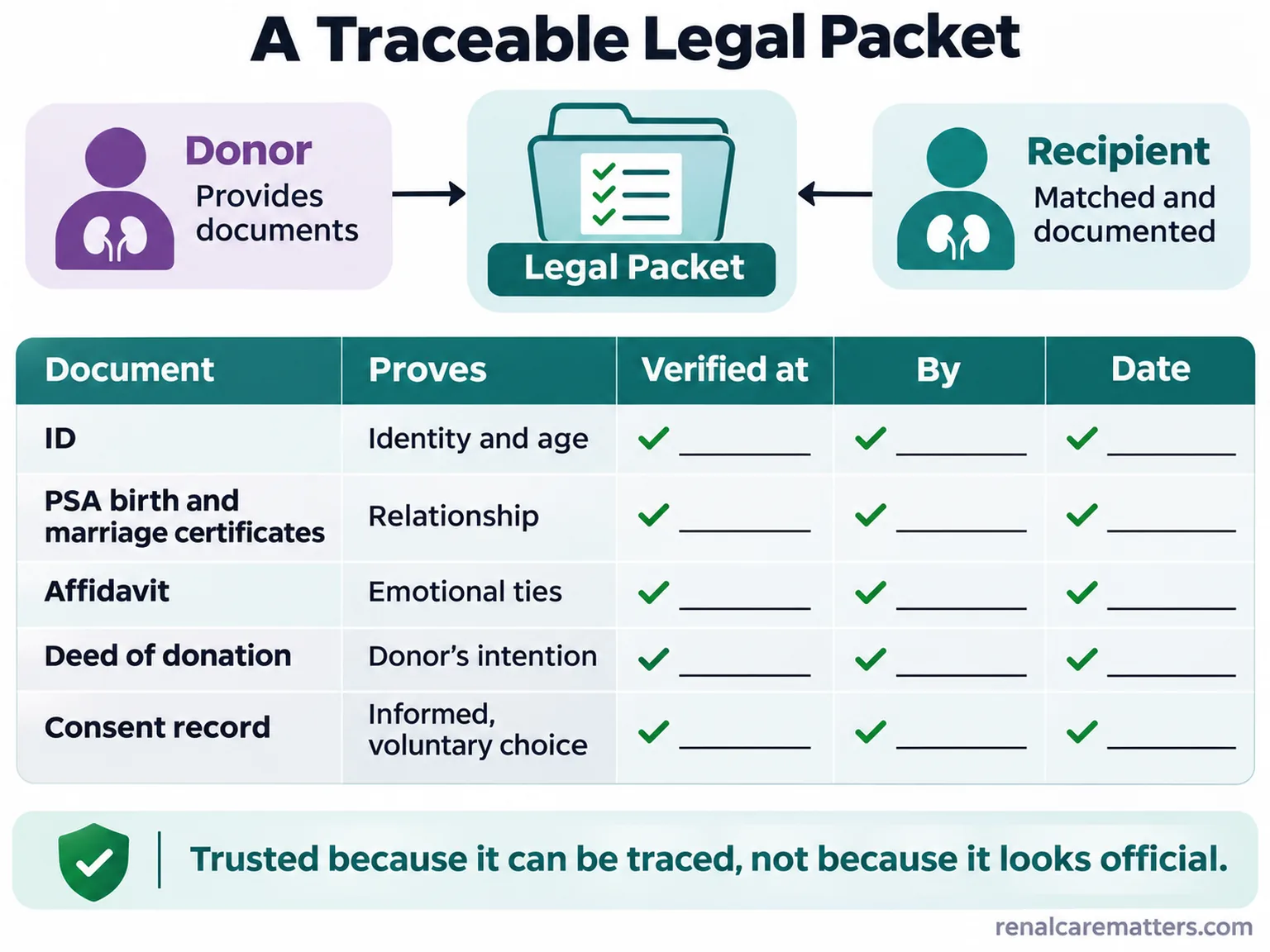
Figure 1. A traceable legal packet: each document, where it was verified, by whom, and when.
The picture has a limit. Land does not have feelings, and a land title does not change its mind. A donor’s consent is not a title you transfer once; it is a continuing agreement the donor may withdraw until the operation. So this module has two halves that work differently: documents, which must be authentic and traceable, and consent, which must be informed, voluntary, and alive until the last moment.
The Department of Health (DOH) living-donor order requires documentation of identity and relationship, and sets out how donor consent is obtained: by the surgeon, with specified independent witnessing, with the right to withdraw preserved.1 Your job is to build a packet a reviewer can trust, and to set up consent conversations that a donor can actually understand.
Figure 2 · Key terms for this module
Legal packetThe set of documents that prove identity, relationship, and consent for a living donation.
ManifestA list of every document in the packet, with source, verifier, and date.
Authenticated copyA copy certified through the issuing agency’s or the hospital’s authorized process.
Deed of donationThe signed instrument by which the donor records the gift, as the program’s legal forms require.
Informed consentAgreement after understanding the purpose, risks, alternatives, and the right to refuse.
Teach-backThe person explains in their own words what they understood.
Opening case · fictional
Case: The photocopy and the interpreter
Mrs. Leticia Dizon, 51, from Pampanga, is being evaluated as a donor for her younger brother, Mr. Arnel Cruz, 47. Their mother’s maiden name differs between the two birth certificates in the packet; one is a clear photocopy, the other a certified copy from the Philippine Statistics Authority (PSA).
Mrs. Dizon reads little English and is most comfortable in Kapampangan. Mr. Cruz’s wife offers to translate at the consent meeting: “I speak Kapampangan, and it’s family anyway.”
A notarized affidavit of relationship spells Mrs. Dizon’s middle name with one letter wrong. The consent meeting with the surgeon is on Friday.
Before reading on, decide:
What do you do about the photocopy and the differing maiden names?
Who should interpret at the consent meeting, and how will understanding be checked?
How is the affidavit corrected?
Keep your answers in mind. The lesson gives you what you need, and the case review near the end shows one sound response.
Lesson · part 1
Every document, its source, its verifier, its date
A reviewer — the ethics committee, Philippine Health Insurance Corporation (PhilHealth), a regulator, a court — should be able to pick up the packet and see, for every document, what it proves and how you know it is authentic.
Document type
What it proves
How it is verified
Government-issued identification
Identity and age
Original seen and compared with the person; copy marked as seen
Birth and marriage certificates
Relationship within the stated degree
PSA-certified copies, or through the program’s authorized verification route
Affidavits
Facts the certificates cannot show, such as emotional ties
Properly executed and notarized; consistency checked against other documents
Deed of donation and program forms
The donor’s recorded intention
Signed under the program’s procedure
Consent record
Informed, voluntary agreement
Obtained by the surgeon with independent witnessing
Keep a manifest on top: each document, what it proves, its source, who verified it, how, and when. When documents disagree — a different maiden name, a different birth date — do not choose the version that “looks right.” Record the discrepancy and route it for verification. A discrepancy may be a clerical error; it may also be the first sign of a false relationship (Module 6).
Corrections follow the legal route. A notarized affidavit with an error is corrected by a properly executed new or corrective document, not by correction fluid or a handwritten note above the line. Keep the original and the correction together, so the trail is visible.
RememberA document is trusted because it can be traced, not because it looks official. Record source, verifier, and date for every page.
Lesson · part 2
Informed, voluntary, and alive until surgery
Consent is not the signature. The signature records a conversation that should have covered the purpose of the operation, the risks with honest numbers (Module 7), the alternatives for the recipient, the costs, the follow-up, and the right to refuse or withdraw at any time before surgery. Under the DOH order, the surgeon obtains the donor’s consent, with the independent witnessing the order specifies.1 The coordinator prepares and supports; the coordinator does not obtain surgical consent.
Prepare. Schedule enough time, in a private room, with the right interpreter.
Support understanding. Give materials in the person’s language beforehand; after the discussion, use teach-back: “Can you tell me in your own words what the operation involves and what you can do if you change your mind?”
Keep it alive. Check again before surgery that the donor still wishes to proceed, and that nothing has changed.
On the floor · “Do you understand?”
At a consent meeting, the donor nods when asked “Do you understand?” Coordinator Ms. Celia Ramos, there to support, asks instead: “What will you do if you decide next week that you don’t want to go ahead?”
The donor says she thinks it is too late once she has signed. The surgeon explains again that she may withdraw until the operation, privately, through her advocate or the coordinator. Ms. Ramos records the teach-back in the donor’s record.
A nod is politeness. Teach-back is understanding.
Illustrative scenario. Names and details are invented.
RememberA signature records a conversation. Check understanding with teach-back and check the decision again before surgery.
Lesson · part 3
Understanding is the point
An interpreter must be competent in both languages and independent of the outcome. The recipient, the recipient’s spouse, and anyone who stands to gain from the donation have a conflict: they may soften the risks or add pressure without meaning to. Use a qualified hospital interpreter or an independent staff member fluent in the language, and record who interpreted.
Some donors raise questions of capacity: a learning disability, a mental illness, severe distress. Capacity is assessed by clinicians, not by coordinators. If you notice that a donor cannot repeat back the main points, or seems confused, record what you observed and route it to the donor’s team and advocate before any consent meeting.
Situation
What you do
Donor prefers a regional language
Independent interpreter; materials in that language where available
Donor cannot read
Materials read aloud; extra time; teach-back
Donor seems unable to understand or recall
Record observations; route to clinicians and advocate
Family member offers to interpret
Thank them; arrange an independent interpreter
RememberThe interpreter must be competent and independent. Never let the recipient’s side translate the donor’s consent.
Lesson · part 4
Escalate, do not improvise
Some cases need more review than the standard pathway: a donor or recipient who is a foreign national, a relationship based on emotional ties rather than kinship, a donor who lives abroad, or a donor whose documents come from another country. The DOH order and your hospital’s policy set additional requirements for some of these; the ethics committee often reviews them with extra care.1 Treat them as exceptional on purpose: list what is different, ask the program manager and legal office which additional steps apply, and record the answer in the register.
Privacy applies to every page. Identity and civil registry documents are personal information, and health information is sensitive personal information under the Data Privacy Act.2 Store the packet in the approved system, share it only with those who need it, and never send it through personal messaging apps.
RememberWhen a case is unusual, name what is unusual and ask who decides the extra steps. Improvising is how safeguards get skipped.
On the floor
Real situations: problems and solutions
These are fictional but typical. For each one, cover the answer, decide what you would do, then compare. Where a step depends on local rules, your unit’s procedure and your supervisor’s direction come first.
The blurry scan
What you see
A family sends a blurry phone photo of a birth certificate.
What is likely going on
An unverifiable copy.
What to do
Request a PSA-certified copy or use the authorized verification route.
Why it matters
Photos cannot be traced to a registry.
The eager notary
What you see
A family offers to get all affidavits notarized “in one afternoon” by a friend.
What is likely going on
Convenience that may compromise independence.
What to do
Follow the program’s legal office guidance on execution and notarization.
Why it matters
Documents must hold up under review.
Consent on the morning of surgery
What you see
A donor seems unsure in the pre-op area.
What is likely going on
Doubt at the last moment.
What to do
Pause; tell the surgeon and advocate; give the donor a private space.
Why it matters
Consent can be withdrawn until surgery.
Field notes
Keep a manifest on top of every packet.
Never correct a notarized document yourself.
Use independent interpreters.
Check the donor’s wish again before surgery.
Case review
Back to the case: The photocopy and the interpreter
The photocopy and the names. Request a PSA-certified copy of the second birth certificate, or verify it through the program’s authorized route. Record the maiden-name discrepancy in the manifest and route it for verification; it may be a clerical error, but it bears directly on the relationship the ethics committee must confirm. Do not choose a version.
The interpreter. Thank Mrs. Cruz and decline: as the recipient’s wife she has a conflict. Arrange a qualified, independent Kapampangan interpreter for Friday, send materials in advance, and plan teach-back after the surgeon’s discussion. Record who interpreted.
The affidavit. Route it for a properly executed corrective document through the notary and program’s legal office. Keep both versions in the packet with the correction trail. If the correction cannot be completed by Friday, the consent discussion can still take place; the packet stays open in the register until the correction is in.
Skills lab · with your preceptor
Skills checklist: Legal packet and consent preparation
Assemble a mock legal packet and prepare a consent meeting while your preceptor observes. Your preceptor rates each step as satisfactory, needs practice, or not observed. Steps marked Critical must all be satisfactory before sign-off. This checklist supports supervised learning; your unit’s own procedure and competency form are the authority. A printable version of every checklist is on the trainer page.
CriticalBuilds a manifest that records source, verifier, method, and date for each document.
CriticalIdentifies and routes a discrepancy between documents without choosing a version.
Explains why a notarized document is corrected through the legal route, not altered.
CriticalArranges an independent, qualified interpreter and declines a conflicted family interpreter.
CriticalSupports a consent discussion and records teach-back, without obtaining consent.
Lists the additional review steps for an exceptional case and records who decided them.
Placement activity. Audit one completed legal packet (with fictional identifiers removed). Mark each document whose source or verifier is not recorded.
Self-assessment
Check your understanding
Each visit draws 5 questions at random from this module’s 10-question bank. Choose the single best answer for each, then select Check answers; an explanation appears under the best answer. Select New set of questions for a different mix. A good target is 4 of 5 on two different sets. Nothing you select is sent anywhere; scoring happens in your browser.
Educational material for transplant coordination staff. Completing it is an Academy learning record only. It is not a DOH-recognized training credit, a PhilHealth requirement, a certification, or CPD units, and it does not appoint anyone as a donor advocate or confer any clinical authority.