Referring early, a useful first conversation, the barriers that stop people, and closing the referral loop.
PublishedNailathalaGipatikPepalwal:ReferencesMga SanggunianMga TinubdanReng Reperensya:4Audience: Clinical transplant coordinators (usually registered nurses) and coordination-support staff in Philippine kidney transplant programs · Z Benefits coordinators · transplant and dialysis staff who refer, prepare, or follow recipients and living donorsRead timeOras ng pagbasaOras sa pagbasaOras ning pamamasa:
Training track for the people who navigate kidney recipients and living donors
This module is study material for kidney transplant coordinators and coordination-support staff. It explains the reasoning behind coordination decisions; it is not a hospital protocol, legal advice, or a benefits ruling. Rules and rates change: confirm every rule against the current issuance and your facility’s approved policy. Medical decisions belong to the transplant team, donation ethics to the ethics committee, and benefits to PhilHealth. Every case, name, and identifier is fictional.
Learning objectives
After this module you should be able to
Explain why referral for transplant evaluation should happen early, ideally before dialysis starts.
Run a first conversation that gives balanced information and a named contact.
Identify the practical, financial, informational, and social barriers that stop people from completing steps.
Close a referral loop with an acknowledgment from the receiving service.
Use family-centered education to help candidates discuss living donation without pressure.
Classroom 2 hSkills lab 2 hSupervised placement 2 h
Pre-testBefore you read, answer the 5 self-assessment questions and note your score. After the module, select New set of questions and compare. The difference is what you learned; the questions you still miss are what to reread.
Start here
The big picture, in plain words
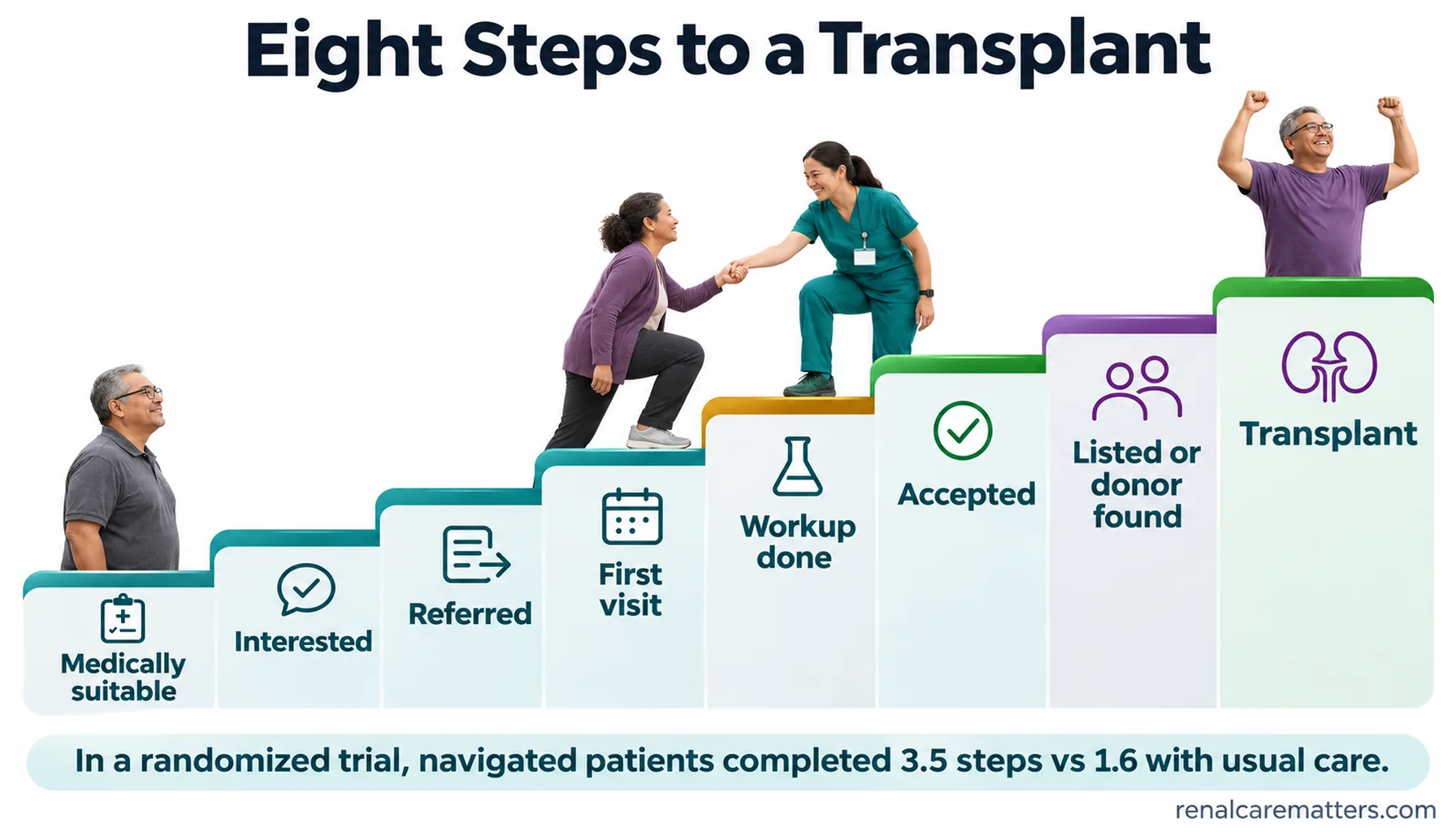
In plain wordsGetting a transplant is like climbing a staircase in the dark. There are about eight steps: being medically suitable, wanting a transplant, being referred, attending the first visit, finishing the workup, being accepted, being listed or finding a donor, and receiving the kidney. Many people stop on a step, not because they cannot climb, but because nobody turned on the light for the next one.
Figure 1. Steps to transplant. People stall at different steps; navigation helps more of them complete each step.
The picture has a limit. A staircase is the same for everyone. The transplant staircase is not: some people meet a missing step — no transport money, no one to watch the children, a referral letter that never arrived, a fear nobody asked about. The trial that defined these eight steps found that navigators helped people climb more of them, across race and sex.1 Your job in this module is to start early, find the missing steps, and make sure every referral actually lands.
Kidney Disease: Improving Global Outcomes (KDIGO) advises that people with chronic kidney disease (CKD) stages G4 to G5 who are expected to reach kidney failure be informed about, educated about, and considered for transplantation; that potential candidates be referred for evaluation at least 6 to 12 months before expected dialysis; and that a pre-emptive living-donor transplant is the preferred treatment for those who are eligible.2
Figure 2 · Key terms for this module
Pre-emptive transplantA transplant done before dialysis starts.
ReferralA request from one service to another to evaluate a person. It is complete only when the receiving service acknowledges it.
IntakeThe first structured conversation and the information gathered then.
Access barrierAnything outside medical suitability that stops a person from completing a step.
Named contactOne person, with a working number, who the candidate can call about the next step.
Opening case · fictional
Case: The referral that went nowhere
Mr. Eduardo Manalo, 52, a tricycle driver from Bulacan, has CKD stage G4 with an estimated glomerular filtration rate (eGFR) of 17. His nephrologist wrote “refer for transplant evaluation” in May. It is now August. He has not been contacted.
His daughter, who works in Dubai, messages the transplant center’s page: “Is my father on your list? My cousin wants to donate but nobody told us what to do.” Mr. Manalo’s phone number in the referral letter is missing a digit. His clinic says the letter was “given to the patient to bring.”
When you reach him at last through the dialysis access clinic, he tells you he did not come because the bus fare to Quezon City is 180 pesos each way and he would lose a day of driving.
Before reading on, decide:
Where did this referral fail, and what would have closed the loop?
What barriers do you see, and which can the program address?
How do you respond to the daughter and the cousin who wants to donate?
Keep your answers in mind. The lesson gives you what you need, and the case review near the end shows one sound response.
Lesson · part 1
Why referral timing matters
Why refer before dialysis? Because evaluation takes months, living donors need their own evaluation, and a transplant done before dialysis avoids the risks of a dialysis access and of the dialysis years themselves. Cohort studies consistently associate transplantation with longer life and better quality of life than dialysis, though no trial has randomized people to the two.3 KDIGO’s advice to refer 6 to 12 months before expected dialysis follows from this timing logic.2
“Fairly” matters as much as “early.” KDIGO’s first statement is that people with CKD G4 to G5 should be informed and considered regardless of socioeconomic status, sex, gender identity, or race and ethnicity.2 In practice, unfairness rarely looks like a refusal. It looks like a referral nobody followed, a form only in English, a clinic open only on weekdays, or an assumption that a poor patient “will not be able to afford it” before anyone checked the package.
Barrier
What it looks like
What the program can do
Practical
Fare, distance, lost workdays, childcare
Cluster appointments on one day; schedule around dialysis; ask about local assistance
Financial
Fear of cost before any estimate exists
Explain the Philippine Health Insurance Corporation (PhilHealth) package early (Module 10); give a written estimate
Informational
Not knowing transplant is possible, or what a donor faces
Plain-language teaching in the person’s language, with family invited
Social
No one to ask about donation; fear of burdening family
Family education sessions; never ask the patient to recruit a donor by pressure
System
Lost letters, wrong numbers, no named contact
Acknowledged referrals; a named coordinator; a register row
RememberRefer early, and assume nothing about who can afford or manage a transplant until someone has asked and checked.
Lesson · part 2
The first conversation
The first conversation sets whether a person comes back. Aim for three outcomes: the person understands the options, knows the next step, and has a named contact with a working number.
Balanced information. Transplant, dialysis, and conservative care are all legitimate choices. Explain what transplant involves — workup, waiting, surgery, lifelong medicines, and uncertainty — without selling it.
Preferences. Language, best contact time, who may receive updates, and who may not.
Open questions about barriers. “What would make it hard for you to come to appointments here?” works better than “You can come every week, right?”
Living donation, carefully. Explain that some people receive a kidney from a relative or close friend, that a potential donor contacts the program privately, and that the program protects donors. Do not ask the patient to name or persuade anyone.
Education that includes the family changes what families do. In a randomized trial in the United States, 152 wait-listed patients received transplant education at home with family and friends present, in a group at the center, or individually. Home education was followed by more patients with at least one living-donor inquiry (82% vs 61% vs 47%) and evaluation (65% vs 39% vs 27%). The difference in living-donor transplants at two years (15% vs 8% vs 6%) was not statistically significant.4 The trial supports bringing the family into education; it does not show that this alone increases transplants, and it studied one population in one country.
On the floor · The question nobody asked
At intake, coordinator Ms. Joy Fernandez asks Mrs. Rosario Dela Cruz, 60, what would make appointments hard. After a pause, Mrs. Dela Cruz says she cares for a grandson with cerebral palsy every afternoon.
Ms. Fernandez books the workup tests on two mornings, at 7 a.m., and links the family to the hospital social worker.
The barrier was not cost or distance. It surfaced only because someone asked an open question.
Illustrative scenario. Names and details are invented.
RememberEvery first conversation ends with three things: the next step, the date, and a named contact with a working number.
Lesson · part 3
Dispatch is not receipt
A referral is a handoff between services, and handoffs fail at the seams. A letter given to the patient “to bring” is the weakest kind: it depends on the patient knowing where to go, being able to get there, and the letter surviving the trip.
Figure 3 · A closed referral loop
ReceivedThe program logs the referral the day it arrives and acknowledges it to the referring clinician.
Contact checkedThe coordinator confirms phone, address, and language within the program’s set time.
First contactA named coordinator reaches the person and gives a next step.
First visit bookedDate, place, what to bring, and help with practical barriers.
Referrer updatedThe referring clinician hears that the person was seen, or why not.
If contact fails, the loop is still yours. Call the referring clinic, the dialysis unit, or the barangay health worker the referral names, using only what is needed to reach the person. Do not post on social media, and do not leave health details in a voicemail.
On the floor · The wrong digit
Coordinator Mr. Ben Aquino receives a referral with a 10-digit mobile number (Philippine mobile numbers have 11). The text bounces. Instead of filing it, he calls the referring clinic the same morning; the clinic secretary reads the correct number from the chart.
He reaches the patient by noon and books the first visit. He sends the referring nephrologist a one-line acknowledgment: received, contacted, visit booked for the 14th.
One phone call to the referrer closed a loop that a filing cabinet would have left open for months.
Illustrative scenario. Names and details are invented.
RememberA referral closes when the person has been reached and the referrer knows the outcome. Until then it is an open row in your register.
Lesson · part 4
Fairness you can see
You cannot fix unfairness you cannot see. Keep a simple referral log with the date received, the date of first contact, the date of the first visit, and the outcome. Once a quarter, look at the same numbers by sex, age group, province, and whether the person is on dialysis or not yet. If people from one province take three times as long to reach a first visit, that is a barrier to investigate, not a fact of life. Module 19 shows how to define these measures properly.
Equity also means honesty with people who may not be eligible. A referral is a request for evaluation, not a promise. Explain at intake that the team will review whether transplant is safe and possible, and that a “not now” usually comes with a reason and a next step.
RememberCount referrals by group, not only in total. An average can look fair while a group falls through.
On the floor
Real situations: problems and solutions
These are fictional but typical. For each one, cover the answer, decide what you would do, then compare. Where a step depends on local rules, your unit’s procedure and your supervisor’s direction come first.
The patient who said no
What you see
A dialysis patient tells you he “doesn’t want a transplant” after hearing it costs millions.
What is likely going on
A decision based on a wrong assumption about cost.
What to do
Explain the PhilHealth package and the process; respect his decision if it stands after accurate information.
Why it matters
Informed refusal is a choice; uninformed refusal is a barrier.
The unit that never refers
What you see
One dialysis unit in your area has referred no one in two years.
What is likely going on
A system barrier, not a patient one.
What to do
Offer the unit’s nephrologist and nurses an education session and a simple referral pathway.
Why it matters
Access depends on which unit a patient happens to attend.
The daughter abroad
What you see
An overseas Filipino worker (OFW) daughter wants weekly updates on her father by message.
What is likely going on
A caring relative without authorization.
What to do
Ask the father whom he authorizes and through which channel; record it.
Why it matters
Privacy applies to family, especially by message.
Field notes
Acknowledge every referral the day it arrives.
Ask “What would make it hard to come here?”
Invite family to education, never to recruit donors.
Count referrals by province and sex each quarter.
Case review
Back to the case: The referral that went nowhere
Where the referral failed. The letter was handed to the patient instead of sent and acknowledged; the phone number was wrong; nobody owned the follow-up. A closed loop would have logged receipt, checked contacts with the referring clinic, reached Mr. Manalo within days, and told his nephrologist the outcome.
The barriers. Transport cost (360 pesos a round trip) and a lost day of income are practical and financial barriers. The program can cluster tests on one day, schedule around his dialysis access visits, link him to the social worker for assistance, and explain early what the PhilHealth package covers. Fear of cost may be hiding behind the fare.
The daughter and the cousin. Reply to the daughter by private message without confirming any health details until Mr. Manalo authorizes it; invite her father to call the named coordinator. For the cousin, explain that potential donors contact the program directly and privately, give the donor intake number, and say that donors have their own evaluation and their own team. Never ask Mr. Manalo to persuade the cousin.
Skills lab · with your preceptor
Skills checklist: Intake and referral loop
Run a simulated intake and close a referral loop while your preceptor observes. Your preceptor rates each step as satisfactory, needs practice, or not observed. Steps marked Critical must all be satisfactory before sign-off. This checklist supports supervised learning; your unit’s own procedure and competency form are the authority. A printable version of every checklist is on the trainer page.
CriticalLogs a referral and sends an acknowledgment to the referring clinician the same working day.
Explains transplant, dialysis, and conservative care in balanced, plain language.
Asks open questions about practical, financial, informational, and social barriers.
CriticalExplains how a potential donor contacts the program privately, without asking the patient to recruit.
CriticalEnds the intake with the next step, its date, and a named contact.
CriticalRecovers a failed contact through the referrer without breaching privacy.
Placement activity. Pull ten recent referrals. For each, record dates of receipt, first contact, and first visit, and mark which loops were closed back to the referrer.
Self-assessment
Check your understanding
Each visit draws 5 questions at random from this module’s 10-question bank. Choose the single best answer for each, then select Check answers; an explanation appears under the best answer. Select New set of questions for a different mix. A good target is 4 of 5 on two different sets. Nothing you select is sent anywhere; scoring happens in your browser.
Sullivan, C., Leon, J. B., Sayre, S. S., Marbury, M., Ivers, M., Pencak, J. A., Bodziak, K. A., Hricik, D. E., Morrison, E. J., Albert, J. M., Navaneethan, S. D., Reyes, C. M., & Sehgal, A. R. (2012). Impact of navigators on completion of steps in the kidney transplant process: A randomized, controlled trial. Clinical Journal of the American Society of Nephrology, 7(10), 1639–1645. https://doi.org/10.2215/CJN.11731111
Chadban, S. J., Ahn, C., Axelrod, D. A., Foster, B. J., Kasiske, B. L., Kher, V., Kumar, D., Oberbauer, R., Pascual, J., Pilmore, H. L., Rodrigue, J. R., Segev, D. L., Sheerin, N. S., Tinckam, K. J., Wong, G., & Knoll, G. A. (2020). KDIGO clinical practice guideline on the evaluation and management of candidates for kidney transplantation. Transplantation, 104(4S1 Suppl 1), S11–S103. https://doi.org/10.1097/TP.0000000000003136
Tonelli, M., Wiebe, N., Knoll, G., Bello, A., Browne, S., Jadhav, D., Klarenbach, S., & Gill, J. (2011). Systematic review: Kidney transplantation compared with dialysis in clinically relevant outcomes. American Journal of Transplantation, 11(10), 2093–2109. https://doi.org/10.1111/j.1600-6143.2011.03686.x
Rodrigue, J. R., Paek, M. J., Egbuna, O., Waterman, A. D., Schold, J. D., Pavlakis, M., & Mandelbrot, D. A. (2014). Making house calls increases living donor inquiries and evaluations for blacks on the kidney transplant waiting list. Transplantation, 98(9), 979–986. https://doi.org/10.1097/TP.0000000000000165
Educational material for transplant coordination staff. Completing it is an Academy learning record only. It is not a DOH-recognized training credit, a PhilHealth requirement, a certification, or CPD units, and it does not appoint anyone as a donor advocate or confer any clinical authority.