Who issues which rule, reading every rule by version and effective date, clinical versus support scope, and the local role charter.
PublishedNailathalaGipatikPepalwal:ReferencesMga SanggunianMga TinubdanReng Reperensya:19Audience: Clinical transplant coordinators (usually registered nurses) and coordination-support staff in Philippine kidney transplant programs · Z Benefits coordinators · transplant and dialysis staff who refer, prepare, or follow recipients and living donorsRead timeOras ng pagbasaOras sa pagbasaOras ning pamamasa:
Training track for the people who navigate kidney recipients and living donors
This module is study material for kidney transplant coordinators and coordination-support staff. It explains the reasoning behind coordination decisions; it is not a hospital protocol, legal advice, or a benefits ruling. Rules and rates change: confirm every rule against the current issuance and your facility’s approved policy. Medical decisions belong to the transplant team, donation ethics to the ethics committee, and benefits to PhilHealth. Every case, name, and identifier is fictional.
Learning objectives
After this module you should be able to
Name the issuers of the laws, orders, circulars, and policies that govern a Philippine kidney transplant program.
Read any rule for its issuer, scope, version, and effective date before acting on it.
Explain why Philippine Health Insurance Corporation (PhilHealth) Circular 2026-0019 was published but not yet effective on November 25, 2026, and how legacy cases are claimed.
Separate clinical coordination tasks from coordination-support tasks, and both from regulated roles.
Build a source register and a local role charter that a program manager can sign.
Classroom 2 hSkills lab 2 hSupervised placement 2 h
Pre-testBefore you read, answer the 5 self-assessment questions and note your score. After the module, select New set of questions and compare. The difference is what you learned; the questions you still miss are what to reread.
Start here
The big picture, in plain words
In plain wordsThink of a transplant program as a house built by several contractors who never meet. Congress poured the foundation. The Department of Health framed the walls. PhilHealth installed the meter that decides what each room costs. The hospital wrote the house rules taped to the fridge. Professional societies left advice in the mailbox. When something goes wrong, the first question is always: whose work was this, and which version of their plan were we following?
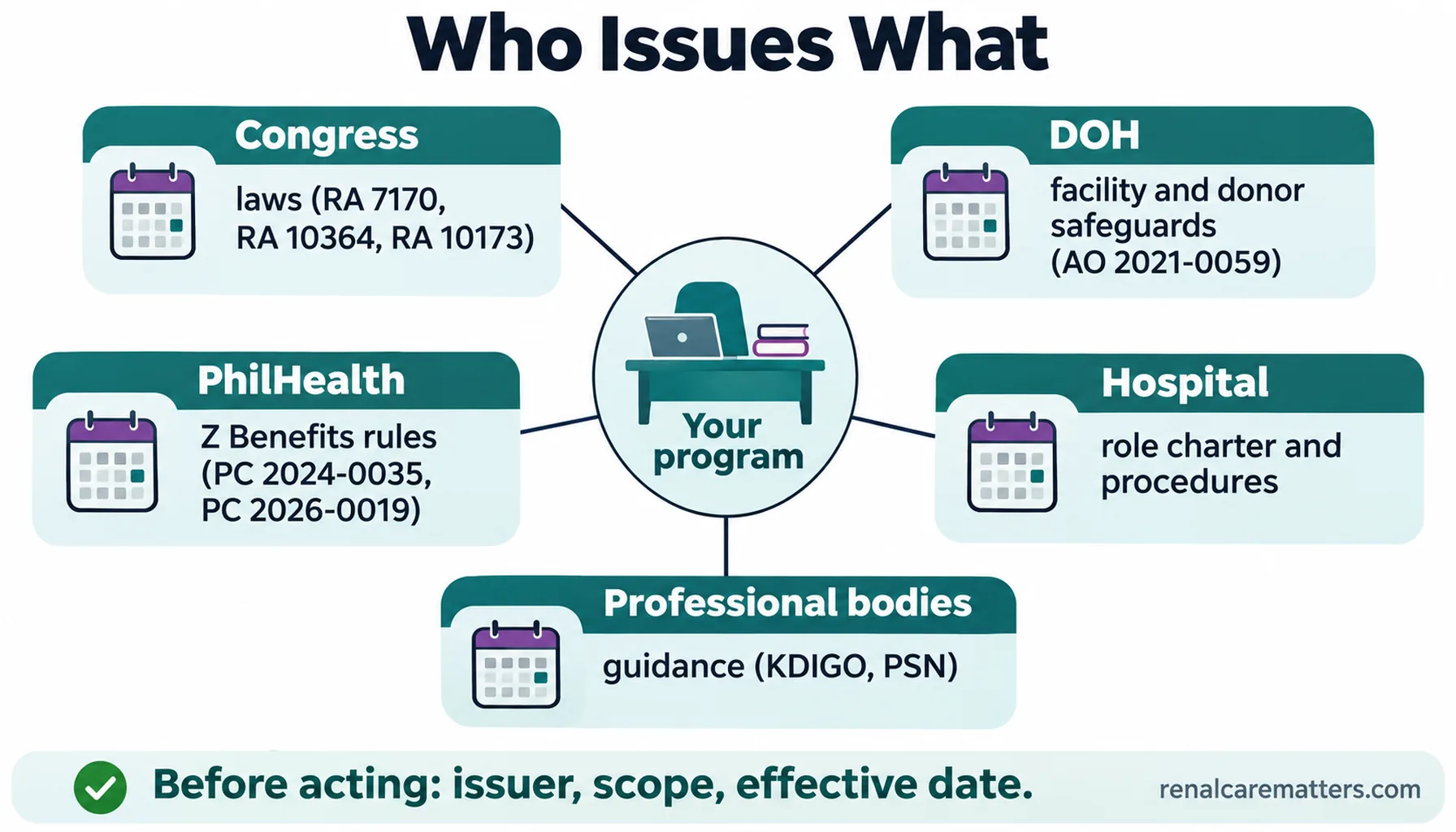
Figure 1. Who issues what. Read every rule for its issuer, scope, and effective date.
The picture has one limit. In a real house the foundation does not change while you live in it. In a transplant program the rules change on their own schedules, and an older rule can keep governing old cases after a newer one appears. PhilHealth’s kidney transplant circular is the clearest example this year: Revision 1 was published on November 21, 2026, and takes effect fifteen days later, while cases already pre-authorized and performed under the 2024 circular stay under the 2024 circular.1,2
The job of this module is one habit. Before you act on any instruction, find out who issued it, whom it covers, which version applies to the date in question, and whether it is already in force. Careful people make most rule mistakes by following the wrong version of the right rule.
Figure 2 · Key terms for this module
Republic Act (RA)A law passed by Congress, such as the Organ Donation Act or the Data Privacy Act.
Administrative order (AO)A numbered Department of Health (DOH) issuance that sets rules, such as AO 2021-0059 on living donors.
Department memorandum (DM)A DOH issuance that implements or clarifies, such as the 2023 memorandum on the national waiting list.
PhilHealth circular (PC)A numbered PhilHealth rule, such as PC 2024-0035 on the kidney transplant package.
PhilHealth advisory (PA)A PhilHealth notice that implements or announces, such as PA 2026-0026 on the transplant registry.
Effective dateThe date a rule starts to govern. Not the same as the date it was signed or published.
Opening case · fictional
Case: The circular in the group chat
It is Tuesday, November 25, 2026. Ms. Grace Villanueva, the Z Benefits coordinator at a Cebu transplant hospital, forwards you a Portable Document Format (PDF) from a regional coordinators’ group chat. The message above it says: “New PhilHealth kidney transplantation (KT) circular, effective na! Use the new forms starting today.”
Your program has three active cases: Mr. Danilo Reyes, transplanted on October 30 under a pre-authorization approved in August; Ms. Cecilia Uy, pre-authorized last week, surgery planned for January; and Mr. Joel Santos, whose pre-authorization request is still being prepared.
That afternoon a new hire asks whether she can “become the donor advocate” now that she has started this course. Her job posting asked for a registered nurse with two years of experience, and she wonders whether that makes her a “certified coordinator.”
Before reading on, decide:
Is the circular in effect today? What do you check, and where?
Which rule governs each of the three cases?
How do you answer the new hire about the donor advocate role and certification?
Keep your answers in mind. The lesson gives you what you need, and the case review near the end shows one sound response.
Lesson · part 1
Who issues which rule
Five kinds of issuer shape a coordinator’s work. Recognize their documents on sight.
Issuer
What it governs
Examples a coordinator uses
Congress
What is lawful
RA 7170, the Organ Donation Act (deceased donation);3 RA 9208 as amended by RA 10364 and RA 11862 (trafficking, including removal or sale of organs);4 RA 10173, the Data Privacy Act5
Department of Health
Which facilities may transplant, and how donors are protected
AO 2008-0034 (transplant facility authorization);6 AO 2010-0018 and AO 2010-0019 with its amendment (donation, including procurement and clinical coordinators);7,8 AO 2021-0059 (ethical donation from living donors);9 DM 2023-0175 (national waiting list)10
PhilHealth
What the package pays, and the conditions
PC 2024-0035 and PC 2026-0019 (kidney transplant package);11,1 the 2025 survey tool;12 PA 2026-0026 (KT registry);13 PC 2025-0011 and PC 2025-0012 (post-transplant services)14,15
Your hospital
How the rules become local work
Role charter, procedures, forms, escalation lists
Professional bodies
What good practice looks like
Philippine Society of Nephrology (PSN) guidance;16 Kidney Disease: Improving Global Outcomes (KDIGO) guidelines17,18
A law can send someone to prison. A DOH order can cost a facility its authorization. A PhilHealth circular can cost a payment. A guideline shapes what is considered reasonable care, but it does not by itself bind anyone. Knowing the issuer tells you how much is at stake and whom to ask.
RememberBefore acting on a rule, say its issuer, its scope, and its effective date. If you cannot, you are not ready to act on it.
Lesson · part 2
Published, effective, and legacy
Three dates matter for every issuance: when it was signed, when it was published, and when it takes effect. PhilHealth circulars commonly take effect fifteen days after publication in the Official Gazette or a newspaper of general circulation. PC 2026-0019 says exactly that.1 The PhilHealth index lists its publication date as November 21, 2026.2 Counting fifteen days gives December 6, 2026 — an indicative date you should confirm with your PhilHealth regional office or the Z Benefits lead, because publication details and counting conventions decide the formal date.
Then the legacy rule. Revision 1 says that kidney transplants pre-authorized and performed under PC 2024-0035 are claimed under PC 2024-0035. Contracted facilities with existing contracts stay eligible while their contracts are being amended.1 So on the same afternoon, two claims from the same hospital may follow two different circulars.
What changed, and what did not? The eight package rates in Revision 1 are the same rates PC 2024-0035 introduced; the revision changes surrounding policy text, such as the transition and registry wording. Do not tell families that the rates changed on November 21.
On the floor · The historical 60 hours
A senior colleague insists that coordinators “need 60 hours of training under PhilHealth.” The program manager asks Ms. Nina Torres, the coordinator, to check.
Ms. Torres finds the requirement in Annex B.1 of PhilHealth Circular 014-2015, a 2015 issuance,19 and cannot find it carried into the current circular or survey tool. She records it in the source register as “historical; not verified as a current requirement” and asks the PhilHealth regional office in writing.
An old rule remembered as a current one is the most common version error.
Illustrative scenario. Names and details are invented.
Field
Example entry
Issuer and number
PhilHealth Circular 2026-0019
Title
Z Benefits Package for Kidney Transplantation (Revision 1)
Published
November 21, 2026 (PhilHealth index)
Effective
15 days after publication; indicative December 6, 2026; confirm
Replaces or amends
Amends PC 2024-0035; legacy cases stay under PC 2024-0035
Local procedure that carries it out
Z Benefits procedure, version 4
Owner and next check
Z Benefits lead; check monthly and after every new circular
RememberA rule governs from its effective date, and an older rule can keep governing older cases. Record both dates in the source register.
Lesson · part 3
Clinical, support, and regulated roles
This course has two learner paths, and the line between them protects patients.
A clinical transplant coordinator holds a professional license and does the clinical tasks the hospital assigns in writing — for example, taking a structured symptom history under protocol, or giving medicine teaching. Philippine employer postings commonly ask for a registered nurse, sometimes with membership in the Philippine Nurses Association and two to three years of clinical experience. Those are hiring requirements of particular employers, not national legal minimums.
A coordination-support staff member — including many Z Benefits coordinators — navigates documents, funding, records, and schedules. Support staff learn the clinical content in this course so they can recognize a problem and route it at once. They never perform a nursing assessment, triage independently, prescribe, decide suitability, obtain surgical consent, or certify death.
Task
Clinical coordinator
Support staff
Explain the pathway and next steps
Yes
Yes
Assemble documents and funding evidence
Yes
Yes
Take a symptom history under protocol
If assigned
No; route at once
Medicine teaching
If assigned
No; arrange it
Decide suitability, obtain surgical consent, accept an offer
No
No
Some roles are not jobs a course can confer. The donor advocate is designated under the DOH living-donor order with its own definition and qualifications.9 The procurement coordinator is defined in the DOH deceased-donation rules.8 No standalone national coordinator credential from the PSN was found when this course was written, and none is implied. United States, United Kingdom, and Australian credentials appear in Module 20 only as comparisons.
RememberA job title, a posting, or this course does not create authority. Authority comes from a license, a written hospital assignment, and the role’s own legal definition.
Lesson · part 4
Make the rules into local work
Rules become safe practice only when the hospital writes down who does what. Ask your program manager for a role charter signed by the medical director, and keep it with your source register.
Figure 3 · A complete coordinator role charter
PurposeNavigate the recipient and the donor through medical, legal, ethical, and insurance systems.
Reporting lineThe named transplant program or nursing manager.
Clinical versus support tasksListed explicitly, per person in the role.
Decision ownersNamed, each with an alternate: team, surgeon, advocate, ethics committee, payer liaison.
EscalationDaytime and after-hours contacts, and the time limits for urgent routing.
Records and privacySeparate donor and recipient records; who may see the restricted donor record.
ReviewYearly, and whenever a governing issuance changes.
The charter is also where conflicts are managed. If one person is both the recipient’s coordinator and the Z Benefits coordinator, the charter says so. If the hospital is small and roles overlap, the charter names who stands in for the donor’s interests so that it is never the recipient’s coordinator by default.
On the floor · Two hats, one person
At a small Davao program, Mr. Ariel Mendoza is both the clinical coordinator and the Z Benefits coordinator for five transplant cases. The survey tool allows at most three Z packages per coordinator.
He raises it with the program manager, who designates a second Z Benefits coordinator from the billing office for two of the cases and amends the role charter the same week.
A limit in a circular becomes real only when the charter assigns the work to fit it.
Illustrative scenario. Names and details are invented.
On the floor
Real situations: problems and solutions
These are fictional but typical. For each one, cover the answer, decide what you would do, then compare. Where a step depends on local rules, your unit’s procedure and your supervisor’s direction come first.
The forwarded memo
What you see
Head office forwards a memo saying coordinators may now sign donor consent as witnesses.
What is likely going on
A local instruction that may conflict with the DOH order’s independent witnessing.
What to do
Ask for the issuer and basis in writing; compare with the DOH order; escalate to the program manager and legal office.
Why it matters
A memo cannot lower a safeguard set by a DOH order.
Two coordinators, one title
What you see
The hospital calls both the clinical coordinator and the Z Benefits clerk “transplant coordinator.”
What is likely going on
Unclear scope.
What to do
Ask for a role charter listing clinical and support tasks for each person.
Why it matters
Patients and staff assume the same title means the same authority.
The old checklist
What you see
A PhilHealth checklist on the wall is from 2021.
What is likely going on
A document that predates PC 2024-0035.
What to do
Replace it with the current version from the Z Benefits lead; record the change in the source register.
Why it matters
Old forms cause returns and denials.
Field notes
Write the effective date on every printed rule.
Check the PhilHealth circular index monthly.
Record “historical” next to any rule you cannot confirm as current.
Ask “who issued this?” before acting.
Case review
Back to the case: The circular in the group chat
Is the circular in effect? Not on November 25. Check the PhilHealth circular index: PC 2026-0019 was published November 21, 2026, and the circular takes effect fifteen days after publication, so about December 6. Reply to the group chat politely with the index link and the effective-date clause. Ask the Z Benefits lead to confirm the formal date with the regional office, and add the circular to the source register as “published, not yet effective.”
Which rule for each case? Mr. Reyes was pre-authorized and transplanted under PC 2024-0035, so his claim follows PC 2024-0035. Ms. Uy was pre-authorized under PC 2024-0035 but will be transplanted after Revision 1 takes effect; the legacy rule covers cases pre-authorized and performed under the old circular, so route her case to the Z Benefits lead for a written determination. Mr. Santos’s request will likely be filed after the effective date; prepare it under Revision 1 and confirm the forms.
The new hire. Welcome her honestly. The donor advocate is a designated role under the DOH living-donor order, with its own definition and qualifications; this course cannot make anyone an advocate. Her posting’s requirements are that employer’s hiring standard, not a national credential, and completing the course is an Academy learning record, not certification.
Skills lab · with your preceptor
Skills checklist: Source register and role charter
Build a source register and a draft role charter for a fictional program while your preceptor observes. Your preceptor rates each step as satisfactory, needs practice, or not observed. Steps marked Critical must all be satisfactory before sign-off. This checklist supports supervised learning; your unit’s own procedure and competency form are the authority. A printable version of every checklist is on the trainer page.
CriticalRecords issuer, number, title, publication date, effective date, scope, and owner for each governing rule.
CriticalExplains the legacy-case rule of PC 2026-0019 using two fictional cases.
Labels the 2015 60-hour criterion as historical and unverified as current.
CriticalLists clinical versus support tasks for two named staff, with the tasks support staff never perform.
Names an owner and an alternate for each decision type.
CriticalIdentifies a role conflict (for example, recipient coordinator as donor advocate) and proposes a fix.
Placement activity. Ask for your program’s role charter and source register. List every rule without an effective date and every decision without an alternate.
Self-assessment
Check your understanding
Each visit draws 5 questions at random from this module’s 10-question bank. Choose the single best answer for each, then select Check answers; an explanation appears under the best answer. Select New set of questions for a different mix. A good target is 4 of 5 on two different sets. Nothing you select is sent anywhere; scoring happens in your browser.
Department of Health. (2010). Administrative Order No. 2010-0019 on deceased organ donation, including procurement and clinical transplant coordinators, as amended by Administrative Order No. 2010-0019-A. https://elibrary.judiciary.gov.ph/thebookshelf/showdocs/10/52063
Chadban, S. J., Ahn, C., Axelrod, D. A., Foster, B. J., Kasiske, B. L., Kher, V., Kumar, D., Oberbauer, R., Pascual, J., Pilmore, H. L., Rodrigue, J. R., Segev, D. L., Sheerin, N. S., Tinckam, K. J., Wong, G., & Knoll, G. A. (2020). KDIGO clinical practice guideline on the evaluation and management of candidates for kidney transplantation. Transplantation, 104(4S1 Suppl 1), S11–S103. https://doi.org/10.1097/TP.0000000000003136
Lentine, K. L., Kasiske, B. L., Levey, A. S., Adams, P. L., Alberú, J., Bakr, M. A., Gallon, L., Garvey, C. A., Guleria, S., Li, P. K., Segev, D. L., Taler, S. J., Tanabe, K., Wright, L., Zeier, M. G., Cheung, M., & Garg, A. X. (2017). KDIGO clinical practice guideline on the evaluation and care of living kidney donors. Transplantation, 101(8S Suppl 1), S1–S109. https://doi.org/10.1097/TP.0000000000001769
Educational material for transplant coordination staff. Completing it is an Academy learning record only. It is not a DOH-recognized training credit, a PhilHealth requirement, a certification, or CPD units, and it does not appoint anyone as a donor advocate or confer any clinical authority.