Organizing the workup by question, preparing a case conference, test expiry, and explaining deferral honestly.
PublishedNailathalaGipatikPepalwal:ReferencesMga SanggunianMga TinubdanReng Reperensya:1Audience: Clinical transplant coordinators (usually registered nurses) and coordination-support staff in Philippine kidney transplant programs · Z Benefits coordinators · transplant and dialysis staff who refer, prepare, or follow recipients and living donorsRead timeOras ng pagbasaOras sa pagbasaOras ning pamamasa:
Training track for the people who navigate kidney recipients and living donors
This module is study material for kidney transplant coordinators and coordination-support staff. It explains the reasoning behind coordination decisions; it is not a hospital protocol, legal advice, or a benefits ruling. Rules and rates change: confirm every rule against the current issuance and your facility’s approved policy. Medical decisions belong to the transplant team, donation ethics to the ethics committee, and benefits to PhilHealth. Every case, name, and identifier is fictional.
Learning objectives
After this module you should be able to
Organize a recipient workup by the clinical questions it must answer, each with an owner.
Track the validity window of each result and flag expiry before a decision meeting.
Prepare a one-page case-conference summary built around the decision requested.
Explain a team decision, including a deferral, in plain and truthful language.
Explain why adherence and psychosocial assessment are part of the medical workup.
Classroom 2 hSkills lab 2 hSupervised placement 2 h
Pre-testBefore you read, answer the 5 self-assessment questions and note your score. After the module, select New set of questions and compare. The difference is what you learned; the questions you still miss are what to reread.
Start here
The big picture, in plain words
In plain wordsA recipient workup is like a building inspection before a big renovation. The inspector does not just collect papers. Each check answers a question: Will the foundation hold the load? Is there hidden water damage? Is the wiring safe? Will someone live here and maintain it? A stack of papers is not an inspection; an answered question is.
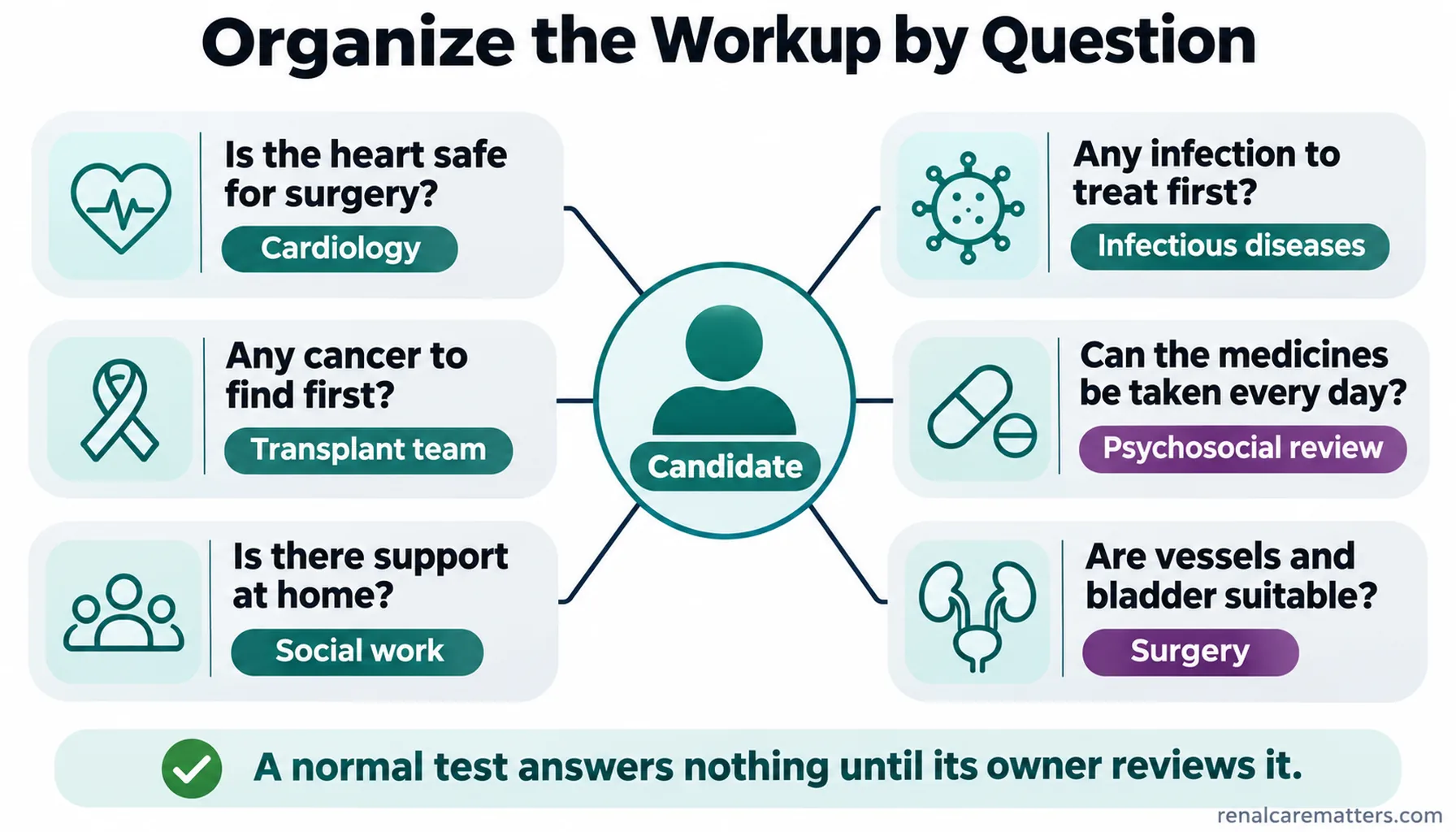
Figure 1. Organize the workup by question, not by test. Each question has an owner who answers it.
The picture has a limit. A building does not change while you inspect it. A person on dialysis does: a heart test from last year may no longer describe today’s heart, an infection can appear after a clean screen, and a person’s home support can change in a week. So a workup is not a checklist you finish once. It is a set of questions, each answered by its owner on results that are still current on the day of the decision.
Kidney Disease: Improving Global Outcomes (KDIGO)’s 2020 candidate guideline organizes the evaluation by domain: age and frailty, psychosocial assessment, adherence, cardiac and vascular disease, infection, cancer, and other organ systems, among others.1 Your job is not to interpret any of these. Your job is to make sure each question has an owner, each result is current, and the team meets with everything it needs to decide.
Figure 2 · Key terms for this module
WorkupThe set of tests and reviews that answer whether transplant is safe and appropriate for this person.
Multidisciplinary team (MDT)The group that decides candidacy: transplant nephrology, surgery, and others such as cardiology, infectious diseases, psychiatry, social work, and nutrition.
Validity windowHow long a result counts as current under the program’s protocol.
DeferralA decision that transplant is not possible now, with a reason and a condition for review.
Case conferenceThe meeting where the team reviews a candidate and records a decision.
Opening case · fictional
Case: The conference on Tuesday
Ms. Marites Gonzales, 38, has been on peritoneal dialysis for two years. Her case is listed for Tuesday’s transplant case conference. It is Thursday. You open her folder.
Her chest X-ray is from four months ago. Her stress echocardiogram is from fourteen months ago; the program protocol accepts twelve. A dental note from last week says “tooth 36: periapical abscess, for extraction.” The psychosocial assessment form is blank except for her name. Her cervical cancer screening result is “to follow.”
The transplant nephrologist, Dr. Liza Soriano, asks you for “the usual summary” by Monday noon.
Before reading on, decide:
Which questions are already answered, which are open, and which are answered on expired results?
What do you route, to whom, and by when?
What will the one-page summary open with?
Keep your answers in mind. The lesson gives you what you need, and the case review near the end shows one sound response.
Lesson · part 1
Each question has an owner
A test list invites a dangerous shortcut: “all tests done” sounds like “cleared.” A question list does not. Rewrite the workup as the questions the team must answer, each with its owner and its status.
Question
Typical owner
What the coordinator tracks
Is the heart safe for surgery?
Cardiology, with the transplant team
Which tests were ordered, dates, whether the cardiologist has written an opinion
Is there an infection to treat first?
Infectious diseases, transplant team
Screening dates; dental and other infection sources; treatment completion
Is there a cancer to find or treat first?
Transplant team, with screening services
Age- and sex-appropriate screening dates and results
Can the person take the medicines every day, and do they have support?
Psychosocial assessor, social work
Assessment completed by an experienced professional; barriers listed
Is the anatomy suitable (vessels, bladder)?
Transplant surgery, urology
Imaging and surgical review dates
Are other organs or conditions a concern?
Transplant nephrology
Specialist opinions requested and received
KDIGO advises a psychosocial assessment for every candidate by a professional experienced in transplant, and an assessment of adherence and its barriers before transplant.1 The reason is practical, not moral. Medicine-taking problems after transplant are common and are associated with graft loss (Module 15); a barrier found before surgery — cost, literacy, no one to help at home — can often be fixed. It is not a test the person passes or fails.
RememberA normal result answers nothing until its owner reviews it. Track questions and owners, not just tests.
Lesson · part 2
Validity windows and expiry
Every result ages. Your program’s protocol sets how long each one counts as current for a decision, and the team can always ask for more. Track two dates for each result: when it was done and when it expires under protocol. Flag anything that expires before the decision meeting, and anything that will expire before a likely surgery date.
Flagging is not ordering. If the stress test is two months past the window, your Situation, Background, Assessment, Recommendation (SBAR) asks the transplant physician whether to repeat it before the conference; the physician decides. Never present an expired result as current, and never leave it off the summary to avoid a delay.
On the floor · The stale echo
Coordinator Ms. Ruth Javier builds the summary for a conference and notices that a candidate’s echocardiogram is 13 months old against a 12-month window. She sends the transplant nephrologist a one-line SBAR on Thursday.
The physician replies that a repeat is needed but the case can still be discussed for a provisional decision. Ms. Javier books the echo for Monday and marks the summary: “Echo repeated Monday; result to be reviewed before final listing.”
The conference went ahead honestly, and the gap had an owner and a date.
Illustrative scenario. Names and details are invented.
RememberFlag expiry before the meeting, not after the decision. The physician decides whether to repeat.
Lesson · part 3
The one-page summary
A case conference is a decision meeting. Busy specialists decide better when the decision is stated first and the evidence is arranged around it.
Figure 3 · A one-page conference summary
Decision requestedFor example, accept as a candidate, defer, or decline, and whether a living donor is under evaluation.
SnapshotAge, cause of kidney failure, dialysis type and start date, blood group.
Questions and answersEach domain from the table, with owner, date, and status: answered, open, or expired.
Open itemsWhat is missing, who owns it, and when it will be ready.
BarriersPractical and psychosocial barriers found, and what is being done.
Donor statusOnly that a separate donor evaluation is or is not in progress; no donor health details.
Two things never go on the recipient’s summary: the donor’s health information and the coordinator’s opinion on suitability. The donor has their own evaluation and their own conference. Your view on whether the person “deserves” a transplant has no place in a clinical decision.
After the meeting, record the decision exactly as the team states it, with conditions and the date of the next review, and close or open register rows to match.
RememberOpen the summary with the decision requested. Close the meeting with a recorded decision and dated conditions.
Lesson · part 4
Deferral is not rejection
Most team decisions are not yes or no. Many are “not yet”: treat a dental abscess, lose some weight safely, finish a cancer screening, stabilize the heart. A deferral explained badly sounds like a rejection; explained well, it is a plan.
Instead of
Say
“You were rejected.”
“The team wants your tooth infection treated first. After that, they will review you again.”
“It’s just paperwork.”
“There is a medical reason: an infection can become dangerous with transplant medicines.”
“You’ll definitely get a transplant after this.”
“Once this is done, the team will look at everything again. I’ll call you with the date.”
If a person disagrees with a decision, explain how to ask for a second opinion or a review under hospital policy, and route the request. Use teach-back: ask the person to tell you in their own words what the next step is.
RememberA deferral is a reason, a next step, and a review date. Give all three, in plain words, and check understanding.
On the floor
Real situations: problems and solutions
These are fictional but typical. For each one, cover the answer, decide what you would do, then compare. Where a step depends on local rules, your unit’s procedure and your supervisor’s direction come first.
All tests done
What you see
A family says “all tests are done, so he’s cleared.”
What is likely going on
Tests confused with decisions.
What to do
Explain that the team reviews the results and decides; give the conference date.
Why it matters
A finished test list is not a clearance.
The missing opinion
What you see
Cardiology did the tests but wrote no opinion.
What is likely going on
Results without an answer to the question.
What to do
Ask cardiology for a written opinion before the conference.
Why it matters
The team needs the specialist’s answer, not just the data.
The deferred candidate who disappears
What you see
A candidate deferred for weight loss stops attending.
What is likely going on
Deferral heard as rejection.
What to do
Call with the review date and the support available; involve the dietitian.
Why it matters
A deferral without follow-up becomes a quiet exclusion.
Field notes
Track questions and owners, not tests.
Flag expiry before the meeting.
Open every summary with the decision requested.
Explain deferrals with a reason, a step, and a date.
Case review
Back to the case: The conference on Tuesday
Answered, open, expired. The chest X-ray is current. The stress echocardiogram is two months past the window: answered on an expired result. Infection is open: a dental abscess needs extraction and review. Psychosocial assessment is open: the form is blank. Cancer screening is open: result to follow.
Routing. SBAR to Dr. Soriano today: the echo is outside the window; does she want it repeated before Tuesday, or will the team give a provisional decision? Confirm with the dental service when the extraction is scheduled and ask that the note reach the infection reviewer. Book the psychosocial assessment with the program’s assessor and the social worker. Chase the screening result with the laboratory, by name, with a due date of Monday.
The summary. It opens with the decision requested — likely “provisional acceptance pending dental clearance, repeat echocardiogram, psychosocial assessment, and screening result” — and lists each open item with owner and date. After the conference, explain the outcome to Ms. Gonzales as a plan, not a verdict, and confirm her understanding with teach-back.
Skills lab · with your preceptor
Skills checklist: Workup tracker and conference summary
Using a fictional candidate folder, build the question-based tracker and the one-page summary while your preceptor observes. Your preceptor rates each step as satisfactory, needs practice, or not observed. Steps marked Critical must all be satisfactory before sign-off. This checklist supports supervised learning; your unit’s own procedure and competency form are the authority. A printable version of every checklist is on the trainer page.
Converts a test list into questions with owners and statuses.
CriticalIdentifies every result outside its validity window and sends an SBAR to the decision owner.
CriticalWrites a summary that opens with the decision requested and excludes donor health details.
Records the team decision with conditions and next review date.
CriticalExplains a deferral in plain language and confirms understanding with teach-back.
Placement activity. Attend one case conference. Afterward, list every decision made and check whether each condition has an owner and date in the register.
Self-assessment
Check your understanding
Each visit draws 5 questions at random from this module’s 10-question bank. Choose the single best answer for each, then select Check answers; an explanation appears under the best answer. Select New set of questions for a different mix. A good target is 4 of 5 on two different sets. Nothing you select is sent anywhere; scoring happens in your browser.
Chadban, S. J., Ahn, C., Axelrod, D. A., Foster, B. J., Kasiske, B. L., Kher, V., Kumar, D., Oberbauer, R., Pascual, J., Pilmore, H. L., Rodrigue, J. R., Segev, D. L., Sheerin, N. S., Tinckam, K. J., Wong, G., & Knoll, G. A. (2020). KDIGO clinical practice guideline on the evaluation and management of candidates for kidney transplantation. Transplantation, 104(4S1 Suppl 1), S11–S103. https://doi.org/10.1097/TP.0000000000003136
Educational material for transplant coordination staff. Completing it is an Academy learning record only. It is not a DOH-recognized training credit, a PhilHealth requirement, a certification, or CPD units, and it does not appoint anyone as a donor advocate or confer any clinical authority.