Documentation, Privacy, Telehealth, and Digital Boundaries
Writing facts, sources, and plans, privacy law for social workers, releasing information, and phones, chats, and remote sessions.
PublishedNailathalaGipatikPepalwal:ReferencesMga SanggunianMga TinubdanReng Reperensya:1Audience: Registered social workers in dialysis units, hospital medical social work departments, and kidney transplant programs · medical social workers rotating into kidney care · navigation and support staff on the orientation pathRead timeOras ng pagbasaOras sa pagbasaOras ning pamamasa:
This module is study material for social workers and navigation staff in kidney care. It explains the reasoning behind social work decisions; it is not a facility procedure, legal advice, a benefits ruling, or a mental health diagnosis. Rules, assistance programs, and amounts change: confirm them against the current issuance and your facility’s approved policy. Medical treatment belongs to the nephrologist, benefits to PhilHealth, donation ethics to the ethics committee, and psychiatric diagnosis to the mental health team. Every case, name, and identifier is fictional.
Learning objectives
After this module you should be able to
Write a social work note that separates facts, sources, assessment, plan, and follow-up, in descriptive language.
Apply the Data Privacy Act’s basics to social work: sensitive personal information, lawful basis, proportionality, and security.
Release information only for a clear purpose, to the right recipient, with the minimum necessary content, and record the release.
Set safe boundaries for phones, messaging apps, group chats, and remote sessions.
Recognize a privacy incident and report it at once to the facility’s data protection officer.
Classroom 1 hSkills lab 1 hSupervised placement 1 h
Pre-testBefore you read, answer the 5 self-assessment questions and note your score. After the module, select New set of questions and compare. The difference is what you learned; the questions you still miss are what to reread.
Start here
The big picture, in plain words
In plain wordsA case record is like a diary kept in a glass house. You write it for the person and the team, but many people may one day read it: the person themselves, a lawyer, an auditor, a family member with permission. Write every line as if the person you wrote about were reading it over your shoulder.
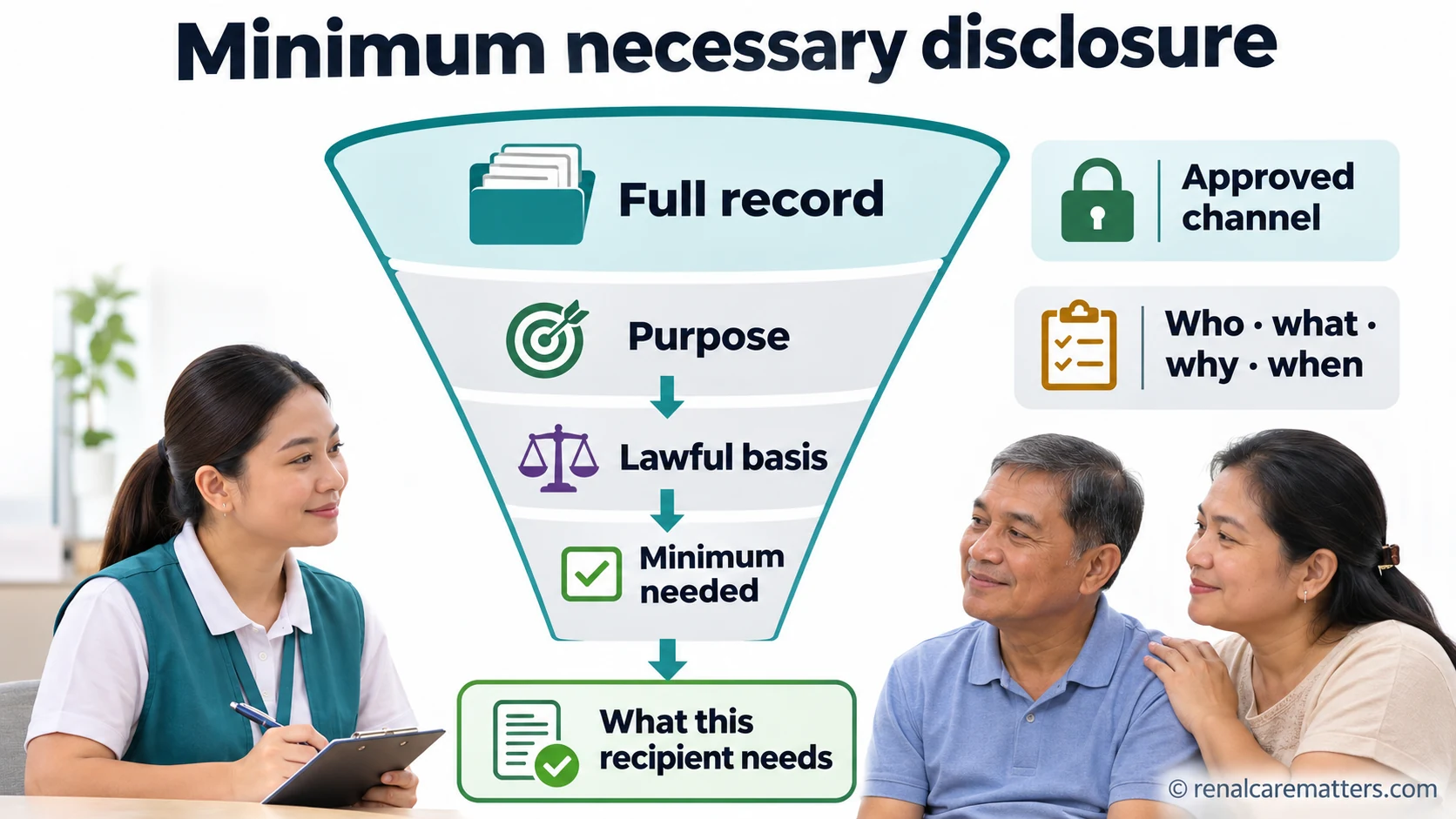
Figure 1. Least information, right recipient, documented reason.
The picture has a limit. A diary in a glass house is visible to everyone. A good record is the opposite: visible only to those with a reason to see it. Two disciplines meet here. Documentation asks you to write enough, clearly, so that care continues when you are not there. Privacy asks you to share only what each reader needs. They are not in conflict; both serve the person.
Your job in this module is to write notes that colleagues can act on and the person could read without being hurt, and to move information safely in a world of phones, group chats, and remote sessions. Under the Data Privacy Act of 2012, health information is sensitive personal information that needs a lawful basis for processing and appropriate safeguards.1 Consent is one lawful basis, not the only one; your facility’s data protection officer (DPO) knows which basis applies to which use.
Figure 2 · Key terms for this module
Sensitive personal informationUnder the Data Privacy Act, includes health information; it needs a lawful basis and extra care.
Lawful basisThe legal ground for processing information, such as consent or the provision of medical treatment.
ProportionalityUsing only the information needed for the purpose.
Data protection officer (DPO)The facility’s person responsible for privacy compliance and incidents.
Release of informationSharing record content with someone outside the care team, for a stated purpose.
Privacy incidentAny event that may expose personal information to the wrong people.
Opening case · fictional
Case: The screenshot in the family group chat
Tuesday, 4:30 p.m. A nurse shows you her phone. Your unit’s staff group chat, used to coordinate shifts, now contains a screenshot of a social work note you wrote yesterday about Mrs. Liza Navarro, 44: her disclosure of her husband’s violence and her plan to stay with her sister. A clerk posted it with the message “FYI so we are careful with the husband.” The group has 38 members, including two former staff.
An hour later, Mrs. Navarro’s husband calls the unit asking for “a copy of my wife’s records, because I am her husband.” Meanwhile, her sister has asked you to send a letter to Mrs. Navarro’s employer explaining her absences.
Before reading on, decide:
What do you do about the screenshot, right now and today?
How do you answer the husband’s request?
What goes into the letter to the employer, and on what basis?
Keep your answers in mind. The lesson gives you what you need, and the case review near the end shows one sound response.
Lesson · part 1
Facts, sources, plan
A useful note answers five questions: what happened (facts, with sources), what you think it means (assessment, labeled as yours), what was agreed (plan with owners and dates), what is unknown, and when you will follow up. Write in descriptive language (Module 5). Write the person’s own words in quotation marks when they matter, especially for safety statements.
Weak note
Stronger note
“Pt depressed, uncooperative. Counseled.”
“Says ‘I do not see the point’ (patient). Patient Health Questionnaire-9 (PHQ-9) 16, item 9 = 0. Agreed: referral to mental health team; nephrologist informed 10:40. Review Friday.”
“Family problem. Husband violent.”
“Discloses husband hit her twice this month (patient, private interview). Safety plan made; staying with sister. Supervisor informed. Details restricted per facility procedure.”
“Financial assistance done.”
“Assistance to Individuals in Crisis Situation (AICS) request submitted 11/12 (ref. no. on file); decision pending; gap this month PHP 6,000 (confirmed support only).”
Write as soon as you can, date and time every entry, and never alter a past entry; add a dated correction instead. Do not write opinions about character, gossip, or information about third parties beyond what care needs.
RememberFacts with sources, your assessment labeled as yours, the plan with owners and dates, the unknowns, and the follow-up date.
Lesson · part 2
Purpose, basis, proportion, security
You do not need to be a lawyer to practice privacy well. Four questions guide almost every decision.
Question
In practice
Purpose: why is this information being used or shared?
Care, benefits, assistance, safety, a legal duty; be specific
Lawful basis: on what ground?
The person’s consent, care provision, a legal requirement, protecting life; your DPO confirms
Proportion: is this the minimum needed?
Share the facts the recipient needs, not the whole record
Security: is it protected?
Approved systems, locked files, no personal phones or chat apps for case content
Some information needs extra protection even inside the team: disclosures of violence, mental health details, human immunodeficiency virus (HIV) status, a donor’s private reasons (Module 15), and anything the person asked you to keep private within the limits of confidentiality. Your facility’s procedure says how restricted notes are kept.
The handoff package for this course was designed so that public practice uses only fictional data. The worksheets in the toolkit keep nothing after you close the page. That is a design safeguard for training, not a rule that every health technology is forbidden.
RememberPurpose, lawful basis, proportion, security. Ask all four before you use or share anything.
Lesson · part 3
The right recipient, the right content
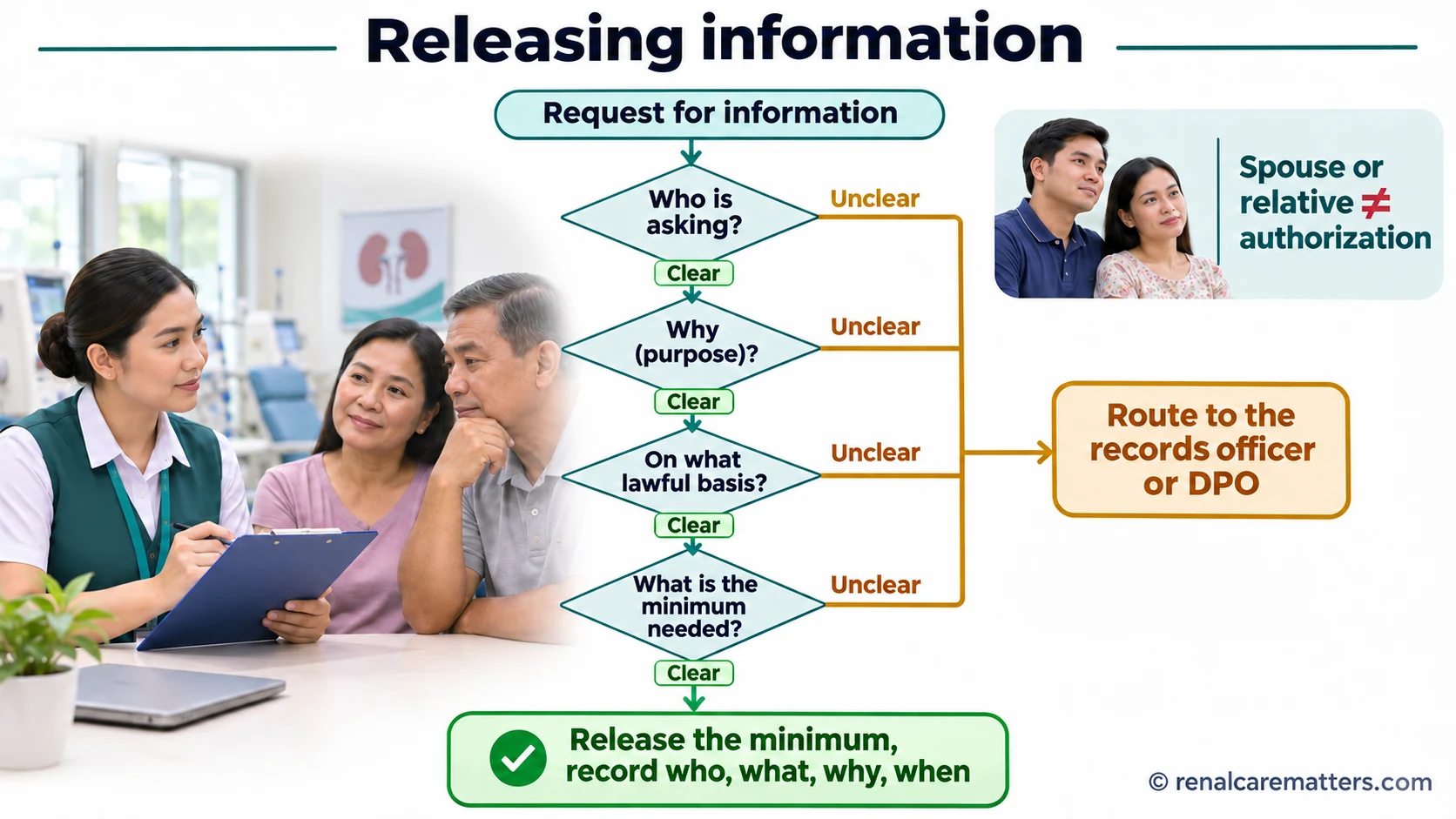
Requests for information come from family members, employers, agencies, lawyers, other facilities, and the person themselves. Each needs the same checks: who is asking, why, on what basis, and what is the minimum they need.
Figure 3. A relationship is not authorization.
Request
Response
A spouse asks for an adult patient’s records
Being a spouse is not by itself a right to an adult’s records; the patient decides, unless a legal basis applies. Route to the records officer.
An employer asks why the patient is absent
With the patient’s consent, a letter stating treatment days and times; no diagnosis unless the patient wants it named
An assistance agency asks for a social case study
With consent, a proportionate report for the stated program (Module 8)
The receiving dialysis unit asks for the transfer packet
What is needed for safe care (Module 17)
Police or a court asks for records
Route to your records officer and legal counsel; follow the facility procedure
The patient asks for their own records
Route to the records officer under the facility’s access procedure
Record every release: what was shared, with whom, why, on what basis, and when.
RememberA relationship is not authorization. Ask who, why, on what basis, and what is the minimum, and record the release.
Lesson · part 4
Digital boundaries
Phones and messaging apps make work faster and privacy harder. A screenshot travels in seconds to people who left the unit years ago. A message sent to the wrong “Ate Lisa” reaches a stranger.
Do
Do not
Use the facility’s approved channels for case content
Post notes, names with diagnoses, or photos of records in group chats
Use initials or codes when a chat must mention a patient for logistics
Forward screenshots of records
Confirm identity before discussing a case by phone
Discuss a case with whoever answers the phone
For remote sessions, check the person is in a private place and agree what to do if the call drops
Hold a sensitive remote session while family listens
Keep personal and work accounts separate
Accept patients as friends on personal social media
A privacy incident (a misdirected message, a lost phone with case data, a screenshot in the wrong place) is reported at once to the DPO, who manages containment and any notification the National Privacy Commission requires. Reporting quickly is what limits harm; hiding an incident multiplies it.
Stop and callA privacy incident involving a safety disclosure (such as violence): contain it, report to the DPO, and assess the person’s immediate safety the same day, because the leak may reach the person who harms them.
On the floor · The wrong Ate Lisa
A social worker sends a benefit update meant for a patient’s daughter to a different contact with the same name.
She tells her DPO within the hour, asks the recipient to delete it, and tells the patient what happened. The unit switches to a policy of confirming contacts before sending case content.
The incident was small because it was reported fast and fixed at the system level.
Illustrative scenario. Names and details are invented.
On the floor
Real situations: problems and solutions
These are fictional but typical. For each one, cover the answer, decide what you would do, then compare. Where a step depends on local rules, your unit’s procedure and your supervisor’s direction come first.
The group chat
What you see
A staff group chat contains a patient’s name and diagnosis.
What is likely going on
Convenience overriding privacy.
What to do
Ask for deletion, report to the DPO if needed, and propose codes or initials for logistics.
Why it matters
Group chats spread information beyond control.
The husband’s request
What you see
A husband demands his wife’s records at the desk.
What is likely going on
A relationship mistaken for authorization, possibly with safety implications.
What to do
Route to the records officer and alert the team if safety is a concern.
Why it matters
Relationship is not authorization.
The wrong number
What you see
A benefit update goes to a stranger with the same name in your contacts.
What is likely going on
A privacy incident.
What to do
Report it to the DPO within the hour, ask for deletion, and tell the patient.
Why it matters
Fast reporting limits harm.
Field notes
Never use personal messaging apps for case content.
Write the reason every time you release information.
Case review
Back to the case: The screenshot in the family group chat
The screenshot. This is a privacy incident with a safety dimension. Right now: ask the clerk and group administrators to delete it from the chat, and report it to the DPO. Today: assess Mrs. Navarro’s safety, because a group with former staff may reach her husband; tell her what happened, honestly; review her safety plan. Later, with your head and DPO: remove former staff from the group, set a rule that no case content goes into chats, and review how the clerk accessed a restricted note.
The husband’s request. Being her husband is not a right to an adult’s records. Do not confirm or discuss her care. Tell him politely that record requests go through the records officer under the facility’s procedure, and alert the records officer and the unit head, given the safety context. Record the call.
The employer letter. Only with Mrs. Navarro’s own consent (not her sister’s request alone). Content: that she receives a medical treatment on stated days and times, and the dates of absence it explains. No diagnosis unless she wants it named, and nothing about the violence or where she is staying.
Skills lab · with your preceptor
Skills checklist: A note, a release, and an incident
Write a note, handle a release request, and respond to a simulated privacy incident while your supervisor observes. Your preceptor rates each step as satisfactory, needs practice, or not observed. Steps marked Critical must all be satisfactory before sign-off. This checklist supports supervised learning; your unit’s own procedure and competency form are the authority. A printable version of every checklist is on the trainer page.
Writes a note with facts and sources, labeled assessment, plan with owners and dates, unknowns, and follow-up.
Uses descriptive language and quotes the person’s words for safety statements.
Applies purpose, lawful basis, proportion, and security before sharing.
CriticalDeclines to release records on relationship alone and routes the request correctly.
Writes a consented employer letter with the minimum content.
CriticalReports a privacy incident to the DPO at once and assesses the safety of anyone it may endanger.
CriticalNever posts case content in personal or group messaging apps.
Placement activity. Read your facility’s privacy manual and release-of-information procedure. Write down your DPO’s name and how to report an incident.
Self-assessment
Check your understanding
Each visit draws 5 questions at random from this module’s 10-question bank. Choose the single best answer for each, then select Check answers; an explanation appears under the best answer. Select New set of questions for a different mix. A good target is 4 of 5 on two different sets. Nothing you select is sent anywhere; scoring happens in your browser.
Educational material for social workers and navigation staff in kidney care. Completing it is an Academy learning record only. It is not a Professional Regulation Commission (PRC) license, a specialty credential, CPD units, or DOH or PhilHealth recognition, and it does not authorize anyone to practice beyond their own registration.