Measures that mean something, numerators and denominators, supervision and reflective practice, and safe workload.
PublishedNailathalaGipatikPepalwal:ReferencesMga SanggunianMga TinubdanReng Reperensya:1Audience: Registered social workers in dialysis units, hospital medical social work departments, and kidney transplant programs · medical social workers rotating into kidney care · navigation and support staff on the orientation pathRead timeOras ng pagbasaOras sa pagbasaOras ning pamamasa:
This module is study material for social workers and navigation staff in kidney care. It explains the reasoning behind social work decisions; it is not a facility procedure, legal advice, a benefits ruling, or a mental health diagnosis. Rules, assistance programs, and amounts change: confirm them against the current issuance and your facility’s approved policy. Medical treatment belongs to the nephrologist, benefits to PhilHealth, donation ethics to the ethics committee, and psychiatric diagnosis to the mental health team. Every case, name, and identifier is fictional.
Learning objectives
After this module you should be able to
Define a social work quality measure with a clear numerator, denominator, time period, and stated limits.
Plot a measure over time on a run chart and avoid claiming that a change caused an improvement without evidence.
Choose measures that reflect what matters to patients, and avoid ranking workers by money raised or applications filed.
Use supervision for case review, reflection, ethical dilemmas, and your own well-being.
Estimate workload in hours, compare it with capacity, and report shortfalls in writing.
Classroom 1 hSkills lab 1 hSupervised placement 0 h
Pre-testBefore you read, answer the 5 self-assessment questions and note your score. After the module, select New set of questions and compare. The difference is what you learned; the questions you still miss are what to reread.
Start here
The big picture, in plain words
In plain wordsA measure is like a thermometer on a wall. It tells you the temperature in one place at one time. It does not tell you why the room is hot, and if someone holds a lighter under it, it will tell you a lie. A good measure is a well-placed thermometer that nobody can easily fool.
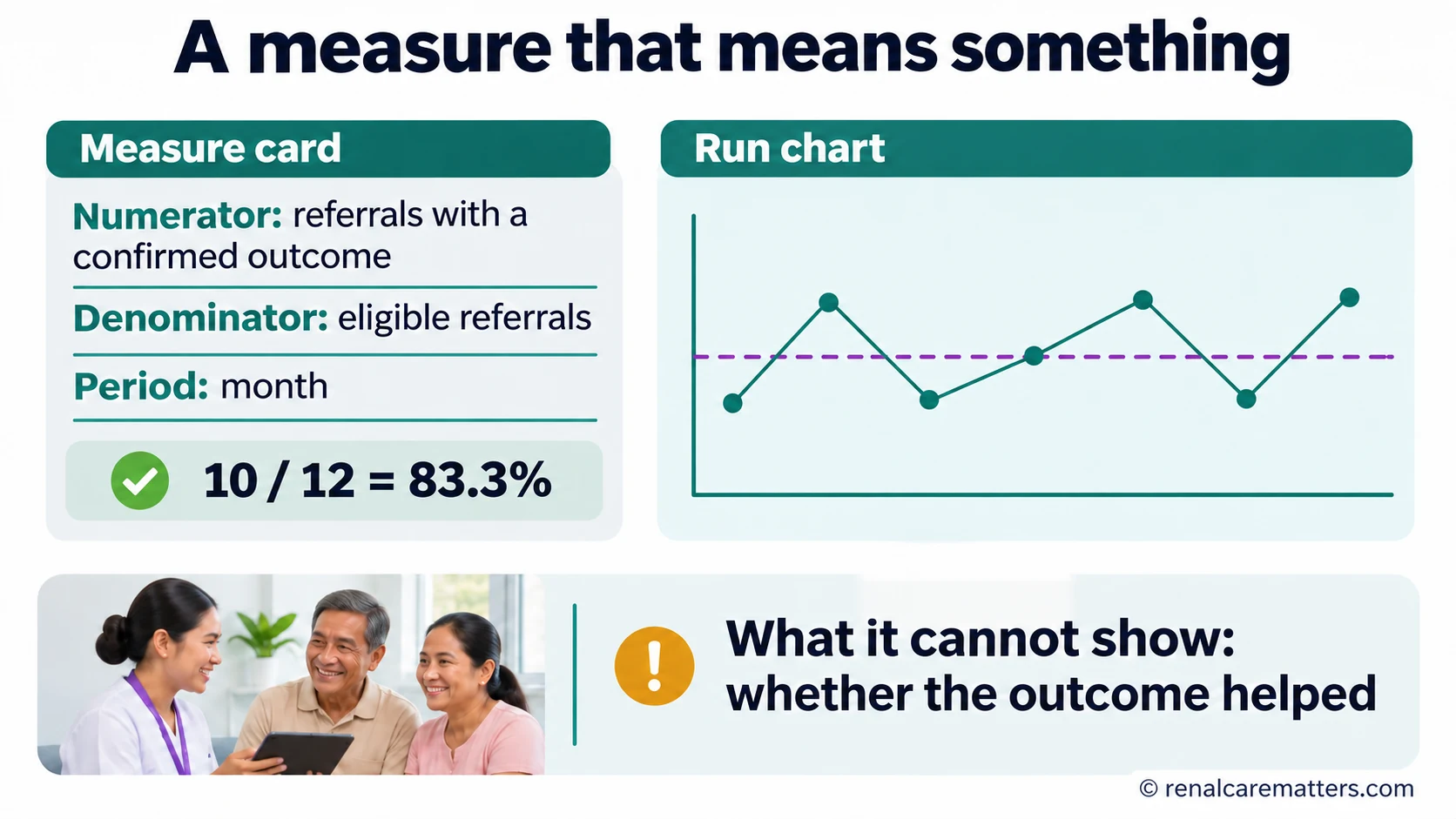
Figure 1. A measure that means something: a defined numerator, a defined denominator, a trend over time, and its limits stated.
The picture has a limit. A thermometer measures one thing that everyone agrees on. Social work outcomes are harder: a family’s sense of being helped, a session not missed, a crisis that did not happen. You will rarely measure those directly. Instead you will measure processes (how fast referrals are answered, how many reach an outcome) and some outcomes (sessions missed, patient feedback), and you will be honest about what each can and cannot show.
Your job in this module is to show what the service does in numbers that mean something, to use supervision well, and to make workload visible. Measured psychosocial care is becoming part of kidney service standards elsewhere: a United Kingdom Delphi consensus of 26 experts and patient representatives recommended a holistic wellbeing assessment with validated tools for people approaching dialysis or transplant listing, with scores reported on a renal data dashboard.1 That is an English commissioning recommendation, not a Philippine rule, but it shows where the field is heading.
Figure 2 · Key terms for this module
MeasureA defined count or rate tracked over time.
NumeratorThe cases that met the measure (for example, referrals with a confirmed outcome).
DenominatorAll the eligible cases (for example, all referrals due for an outcome).
Run chartA simple line chart of a measure over time, with its median.
SupervisionRegular, structured time with a senior social worker for case review, reflection, and support.
WorkloadThe hours of work a caseload generates, compared with the hours available.
Opening case · fictional
Case: “Our success rate is 100%”
Friday, 2:00 p.m. The hospital’s monthly quality report includes a slide from the previous social worker: “Social Work Service: 100% success rate. All 45 assistance applications were submitted.” The administrator asks you to keep the figure at 100% and to add “total pesos raised” as a performance measure for each social worker.
Your own records show that of 45 applications submitted in the quarter, 30 received a decision, 22 were approved in full or part, and you can confirm that support reached the household for 18. Separately, 12 patients missed three or more sessions in the quarter; you saw 7 of them.
You also notice that you worked 14 hours of overtime last month and have had no supervision session since you started four months ago.
Before reading on, decide:
What is wrong with “100% success rate,” and what measures would you propose instead?
How do you respond to “pesos raised” as a performance measure?
What do you do about your overtime and the missing supervision?
Keep your answers in mind. The lesson gives you what you need, and the case review near the end shows one sound response.
Lesson · part 1
Numerator, denominator, period, limits
A measure needs four parts: a numerator, a denominator, a time period, and a statement of what it cannot show. Without a defined denominator, a number is just a count; without stated limits, it invites false conclusions.
Worked example, illustrative. Rate = numerator ÷ denominator × 100. Measure: referrals with a confirmed outcome within 30 days. Numerator: 10. Denominator: 12 referrals due in the month. Rate = 10 ÷ 12 × 100 = 83.3%. If the denominator is 0, the rate is not calculable (not 0%). What the number tells you: how reliably referrals reached an outcome. What it does not tell you: whether the outcome helped, or why the other two did not close.
Measure
Type
What it can show
What it cannot
Referrals acknowledged within 2 working days
Process
Responsiveness
Quality of the help
Referrals with a confirmed outcome
Process
Loop closure (Module 6)
Whether the outcome was good
New patients assessed within 10 working days
Process
Coverage of new starts
Depth of assessment
Patients with 3+ missed sessions seen by social work
Process
Reach to those at risk
Whether attendance improved
Patients screened for depression in the period
Process
Screening coverage
Treatment or recovery
Patient and family feedback
Experience
How help felt
Representativeness if few respond
The toolkit’s quality measure tool computes a rate and refuses an impossible one (a numerator larger than the denominator, or a zero denominator).
RememberEvery measure has a numerator, a denominator, a period, and stated limits. Zero over zero is not calculable.
Lesson · part 2
What a chart can and cannot claim
Plot a measure monthly on a run chart, with its median. A single month up or down is usually noise. A sustained shift (several points in a row on one side of the median) suggests something real has changed. Even then, a chart does not prove that your change caused it. A new shift schedule, a new assistance program, a typhoon, or a change in patient mix could explain the movement.
Comparisons between workers or units are especially risky. Assistance approvals depend on agency budgets and policies. Attendance depends on poverty, distance, illness, and weather. A worker serving a poorer, sicker, more distant population will look worse on almost any raw measure.
Tempting measure
Problem
Better use
Pesos raised per worker
Depends on agency budgets and patient need; rewards chasing money over care
Track household gaps closed, as a service measure, not a ranking
Applications submitted
Counts activity, not help
Decisions received and support confirmed (Module 8)
Attendance by worker
Driven by factors outside the worker’s control
Reach and follow-up for patients at risk
RememberA run chart shows change, not its cause. Never rank social workers by money raised or forms filed.
Lesson · part 3
Time to think, protected
Social work in kidney care brings hard material every week: poverty, violence, grief, death, families in conflict, decisions about stopping treatment. Supervision is where you take that material to think clearly about it. It is part of professional practice, not a sign of weakness.
Use supervision for
Examples
Case review
A stuck plan, a formulation you are unsure of
Ethical dilemmas
A conflict of interest, a confidentiality limit, a family pressing against the patient’s wishes
Safety decisions
Safeguarding concerns, donor coercion signals
Your own reactions
A death that affected you, anger at a family, exhaustion
Workload and development
Priorities, learning goals, the development plan (Module 20)
If your unit has no senior social worker, arrange supervision with your hospital’s social work department, a peer in another facility, or a professional network, and agree a regular schedule in writing. Record supervision dates and decisions as your service requires.
RememberBook supervision regularly and use it for cases, ethics, safety, your reactions, and workload.
Lesson · part 4
Hours, not ratios
No social worker staffing ratio for Philippine dialysis was identified in the documents reviewed (Module 3), and borrowing one from abroad would not fit local work. Instead, measure demand in hours. The workload tool adds routine and complex episodes and fixed duties, and compares the total with the hours available.
Worked example, illustrative. Demand = (8 routine episodes × 45 min + 2 complex × 120 min) ÷ 60 + 5 fixed hours = 6 + 4 + 5 = 15 hours. Available: 12 hours. Balance: −3 hours. At 30 productive hours per full-time equivalent (FTE): 0.50 FTE. What the number tells you: the gap between work and time. What it does not tell you: the right staffing, which is a management decision.
When demand exceeds capacity, three things happen in order: triage by risk (Module 3), a written report to your head with the numbers and what is waiting, and a request for a decision (more hours, a covering worker, or explicit agreement on what will not be done). Chronic unpaid overtime hides the shortfall from the people who could fix it and burns out the person carrying it.
RememberCount workload in hours. Report a shortfall in writing with what is waiting and the risk.
On the floor · The overtime log
Social worker Ms. Ivy Santos keeps a simple log of her overtime and of referrals waiting more than two weeks. After three months she brings it to her head.
The hospital assigns a second social worker to the dialysis unit two mornings a week.
The shortfall became visible when it was written down in hours.
Illustrative scenario. Names and details are invented.
On the floor
Real situations: problems and solutions
These are fictional but typical. For each one, cover the answer, decide what you would do, then compare. Where a step depends on local rules, your unit’s procedure and your supervisor’s direction come first.
The 100% slide
What you see
A report claims a 100% success rate based on applications submitted.
What is likely going on
Activity counted as outcome.
What to do
Propose measures with defined numerators and denominators, and state their limits.
Why it matters
Measures that cannot fail cannot inform.
Pesos per worker
What you see
Management wants to rank social workers by money raised.
What is likely going on
A measure driven by factors outside the worker’s control.
What to do
Explain the problem and offer a service-level measure instead.
Why it matters
Bad incentives change behavior in the wrong direction.
The silent overtime
What you see
You have worked 14 hours of overtime a month for a quarter.
What is likely going on
A hidden shortfall.
What to do
Estimate the workload in hours and report it in writing with the risks.
Why it matters
Unseen shortfalls are never fixed.
Field notes
Choose one measure and plot it monthly for six months before adding another.
Book supervision as a standing appointment, not when a crisis comes.
Case review
Back to the case: “Our success rate is 100%”
“100% success.” It counts submissions, not help: every submission “succeeded” by definition. Propose instead: decisions received (30 of 45, 66.7%), approvals (22 of 30 decided, 73.3%), support confirmed reaching the household (18 of 45 submitted, 40.0%), and reach to patients with three or more missed sessions (7 of 12, 58.3%). State the limits: approvals depend on agency budgets, and reach does not show whether attendance improved. Plot them monthly.
“Pesos raised.” Explain respectfully that money raised depends on agency budgets and patients’ needs, not only on the worker, and that ranking workers by it would reward chasing money over care and penalize workers serving the poorest patients. Offer a service-level measure instead: household gaps closed for patients at risk of missing treatment.
Overtime and supervision. Run the workload tool with your real numbers and report the shortfall in writing to your head, with what is waiting and the risk. Ask for a supervision arrangement in writing: with the hospital’s social work department head or a peer, on a regular schedule. Both protect patients as much as they protect you.
Skills lab · with your preceptor
Skills checklist: A measure card and a workload report
Define a measure, compute it, and present a workload report to a simulated manager while your supervisor observes. Your preceptor rates each step as satisfactory, needs practice, or not observed. Steps marked Critical must all be satisfactory before sign-off. This checklist supports supervised learning; your unit’s own procedure and competency form are the authority. A printable version of every checklist is on the trainer page.
Defines a measure with numerator, denominator, period, and stated limits.
Computes a rate correctly and states that 0 over 0 is not calculable.
Explains why a run chart shows change but not its cause.
CriticalDeclines to rank workers by money raised or forms filed, and proposes a fair alternative.
Estimates workload in hours and reports a shortfall in writing with risks.
Arranges regular supervision and brings a case, an ethical question, and a personal reaction to it.
Placement activity. Choose one measure for your service. Collect three months of data, plot a run chart, and discuss it with your supervisor.
Self-assessment
Check your understanding
Each visit draws 5 questions at random from this module’s 10-question bank. Choose the single best answer for each, then select Check answers; an explanation appears under the best answer. Select New set of questions for a different mix. A good target is 4 of 5 on two different sets. Nothing you select is sent anywhere; scoring happens in your browser.
Coyne, E., Briggs, J., Loud, F., Bristow, P., Young, H. M. L., Castle, E. M., Lightfoot, C. J., Graham-Brown, M., Eyre, M., Ormandy, P., Sachar, A., Bevin, A., Burton, J. O., Wilkinson, T. J., Koufaki, P., Macdonald, J., Ashman, N., & Greenwood, S. A. (2023). Achieving consensus on psychosocial and physical rehabilitation management for people living with kidney disease. Clinical Kidney Journal, 16(11), 2185–2193. https://doi.org/10.1093/ckj/sfad116
Educational material for social workers and navigation staff in kidney care. Completing it is an Academy learning record only. It is not a Professional Regulation Commission (PRC) license, a specialty credential, CPD units, or DOH or PhilHealth recognition, and it does not authorize anyone to practice beyond their own registration.