Medical Nutrition Therapy in Maintenance Hemodialysis
Why protein needs rise on dialysis, the dialysis-day gap, eating during treatment, oral supplements, intradialytic parenteral nutrition, and incremental and twice-weekly schedules.
PublishedNailathalaGipatikPepalwal:ReferencesMga SanggunianMga TinubdanReng Reperensya:6Audience: Registered nutritionist-dietitians entering adult kidney care · renal RND preceptors, nephrologists, and head nurses who orient themRead timeOras ng pagbasaOras sa pagbasaOras ning pamamasa:
This module is study material for dietitians in adult kidney care. It explains the reasoning behind common decisions; it is not a protocol. In practice, follow your facility’s policy and the responsible physician’s orders. Targets and cut-off values are set by your unit and the attending nephrologist. Every case is fictional.
Learning objectives
After this module you should be able to
Explain why protein needs rise when hemodialysis (HD) starts, and rewrite a pre-dialysis plan.
Assess intake on a dialysis day and a non-dialysis day, including the long gap.
Weigh the benefits and risks of eating during treatment.
Use oral nutrition supplements in a stepwise plan, and say what the trials show about intradialytic parenteral nutrition (IDPN).
Adapt advice for twice-weekly and incremental schedules.
Recognize when a fall in intake or weight needs the nephrologist today.
Pre-testBefore you read, answer the 8 self-assessment questions and note your score. After the module, select New set of questions and compare. The difference is what you learned; the questions you still miss are what to reread.
Start here
The big picture, in plain words
In plain wordsStarting dialysis is like a family moving from a small house with a slow leak to a bigger house with a cleaning crew that comes three times a week. The crew clears waste well, but every visit also carries away some of the family’s food: amino acids, vitamins, and glucose leave with the waste. The diet that suited the small, leaky house now leaves the family short. The comparison has one gap: the “crew” also stirs up inflammation, which raises protein needs further.
Figure 1 · Key terms for this module
Hemodialysis (HD)Blood is pumped through a filter outside the body to remove waste and fluid, usually 4 hours, two or three times a week.
Amino acid lossesAbout 6 to 12 g of amino acids pass into the dialysis fluid in each session.
Oral nutrition supplement (ONS)A ready-made drink or powder that adds energy and protein.
Intradialytic parenteral nutrition (IDPN)Amino acids, glucose, and fat given into the dialysis circuit during treatment.
Incremental hemodialysisStarting with fewer or shorter sessions while the patient still has useful urine output.
Interdialytic intervalThe time between sessions; the long gap is the weekend in a thrice-weekly schedule.
Figure 2 · Stepwise nutrition support on HD
CounselFind the cause and fix the plan.
Fortify foodAdd protein and energy to meals the patient already eats.
Oral supplementA product chosen with the patient, with a trial period.
Tube feedingIf oral intake still falls short and the gut works.
IDPN or full parenteral nutritionSelected patients, with the team.
Opening case · fictional
Case: Still on the old diet
Mr. Tan, 63, started HD five weeks ago. Before dialysis he followed a 48 g/day protein plan, 0.8 g/kg at his 60 kg weight, and he is proud of how well he has kept to it. He dialyzes Monday, Wednesday, and Friday at 6 a.m.
He leaves home at 4:30 a.m. without breakfast, because “eating before dialysis makes me dizzy.” After the session he is tired and eats little until dinner. His post-dialysis weight has fallen from 60.0 to 58.5 kg. He is otherwise well.
Before reading on, decide:
What is his protein target now, and how far is he below it?
Why is his dialysis day his worst day for nutrition?
What two changes would you try first, and how would you know they worked?
Keep your answers in mind. The lesson gives you what you need, and the case review near the end shows one sound response.
Lesson · part 1
The day dialysis starts, the diet must change
Before dialysis, protein was kept moderate to slow kidney damage and limit waste. Once dialysis starts, that reason is gone, and three new losses appear. Each session removes about 6 to 12 g of amino acids. Contact between blood and the dialysis circuit stirs low-grade inflammation, which speeds muscle breakdown. And on dialysis days many patients simply eat less.1
Kidney Disease Outcomes Quality Initiative (KDOQI) advises 1.0 to 1.2 g/kg/day of protein for metabolically stable adults on HD or peritoneal dialysis, with or without diabetes (expert opinion), and the same energy range as in chronic kidney disease (CKD), 25 to 35 kcal/kg/day (a firm recommendation, grade 1C).2 For a 60 kg patient, that is 60 to 72 g of protein a day, compared with 48 g before.
RememberEvery patient starting dialysis needs a new nutrition prescription in the first weeks. A pre-dialysis protein restriction that nobody lifts is one of the most common causes of wasting in the first year.
Phosphorus rises with protein, which is why many patients and some staff resist raising it. Module 7 showed how to add protein while keeping phosphorus down: fresh sources, egg whites, no additives, and binders taken with meals. Potassium and fluid advice now depend on urine output, the dialysis schedule, and the monthly results, not on the old list.
Lesson · part 2
Look at the whole week, not one day
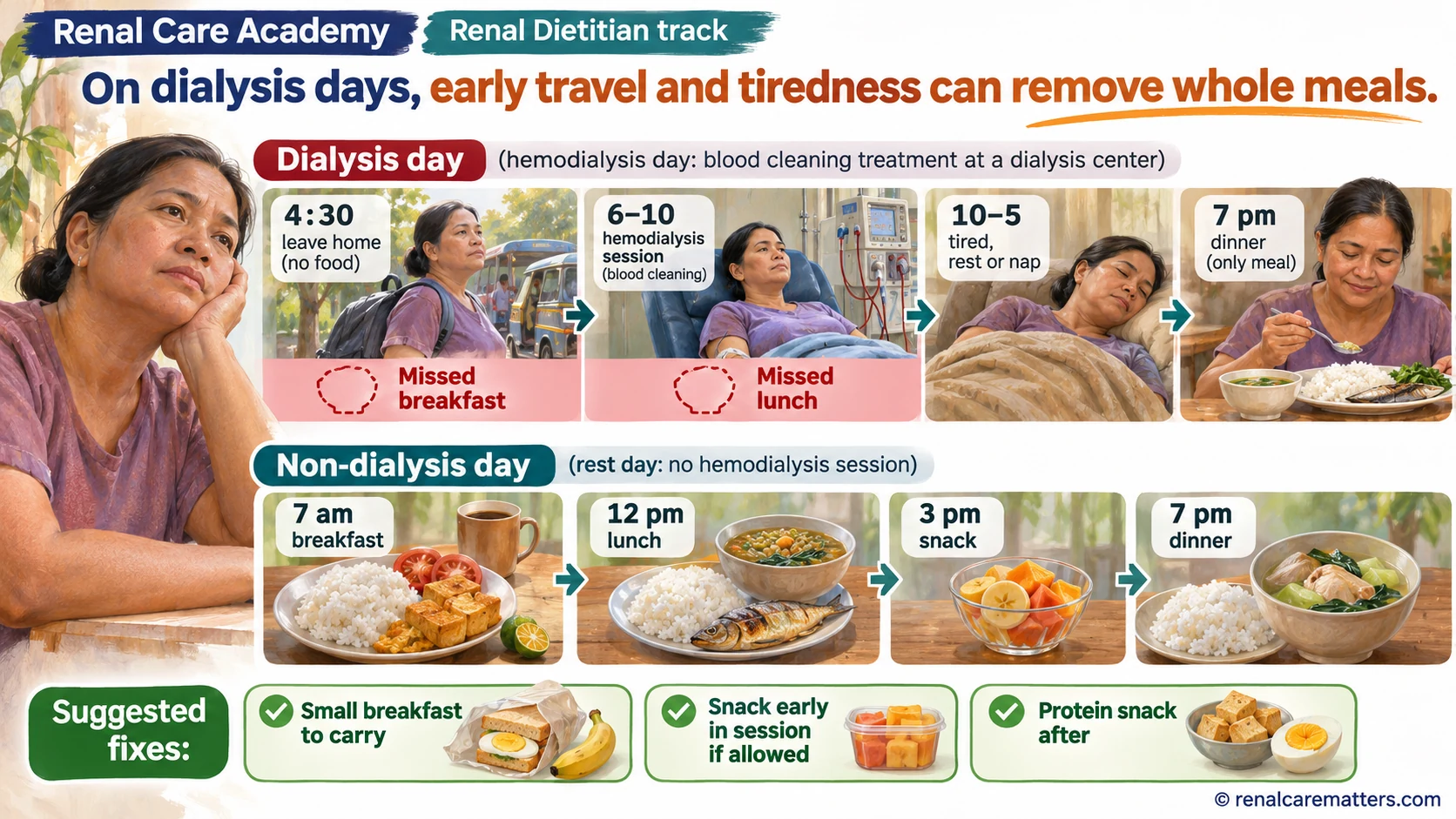
Ask for two recalls: one dialysis day and one non-dialysis day. They often look like two different patients. On dialysis days, early transport, the session itself, and tiredness afterward can wipe out one or two meals. In the Philippines, many patients dialyze twice a week, so the gap is three or four days, and potassium, phosphorus, and fluid build up for longer.
Figure 3 · Common barriers on dialysis days
Early shiftsNo breakfast before a 5 or 6 a.m. start.
DizzinessEating just before a session can drop blood pressure in some patients.
Tiredness after“Washed out” for hours; meals are skipped until evening.
Cost and travelFare, food, and lost work pay on the same day.
Unit rulesSome units do not allow food during treatment.
Then look at the data the unit already has. The normalized protein catabolic rate (nPCR), calculated from urea before and after dialysis, estimates protein intake in stable patients. An nPCR below about 1.0 g/kg/day supports your concern; a normal nPCR in a patient who is losing weight does not cancel it. Compare serial post-dialysis weights at the same point in the week, and ask the nurse whether sessions are being shortened or missed.2
Figure 4. On dialysis days, early travel and tiredness can remove whole meals.
Lesson · part 3
Food in the chair: benefits and cautions
Eating during HD is common in Asia and less common in some Western units. An international expert consensus from the International Society of Renal Nutrition and Metabolism (ISRNM) concluded that meals, snacks, or oral supplements during treatment can improve nutrition and that the possible problems can usually be managed.3 The problems are real: blood pressure can fall after eating, especially in patients prone to low pressure; there is a risk of choking in drowsy patients; and hygiene and staff time need planning.
The strongest data come from a large quality-improvement program in the United States. Patients with albumin at or below 3.5 g/dL who received a supervised oral supplement during dialysis were compared with matched patients who did not. In the analysis that kept everyone in their starting group, deaths were slightly lower with supplements (adjusted hazard ratio 0.91); among those who stayed on the program, the difference was larger (hazard ratio 0.66).4 This was not a randomized trial. Patients who keep taking a supplement are often healthier in other ways, so it shows an association and does not prove that the supplement prevented deaths. It does support offering one.
Figure 5 · Making it safe
TimingEarly in the session, not in the last hour when pressure is lowest.
WhoNot patients with frequent low pressure, poor swallowing, or drowsiness, unless the nurse agrees.
WhatSmall, low-potassium, low-phosphorus items, or a renal supplement.
Unit policyFollow it, and help change it with the nephrologist if evidence supports a change.
Lesson · part 4
Supplements, IDPN, and other schedules
Oral supplements. When counseling and fortified food do not close the gap, KDOQI suggests a trial of oral supplements for at least three months in patients with or at risk of protein-energy wasting (a weak suggestion).2 Choose a product the patient will drink: check energy and protein per serving, potassium, phosphorus, and sugar, the price per day, and taste. One serving a day, taken during or right after dialysis, is a reasonable start. Set a review in two to four weeks with intake and weight.
IDPN. IDPN delivers amino acids, glucose, and fat into the blood during the session. It cannot cover a full day’s needs; it adds to oral intake. Two randomized trials frame what it can do. In France, 186 malnourished HD patients all received oral supplements, and half also had IDPN for a year. Two-year survival and hospital admissions did not differ.5 In Germany, IDPN for 16 weeks raised prealbumin more than counseling alone in 83 patients.6 Prealbumin is a laboratory marker, not survival. So IDPN can improve nutrition markers, and it has not been shown to help patients live longer. KDOQI suggests a trial only when oral and tube feeding cannot meet needs (a weak suggestion).2 Eligibility, the solution, and glucose monitoring belong to the nephrologist and nutrition support team.
Twice-weekly and incremental dialysis. Some patients start with fewer sessions while they still pass useful urine. Their potassium and fluid allowances depend on that urine. Ask about urine output at every visit, because when it falls, the diet must tighten and the nephrologist may add sessions.
Stop and reportReport to the nephrologist the same day: post-dialysis weight falling with poor intake, new difficulty eating or swallowing, vomiting or diarrhea lasting more than a day, or a patient who has stopped eating after a hospital stay.
On the floor
Real situations: problems and solutions
These are fictional but typical. For each one, cover the answer, decide what you would do, then compare. Where a step depends on local rules, your unit’s procedure and your supervisor’s direction come first.
The snack ban
What you see
Your unit does not allow food during HD. Several patients skip two meals on dialysis days.
What is likely going on
A policy designed for safety is causing undernutrition.
What to do
Collect dialysis-day recalls and weights for a month, and bring them to the nephrologist and head nurse with the ISRNM consensus. Propose a safe pilot.
Why it matters
Policies change when someone brings data.
Supplement left in the bag
What you see
A patient was given an oral supplement two weeks ago. The cans are still in his bag.
What is likely going on
He dislikes the taste, or it costs too much to continue.
What to do
Ask why, without judgment. Try another flavor, a smaller serving, mixing it into food, or a cheaper food-based alternative.
Why it matters
A supplement only works if it is drunk.
Field notes
Ask what the patient ate on the way to dialysis.
Rewrite the plan in the first month of dialysis; do not let the pre-dialysis diet run on.
Case review
Back to the case: Still on the old diet
What is his target now? At 60 kg, 1.0 to 1.2 g/kg/day is 60 to 72 g of protein a day. He is eating about 48 g, so he is 12 to 24 g short, every day, and his weight shows it: 1.5 kg lost in five weeks. Nobody told him the rules had changed. He is being punished for following them well.
Why is his dialysis day the worst? He leaves at 4:30 a.m. without food, dialyzes on an empty stomach, and is too tired afterward to eat until dinner. On three days a week he eats one real meal. His non-dialysis days may look much better.
What would you try first? Tell him, clearly and kindly, that his protein should now go up, and why. Then work on the dialysis day. If eating before dialysis makes him dizzy, try a small, easy breakfast he can carry and eat early in the session if the unit allows, such as pandesal with egg, or a small portion of the unit’s approved snack. Add a protein-rich snack after the session, before he naps. If those do not close the gap in two weeks, discuss an oral supplement with the team.
How will you know it worked? Repeat both recalls at two weeks. Track his post-dialysis weight at the same session each week. Check the next nPCR. Tell the nephrologist about the weight loss and the new plan today. The dietitian is often the only person on the team who asks a new patient what he ate on the way to dialysis.
Skills lab · with your preceptor
Skills checklist: Hemodialysis nutrition review
Use a fictional patient in the first three months of dialysis. Your preceptor rates each step as satisfactory, needs practice, or not observed. Steps marked Critical must all be satisfactory before sign-off. This checklist supports supervised learning; your unit’s own procedure and competency form are the authority. A printable version of every checklist is on the trainer page.
CriticalRecalculates protein for dialysis (1.0 to 1.2 g/kg/day) and identifies any leftover pre-dialysis restriction.
Takes a dialysis-day recall and a non-dialysis-day recall.
Asks about transport, session time, tiredness, and food at the unit.
Reads nPCR and serial post-dialysis weights and explains their limits.
Applies the unit’s policy on eating during treatment and names patients for whom it is unsafe.
Chooses an oral supplement by protein, energy, potassium, phosphorus, cost, and taste, and sets a trial period.
Explains what the IDPN trials showed and did not show.
CriticalReports weight loss with poor intake to the nephrologist the same day.
Placement activity. Spend one full HD shift on the floor and record what each patient ate before, during, and after the session.
Self-assessment
Check your understanding
Each visit draws 8 questions at random from this module’s 15-question bank. Choose the single best answer for each, then select Check answers; an explanation appears under the best answer. Select New set of questions for a different mix. A good target is 7 of 8 on two different sets. Nothing you select is sent anywhere; scoring happens in your browser.
Ikizler, T. A., Cano, N. J., Franch, H., Fouque, D., Himmelfarb, J., Kalantar-Zadeh, K., Kuhlmann, M. K., Stenvinkel, P., TerWee, P., Teta, D., Wang, A. Y., Wanner, C., & International Society of Renal Nutrition and Metabolism. (2013). Prevention and treatment of protein energy wasting in chronic kidney disease patients: A consensus statement by the International Society of Renal Nutrition and Metabolism. Kidney International, 84(6), 1096–1107. https://doi.org/10.1038/ki.2013.147
Ikizler, T. A., Burrowes, J. D., Byham-Gray, L. D., Campbell, K. L., Carrero, J. J., Chan, W., Fouque, D., Friedman, A. N., Ghaddar, S., Goldstein-Fuchs, D. J., Kaysen, G. A., Kopple, J. D., Teta, D., Yee-Moon Wang, A., & Cuppari, L. (2020). KDOQI clinical practice guideline for nutrition in CKD: 2020 update. American Journal of Kidney Diseases, 76(3, Suppl. 1), S1–S107. https://doi.org/10.1053/j.ajkd.2020.05.006
Kistler, B. M., Benner, D., Burrowes, J. D., Campbell, K. L., Fouque, D., Garibotto, G., Kopple, J. D., Kovesdy, C. P., Rhee, C. M., Steiber, A., Stenvinkel, P., Ter Wee, P., Teta, D., Wang, A. Y. M., & Kalantar-Zadeh, K. (2018). Eating during hemodialysis treatment: A consensus statement from the International Society of Renal Nutrition and Metabolism. Journal of Renal Nutrition, 28(1), 4–12. https://doi.org/10.1053/j.jrn.2017.10.003
Lacson, E., Wang, W., Zebrowski, B., Wingard, R., & Hakim, R. M. (2012). Outcomes associated with intradialytic oral nutritional supplements in patients undergoing maintenance hemodialysis: A quality improvement report. American Journal of Kidney Diseases, 60(4), 591–600. https://doi.org/10.1053/j.ajkd.2012.04.019
Cano, N. J., Fouque, D., Roth, H., Aparicio, M., Azar, R., Canaud, B., Chauveau, P., Combe, C., Laville, M., Leverve, X. M., & French Study Group for Nutrition in Dialysis. (2007). Intradialytic parenteral nutrition does not improve survival in malnourished hemodialysis patients: A 2-year multicenter, prospective, randomized study. Journal of the American Society of Nephrology, 18(9), 2583–2591. https://doi.org/10.1681/ASN.2007020184
Marsen, T. A., Beer, J., Mann, H., & German IDPN-Trial group. (2017). Intradialytic parenteral nutrition in maintenance hemodialysis patients suffering from protein-energy wasting: Results of a multicenter, open, prospective, randomized trial. Clinical Nutrition, 36(1), 107–117. https://doi.org/10.1016/j.clnu.2015.11.016
Educational study material for registered nutritionist-dietitians. Does not replace the nephrologist’s orders, facility policy, the Nutrition Care Process documentation required by the Department of Health, or supervised practice.