- Set the BUN unit (mg/dL ↔ urea mmol/L) to match your lab. The same unit applies to all three BUN fields. Switching the unit clears those fields.
- Enter this session's pre-dialysis BUN and post-dialysis BUN — these drive spKt/V and URR.
- Enter the session length (hours), the pre- and post-dialysis weight (kg/lb toggle), and confirm the auto-derived ultrafiltration volume (pre − post weight) — these feed spKt/V (Daugirdas needs UF/W) and the UF-rate readout.
- Enter the next session's pre-dialysis BUN and the interdialytic interval (hours) between this session's end and that next draw — these drive nPCR.
- Results update live: spKt/V, URR, nPCR, and UF rate, each with a colored target badge, an overall verdict, and a recommended action.
All computation runs in your browser; no values are stored or transmitted. nPCR fields are optional — leave them blank to compute adequacy alone.
When to Use
Use this combined tool at the monthly adequacy review, or whenever a maintenance hemodialysis patient feels under-dialyzed or is being assessed for protein-energy wasting. In real practice the dialysis dose (Kt/V, URR) and the protein catabolic rate (nPCR) are computed from the same blood draws and reported together, because both depend on urea kinetics — so this page takes one set of BUN values and returns both.
Appropriate population
Adult maintenance hemodialysis patients who are metabolically stable and at steady state. The adequacy block (spKt/V, URR, UF rate) needs this session's pre- and post-dialysis BUN with session time, weights, and ultrafiltration volume. The nPCR block additionally needs the predialysis BUN of the following treatment and the interdialytic interval bracketing it.
When NOT to rely on it
Do not use the nPCR result in acute illness, sepsis, high-dose steroids, or any non-steady state — nPCR equals protein intake only at neutral nitrogen balance. This calculator is for thrice-weekly hemodialysis; it does not apply to peritoneal dialysis, which uses a weekly Kt/V from a 24-hour dialysate and urine collection. Significant residual renal urea clearance underestimates nPCR. Interpret every value against trends, fluid status, and a formal nutrition assessment — not in isolation.
Pearls & Pitfalls
One blood draw, two answers
The post-dialysis BUN of this session is shared by both calculations: it is the numerator term in the Kt/V ratio (R = post/pre) and the starting point of the interdialytic rise used for nPCR (next-pre minus this-post). Charting both together is standard at the monthly review.
Trust Kt/V over URR; trend nPCR
URR ignores ultrafiltration and is less precise than Kt/V — trust the Kt/V when they disagree. nPCR should be trended monthly alongside serum albumin, dry-weight trend, and Kt/V, not acted on from a single value.
Pitfalls
(1) Single-pool Kt/V overestimates the true equilibrated dose by ~0.2 from urea rebound — a borderline spKt/V of 1.2 may be inadequate. (2) Draw the post-dialysis BUN within 30 sec of stopping (before rinse-back) using a slow-flow/stop-pump technique, or Kt/V is falsely high. (3) The interdialytic rise must span one interval: next-session predialysis BUN minus this session's postdialysis BUN — mixing sessions breaks nPCR. (4) A high UF rate (> 13 mL/kg/h) is a hemodynamic red flag even when Kt/V is excellent. (5) Normalize nPCR to V-derived dry weight, not edematous weight.
Why Use It
Under-dialysis (low Kt/V) and protein-energy wasting (low nPCR) are independent, additive drivers of mortality on hemodialysis — and both are read from the same monthly urea panel. Computing them together avoids the common error of reporting an "adequate" Kt/V while missing a silently low nPCR, or attributing a low predialysis BUN to good clearance when it actually reflects poor protein intake. Pairing dose and nutrition on one screen keeps the clinical picture coherent: it shows whether a normal BUN reflects effective dialysis, inadequate intake, or both.
How & Why Use Together
Single-pool Kt/V (dialysis dose) and nPCR (protein intake) are both derived from the same pre- and post-dialysis urea draws, so this page computes them from one entry. Reading them together disambiguates the predialysis BUN — the same value means very different things depending on clearance and intake:
| spKt/V | nPCR | Interpretation & action |
|---|---|---|
| ≥1.2 (adequate) | 1.0–1.2 (adequate) | On target — maintain the prescription and nutrition; continue monthly monitoring. |
| ≥1.2 | <1.0 (low) | Adequately dialyzed but under-nourished — a low/normal BUN reflects poor protein intake, not just good clearance. Dietitian referral; assess protein-energy wasting. |
| <1.2 (low) | ≥1.0 | Under-dialyzed — increase dose (time, blood/dialysate flow, dialyzer surface, or access-recirculation work-up). |
| <1.2 | <1.0 | Both inadequate — escalate dose AND nutrition; a high-mortality combination warranting a full prescription review. |
Don't read a low BUN as "good dialysis"
A low predialysis urea can reflect excellent clearance OR poor protein intake. Pairing Kt/V with nPCR tells you which — preventing a falsely reassuring "adequate" report in a malnourished patient.
One draw, three answers
The same pre/post urea — plus the next pre-dialysis BUN and the session UF/weight — yields adequacy (Kt/V, URR), nutrition (nPCR), and volume removal (UF rate): the core monthly adequacy review on one screen.
HD Adequacy + nPCR Calculator — spKt/V · URR · nPCR · UF Rate
Enter one set of BUN values and the session details. The tool computes single-pool Kt/V (Daugirdas 2nd-generation), urea reduction ratio (URR), and the ultrafiltration rate from this session, and the normalized protein catabolic rate (nPCR) from the rise to the next predialysis BUN. Find these values on the monthly dialysis labs and the run sheet.
⚕ spKt/V (Daugirdas 2nd-gen) = −ln(R − 0.008×t) + (4 − 3.5×R) × UF/W, where R = post-BUN/pre-BUN, t = session hours, UF = ultrafiltration volume (L), W = post-dialysis weight (kg). URR = (1 − post/pre) × 100. UF rate = UF volume (mL) ÷ session hours ÷ post weight (kg). nPCR = 0.22 + [0.036 × interdialytic BUN rise (mg/dL) × 24] ÷ interval (h), with rise = next predialysis BUN − this postdialysis BUN. Educational aid only — does not replace clinical assessment by the dialysis team. Sources: Daugirdas JT, J Am Soc Nephrol 1993;4(5):1205–1213; Depner TA & Daugirdas JT, J Am Soc Nephrol 1996;7(5):780–785; KDOQI 2015 Hemodialysis Adequacy; KDOQI 2020 Nutrition.
Next Steps
Use the results to support — not replace — clinical judgment.
- If underdialyzed (spKt/V < 1.2 or URR < 65%): review the prescription — extend session time, raise blood and dialysate flow rates (Qb/Qd), upsize the dialyzer, and check access recirculation. Do not wait for the next scheduled review when the dose is critically low.
- If nPCR is low (< 1.0 g/kg/day): refer to the renal dietitian, screen for protein-energy wasting, review appetite and adequacy, and consider oral nutritional supplementation. A low nPCR with a normal predialysis BUN often means poor intake, not good clearance.
- If the UF rate is high (> 13 mL/kg/h): reduce it by lengthening sessions, adding a treatment, or tightening interdialytic fluid and sodium intake — a hemodynamic red flag even when Kt/V is excellent.
- Trend all four metrics monthly alongside serum albumin and dry-weight; confirm unexpected values before changing management, and document the indication.
Evidence & References
Formula & Equations
| Quantity | Equation |
|---|---|
| Post/pre urea ratio (R) | R = this-session post-dialysis BUN ÷ pre-dialysis BUN |
| Single-pool Kt/V (Daugirdas 2nd-gen) | spKt/V = −ln(R − 0.008 × t) + (4 − 3.5 × R) × UF ÷ W, with t = session time in hours, UF = ultrafiltration volume (L), W = post-dialysis weight (kg) |
| Urea reduction ratio (URR, %) | URR = (1 − R) × 100 = (pre-BUN − post-BUN) ÷ pre-BUN × 100 |
| Ultrafiltration volume | UF (L) = pre-dialysis weight (kg) − post-dialysis weight (kg) |
| Ultrafiltration rate (UF rate, mL/kg/h) | UF rate = UF volume (mL) ÷ session time (h) ÷ post-dialysis weight (kg) |
| nPCR / nPNA (g/kg/day) | 0.22 + [0.036 × (interdialytic BUN rise, mg/dL) × 24] ÷ (interdialytic interval, hours), where rise = next-session predialysis BUN − this-session postdialysis BUN |
| Unit conversion | BUN (mg/dL) = urea (mmol/L) × 2.8; weight (kg) = lb ÷ 2.2046 |
Target reference ranges (thrice-weekly HD)
| Metric | Target |
|---|---|
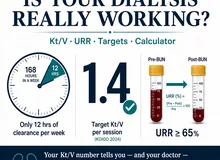
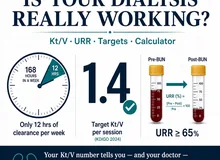
| Single-pool Kt/V | Minimum ≥ 1.2; recommended target ~1.4 (KDOQI 2015) |
| Urea reduction ratio (URR) | ≥ 65% |
| nPCR / nPNA | 1.0–1.2 g/kg/day (KDOQI 2020 Nutrition) |
| Ultrafiltration rate (UF rate) | ≤ 13 mL/kg/h; flag values > 13 |
The Daugirdas second-generation logarithmic equation is the KDOQI/KDIGO-endorsed bedside estimate of single-pool variable-volume Kt/V; the (4 − 3.5 × R) × UF/W term accounts for convective urea removal during ultrafiltration. Single-pool Kt/V overestimates the equilibrated Kt/V by roughly 0.2 because of urea rebound. nPCR equals protein intake only at neutral nitrogen balance in a metabolically stable patient; significant residual renal urea clearance underestimates it. Normalize nPCR to V-derived dry weight, not edematous weight.
Evidence & References
spKt/V uses the Daugirdas second-generation formula (1993), the standard bedside method adopted by KDOQI and KDIGO; the equilibrated-Kt/V relationship was characterized by Depner and Daugirdas (1996). The minimum spKt/V ≥ 1.2 and target ~1.4 come from the KDOQI 2015 Hemodialysis Adequacy update, informed by the HEMO Study, with URR ≥ 65% the corresponding CMS/KDOQI benchmark. The nPCR interdialytic-rise method and its 1.0–1.2 g/kg/day target follow the KDOQI 2020 nutrition guideline.
- Daugirdas JT. Second generation logarithmic estimates of single-pool variable volume Kt/V: an analysis of error. J Am Soc Nephrol. 1993;4(5):1205–1213.
- Depner TA, Daugirdas JT. Equations for normalized protein catabolic rate based on two-point modeling of hemodialysis urea kinetics. J Am Soc Nephrol. 1996;7(5):780–785.
- National Kidney Foundation. KDOQI Clinical Practice Guideline for Hemodialysis Adequacy: 2015 Update. Am J Kidney Dis. 2015;66(5):884–930.
- Ikizler TA, Burrowes JD, Byham-Gray LD, et al. KDOQI Clinical Practice Guideline for Nutrition in CKD: 2020 Update. Am J Kidney Dis. 2020;76(3 Suppl 1):S1–S107.
- Eknoyan G, Beck GJ, Cheung AK, et al. Effect of dialysis dose and membrane flux in maintenance hemodialysis (the HEMO Study). N Engl J Med. 2002;347(25):2010–2019.