Glucose absorbed from dialysate, protein losses, early satiety, low potassium and peritonitis, icodextrin and glucose meters, and when to call the peritoneal dialysis nurse.
PublishedNailathalaGipatikPepalwal:ReferencesMga SanggunianMga TinubdanReng Reperensya:6Audience: Registered nutritionist-dietitians entering adult kidney care · renal RND preceptors, nephrologists, and head nurses who orient themRead timeOras ng pagbasaOras sa pagbasaOras ning pamamasa:
This module is study material for dietitians in adult kidney care. It explains the reasoning behind common decisions; it is not a protocol. In practice, follow your facility’s policy and the responsible physician’s orders. Targets and cut-off values are set by your unit and the attending nephrologist. Every case is fictional.
Learning objectives
After this module you should be able to
Explain how glucose is absorbed from peritoneal dialysis (PD) fluid and count it as energy.
Explain why protein needs stay high on PD and rise during peritonitis.
Manage early fullness and poor appetite around the exchange schedule.
Recognize low potassium as common on PD and say what the evidence shows about treating it.
Know which glucose meters give false readings with icodextrin.
Recognize cloudy fluid and abdominal pain as reasons to call the PD team at once.
Pre-testBefore you read, answer the 8 self-assessment questions and note your score. After the module, select New set of questions and compare. The difference is what you learned; the questions you still miss are what to reread.
Start here
The big picture, in plain words
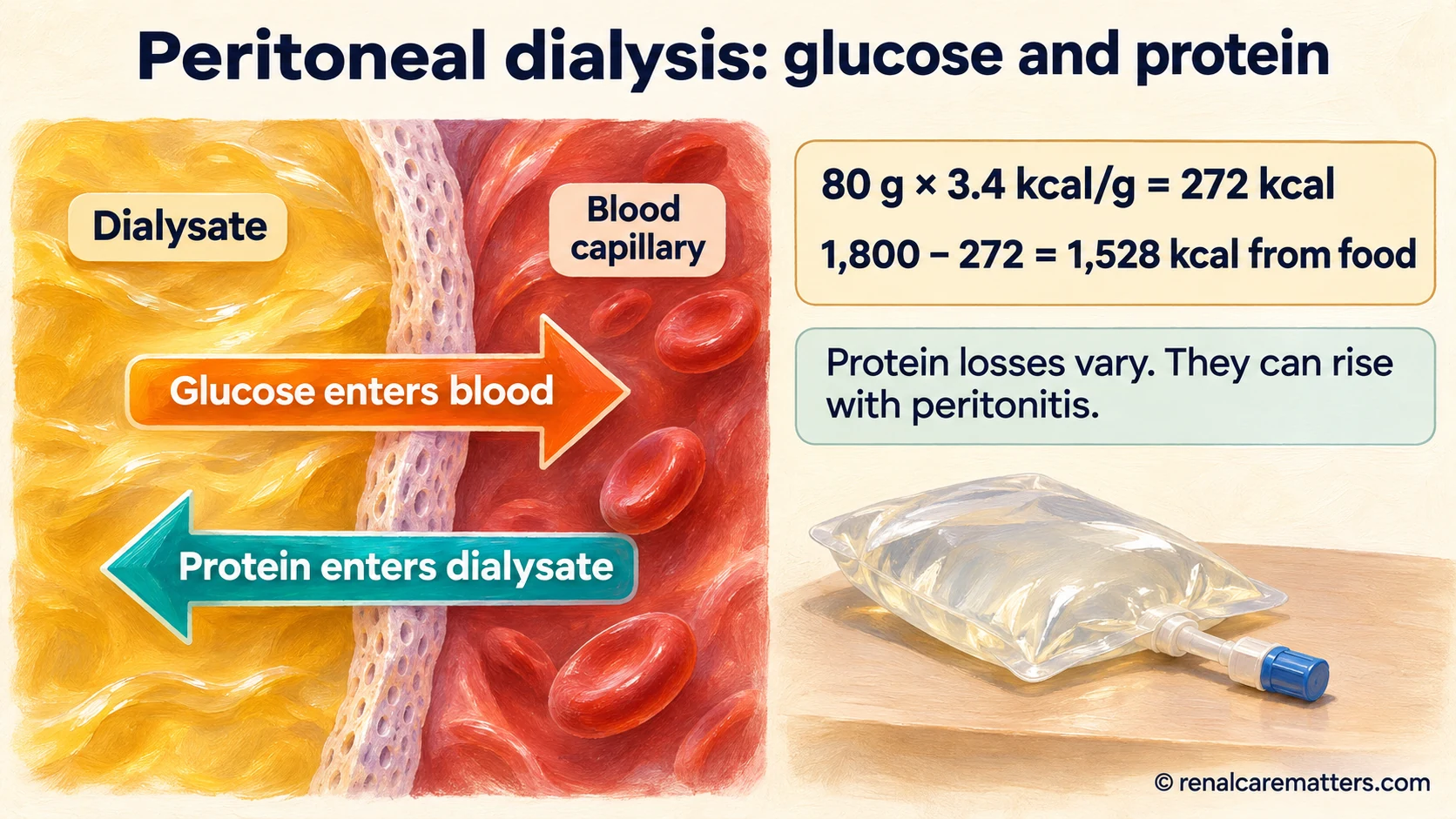
In plain wordsPeritoneal dialysis uses the lining of the belly as the filter. Sugar water is placed inside, and over hours, waste and water move from the blood into it. But the traffic goes both ways. Some of the sugar moves into the blood and becomes energy, and some of the patient’s protein moves out into the bag. A PD patient is being fed sugar and drained of protein around the clock.
Figure 1 · Key terms for this module
Peritoneal dialysis (PD)Dialysis using the lining of the abdomen (peritoneum), done at home.
ExchangeDraining used fluid and filling fresh fluid. Four a day in continuous ambulatory PD.
Automated PD (APD)A machine performs exchanges at night.
Dextrose concentrationHow much glucose is in the fluid, such as 1.5%, 2.5%, or 4.25%. Stronger fluid removes more water and gives more glucose.
IcodextrinA starch-based PD fluid used for the long dwell; it releases maltose into the blood.
PeritonitisInfection of the peritoneum; the first sign is often cloudy drained fluid.
EffluentThe fluid drained out after a dwell.
Figure 2 · Order of work on PD
ScheduleWhich fluids, how many exchanges, which strengths.
Hidden energyGlucose absorbed from the fluid.
ProteinLosses into the fluid, and appetite.
PotassiumOften low, not high.
Glucose metersSafe with icodextrin?
Red flagsCloudy fluid or belly pain goes to the PD team now.
Opening case · fictional
Case: Full by dinner
Mrs. Villanueva, 58, has been on continuous ambulatory PD for eight months. She weighs 60 kg. The PD nurse estimates she absorbs about 80 g of glucose a day from her dialysis fluid. The team puts her total energy need at 1,800 kcal a day.
She says she feels full and bloated by dinner and eats little. Her potassium has fallen from 4.2 to 3.4 mmol/L over three months. She asks if she should still avoid bananas, as her old diet sheet says. While you are talking, she mentions that this morning’s drained fluid looked “a bit cloudy.”
Before reading on, decide:
What should you do about the cloudy fluid, and when?
How much energy is she getting from her dialysis fluid, and what is left for food?
What would you say about bananas?
Keep your answers in mind. The lesson gives you what you need, and the case review near the end shows one sound response.
Lesson · part 1
Count the glucose in the bag
PD fluid contains glucose so that water will move from the blood into the belly. Over a dwell, part of that glucose crosses into the blood. In a classic study of patients on continuous ambulatory PD, net absorption averaged about 180 g of glucose a day, about 8 kcal per kg of body weight a day, or 12% to 34% of total energy intake.1 The amount depends on the strength of the fluid, the number of exchanges, and how fast the patient’s membrane transports solutes.
Energy from dialysate (kcal/day) = absorbed glucose (g/day) × kcal per gram. Example: 80 g × 3.4 kcal/g = 272 kcal. Food energy target = 1,800 − 272 = about 1,528 kcal/day. Use the kcal-per-gram value your PD team uses (3.4 for glucose monohydrate is common) and write it in the note.
The absorbed glucose is ordinary energy. In a thin patient it helps. In a patient with diabetes or obesity it raises glucose, weight, and blood fats. Kidney Disease Outcomes Quality Initiative (KDOQI) advises counting dialysate energy as part of total intake (expert opinion).2 Ask the PD team for their estimate rather than guessing, and recheck it when the fluid strengths change. The figure is an estimate; the patient’s weight trend tells you whether the plan is right.
Figure 3. PD gives energy and takes protein. Count both.
Lesson · part 2
Protein out, fullness in
Protein crosses the membrane too. A stable PD patient loses about 5 to 15 g of protein a day into the fluid, mostly albumin, and much more during peritonitis. That is why KDOQI applies the same 1.0 to 1.2 g/kg/day protein advice to PD as to HD (expert opinion).2 The International Society for Peritoneal Dialysis (ISPD) advises that PD care be goal-directed, with nutrition and appetite reviewed as part of how well the patient lives, not only by laboratory numbers.3
Two things work against eating. The fluid in the belly, often 2 liters, presses on the stomach and causes early fullness. And the steady glucose supply blunts appetite.
Figure 4 · Practical ideas for early fullness
Small, frequent mealsFive or six small meals instead of three large ones.
Protein firstEat the fish, egg, or chicken before the rice.
Timing with drainsEat soon after a drain, when the belly is emptier, if the routine allows.
Fewer drinks with mealsDrink between meals, not during them.
Report persistent bloatingConstipation and a full belly make each other worse, and both can disturb drainage. Tell the PD nurse.
You do not change the exchange schedule or fluid strengths. Those belong to the nephrologist and the PD team. You can tell them which part of the day is hardest for eating and ask whether anything can be adjusted.
Lesson · part 3
On PD, potassium is more often low than high
PD runs all day, and the fluid contains no potassium, so potassium is removed continuously. Many PD patients have low or low-normal potassium, especially if they eat poorly. Low potassium slows the bowel and may make it easier for gut bacteria to cross into the peritoneum.
A randomized trial in Thailand tested this. 167 PD patients with low potassium were assigned either to a protocol of oral potassium to keep the level at 4 to 5 mmol/L or to the usual approach of treating only when it fell below 3.5. Over about a year, the protocol group had fewer episodes of peritonitis (hazard ratio 0.47), and 4% had a high potassium without symptoms.4 This was one open-label trial of moderate size. It suggests correcting low potassium matters, and it needs confirmation.
RememberA PD patient with a falling potassium usually needs more potassium-rich food, not less. Old hemodialysis diet sheets that ban bananas can do harm here. Report the result; supplements are ordered by the physician.
Lesson · part 4
Icodextrin, glucose meters, and the cloudy bag
Icodextrin. This starch-based fluid is used for the long dwell. It releases maltose and related sugars into the blood. Some glucose meters and test strips, those using the enzyme glucose dehydrogenase with the cofactor pyrroloquinoline quinone, read maltose as glucose and show a falsely high result. A patient may then be given insulin for a high glucose that does not exist and become dangerously low. The product label warns about this.5 Confirm with the PD team that the patient’s meter is safe with icodextrin. When in doubt, the hospital laboratory glucose is the reference.
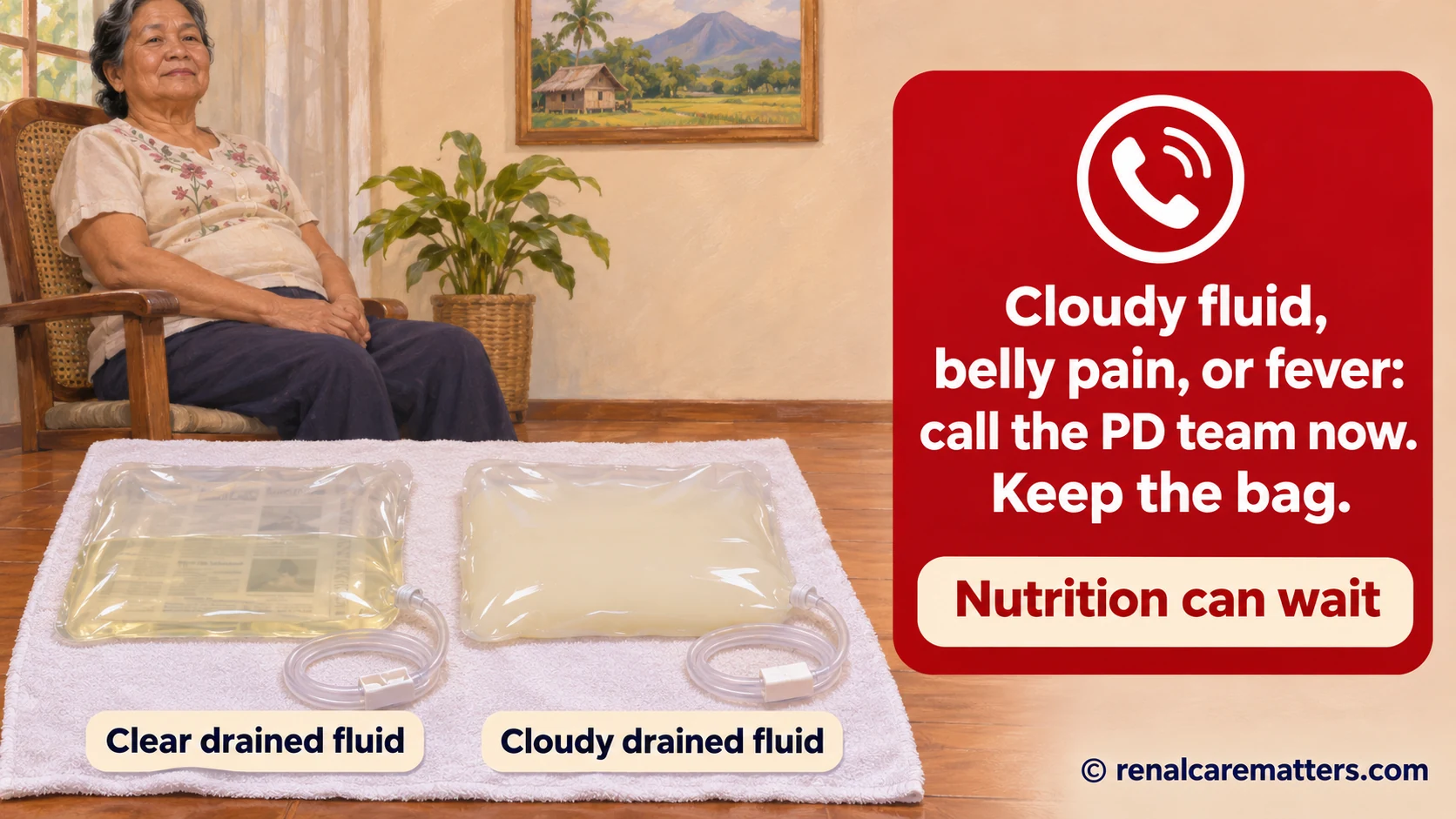
Peritonitis. Cloudy drained fluid is the most common first sign of peritonitis. Abdominal pain and fever may follow, or may not. ISPD advises that patients with cloudy fluid be presumed to have peritonitis and treated promptly; the drained fluid is sent for cell count and culture, and antibiotics are often started before the results return.6 Every hour of delay matters for the membrane and the patient.
Stop and reportCloudy fluid, abdominal pain, or fever in a PD patient: stop the nutrition visit and contact the PD team at once, following the unit’s protocol. Tell the patient to keep the cloudy bag for the team. Nutrition can wait until treatment has started.
After an episode, protein losses rise for several days. Check intake, protein, and glucose exposure again with the team once the patient is on treatment.
Figure 5. Cloudy fluid means call the PD team now. Keep the bag.
On the floor
Real situations: problems and solutions
These are fictional but typical. For each one, cover the answer, decide what you would do, then compare. Where a step depends on local rules, your unit’s procedure and your supervisor’s direction come first.
Cloudy bag during a telephone review
What you see
During a routine telephone call, a PD patient says the night bag looked cloudy.
What is likely going on
Possible peritonitis.
What to do
End the nutrition review. Tell the patient to contact the PD team now, keep the bag, and follow the unit’s instructions; contact the PD nurse yourself as well.
Why it matters
Every hour counts for the membrane.
Weight gain on PD
What you see
A PD patient has gained 4 kg over six months, mostly fat, and his glucose is rising.
What is likely going on
Glucose absorbed from the dialysate is adding energy.
What to do
Ask the PD team for the absorbed glucose estimate and fluid strengths. Reduce food energy, not protein, and tell the team about the glucose trend.
Why it matters
Hidden energy explains weight gain that the food record cannot.
Field notes
Ask the PD nurse which glucose meter the patient uses.
On PD, think low potassium before high.
Case review
Back to the case: Full by dinner
What about the cloudy fluid? Act on it first, now. Cloudy fluid on PD is peritonitis until proven otherwise, even without fever or pain. Stop the nutrition visit. Contact the PD team immediately under the unit’s protocol, and tell her to keep the bag. Everything else in this case comes after that.
How much energy comes from the fluid? 80 g × 3.4 kcal/g = about 272 kcal a day. That leaves about 1,528 kcal to come from food. Write down the 3.4 kcal/g figure and that the 80 g estimate came from the PD team. Her protein target is 1.0 to 1.2 × 60 = 60 to 72 g a day, and it will rise while she has peritonitis.
What about bananas? Her potassium is low, not high, and falling. The old ban is wrong for her now. Report the 3.4 mmol/L result to the team, who may order a supplement, and tell her she can eat bananas and other potassium-rich fruits and vegetables. Cancel the old diet sheet in writing.
And the fullness? Small, frequent meals with protein first, drinks between meals, and food soon after a drain. Ask about constipation. Tell the PD nurse which part of the day is hardest. PD patients see their team less often than HD patients. When you see one, look for the problem nobody has asked about yet.
Skills lab · with your preceptor
Skills checklist: Peritoneal dialysis nutrition review and urgent escalation
Use a fictional PD patient card with a fluid schedule and three months of results. The preceptor will reveal one red flag during the visit. Your preceptor rates each step as satisfactory, needs practice, or not observed. Steps marked Critical must all be satisfactory before sign-off. This checklist supports supervised learning; your unit’s own procedure and competency form are the authority. A printable version of every checklist is on the trainer page.
Asks for the PD schedule, fluid strengths, and the team’s estimate of absorbed glucose, and records the kcal-per-gram value used.
Calculates dialysate energy and the energy left for food.
Sets a protein target of 1.0 to 1.2 g/kg/day and explains protein losses.
Recognizes low or falling potassium and cancels outdated restrictions.
CriticalConfirms that the glucose meter is safe with icodextrin.
CriticalWhen cloudy fluid is mentioned, stops the visit and contacts the PD team at once.
Gives practical advice for early fullness without changing the exchange schedule.
Placement activity. Spend one session in a PD clinic or on a home visit with the PD nurse, and watch one exchange from start to finish.
Self-assessment
Check your understanding
Each visit draws 8 questions at random from this module’s 15-question bank. Choose the single best answer for each, then select Check answers; an explanation appears under the best answer. Select New set of questions for a different mix. A good target is 7 of 8 on two different sets. Nothing you select is sent anywhere; scoring happens in your browser.
Grodstein, G. P., Blumenkrantz, M. J., Kopple, J. D., Moran, J. K., & Coburn, J. W. (1981). Glucose absorption during continuous ambulatory peritoneal dialysis. Kidney International, 19(4), 564–567. https://doi.org/10.1038/ki.1981.53
Ikizler, T. A., Burrowes, J. D., Byham-Gray, L. D., Campbell, K. L., Carrero, J. J., Chan, W., Fouque, D., Friedman, A. N., Ghaddar, S., Goldstein-Fuchs, D. J., Kaysen, G. A., Kopple, J. D., Teta, D., Yee-Moon Wang, A., & Cuppari, L. (2020). KDOQI clinical practice guideline for nutrition in CKD: 2020 update. American Journal of Kidney Diseases, 76(3, Suppl. 1), S1–S107. https://doi.org/10.1053/j.ajkd.2020.05.006
Brown, E. A., Blake, P. G., Boudville, N., Davies, S., de Arteaga, J., Dong, J., Finkelstein, F., Foo, M., Hurst, H., Johnson, D. W., Johnson, M., Liew, A., Moraes, T., Perl, J., Shroff, R., Teitelbaum, I., Wang, A. Y., & Warady, B. (2020). International Society for Peritoneal Dialysis practice recommendations: Prescribing high-quality goal-directed peritoneal dialysis. Peritoneal Dialysis International, 40(3), 244–253. https://doi.org/10.1177/0896860819895364
Pichitporn, W., Kanjanabuch, T., Phannajit, J., Puapatanakul, P., Chuengsaman, P., Parapiboon, W., Treamtrakanpon, W., Boonyakrai, C., Matayart, S., Katavetin, P., Perl, J., Praditpornilpa, K., Eiam-Ong, S., Tungsanga, K., & Johnson, D. W. (2022). Efficacy of potassium supplementation in hypokalemic patients receiving peritoneal dialysis: A randomized controlled trial. American Journal of Kidney Diseases, 80(5), 580–588.e1. https://doi.org/10.1053/j.ajkd.2022.03.013
Li, P. K., Chow, K. M., Cho, Y., Fan, S., Figueiredo, A. E., Harris, T., Kanjanabuch, T., Kim, Y. L., Madero, M., Malyszko, J., Mehrotra, R., Okpechi, I. G., Perl, J., Piraino, B., Runnegar, N., Teitelbaum, I., Wong, J. K., Yu, X., & Johnson, D. W. (2022). ISPD peritonitis guideline recommendations: 2022 update on prevention and treatment. Peritoneal Dialysis International, 42(2), 110–153. https://doi.org/10.1177/08968608221080586
Educational study material for registered nutritionist-dietitians. Does not replace the nephrologist’s orders, facility policy, the Nutrition Care Process documentation required by the Department of Health, or supervised practice.