After this module you should be able to
- Run a structured routine follow-up that covers therapy, access, nutrition, metabolic issues, mental health, supplies and the person’s goals.
- Explain the nutritional and metabolic consequences of PD (protein loss, glucose absorption, hypokalemia) and the 2026 International Society of Renal Nutrition and Metabolism (ISRNM)–International Society for Peritoneal Dialysis (ISPD) nutrition recommendations at a nursing level.
- Prevent the icodextrin–glucose meter error that can hide hypoglycemia.
- Hand over a PD patient safely between home, ward, emergency department and other facilities.
- Coordinate transplant referral, modality change and supportive care as planned transitions rather than crises.
The big picture, in plain words
The first three months of PD are about training and starting. The years after are about keeping the person well, nourished and on therapy, and keeping them safe whenever they cross a boundary: admitted to a ward where nobody knows PD, transferred to another city, switched to hemodialysis, listed for a transplant. Nearly half of people who start PD are no longer on it at two years, according to the 2026 ISPD position statement on loss from PD therapy. Some of those exits are the right outcome, such as transplantation. Some are avoidable. Your work is to make every exit a planned one.1
The picture has a limit. In a relay, every runner knows the baton. In a general ward, the receiving team may never have seen a PD catheter, may not know the order, and may stop or change therapy without telling the PD unit. You may need to hand over the baton and teach how to hold it.
Case: A normal sugar that was not
Mrs. Teresita Uy, 66, on continuous ambulatory peritoneal dialysis (CAPD) with an icodextrin night dwell, is admitted to the medical ward for peritonitis. Nurse Grace from the PD unit visits.
Before reading on, decide:
- What is wrong with the glucose reading on the ward?
- What do you do about the conflicting discharge orders?
- What follow-up must be arranged before she leaves?
Keep your answers in mind. The lesson gives you what you need, and the case review near the end shows one sound response.
Routine follow-up
At each scheduled review, cover:
| Domain | Questions and checks |
|---|---|
| Goals | What matters now? Any change in work, family, plans? |
| Therapy | Records versus order; missed exchanges or cycler sessions; supply problems |
| Fluid | Weight, blood pressure, edema, breathlessness, ultrafiltration (UF), urine trend |
| Access | Exit site, tunnel, catheter integrity, drain performance |
| Nutrition | Appetite, unintended weight change, intake, protein sources, diet barriers |
| Bowel | Constipation (catheter function and enteric peritonitis risk) |
| Metabolic | Potassium, glucose control in diabetes, results due |
| Medicines | Reconciliation; new prescriptions from other doctors |
| Mental health and sleep | Mood, anxiety, burnout, sleep, caregiver strain |
| Supplies and finances | Delivery reliability, storage, benefit status |
| Plans | Transplant work-up, advance care planning, next tests |
Document responsibilities and dates across disciplines.
Nutrition and metabolism
Protein and albumin loss. PD loses protein into the effluent daily through the large pores (PD01), and more during peritonitis. Inflammation, poor appetite from glucose absorption and abdominal fullness add to the risk of protein-energy wasting.
Glucose exposure. Glucose in the solution is absorbed. It supplies calories, which can help an underweight person and harm someone with obesity, diabetes or dyslipidemia. Hypertonic exchanges carry more glucose. The site’s glucose absorption calculator shows the order of magnitude for a given prescription.
Potassium. Because PD removes potassium continuously and many patients eat little, hypokalemia is common, unlike in hemodialysis. The 2022 ISPD peritonitis recommendations name hypokalemia as a modifiable peritonitis risk factor. Patients often carry hemodialysis-era advice to avoid fruit; check what they are actually eating and route potassium decisions to the team and the renal dietitian.2
The 2026 joint ISRNM–ISPD practice recommendation is the first international nutrition guidance specific to PD. It used the GRADE framework for graded recommendations and expert-consensus practice points, and covers five themes: nutrition screening, assessment and monitoring; dietary recommendations; nutrition interventions for complications; supplementation; and education to build health, nutrition and food literacy. Nurses contribute screening, monitoring and reinforcement of the dietitian’s plan.3
The icodextrin–glucose meter hazard
Icodextrin is metabolized to maltose and other oligosaccharides that circulate in the blood. Some point-of-care glucose meters and test strips cannot distinguish maltose from glucose and report falsely high glucose. The real danger is a falsely normal reading when the patient is actually hypoglycemic, or insulin given for a falsely high reading.
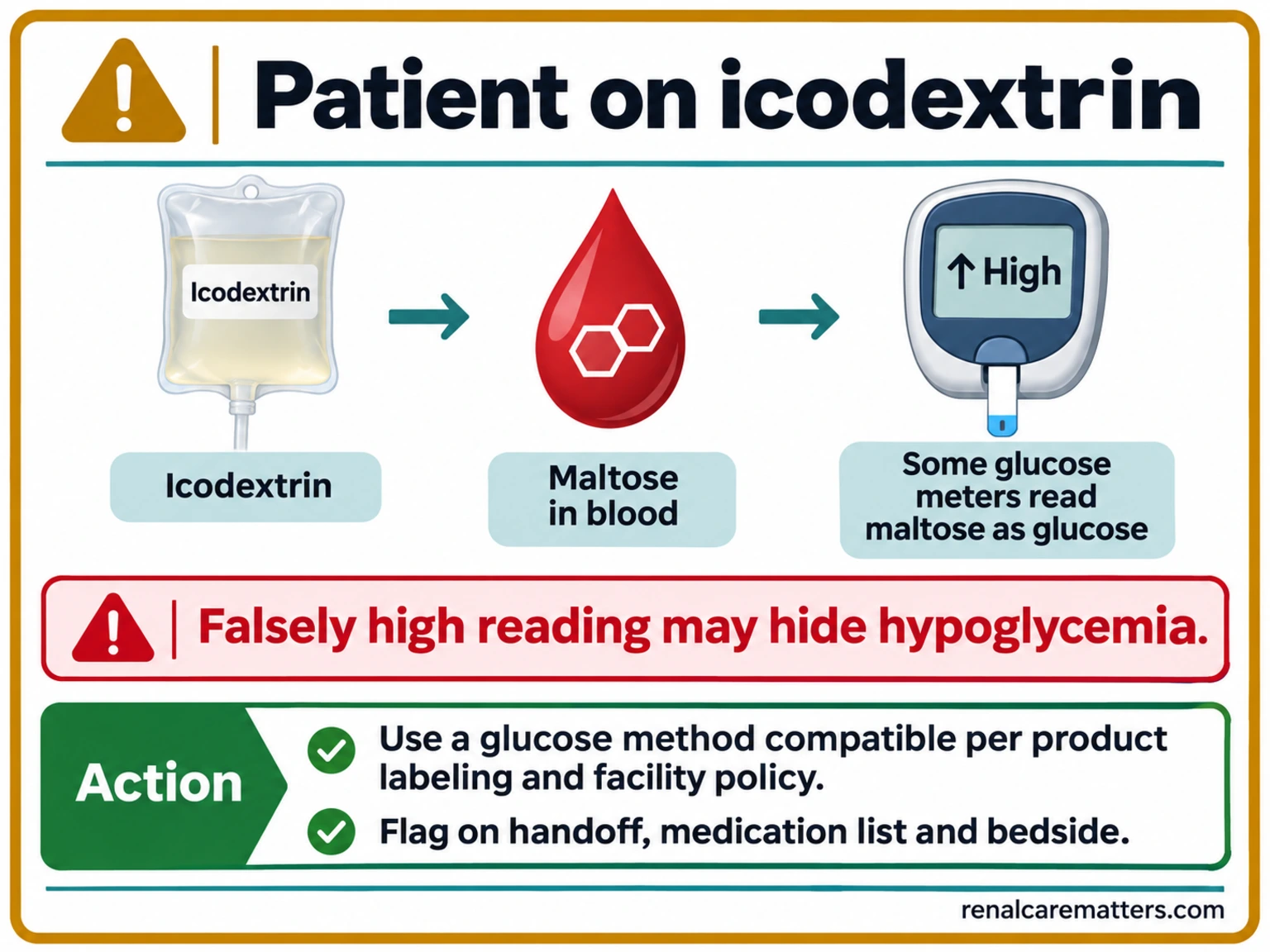
Every patient on icodextrin, and every ward they are admitted to, must use a glucose method that is compatible according to product labeling and facility policy. Put "on icodextrin" on the handoff, the medication list and the bedside.
Hospital and home transitions
Admission to a non-PD ward. Call or send to the receiving team:
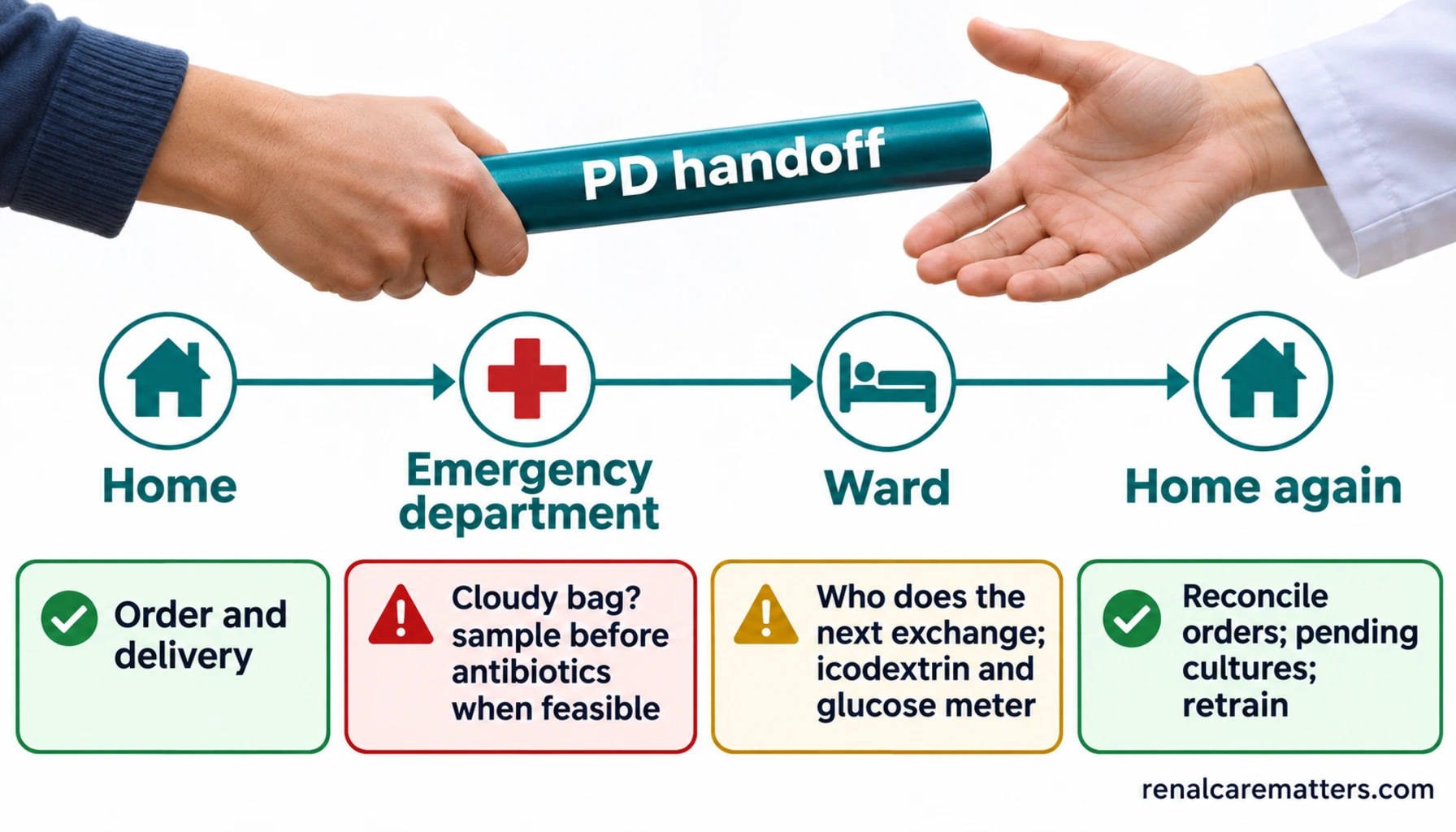
- Current PD order (modality, solutions, volumes, dwell or cycler program), actual delivery over the last days, and the next planned treatment
- Who will perform the next exchange, and how; whether the PD unit will send staff or supplies
- Catheter, exit-site and tunnel status; last dressing
- Infection history, recent cultures and sensitivities, allergies
- Icodextrin use and glucose-meter compatibility
- Fluid targets, weight, urine output, potassium
- Outstanding issues and the PD unit’s contact number
Discharge home. Compare discharge orders with the pre-admission home record. Identify pending cultures and who will review them. Check supplies, technique (retrain after peritonitis or long admission), transport and follow-up date. Resolve conflicting instructions through the treating team before the patient relies on them.
Transfer to another unit or city. Send the order, records, recent labs and a named contact; confirm the receiving unit has the same system or arrange device-specific training.
Planned exits from PD
| Exit | Nursing role |
|---|---|
| Transplant | Keep work-up moving; plan catheter management with the transplant team |
| Transfer to hemodialysis | Prepare early when trends suggest PD is failing (falling UF, recurrent peritonitis, burnout); vascular access planning with the team |
| Recovery of kidney function | Rare; document and support |
| Transfer to another program | Complete handover |
| Supportive or conservative care | Advance care planning; symptom focus; family support |
| Death | Bereavement support; review for learning |
The 2026 ISPD position statement recommends replacing the vague term "technique failure" with standardized definitions of each cause of loss and proposes key performance indicators for benchmarking (PD12).1
Back to the case: A normal sugar that was not
Day 1. The ward’s glucose meter reads 180 mg/dL; insulin is due by sliding scale. Grace checks: the ward meter is not labeled compatible with icodextrin. She alerts the ward nurse and the attending, who order laboratory glucose and a compatible method. Laboratory glucose is 68 mg/dL.
Day 6, discharge. Discharge orders list four exchanges of 1.5% dextrose; her home record shows three 1.5% exchanges plus icodextrin overnight. Grace does not let Mrs. Uy go home with conflicting instructions. She contacts the treating nephrologist, confirms the intended order, updates the written order card, and lists the pending culture with the reviewer and date. She arranges retraining in one week and an exit-site check.
Take-home. Every transition is a medication-safety and glucose-safety moment.
Skills checklist: Practice drill
Write a hospital handoff and a follow-up call note for a fictional patient discharged after peritonitis. Include the owner of the next treatment, icodextrin status, pending results with the reviewer and date, and a backup contact. Your preceptor rates each step as satisfactory, needs practice, or not observed. Steps marked Critical must all be satisfactory before sign-off. This checklist supports supervised learning; your unit’s own procedure and competency form are the authority. A printable version of every checklist is on the trainer page.
- Write a hospital handoff and a follow-up call note for a fictional patient discharged after peritonitis.
- Include the owner of the next treatment, icodextrin status, pending results with the reviewer and date, and a backup contact.
Check your understanding
Each visit draws 5 questions at random from this module’s 15-question bank. Choose the single best answer for each, then select Check answers; an explanation appears under the best answer. Select New set of questions for a different mix. A good target is 4 of 5 on two different sets. Nothing you select is sent anywhere; scoring happens in your browser.
Read next on this site
- Eating on Dialysis: What the Evidence Actually SaysDiet on dialysis.
- Advance Care Planning for Dialysis PatientsAdvance care planning in dialysis.