After this module you should be able to
- Distinguish chronic pediatric peritoneal dialysis (PD), acute PD for acute kidney injury (AKI), and assisted PD by who leads care, what changes clinically, and what the nurse may do.
- Summarize the 2020 International Society for Peritoneal Dialysis (ISPD) acute PD guidelines for adults and children, with their grades.
- Summarize the 2024 ISPD position paper on assisted PD and build an assistance plan.
- Route each context to the qualified team and recognize which tasks need additional training.
The big picture, in plain words
This course prepares you for adult chronic PD. You will still meet a child on PD, a critically ill adult on acute PD, or an older person who can no longer manage alone. This module gives you enough understanding to recognize what is different, to keep the person safe in the first hour, and to hand over to the right team. It does not authorize independent practice in these areas.
The picture has a limit. "Same theme" can tempt you to apply adult chronic routines everywhere. In each of these contexts, the routine is different enough that applying adult defaults can cause harm.
Case: He can explain it, but not do it
Mr. Romeo Santos, 69, on continuous ambulatory peritoneal dialysis (CAPD) for three years, has a stroke affecting his right hand. He can explain every step of the exchange but cannot manage the connections. His wife Nena, 66, has arthritis. Their son works abroad.
Before reading on, decide:
- What can Romeo still do, and what needs help?
- Who could assist, and what must the plan specify?
- Who supervises care while the team decides?
Keep your answers in mind. The lesson gives you what you need, and the case review near the end shows one sound response.
Pediatric PD
Why PD is common in children. PD avoids repeated needling, allows school attendance and can be performed at home by parents. It is often the preferred modality in young children.
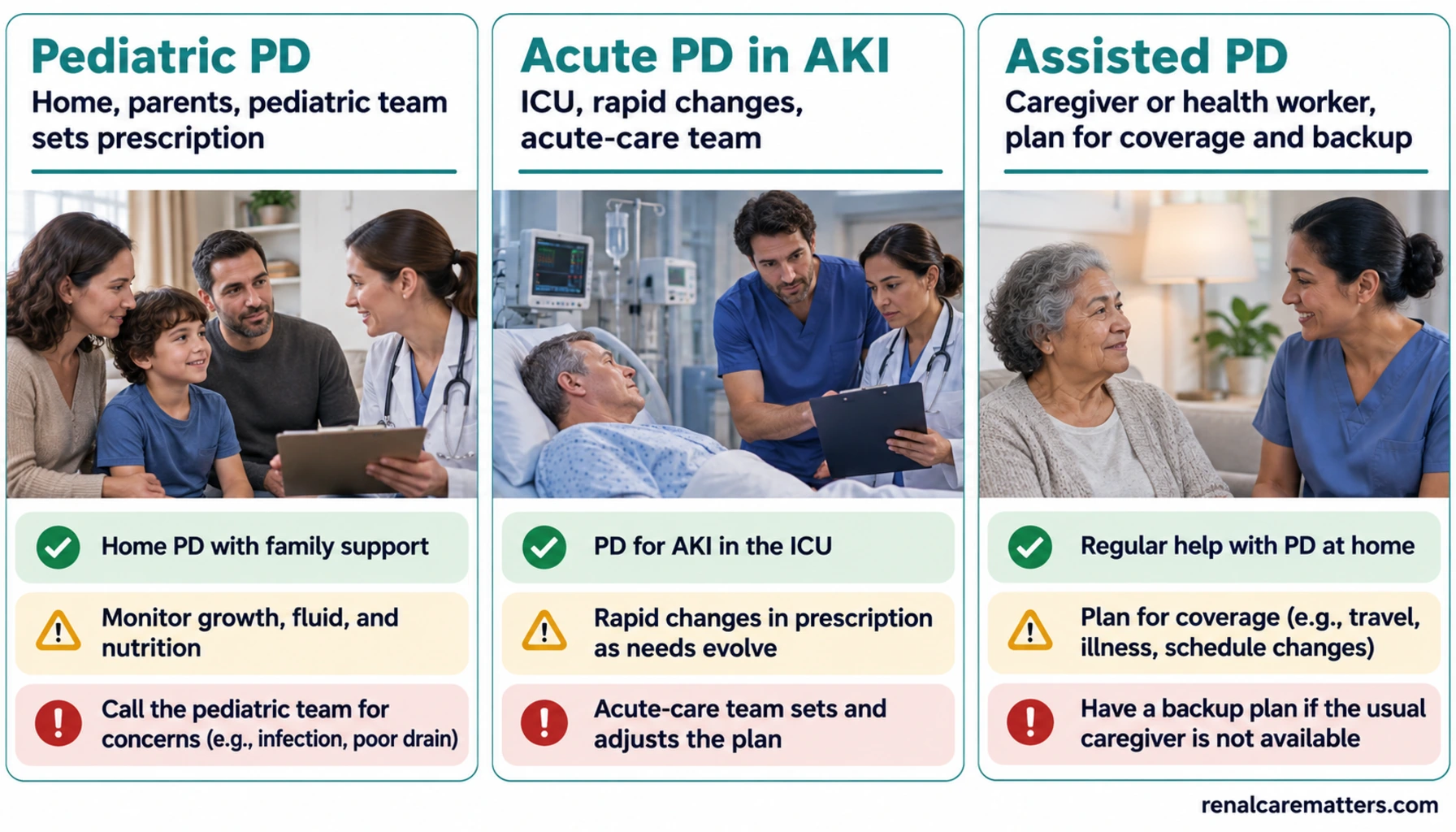
- Prescriptions are scaled to body size (often body surface area), and fill volumes are small. The pediatric nephrology team sets all parameters.
- Growth, nutrition, development, schooling and family function are central outcomes.
- Caregiver competence and backup coverage are essential; parents may share or alternate tasks.
- Infection assessment and treatment follow pediatric-specific ISPD guidance, not adult dosing.
In the Philippines, Philippine Health Insurance Corporation (PhilHealth) Advisory 2026-0013 extended the pediatric automated peritoneal dialysis (APD) pilot through 31 July 2026. Availability after that date and eligible sites were not verified when this curriculum was written. Verify with PhilHealth before discussing coverage with a family.1
Your role: engage the child at a developmentally appropriate level, support parents, reinforce training, recognize red flags (cloudy effluent, fever, poor drain, dehydration, poor feeding) and escalate to the pediatric PD team.
Acute PD for acute kidney injury
The 2020 ISPD guidelines on PD in AKI state that PD should be considered a suitable modality for AKI in all settings (adults, GRADE 1B; children, GRADE 1C). Acute PD matters especially where hemodialysis or continuous therapies are scarce, and the guidelines include "minimum standard" options for resource-limited settings.2
| Recommendation (adults, 2020) | Grade |
|---|---|
| PD is a suitable modality for AKI in all settings | 1B |
| Flexible peritoneal catheters where resources and expertise exist | 1B (optimal) |
| Rigid or improvised catheters may be used in resource-poor environments where they may be life-saving | 1C (minimum standard) |
| Tunnel catheters to reduce peritonitis and leak | Practice point |
| Catheter insertion by trained nephrologists is safe, with results equivalent to surgical insertion in patients without contraindications | 1B |
| Prophylactic antibiotics before catheter insertion | 1B |
| Closed delivery system with a Y connection | 1A (optimal) |
| Bicarbonate-containing solutions in critically ill patients, especially with significant liver dysfunction and marked lactate elevation | 1B (optimal) |
For children (2020 pediatric update): PD is suitable for pediatric AKI (1C); prophylactic antibiotics before insertion (1B); a closed Y-connection system (1A); APD is suitable except in neonates, whose fill volumes are too small for current machines (1D).2,3
What changes for nursing. Acute PD patients are often unstable. Fluid removal, potassium, glucose, acid–base and hemodynamics can change within hours. Monitoring is frequent, prescriptions change often, and exchanges may be performed by ICU or ward nurses with variable PD experience. Know your facility’s escalation, documentation and handoff procedures, and which tasks require additional training.
Assisted PD
Definition and scope. The 2024 ISPD position paper on assisted PD notes that many people with kidney failure are older, frail, or have physical or cognitive disabilities that limit self-care PD, and may lack family support. Assistance can come from family members, paid caregivers, home-care nurses or health workers, and may be temporary (for example after a stroke or surgery) or long term. The paper states that PD should be offered to every eligible person considering maintenance dialysis and aims to expand equitable access through assistance.4
Outcomes. Observational comparisons, including a study of older patients, have found broadly similar survival and peritonitis-free survival between assisted and self-care PD after adjustment, despite assisted patients being older and having more comorbidity. These are selected, observational cohorts; they support feasibility rather than prove equivalence.
| Element | Content |
|---|---|
| Task allocation | Exactly which steps the assistant performs and which the patient performs |
| Training | How the assistant was trained, by whom, and how competence was verified |
| Coverage | Days, times, and who covers absences |
| Escalation | Whom the assistant calls for each problem |
| Backup | What happens if the assistant is unavailable |
| Supervision | Which clinician retains clinical oversight |
| Review | Reassessment date and triggers (change in function, living arrangement or caregiver) |
Back to the case: He can explain it, but not do it
Nurse Celia obtains consent and assesses what Romeo can still do (verify supplies, observe effluent, record volumes, recognize problems) and what Nena can do safely with adapted grips. She raises with the team whether APD with Nena doing a single evening setup would be more feasible than four daily manual exchanges, and whether a home-care nurse or trained helper could support for the first weeks. While the team decides, Romeo stays in hospital-based exchanges per order, and Celia documents who performs each exchange, the interim supervision plan and the reassessment date.
Skills checklist: Practice drill
Develop a one-page assistance plan for the stroke case. Then write two sentences each on how the plan would differ for a 6-year-old on PD and for an unstable adult on acute PD in the ICU. Your preceptor rates each step as satisfactory, needs practice, or not observed. Steps marked Critical must all be satisfactory before sign-off. This checklist supports supervised learning; your unit’s own procedure and competency form are the authority. A printable version of every checklist is on the trainer page.
- Develop a one-page assistance plan for the stroke case.
- Then write two sentences each on how the plan would differ for a 6-year-old on PD and for an unstable adult on acute PD in the ICU.
Check your understanding
Each visit draws 5 questions at random from this module’s 15-question bank. Choose the single best answer for each, then select Check answers; an explanation appears under the best answer. Select New set of questions for a different mix. A good target is 4 of 5 on two different sets. Nothing you select is sent anywhere; scoring happens in your browser.
Read next on this site
- Roadmap to Adding a Peritoneal Dialysis Program — A Staged Implementation GuideBuilding a PD program, including assisted PD.