Nephrology Nursing specialty subtrack for pediatric dialysis
This module is study material for registered nurses in pediatric dialysis. It explains the reasoning behind common nursing decisions; it is not a procedure. Exact steps follow your unit’s pediatric protocol and the device instructions; treatment parameters follow the written order of the pediatric nephrologist. Nurses assess, verify, teach, document and escalate; they do not prescribe, choose antibiotics, change doses or adjust anticoagulation. Every case is fictional and every value in a case is illustrative. Pending review by a pediatric nephrologist and a senior pediatric dialysis nurse.
Learning objectives
After this module you should be able to
Trace how organisms reach a child’s bloodstream or peritoneum, including routes unique to children.
Protect key parts and catheter hubs with aseptic non-touch technique and scrub-the-hub.
Summarize the Standardizing Care to Improve Outcomes in Pediatric End-Stage Kidney Disease collaborative (SCOPE) evidence on care bundles and state honestly what a quality collaborative can and cannot prove.
Respond to an early infection signal by recording, escalating and protecting the specimen.
Classroom 2 hSkills lab 2 hSupervised placement 4 h
Pre-testBefore you read, answer the 5 self-assessment questions and note your score. After the module, select New set of questions and compare. The difference is what you learned; the questions you still miss are what to reread.
Start here
The big picture, in plain words
Infection is the leading cause of illness and technique failure in children on dialysis. A child on peritoneal dialysis (PD) carries a tube from the skin into the abdomen; a child on hemodialysis often carries a tube into a large vein near the heart. Every connection is a door.
Your work in this module is to keep those doors closed: clean hands, protected key parts, scrubbed hubs, clean exit sites, and attention to the extra routes that come with being small.
In plain wordsThink of a catheter hub as the front door of a house in a dusty street. Wiping your feet once is not enough if you leave the door open while you talk. Protect the door, open it only as long as needed, and clean it every time.
The picture has a limit. A house door keeps out what you can see. Bacteria that cause line infections are invisible and can live in a thin film inside the hub and on the catheter wall, where a quick wipe does not reach. That is why scrubbing time and friction matter, and why the catheter itself, not only the skin, is the target.
Figure 1 · Key terms for this module
Key partA part that must stay sterile, such as a hub, connector tip or needle.
Aseptic non-touch techniqueDoing a procedure without touching key parts.
BiofilmA protective layer bacteria form on catheter surfaces.
Care bundleA small set of evidence-based steps done together, every time.
Catheter-associated bloodstream infection (CA-BSI)Infection of the blood that starts from a catheter.
Opening case · fictional
Case: The diaper and the dressing
Baby Elijah Gomez, 14 months, has a PD catheter and a gastrostomy tube. At a home visit, Nurse Carmela finds the exit-site dressing damp at the lower edge, where the diaper rubs. His grandmother says she changes the dressing “when it looks dirty”. In the same week, a 13-year-old on hemodialysis in the unit has a temperature of 38.4 °C an hour into treatment.
Before reading on, decide:
Which routes put Elijah at risk, and what can be changed?
What is the first response to the teenager’s fever?
Which care-bundle steps would you audit in this unit?
Keep your answers in mind. The lesson gives you what you need, and the case review near the end shows one sound response.
Lesson · part 1
How organisms reach the child
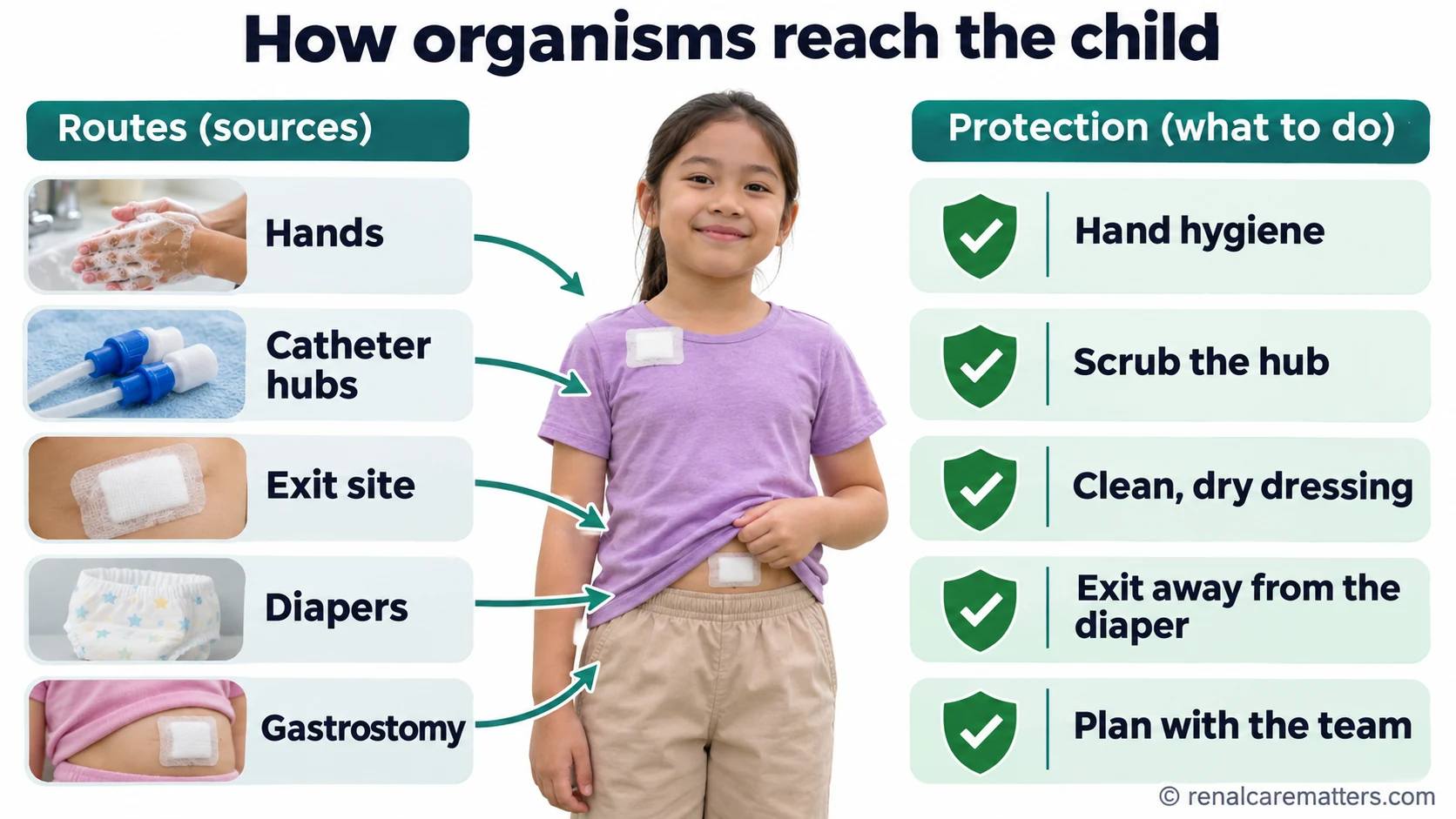
Most catheter infections start from the child’s own skin or from hands that touch a key part. Organisms travel along the outside of the catheter from the exit site, or along the inside from a contaminated hub or connection.
Figure 2. How organisms reach the child. Hands and hubs are the main gates; diapers and gastrostomies add routes unique to children.
Route
Why children are different
What you do
Hands
Children touch lines; parents and siblings help
Hand hygiene for everyone near the line; teach the family the moments
Hubs and connections
Small lines, frequent access, play
Scrub the hub; keep caps on; never leave a line open
Exit site
Diapers, sweat, a busy child
Exit site away from the diaper; dressing for incontinent children
Gastrostomy and ostomies
Common in children on PD
Placed before or with the PD catheter when possible; extra care and prophylaxis decisions by the team
The 2024 International Society for Peritoneal Dialysis (ISPD) pediatric guideline says a dressing is crucial for children with incontinence and that the exit site should avoid the diaper area in infants. It suggests placing a gastrostomy before or at the same time as the PD catheter (2D), and prophylactic antibiotic and antifungal cover when a gastrostomy is placed in a child already on PD (2D).1
RememberIn small children, diapers, gastrostomies and helping hands are infection routes. Plan for them; do not hope.
Lesson · part 2
Key parts and hubs
Aseptic non-touch technique means you never touch a key part, even with gloves. Gloves protect you; technique protects the child.
For hemodialysis catheters, the Centers for Disease Control and Prevention (CDC) core interventions include hand hygiene, catheter care with an antiseptic, scrubbing the hub before each access, and staff competency and audit.2 The scrub-the-hub protocol uses friction on the hub threads and end for the time stated by the antiseptic’s instructions, then lets it dry before connection.3
Antibiotic ointment at hemodialysis catheter exit sites
Do not assume an ointment helps. In the Standardizing Care to Improve Outcomes in Pediatric End-Stage Kidney Disease (SCOPE) cohort of 1,277 children, mupirocin at the hemodialysis catheter exit site was associated with a higher rate of catheter-associated bloodstream infection (rate ratio 4.45).4 This is an observational association that may reflect which children received it. It is a reason to follow the unit’s written protocol, not to improvise.
RememberGloves protect you; technique protects the child. Scrub, wait, connect. Never touch a key part.
Lesson · part 3
Bundles that lowered infection
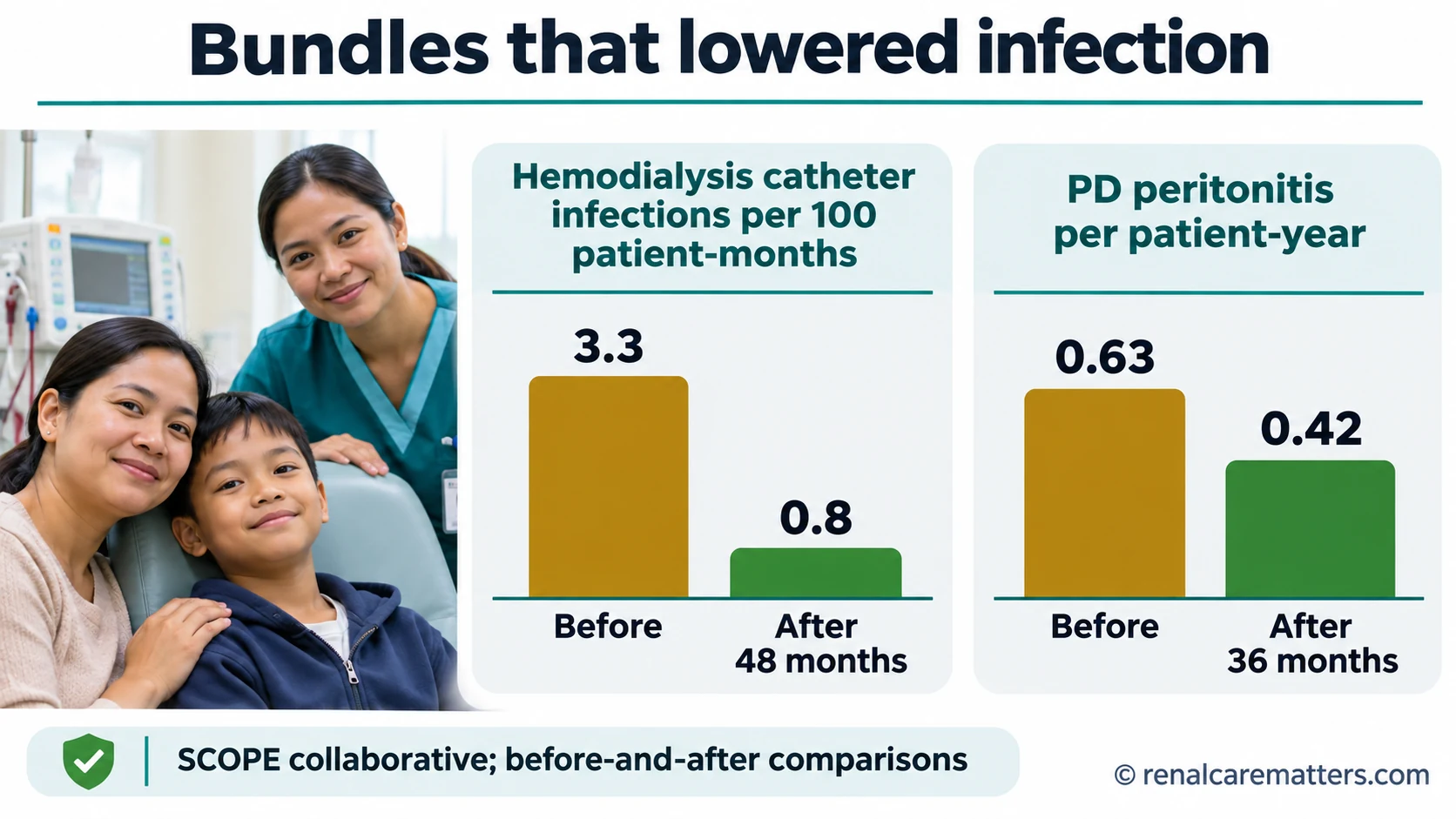
Most pediatric infection evidence comes from quality collaboratives rather than randomized trials, because children on dialysis are few. The SCOPE collaborative asked centers to adopt standardized care bundles and to audit them.
Figure 3. Bundles that lowered infection. Standardized care in the SCOPE collaborative was followed by fewer infections (pre–post comparisons, not randomized).
In the PD analysis, peritonitis rates fell further as compliance with follow-up care rose, reaching statistical significance at 80% compliance.6 Pre–post designs cannot exclude other changes that happened at the same time, so these results support bundles strongly but do not prove each step. What they show reliably is that consistent, audited practice is followed by fewer infections.
On the floor · The 13-year-old with a fever
Nurse Raffy sees 38.4 °C an hour into treatment. He rechecks, looks at the exit site and the child, takes blood pressure and heart rate, and calls the nephrologist at once, per unit protocol. Blood cultures are drawn as ordered before any antibiotic. He records the time of each step and the hub care done at connection.
A fever on a line is a bloodstream infection until the team says otherwise.
Illustrative scenario. Names and details are invented.
RememberBundles work when everyone does every step, every time, and someone checks. Audit is part of the bundle.
On the floor
Real situations: problems and solutions
These are fictional but typical. For each one, cover the answer, decide what you would do, then compare. Where a step depends on local rules, your unit’s procedure and your supervisor’s direction come first.
The quick wipe
What you see
A colleague wipes a catheter hub for two seconds and connects while wet.
What is likely going on
Scrub-the-hub time and drying skipped.
What to do
Remind kindly, model the full scrub and dry, and include it in audit.
Why it matters
Friction and drying time do the work.
Diaper over the exit site
What you see
An infant’s PD exit-site dressing is wet with urine.
What is likely going on
Exit site near the diaper line or dressing poorly placed.
What to do
Change the dressing per protocol, reposition the diaper, report for a plan.
Why it matters
Diapers are an infection route.
Mupirocin from home
What you see
A parent brings mupirocin to use on an hemodialysis (HD) catheter exit site.
What is likely going on
Well-meant improvisation.
What to do
Explain that the unit follows its written protocol; refer to the nephrologist.
Why it matters
An observational study linked it with more infection.
Field notes
Audit one bundle element each week.
Teach siblings hand hygiene too.
Case review
Back to the case: The diaper and the dressing
Elijah’s routes. The diaper wets the dressing, and the dressing is changed by appearance rather than on schedule. Carmela re-teaches dressing care and diaper positioning, checks the gastrostomy, records the exit-site appearance with a score, and asks the PD team about the dressing plan. Retraining follows the unit’s protocol.
The fever. Recheck, assess, call the nephrologist, obtain cultures as ordered before antibiotics, and record times.
Audit. Hand hygiene, scrub-the-hub timing and drying, exit-site care, dressing integrity, and connection and disconnection technique, observed and recorded monthly.
Skills lab · with your preceptor
Skills checklist: Asepsis and access protection
Practice on models first. Your preceptor rates each step as satisfactory, needs practice, or not observed. Steps marked Critical must all be satisfactory before sign-off. This checklist supports supervised learning; your unit’s own procedure and competency form are the authority. A printable version of every checklist is on the trainer page.
Performs hand hygiene at the right moments and teaches them to a caregiver
CriticalScrubs the hub with friction for the antiseptic’s stated time and lets it dry
CriticalConnects and disconnects without touching a key part
Assesses and dresses an exit site in a child in diapers
CriticalResponds to fever on a line by assessing, escalating and preserving cultures before antibiotics
Self-assessment
Check your understanding
Each visit draws 5 questions at random from this module’s 15-question bank. Choose the single best answer for each, then select Check answers; an explanation appears under the best answer. Select New set of questions for a different mix. A good target is 4 of 5 on two different sets. Nothing you select is sent anywhere; scoring happens in your browser.
Warady, B. A., Same, R., Borzych-Duzalka, D., Neu, A. M., El Mikati, I., Mustafa, R. A., Begin, B., Nourse, P., Bakkaloglu, S. A., Chadha, V., Cano, F., Yap, H. K., Shen, Q., Newland, J., Verrina, E., Wirtz, A. L., Smith, V., & Schaefer, F. (2024). Clinical practice guideline for the prevention and management of peritoneal dialysis associated infections in children: 2024 update. Peritoneal Dialysis International, 44(5), 303–364. https://doi.org/10.1177/08968608241274096
Ruebner, R. L., De Souza, H. G., Richardson, T., Bedri, B., Marsenic, O., Iorember, F., Warejko, J. K., Warady, B. A., & Neu, A. M. (2022). Epidemiology and risk factors for hemodialysis access-associated infections in children: A prospective cohort study from the SCOPE collaborative. American Journal of Kidney Diseases, 80(2), 186–195.e1. https://doi.org/10.1053/j.ajkd.2021.11.008
Marsenic, O., Rodean, J., Richardson, T., Swartz, S., Claes, D., Day, J. C., Warady, B., & Neu, A. (2020). Tunneled hemodialysis catheter care practices and blood stream infection rate in children: Results from the SCOPE collaborative. Pediatric Nephrology, 35(1), 135–143. https://doi.org/10.1007/s00467-019-04384-7
Neu, A. M., Richardson, T., Lawlor, J., Stuart, J., Newland, J., McAfee, N., & Warady, B. A. (2016). Implementation of standardized follow-up care significantly reduces peritonitis in children on chronic peritoneal dialysis. Kidney International, 89(6), 1346–1354. https://doi.org/10.1016/j.kint.2016.02.015
Educational material for registered nurses. Completing it is an Academy learning record only. It does not confer CPD units, PSN or National Kidney and Transplant Institute (NKTI) training recognition, PhilHealth staffing credit, or clinical privileges, and it does not replace your facility’s protocols, device instructions, or written orders.