Nephrology Nursing · Specialization · Module 6 of 20
Medication Safety in Children on Dialysis
Ten-fold dosing errors, what dialysis removes, body-surface-area dosing logic, and the independent double check.
PublishedNailathalaGipatikPepalwal:Audience: Philippine-licensed registered nurses entering pediatric peritoneal dialysis or hemodialysis · pediatric dialysis nurse educators and preceptorsRead timeOras ng pagbasaOras sa pagbasaOras ning pamamasa:
Nephrology Nursing specialty subtrack for pediatric dialysis
This module is study material for registered nurses in pediatric dialysis. It explains the reasoning behind common nursing decisions; it is not a procedure. Exact steps follow your unit’s pediatric protocol and the device instructions; treatment parameters follow the written order of the pediatric nephrologist. Nurses assess, verify, teach, document and escalate; they do not prescribe, choose antibiotics, change doses or adjust anticoagulation. Every case is fictional and every value in a case is illustrative. Pending review by a pediatric nephrologist and a senior pediatric dialysis nurse.
Learning objectives
After this module you should be able to
Explain why weight-based and body-surface-area dosing creates ten-fold errors, and the habits that prevent them.
Predict which drugs dialysis is likely to remove from the drug’s size, protein binding and distribution.
Verify a pediatric dose against weight, units and concentration with an independent double check.
Time and document medicines around dialysis sessions as ordered, and report missed or vomited doses.
Classroom 2 hSkills lab 2 hSupervised placement 4 h
Pre-testBefore you read, answer the 5 self-assessment questions and note your score. After the module, select New set of questions and compare. The difference is what you learned; the questions you still miss are what to reread.
Start here
The big picture, in plain words
Almost every medicine a child receives is calculated, not chosen from a fixed tablet. The dose depends on weight or body surface area, the liquid comes in a concentration, and the volume is measured in a syringe. Each step is a chance to move a decimal point. A ten-fold error in an adult dose may be noticed; in a child it may be the entire difference between a dose and an overdose.
Your work in this module is not to choose doses. The pediatric nephrologist and pharmacist do that. Your work is to make sure the dose the child receives is the dose that was ordered, at the right time relative to dialysis.
In plain wordsThink of a dose as a sentence with three words: an amount, a unit and a concentration. Change any word, and the sentence means something else. “Five” means nothing until you know “five milligrams” and “in one milliliter”.
The picture has a limit. Even a perfectly checked sentence can be wrong for the child if the kidney and the dialysis change how long the drug stays in the body. That is the prescriber’s and pharmacist’s reasoning, but you are the one who sees the child sleepy after a dose or vomiting it back. Report what you see.
Figure 1 · Key terms for this module
Ten-fold errorA dose ten times too large or too small, usually from a misplaced decimal or a zero.
ConcentrationAmount of drug per volume, for example mg per mL.
Protein bindingThe share of a drug attached to blood proteins; bound drug is poorly dialyzed.
Volume of distributionHow widely a drug spreads through body tissues; wide spread means little is in the blood for dialysis to remove.
Independent double checkTwo people calculating separately and comparing.
Opening case · fictional
Case: Point five or five
Ella Navarro, 4, weighs 15 kilograms and is on hemodialysis three times a week. Her new order for an oral medicine reads “.5 mL”. The bottle’s concentration differs from the one the family used last month. Her mother says Ella usually gets her morning medicines “before the machine”. Nurse Dani prepares the dose.
Before reading on, decide:
What is unsafe about the order as written?
How should Dani verify the dose?
Should the medicine be given before or after dialysis?
Keep your answers in mind. The lesson gives you what you need, and the case review near the end shows one sound response.
Lesson · part 1
Where ten-fold errors come from
Pediatric doses travel through many hands: prescriber, pharmacist, nurse, caregiver. Errors cluster at the steps where a number is converted or copied.
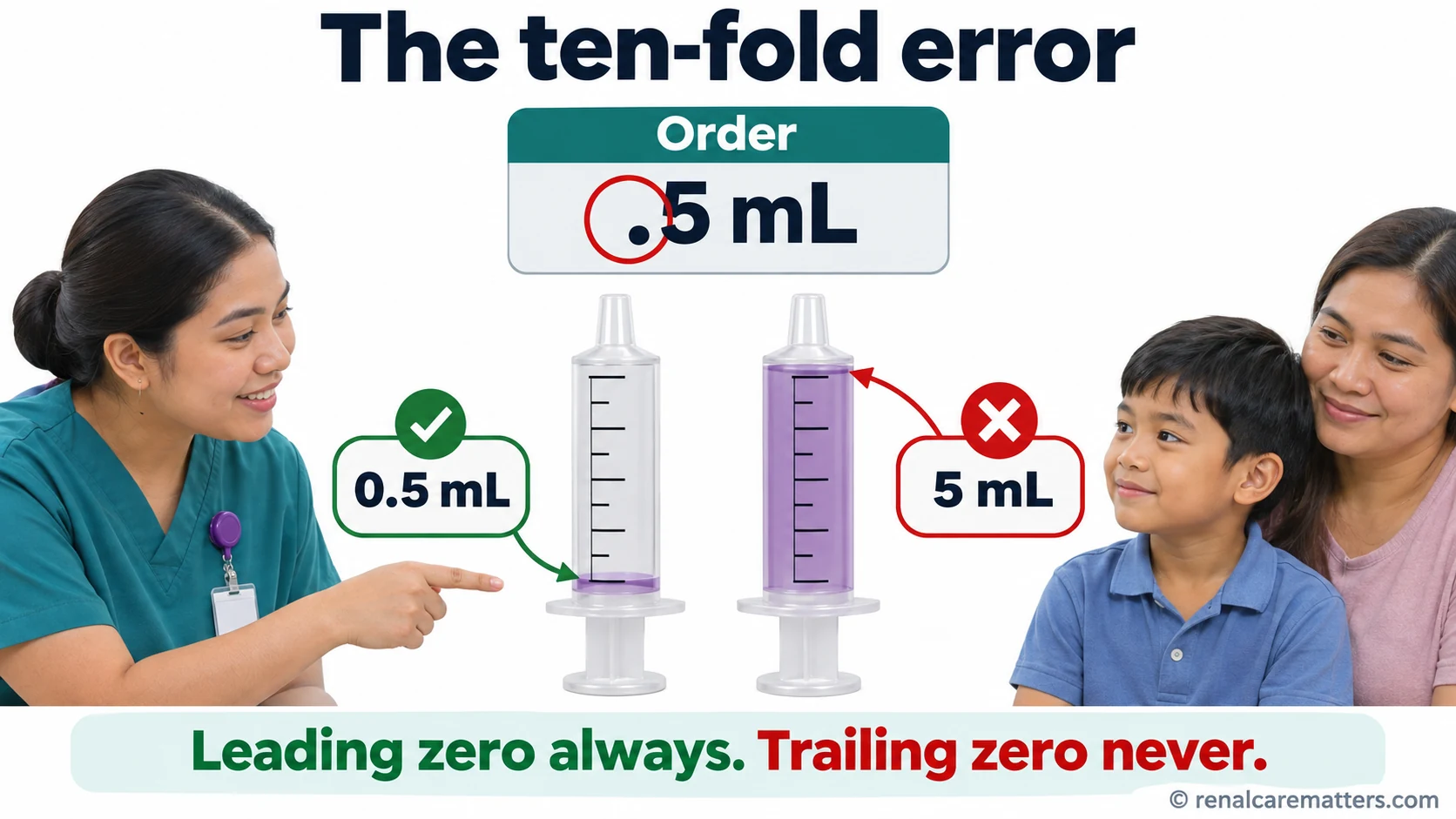
Figure 2. The ten-fold error. Weight-based doses create decimals, and decimals create ten-fold errors.
Error source
Example
Prevention
Naked decimal
“.5 mL” read as “5 mL”
Always a leading zero: 0.5 mL
Trailing zero
“5.0 mg” read as “50 mg”
Never a trailing zero: 5 mg
Unit confusion
mg versus mcg; mL versus mg
Write units in full where confusion is possible; order in mg, give in mL with the concentration stated
Changed concentration
A new brand or a compounded liquid
Recalculate the volume each time the bottle changes
Outdated weight
Dose based on last year’s weight
Confirm the weight used and when it was measured
RememberLeading zero always, trailing zero never, and recalculate every time the bottle changes.
Lesson · part 2
What dialysis removes
Dialysis removes drugs by the same physics that removes urea. A drug is likely to be removed when it is small, water-soluble, little bound to protein and mostly in the blood rather than the tissues. A drug that is large, highly protein-bound or widely distributed in tissues is removed little.
Drug property
Effect on removal by dialysis
Practical consequence
Small molecule, water-soluble
More removed
Often given after the session; a supplemental dose may be ordered
Highly protein-bound
Less removed
Timing around dialysis matters less
Large volume of distribution
Little in the blood to remove
Dialysis does not clear an overdose well
High-flux dialyzer or longer session
More removed than older low-flux dialysis
Older dosing references may underestimate loss
In peritoneal dialysis (PD), removal is slower and continuous, and some drugs are added to the dialysate on purpose, such as intraperitoneal antibiotics for peritonitis (Module 11). For timing, follow the order. When an order says “after dialysis” and the family gives it before, the child may lose part of the dose to the dialyzer. Ask the family what they actually do at home.
RememberSmall, water-soluble, unbound drugs are dialyzed. When the order says after dialysis, it means after.
Lesson · part 3
The checked dose
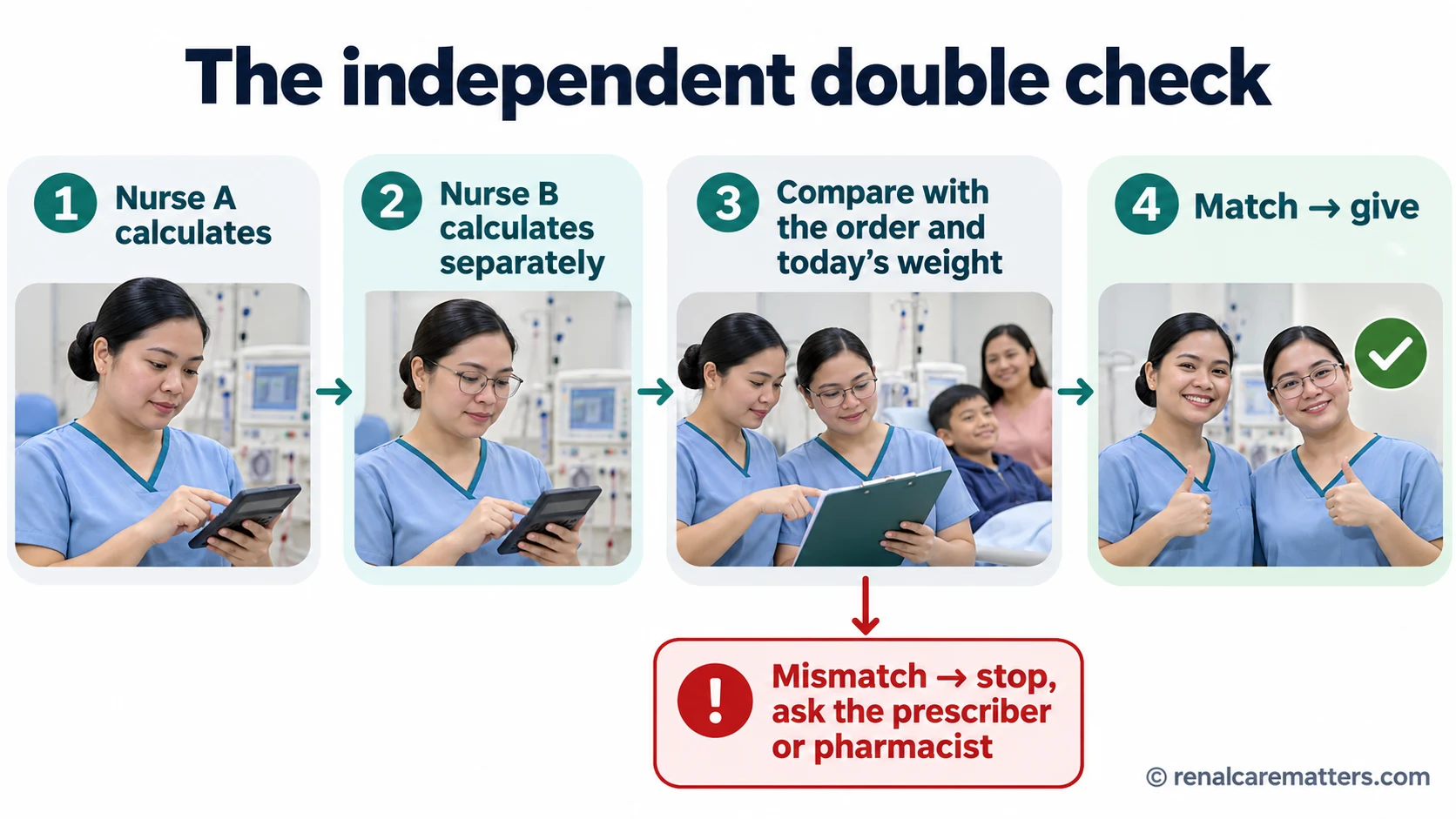
For high-alert medicines and for every calculated pediatric dose your unit lists, use an independent double check.
Figure 3. The independent double check. Two people calculating separately catch what one person checking another’s work misses.
Volume to give (mL) = ordered dose (mg) ÷ concentration (mg/mL) Check the dose per kg: ordered dose (mg) ÷ weight (kg) = mg/kg, compare with the order or pharmacy reference Example arithmetic only: 30 mg ordered, liquid 10 mg/mL → 3 mL; 30 mg ÷ 15 kg = 2 mg/kg
That example verifies arithmetic. It does not say 2 mg/kg is a right dose for any drug. If the per-kilogram dose differs from the order or the pharmacy label, stop and ask the prescriber or pharmacist. Body-surface-area doses use square meters; check which basis the order uses before you compare.
Give oral liquids with an oral syringe, never an injection syringe that could be connected to a line. Record vomiting within the time your unit specifies and ask whether to repeat; do not repeat a dose on your own.
On the floor · Dani and the “.5”
Dani will not give a dose written as “.5 mL” with a new concentration. She asks for the order in milligrams, checks Ella’s weight from today, calculates the volume from the new bottle, and asks a colleague to calculate separately. The two answers match the pharmacist’s label. The order says “after dialysis”, so she gives it after the session and teaches Ella’s mother the change.
Ask for the dose in milligrams, calculate from the bottle in your hand, and match the timing to the order.
Illustrative scenario. Names and details are invented.
RememberDose in milligrams, volume from the bottle in your hand, a second person calculating blind, and timing from the order.
On the floor
Real situations: problems and solutions
These are fictional but typical. For each one, cover the answer, decide what you would do, then compare. Where a step depends on local rules, your unit’s procedure and your supervisor’s direction come first.
The new bottle
What you see
A family’s medicine has a new brand with a different concentration.
What is likely going on
Same mg, different mL.
What to do
Recalculate the volume and teach the family the new amount; involve the pharmacist.
Why it matters
Concentration changes cause ten-fold errors.
Before or after?
What you see
A child’s antibiotic is ordered after dialysis but given before at home.
What is likely going on
Timing not taught or not practical.
What to do
Explain why, adjust the routine with the family, report to the prescriber.
Why it matters
The dialyzer may remove the dose.
The vomited dose
What you see
A child vomits ten minutes after a dose.
What is likely going on
Unclear whether to repeat.
What to do
Record and ask the prescriber; do not repeat on your own.
Why it matters
Repeats can overdose.
Field notes
Leading zero, no trailing zero.
Use oral syringes for oral liquids.
Case review
Back to the case: Point five or five
Unsafe order. A naked decimal (“.5”), a volume without a milligram dose, and a changed concentration together make a ten-fold error likely.
Verification. Order in milligrams with a leading zero; today’s weight; volume calculated from the new bottle; independent double check; comparison with the pharmacist’s label.
Timing. As ordered. If the order says after dialysis, give it after and teach the family why; if the order is silent, ask.
Skills lab · with your preceptor
Skills checklist: Medication verification
Use fictional orders and training liquids. Your preceptor rates each step as satisfactory, needs practice, or not observed. Steps marked Critical must all be satisfactory before sign-off. This checklist supports supervised learning; your unit’s own procedure and competency form are the authority. A printable version of every checklist is on the trainer page.
CriticalRejects an order with a naked decimal or trailing zero and requests correction
CriticalCalculates volume from the dose and the concentration in hand
CriticalPerforms an independent double check for a calculated pediatric dose
States whether a drug is likely to be dialyzed from its properties
Gives an oral liquid with an oral syringe and documents vomiting and the follow-up decision
Self-assessment
Check your understanding
Each visit draws 5 questions at random from this module’s 15-question bank. Choose the single best answer for each, then select Check answers; an explanation appears under the best answer. Select New set of questions for a different mix. A good target is 4 of 5 on two different sets. Nothing you select is sent anywhere; scoring happens in your browser.
Educational material for registered nurses. Completing it is an Academy learning record only. It does not confer CPD units, PSN or National Kidney and Transplant Institute (NKTI) training recognition, PhilHealth staffing credit, or clinical privileges, and it does not replace your facility’s protocols, device instructions, or written orders.