Nephrology Nursing specialty subtrack for pediatric dialysis
This module is study material for registered nurses in pediatric dialysis. It explains the reasoning behind common nursing decisions; it is not a procedure. Exact steps follow your unit’s pediatric protocol and the device instructions; treatment parameters follow the written order of the pediatric nephrologist. Nurses assess, verify, teach, document and escalate; they do not prescribe, choose antibiotics, change doses or adjust anticoagulation. Every case is fictional and every value in a case is illustrative. Pending review by a pediatric nephrologist and a senior pediatric dialysis nurse.
Learning objectives
After this module you should be able to
Obtain weights, heights and blood pressures that can be trusted, using the right scale, conditions and cuff.
Account for every fluid route in a child, including flushes, medicines and dialysis balance.
Calculate weight-based rates with units at every step, and verify them with an independent check.
Classify a child’s blood pressure by percentile and recognize when a reading does not fit the child.
Classroom 2 hSkills lab 2 hSupervised placement 4 h
Pre-testBefore you read, answer the 5 self-assessment questions and note your score. After the module, select New set of questions and compare. The difference is what you learned; the questions you still miss are what to reread.
Start here
The big picture, in plain words
In adult dialysis, a 200-gram error on the scale is noise. In a 10-kilogram child it is 2% of body weight. A decimal slip in a fluid order can be the whole difference between safe and dangerous. Pediatric dialysis rests on small numbers, so it rests on measurement and arithmetic.
Your work in this module is to make every number trustworthy before it reaches a decision: measured the same way each time, written with units, and checked by a second person who did not see your answer.
In plain wordsThink of a recipe scaled down from a restaurant to a single serving. A pinch of salt that disappears in a big pot ruins a small bowl. Every ingredient must be measured more carefully, not less, when the batch is small.
The picture has a limit. A recipe scales in proportion; a child does not. A child’s body surface area, blood volume and metabolic rate do not shrink at the same pace as weight. That is why some orders use kilograms and others use square meters, and why you must know which one an order uses.
Figure 1 · Key terms for this module
Target weightThe weight the nephrologist aims for after fluid removal, reviewed as the child grows.
Fluid balanceAll fluid in minus all fluid out over a stated period.
mL/kg/hVolume per kilogram of body weight per hour.
Body surface area (BSA)An estimate of skin area in square meters, from height and weight.
PercentileWhere a value sits among healthy children of the same age, sex and height.
Opening case · fictional
Case: 300 per hour
Kyla Ramos, 6, weighs 20 kilograms and is on acute peritoneal dialysis (PD) in a provincial hospital. The written order is net removal of 300 mL over 3 hours. The bedside worksheet, copied by a busy night nurse, reads “300 mL/hour”. Nurse Paolo takes over at 6 a.m. Kyla’s weight this morning is 20.6 kilograms on a different scale than yesterday’s.
Before reading on, decide:
What is the intended hourly removal, in mL/h and mL/kg/h?
Can Paolo continue with the worksheet as written?
Is today’s weight gain real?
Keep your answers in mind. The lesson gives you what you need, and the case review near the end shows one sound response.
Lesson · part 1
Making measurements trustworthy
A weight is only comparable to another weight taken the same way. Use the same calibrated scale, at the same point in the routine, with the same clothing or a dry diaper, and note whether the abdomen contains dialysate. A child with 600 mL of PD fluid in the abdomen weighs 0.6 kilograms more than the same child drained.
Measurement
Do
Common error
Weight
Same scale, same time, minimal clothing; infants nude or dry diaper; record PD fluid in or out
Different scale; wet diaper; full abdomen not recorded
Height or length
Length board under 2 years; stadiometer, shoes off, heels to the wall after
Tape measure on a moving child
Blood pressure
Right cuff, child seated and calm, same arm (not the fistula arm), repeat if high
Cuff too small reads falsely high
Temperature, heart rate, breathing
Compare with the child’s own baseline and age norms
Reading one value without the trend
The target weight is not permanent. A growing child gains lean tissue, so a target weight that does not rise can slowly dehydrate the child. Report steady weight below target together with symptoms, and report a target that has not been reviewed in months.
RememberA weight means nothing without its conditions. Same scale, same time, same clothing, abdomen full or empty recorded.
Lesson · part 2
Every route counts
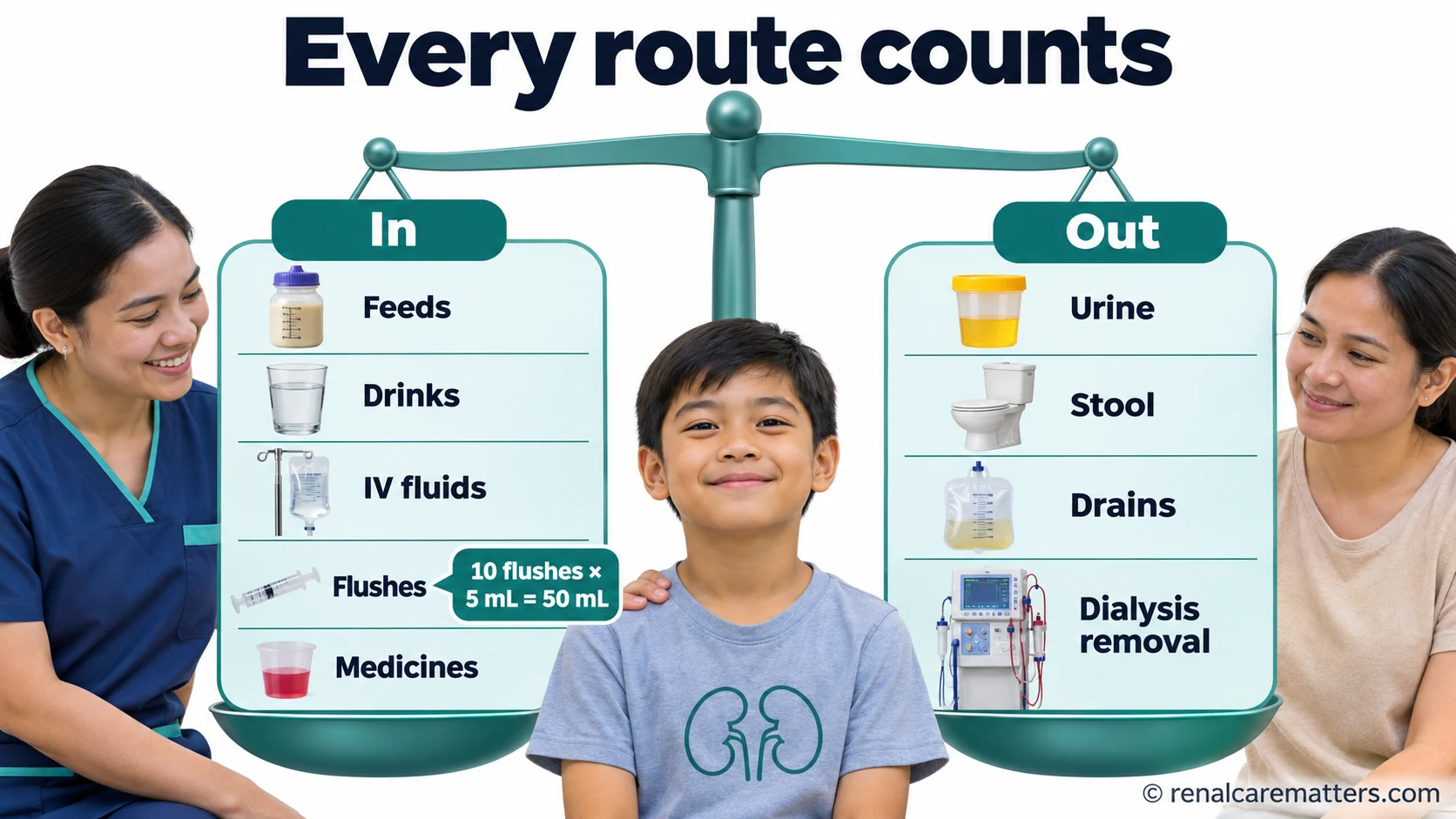
In a small child, the “hidden” fluids can be a large share of the day. Intravenous line flushes, medicine diluents and feed water add up. A 10-kilogram child who receives ten 5 mL flushes a day has received 50 mL, about 5 mL per kilogram, before any drink.
Figure 2. Every route counts. Flushes and medicines can be a large share of a small child’s daily intake.
Distinguish two balances. Body fluid balance counts everything in and out of the child. Dialysis balance counts only what the dialysis removed or added. For PD, net removal for a completed exchange is drained volume minus instilled volume, recorded separately from the initial drain. Confirm whether a cycler’s displayed total includes the initial drain or the last fill before you write it down.
Insensible losses are larger in proportion in small children, and fever or fast breathing increases them. Maintenance fluid estimates such as the Holliday–Segar method are planning tools for the prescriber, not targets for the nurse.
RememberCount the flushes and the medicines. In a small child they can be a meal’s worth of water.
Lesson · part 3
Arithmetic with units
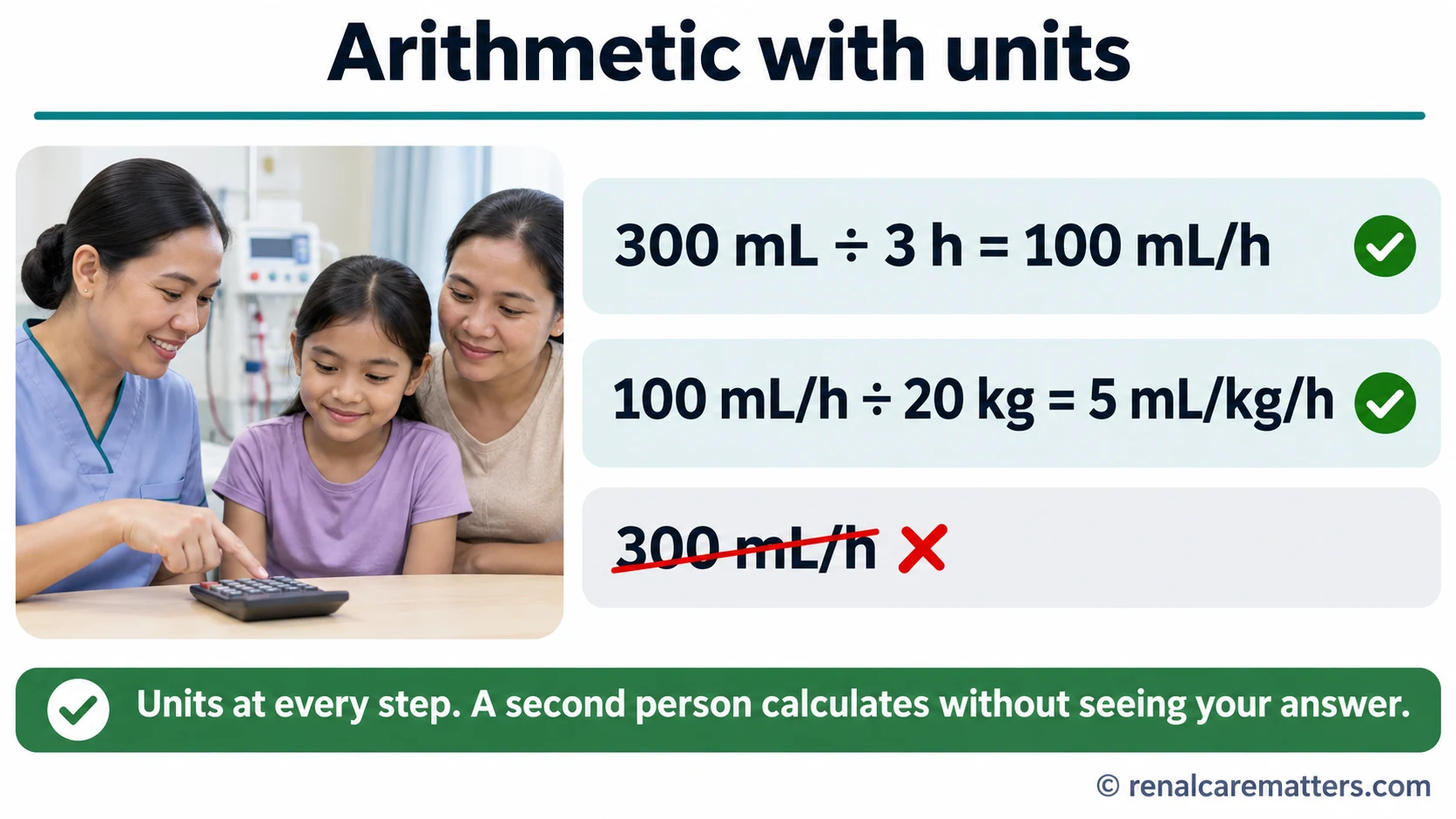
Write the units at every step. Units that do not cancel tell you a step is wrong before the child pays for it.
Figure 3. Arithmetic with units. Write the units at every step, then have a second person check without seeing your answer.
Hourly removal = total volume ÷ hours Weight-based rate = hourly removal ÷ weight (kg) Example: 300 mL ÷ 3 h = 100 mL/h; 100 mL/h ÷ 20 kg = 5 mL/kg/h
That arithmetic verifies an order. It does not tell you the order is clinically right. A safe removal rate depends on the child’s blood pressure, blood volume, symptoms and the nephrologist’s goal. Never infer a safe rate from arithmetic alone.
The independent check
The second person calculates from the order and the weight without seeing your answer. Then you compare. A second person who only reads your number and nods tends to agree with it, including its errors.
On the floor · 6:05 a.m., the handover
Paolo reads the order, then the worksheet. 300 mL over 3 hours is 100 mL per hour, 5 mL/kg per hour. The worksheet says 300 mL per hour, three times the order. He stops the cycler program change, asks a colleague to calculate separately, gets 100 mL/h, and calls the nephrologist to confirm the order and the machine entry.
A mismatch between order, worksheet and machine is a stop sign, not a rounding issue.
Illustrative scenario. Names and details are invented.
RememberUnits at every step, a second person calculating blind, and a stop whenever order, worksheet and machine disagree.
Lesson · part 4
Blood pressure in children
A child’s normal blood pressure depends on age, sex and height. The 2017 American Academy of Pediatrics (AAP) guideline classifies children under 13 years by percentile (elevated from the 90th, stage 1 hypertension from the 95th) and uses fixed values from age 13, aligned with adult categories (stage 1 from 130/80 mmHg).1 For children with chronic kidney disease (CKD), it suggests a treatment goal of a 24-hour mean arterial pressure below the 50th percentile on ambulatory monitoring.
Use a cuff whose bladder width is at least 40% of the arm’s circumference and whose length covers 80% to 100% of it. A cuff that is too small reads falsely high, which can lead to unnecessary fluid removal. Low blood pressure in a child is often a late sign of shock, because children compensate with heart rate first; see Module 15.
RememberInterpret a child’s blood pressure against age, sex and height, with the right cuff, and always beside the heart rate.
On the floor
Real situations: problems and solutions
These are fictional but typical. For each one, cover the answer, decide what you would do, then compare. Where a step depends on local rules, your unit’s procedure and your supervisor’s direction come first.
The heavier Monday
What you see
A child weighs 0.5 kg more than expected on a new scale.
What is likely going on
Different scale or clothing, not necessarily fluid.
What to do
Reweigh on the usual scale with standard clothing and record PD fill state.
Why it matters
Only comparable weights guide removal.
The tiny cuff
What you see
A blood pressure of 150/95 in a 7-year-old with an adult small cuff on a thin arm.
What is likely going on
Wrong cuff size or technique.
What to do
Measure arm circumference, choose the right cuff, repeat calm, compare with percentiles.
Why it matters
False highs lead to unnecessary fluid removal.
The copied decimal
What you see
A transcribed rate reads 30 mL/kg/h instead of 3.
What is likely going on
Copying error.
What to do
Stop, calculate from the source order, independent check, confirm with prescriber.
Why it matters
Ten-fold errors start in copying.
Field notes
Write units at every step.
Count flushes as intake.
Case review
Back to the case: 300 per hour
The arithmetic. 300 mL ÷ 3 h = 100 mL/h; ÷ 20 kg = 5 mL/kg/h. The worksheet’s 300 mL/h is three times the order.
Continue? No. Paolo stops at the mismatch, obtains an independent calculation, and has the nephrologist confirm the order and the machine entry before any change. He documents the discrepancy and files an incident report so the copying step can be fixed.
The weight. A 0.6 kg rise on a different scale is uninterpretable until he reweighs on yesterday’s scale, with the abdomen’s fill state recorded. If the gain is real, he reports it with the balance and blood pressure.
Skills lab · with your preceptor
Skills checklist: Measurement and arithmetic
Use models and fictional charts first. Your preceptor rates each step as satisfactory, needs practice, or not observed. Steps marked Critical must all be satisfactory before sign-off. This checklist supports supervised learning; your unit’s own procedure and competency form are the authority. A printable version of every checklist is on the trainer page.
CriticalWeighs a child under standard conditions and records clothing and PD fill state
Selects a cuff by arm circumference and repeats a high reading
Reconciles a 24-hour intake and output sheet including flushes and medicine volumes
CriticalCalculates mL/h and mL/kg/h with units and an independent blind check
CriticalStops and escalates when order, worksheet and machine entry disagree
Placement activity. Audit three real pediatric charts (de-identified) for scale, clothing and fill-state documentation; report gaps to your preceptor.
Self-assessment
Check your understanding
Each visit draws 5 questions at random from this module’s 15-question bank. Choose the single best answer for each, then select Check answers; an explanation appears under the best answer. Select New set of questions for a different mix. A good target is 4 of 5 on two different sets. Nothing you select is sent anywhere; scoring happens in your browser.
Flynn, J. T., Kaelber, D. C., Baker-Smith, C. M., Blowey, D., Carroll, A. E., Daniels, S. R., de Ferranti, S. D., Dionne, J. M., Falkner, B., Flinn, S. K., Gidding, S. S., Goodwin, C., Leu, M. G., Powers, M. E., Rea, C., Samuels, J., Simasek, M., Thaker, V. V., Urbina, E. M., & Subcommittee on Screening and Management of High Blood Pressure in Children. (2017). Clinical practice guideline for screening and management of high blood pressure in children and adolescents. Pediatrics, 140(3), e20171904. https://doi.org/10.1542/peds.2017-1904
Educational material for registered nurses. Completing it is an Academy learning record only. It does not confer CPD units, PSN or National Kidney and Transplant Institute (NKTI) training recognition, PhilHealth staffing credit, or clinical privileges, and it does not replace your facility’s protocols, device instructions, or written orders.