The worn cane
- What you see
- A cane’s rubber tip is smooth.
- What is likely going on
- A slip hazard.
- What to do
- Replace the tip; check height.
- Why it matters
- A cheap fix prevents falls.
Why people on dialysis fall after sessions, fracture more, and fear walking, and how to make transfers and walking safe.

Study material for licensed occupational therapists (RA 11241) and physical therapists (RA 5680) working with people who have kidney disease. It explains the reasoning behind renal rehabilitation; it is not a hospital protocol. It never authorizes changes to dialysis settings, handling of a needled access or catheter, medicine decisions or benefit promises. Exercise parameters come from the referring physician and your unit’s agreed sheet: per unit protocol, but always ask the attending nephrologist’s guidance. Every case, name and number in the cases is fictional and illustrative.
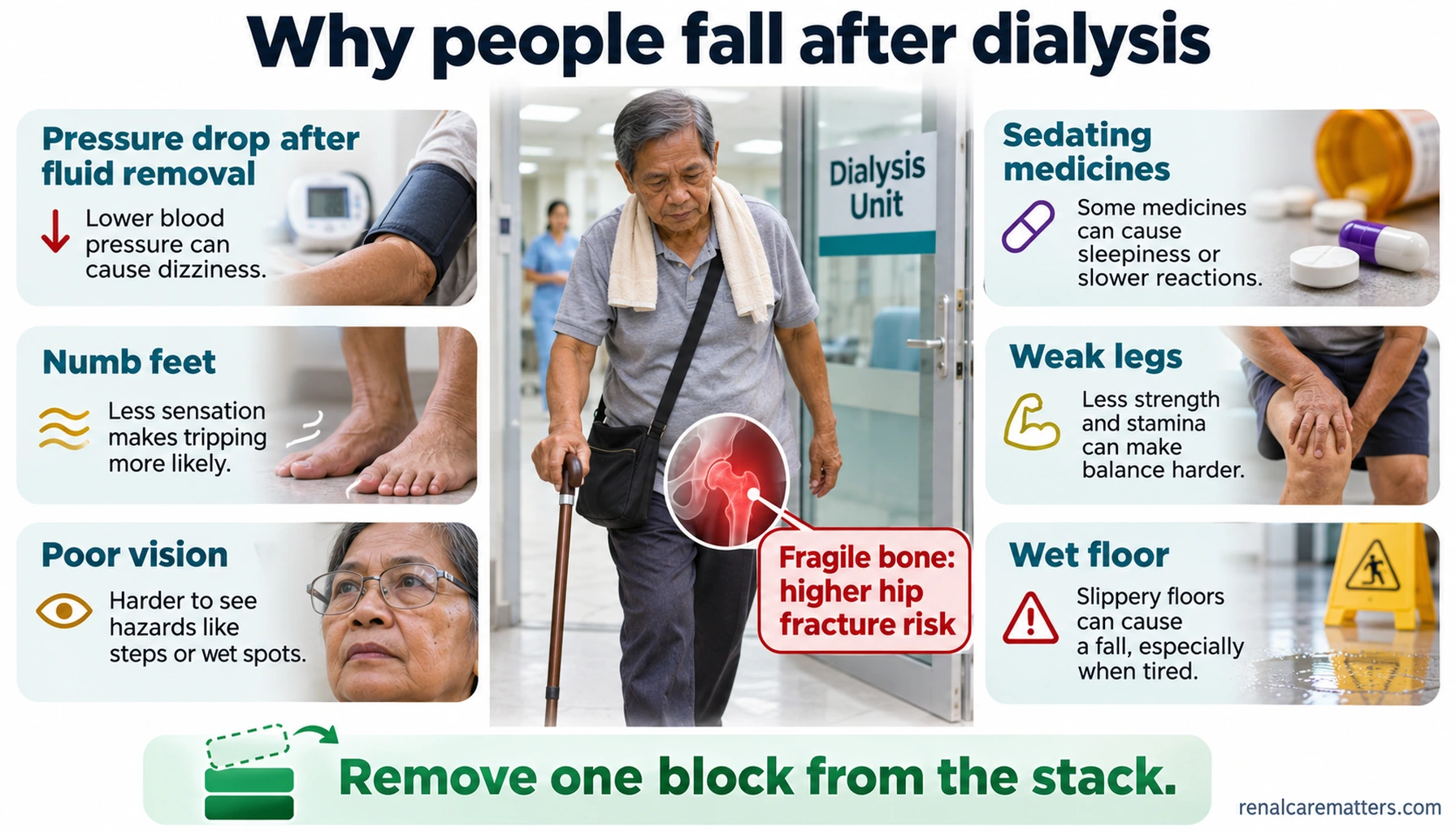
The picture has a limit. Some blocks are heavier than others, and some cannot be removed, only padded. Fragile bone cannot be fixed by you, but you can make a fall less likely and less harmful. The work is to find the blocks in this person’s stack and remove or pad as many as you can.
Falls are common and costly in this population. In a prospective study of 162 people aged 65 and older on hemodialysis, followed for at least a year, 47 percent fell, at a rate of 1.60 falls per person-year, roughly twice published rates for older people in the community; 19 percent of falls caused injury. Falls were associated with age, comorbidity, pre-dialysis systolic pressure and a history of falls.1 And when a person on dialysis falls, the bone is weaker: the relative risk of hip fracture in a large United States dialysis population was about 4.4 times that of the general population.2
Figure 2 · Key terms for this module
Wednesday, 11:50 a.m. Mrs. Felicidad Torres, 76, finishes hemodialysis with 2.5 kilograms removed. Walking toward the exit with her cane, she sways, grabs the door frame and sits down hard on a waiting-room bench. She does not hit the floor. “I’m fine,” she says. “It always happens. My tricycle is waiting.”
Her chart lists diabetic neuropathy, cataracts, a vertebral fracture two years ago, and a new prescription of amlodipine. Her cane is set too high and the rubber tip is worn smooth. She tells physical therapist (PT) Carlo Dizon she has “stopped going to the market because of my legs.”
Before reading on, decide:
Keep your answers in mind. The lesson gives you what you need, and the case review near the end shows one sound response.
| Block | Mechanism | What you do |
|---|---|---|
| Blood pressure falls after dialysis | Fluid removal, weak reflexes, antihypertensives (Module 3) | Sit, then stand slowly; check symptoms; report patterns to the nurse |
| Neuropathy | Lost sensation and position sense in the feet | Balance training, good footwear, light, a walking aid |
| Weak legs | Sarcopenia and deconditioning (Module 2) | Strength training (Module 9) |
| Vision | Diabetic eye disease, cataracts | Glasses on, light on, contrast on steps; refer |
| Medicines | Sedatives, some antihypertensives, hypoglycemia from diabetes medicines | Report to the physician and pharmacist; do not change |
| Environment | Wet floors, steps without rails, poor light, loose mats | Home and unit assessment (Module 15) |
| Fear of falling | Less activity, more weakness, more falls | Graded confidence-building practice |
Start with history: falls and near falls in the past year, when they happen (dialysis days?), what the person was doing, and injuries. Then observe.
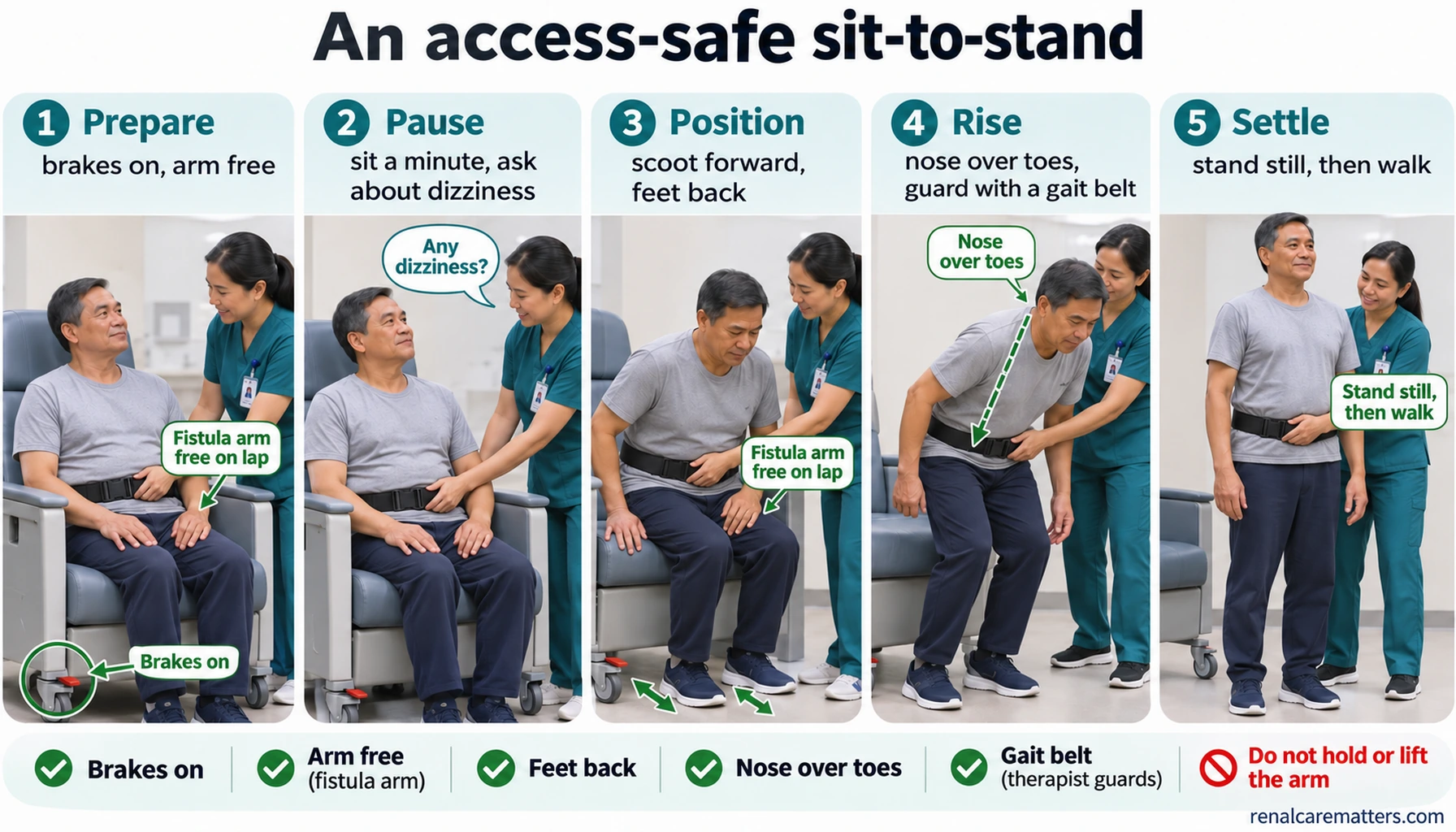
Most falls in a dialysis unit happen getting up or setting off. Teach the patient, the family and the staff the same sequence.
Figure 4 · An access-safe sit-to-stand
For a person who cannot bear weight safely, use the team’s plan: a transfer board, more helpers, or a mechanical lift. Never lift a person alone and never pull on the fistula arm or on dialysis lines.
Falls prevention works best when several blocks are addressed at once and the plan is shared.
These are fictional but typical. For each one, cover the answer, decide what you would do, then compare. Where a step depends on local rules, your unit’s procedure and your supervisor’s direction come first.
Before she leaves. Carlo sits with her, asks about dizziness, chest symptoms and whether she hit anything, and calls the nurse to check her blood pressure and assess her before she goes. She waits until she is steady. Carlo or the nurse walks her to the tricycle with a gait belt, and the near fall is documented and reported, with an incident report if the unit requires one.
Removable blocks. Post-dialysis pressure drop and the new amlodipine go to the nurse and nephrologist. The cane height and worn tip are Carlo’s to fix today. Neuropathy and weak legs call for balance and strength training. Cataracts call for an eye referral through her physician. Fragile bone (the earlier vertebral fracture) goes to the nephrologist for bone-health review. Fear of falling and stopping the market are shared OT and PT targets.
Next session. On a non-dialysis day: falls history, orthostatic check, TUG, gait and balance tests, footwear, and an OT discussion of the market trip and home bathroom.
Assess fall risk and teach an access-safe transfer to a simulated patient after dialysis. Your preceptor rates each step as satisfactory, needs practice, or not observed. Steps marked Critical must all be satisfactory before sign-off. This checklist supports supervised learning; your unit’s own procedure and competency form are the authority. A printable version of every checklist is on the trainer page.
Each visit draws 5 questions at random from this module’s 10-question bank. Choose the single best answer for each, then select Check answers; an explanation appears under the best answer. Select New set of questions for a different mix. A good target is 4 of 5 on two different sets. Nothing you select is sent anywhere; scoring happens in your browser.

Internal Medicine · Nephrology · Nutrition · Philippines · PRC 0105184
Educational material for licensed occupational and physical therapists. Completing it is an Academy learning record only. It is not a PRC, DOH, PhilHealth or PSN credential, not CPD units, and not a workplace privilege. Your license, your referral or prescription, your employer’s privileges and the renal team’s plan govern what you may do.

Scan and save