Support Self-Care, Cognition and Treatment Routines
Cognitive impairment that nobody has diagnosed, health literacy, and routines for medicines, fluids and daily care that survive a tired day.
PublishedNailathalaGipatikPepalwal:ReferencesMga SanggunianMga TinubdanReng Reperensya:2Audience: Philippine-registered occupational therapists and physical therapists who see people with kidney disease · rehabilitation leads, physiatrists and renal teams who refer to them · students on an observer pathwayRead timeOras ng pagbasaOras sa pagbasaOras ning pamamasa:
Renal rehabilitation track for licensed occupational and physical therapists
Study material for licensed occupational therapists (RA 11241) and physical therapists (RA 5680) working with people who have kidney disease. It explains the reasoning behind renal rehabilitation; it is not a hospital protocol. It never authorizes changes to dialysis settings, handling of a needled access or catheter, medicine decisions or benefit promises. Exercise parameters come from the referring physician and your unit’s agreed sheet: per unit protocol, but always ask the attending nephrologist’s guidance. Every case, name and number in the cases is fictional and illustrative.
Learning objectives
After this module you should be able to
Explain why cognitive impairment is common and often unrecognized in people on hemodialysis.
Recognize how executive dysfunction and low health literacy show up in daily tasks and treatment routines.
Observe a self-care or treatment routine and identify where it breaks down.
Design routine supports (cues, simplification, caregiver roles) and confirm learning with teach-back.
Know where your role ends: technical dialysis and medicine decisions belong to the nurse, pharmacist and physician.
Classroom 2 hSkills lab 2 hSupervised placement 1 h
Pre-testBefore you read, answer the 5 self-assessment questions and note your score. After the module, select New set of questions and compare. The difference is what you learned; the questions you still miss are what to reread.
Start here
The big picture, in plain words
In plain wordsA treatment routine is like a recipe with twenty steps. Most people can follow a recipe they know by heart. Ask them to follow a new, complicated one while tired, distracted and with half the light off, and steps get skipped, not from carelessness but because the brain doing the work is overloaded.
The picture has a limit. A recipe failure costs a meal. A routine failure in kidney failure can cost a hospital stay: a missed phosphate binder, three liters of fluid on a hot weekend, a skipped session. And the overload is often not just tiredness. Many people on dialysis have a measurable problem with memory and especially with planning and organizing, the executive functions that run a routine.
In a study of 338 people aged 55 and older on hemodialysis, only 12.7 percent had normal cognition; 36.1 percent had moderate and 37.3 percent severe impairment on testing, yet only 2.9 percent had any documented history of cognitive impairment.1 The study was cross-sectional and from one American region, but the message travels: assume nothing, observe the task.
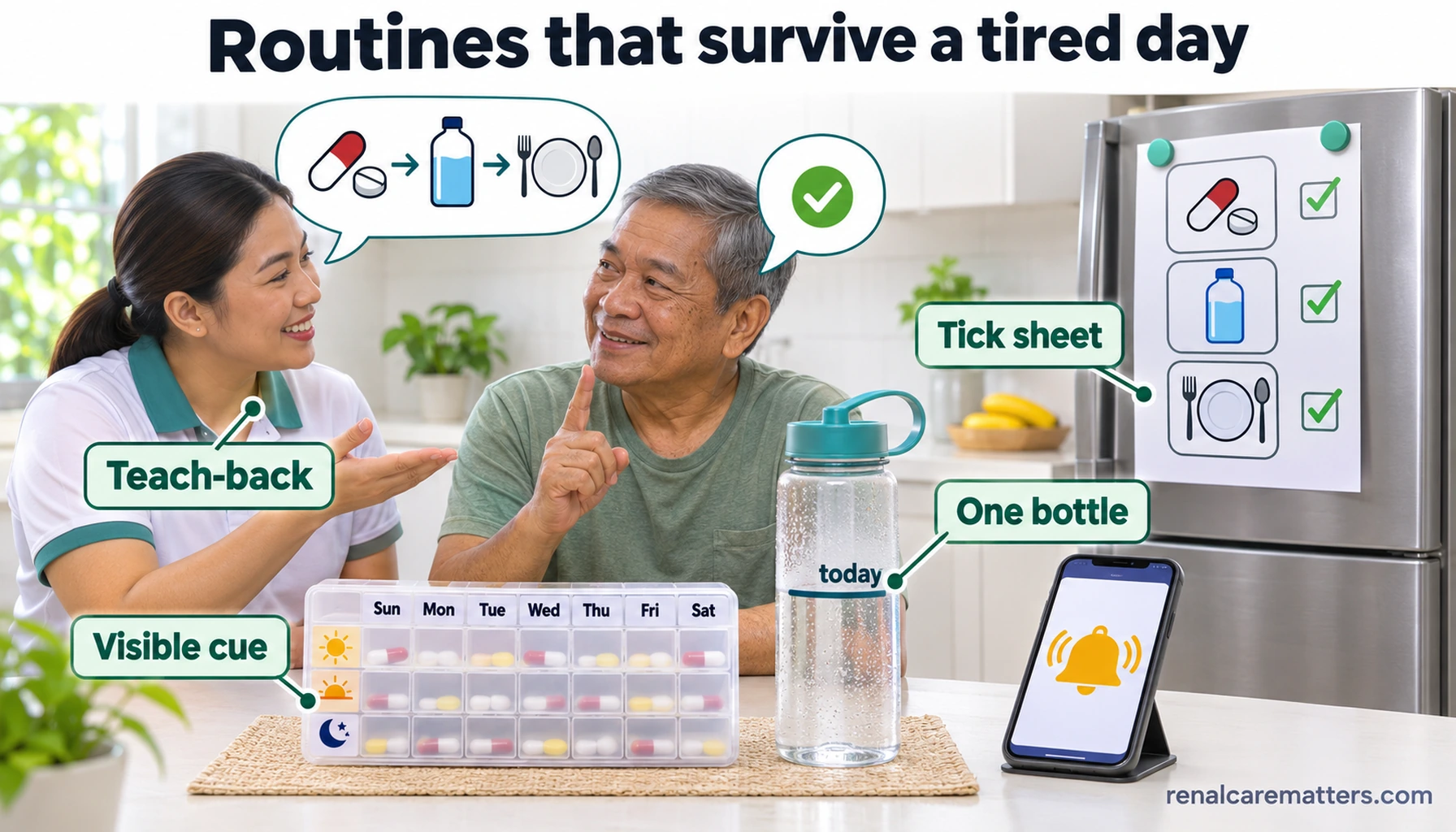
Figure 1. Routines that survive a tired day: fewer steps, visible cues, the same place every time.
Figure 2 · Key terms for this module
Executive functionPlanning, organizing, starting, switching and checking tasks.
Health literacyThe ability to find, understand and use health information.
Teach-backThe person explains or shows what they will do, in their own words.
CueA visible or audible prompt that triggers a step.
Routine scaffoldChanges to a task that reduce how much memory and planning it needs.
Opening case · fictional
Case: The full pillbox
Tuesday, 10:30 a.m. Mr. Romualdo Garcia, 69, a retired school principal, has been on hemodialysis for eight months. His nurse reports high phosphate and large weight gains between sessions. “He understands everything we tell him,” she says. “He can explain it better than I can.”
At home, occupational therapist (OT) Bea Santiago finds a weekly pillbox that is still full on Thursday, three fluid charts started and abandoned, and a stack of unopened hospital leaflets. His daughter Mylene, who works long shifts at a call center, says: “He was so organized before. Now he forgets whether he took his medicines, and he drinks whenever he talks.”
Before reading on, decide:
Why might a man who explains his treatment well still fail to follow it?
What would you observe, and how?
What changes would you propose, and what is outside your role?
Keep your answers in mind. The lesson gives you what you need, and the case review near the end shows one sound response.
Lesson · part 1
The kidney–brain connection
Several mechanisms combine. Retained uremic toxins affect brain cells and neurotransmitters. Small-vessel disease from hypertension and diabetes damages the white matter that connects brain regions, and white-matter damage hits executive function and processing speed first. Anemia lowers oxygen delivery. During and after a session, rapid shifts in fluid and blood pressure may briefly reduce blood flow to the brain, and many patients are slower and more forgetful in the hours after dialysis. Sleep problems and depression add their own fog.
The practical consequences for you are three. Verbal knowledge can be preserved while doing fails, so a person who explains the routine perfectly may still be unable to run it. Teaching straight after a session often does not stick. And because impairment is usually undiagnosed, you should screen with the team’s chosen tool (the site’s cognitive screen calculator is one) and observe real tasks rather than rely on conversation.
RememberKnowing is not doing. Watch the routine, at the time and place it really happens.
Lesson · part 2
Health literacy and the treatment burden
A person on hemodialysis may be asked to manage a fluid limit, a potassium and phosphate diet, several medicines at different times (some only with meals), access care, three sessions a week and transport to them. That is a heavy cognitive load for anyone. In a United States cohort of 480 people starting hemodialysis, 32 percent had limited health literacy, which was associated with higher mortality (hazard ratio 1.54) after adjustment.2 The association does not prove that literacy itself causes death, but it shows who is at risk of falling through the cracks.
Plain language, fewer messages at a time, and pictures help. So does teach-back: ask the person to show or tell you, in their own words, what they will do tomorrow morning. If they cannot, the problem is your explanation or the routine’s design, not the patient.
RememberTeach one thing at a time, confirm it with teach-back, and write it where the task happens.
Lesson · part 3
Task analysis and routine scaffolds
The OT’s core move is to observe the task, step by step, in its real setting, and find where it breaks. For a medicine routine, that means watching the person fill the pillbox, take the morning dose, and decide whether they took it. For fluids, it means watching a day of drinking: the glasses, the soup, the coffee with visitors.
Where it breaks
Scaffold
Starting the task (no trigger)
Link it to an existing habit (after brushing teeth), phone alarm, visible cue
Remembering whether it was done
Blister or pillbox with day and time, tick sheet on the refrigerator
Too many steps
Ask the pharmacist and physician whether doses can be simplified; group times
Fluid tracking
One marked bottle holding the day’s allowance; smaller cups; ice chips
Information overload
One-page, large-print plan with pictures; remove old leaflets
Caregiver availability
A short, specific role for the caregiver (a nightly check) rather than “help him”
Medicine timing and doses are not yours to change. You can ask the pharmacist and physician whether a regimen can be simplified, and you can design how the person carries it out. Technical dialysis tasks at home (for example, peritoneal dialysis exchanges) are taught and signed off by the home dialysis nurse; you support the routine around them (Module 11).
RememberRedesign the routine so it needs less memory, not more effort.
On the floor
Real situations: problems and solutions
These are fictional but typical. For each one, cover the answer, decide what you would do, then compare. Where a step depends on local rules, your unit’s procedure and your supervisor’s direction come first.
The perfect explanation
What you see
A patient explains his medicines perfectly but his pillbox is full on Thursday.
What is likely going on
Preserved knowledge, impaired executive function.
What to do
Observe the routine; add cues and simplify.
Why it matters
Knowing is not doing.
The leaflet pile
What you see
A home has a stack of unopened hospital leaflets.
What is likely going on
Information overload.
What to do
Replace with a one-page picture plan; teach-back.
Why it matters
Less information, better used, is safer.
Teaching after the session
What you see
Teaching is always done in the last 10 minutes of dialysis.
What is likely going on
Post-dialysis cognitive dip.
What to do
Teach on non-dialysis days or early in the session.
Why it matters
Learning sticks better when the brain is fresh.
Field notes
Use teach-back every time.
Teach one thing per session.
Give caregivers one specific task.
Never change a medicine or fluid target.
Case review
Back to the case: The full pillbox
Why explaining is not doing. Mr. Garcia’s verbal knowledge is preserved, but his executive function (starting, sequencing and checking tasks) may be impaired, as it is in many people on hemodialysis. Teaching sessions in the unit test what he knows, not what he does at home on a tired afternoon.
What Bea observes. A cognitive screen agreed with the team; then a real morning: filling and using the pillbox, a day’s drinking, and where the leaflets end up. She times the observation for a non-dialysis morning and repeats one element on a dialysis afternoon to see the difference.
Changes, and limits. Pre-filled day-and-time pillbox filled weekly with Mylene; a phone alarm linked to breakfast; a tick sheet on the refrigerator; one marked 1-liter bottle for the day’s drinking; a one-page picture plan replacing the leaflets; and Mylene’s specific role as a nightly two-minute check. Bea reports the suspected cognitive impairment and the fluid pattern to the nurse and nephrologist, and asks the pharmacist whether doses can be grouped. She does not change medicines, fluid targets or binder timing herself.
Skills lab · with your preceptor
Skills checklist: Routine observation and teach-back
Observe a simulated medicine or fluid routine, propose scaffolds and confirm learning with teach-back. Your preceptor rates each step as satisfactory, needs practice, or not observed. Steps marked Critical must all be satisfactory before sign-off. This checklist supports supervised learning; your unit’s own procedure and competency form are the authority. A printable version of every checklist is on the trainer page.
Explains why preserved verbal knowledge does not rule out executive dysfunction.
Uses the team’s cognitive screening tool or reviews its result, and reports concerns.
Observes the task step by step in a realistic setting and identifies the failure points.
Proposes scaffolds that reduce memory and planning load.
CriticalDoes not change any medicine, dose, timing or fluid target; routes those questions.
CriticalUses teach-back and revises the explanation when the person cannot teach it back.
Agrees a specific caregiver role with the person’s consent.
Placement activity. Observe one real routine in a patient’s home or simulated kitchen, and present the failure points and scaffolds to your preceptor.
Self-assessment
Check your understanding
Each visit draws 5 questions at random from this module’s 10-question bank. Choose the single best answer for each, then select Check answers; an explanation appears under the best answer. Select New set of questions for a different mix. A good target is 4 of 5 on two different sets. Nothing you select is sent anywhere; scoring happens in your browser.
Murray, A. M., Tupper, D. E., Knopman, D. S., Gilbertson, D. T., Pederson, S. L., Li, S., Smith, G. E., Hochhalter, A. K., Collins, A. J., & Kane, R. L. (2006). Cognitive impairment in hemodialysis patients is common. Neurology, 67(2), 216–223. https://doi.org/10.1212/01.wnl.0000225182.15532.40
Cavanaugh, K. L., Wingard, R. L., Hakim, R. M., Eden, S., Shintani, A., Wallston, K. A., Huizinga, M. M., Elasy, T. A., Rothman, R. L., & Ikizler, T. A. (2010). Low health literacy associates with increased mortality in ESRD. Journal of the American Society of Nephrology, 21(11), 1979–1985. https://doi.org/10.1681/ASN.2009111163
Educational material for licensed occupational and physical therapists. Completing it is an Academy learning record only. It is not a PRC, DOH, PhilHealth or PSN credential, not CPD units, and not a workplace privilege. Your license, your referral or prescription, your employer’s privileges and the renal team’s plan govern what you may do.