Design and Progress an Individualized Exercise Plan
What training does to uremic muscle and heart, FITT-VP in kidney failure, effort-based intensity, and progression that survives a dialysis week.
PublishedNailathalaGipatikPepalwal:ReferencesMga SanggunianMga TinubdanReng Reperensya:3Audience: Philippine-registered occupational therapists and physical therapists who see people with kidney disease · rehabilitation leads, physiatrists and renal teams who refer to them · students on an observer pathwayRead timeOras ng pagbasaOras sa pagbasaOras ning pamamasa:
Renal rehabilitation track for licensed occupational and physical therapists
Study material for licensed occupational therapists (RA 11241) and physical therapists (RA 5680) working with people who have kidney disease. It explains the reasoning behind renal rehabilitation; it is not a hospital protocol. It never authorizes changes to dialysis settings, handling of a needled access or catheter, medicine decisions or benefit promises. Exercise parameters come from the referring physician and your unit’s agreed sheet: per unit protocol, but always ask the attending nephrologist’s guidance. Every case, name and number in the cases is fictional and illustrative.
Learning objectives
After this module you should be able to
Explain what aerobic and resistance training change in uremic muscle and the cardiovascular system, and on what time scale.
State the Kidney Disease: Improving Global Outcomes (KDIGO) 2024 physical activity recommendation and its grade, and what the trial evidence shows.
Write an individualized prescription using frequency, intensity, time, type, volume and progression (FITT-VP), with intensity set by effort rather than heart rate when appropriate.
Progress the plan safely around the dialysis week and adjust it after missed sessions or illness.
Identify when exercise must be paused and the plan reviewed by the physician.
Classroom 2 hSkills lab 2 hSupervised placement 1 h
Pre-testBefore you read, answer the 5 self-assessment questions and note your score. After the module, select New set of questions and compare. The difference is what you learned; the questions you still miss are what to reread.
Start here
The big picture, in plain words
In plain wordsMuscle is like a savings account that pays interest only if you keep making deposits. Each session is a small deposit. Skip deposits and the balance drains, faster in kidney failure than in health. Deposit too much at once and you can overdraw, with soreness, exhaustion or injury.
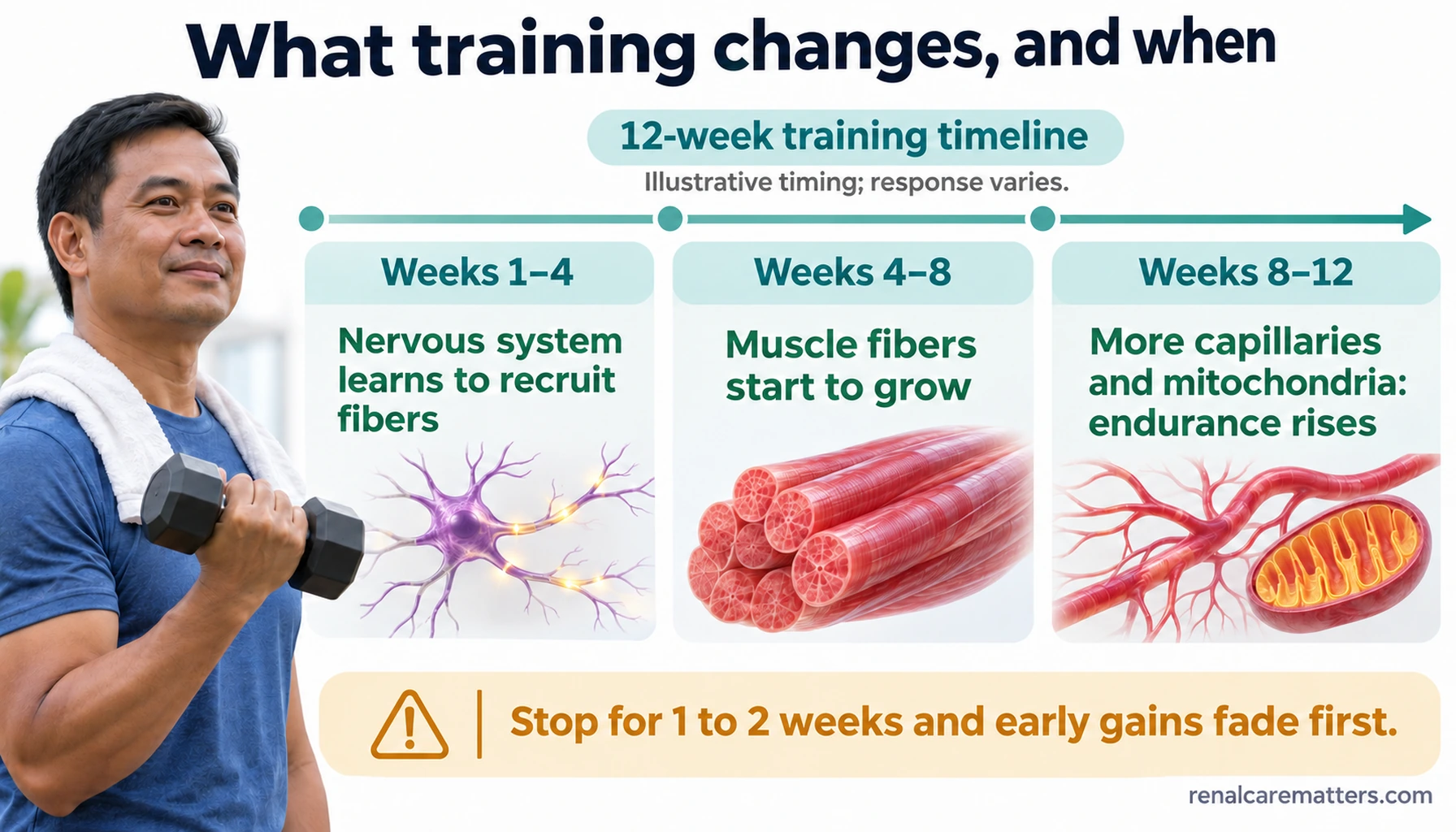
The picture has a limit. Interest is not paid at once. In the first few weeks of strength training, most of the gain comes from the nervous system learning to recruit more muscle fibers; actual muscle growth follows over weeks to months. Endurance improves as muscle grows more capillaries and mitochondria and the heart pumps more per beat. So early gains are real but fragile, and the plan must last long enough for the slower changes to arrive.
Figure 1. What training changes, and when. Early gains are mostly nervous system; muscle growth comes later.
The Kidney Disease: Improving Global Outcomes (KDIGO) 2024 guideline recommends that people with chronic kidney disease (CKD) be advised to undertake moderate-intensity physical activity for a cumulative duration of at least 150 minutes per week, or to a level compatible with their cardiovascular and physical tolerance. It is graded 1D: a strong recommendation built on very low-certainty evidence.1 The strength reflects the low risk and the broad benefits of activity in the general population; the low certainty reflects how little CKD-specific outcome data exist. The UK Kidney Association’s guideline also supports combined aerobic and resistance exercise across CKD, dialysis and transplantation.2
Figure 2 · Key terms for this module
FITT-VPFrequency, intensity, time, type, volume and progression.
Rating of perceived exertion (RPE)How hard the work feels, on the 6 to 20 Borg scale; 12 to 14 is “somewhat hard.”
Resistance trainingWork against a load (body weight, bands, weights) to build strength.
Repetition maximumThe most a person can lift for a given number of repetitions.
ProgressionA planned increase in load, time or difficulty.
Opening case · fictional
Case: Twelve weeks for Mang Jun
Monday, 4:00 p.m. Mr. Junel “Mang Jun” Ramos, 52, a former construction foreman, has been on hemodialysis for a year (Tuesday, Thursday, Saturday mornings). He wants to return to light work in his cousin’s hardware store, which means standing for hours and lifting boxes of nails and paint of up to 10 kilograms.
His baseline: five-times sit-to-stand 15.8 seconds, six-minute walk 380 meters, Short Physical Performance Battery (SPPB) 9. He takes carvedilol. His nephrologist has set exercise parameters on the unit sheet and written “cleared for moderate exercise; avoid fistula-arm loading; review if dizziness.” Mang Jun says, “Give me heavy work. I used to carry cement.”
Before reading on, decide:
What would you prescribe for weeks 1 to 4, using FITT-VP?
How will you set intensity, given carvedilol?
How do you progress to the 10-kilogram lift safely, and what would make you pause?
Keep your answers in mind. The lesson gives you what you need, and the case review near the end shows one sound response.
Lesson · part 1
The evidence: what changes, and how sure we are
A Cochrane review of 45 randomized trials (1,863 participants) found that regular exercise in adults with CKD improved aerobic capacity (standardized mean difference −0.56, favoring exercise), walking capacity, resting blood pressure, heart rate and health-related quality of life. Seventeen percent of trials had low risk of bias and 49 percent high, and most outcomes were measured over months, not years.3 Since then, larger trials have refined the picture (Module 10): long, supervised, combined training improved function; short, poorly attended programs did not.
What exercise has not shown is a reduction in death or kidney failure in a randomized trial. The physiological benefits are well established; the hard-outcome benefits are not yet proven. Say so honestly, then point to what patients feel: easier stairs, longer walks, less fatigue.
RememberExercise in CKD improves fitness and function; it has not been shown to prolong life. Both statements are true, and patients deserve both.
Lesson · part 2
FITT-VP for a person on dialysis
Element
Aerobic
Resistance
Frequency
Most days, building toward the KDIGO aim of 150 minutes a week as tolerated
Two to three non-consecutive days a week is common practice
Intensity
Moderate: RPE 12 to 14, able to talk but not sing
A load the person can lift 10 to 15 times with good form, stopping one or two short of failure
Time
Start with what the person can do (even 5 to 10 minutes), in bouts if needed
One to two sets per exercise to start
Type
Walking, stationary or pedal cycling, step-ups
Sit-to-stand, step-ups, bands, ankle weights, wall push-ups; large leg muscles first
Volume
Minutes per week
Sets × repetitions × load
Progression
Time first, then intensity
Repetitions first, then load
Why effort, not heart rate. Beta-blockers such as carvedilol and metoprolol blunt the heart-rate response, and autonomic neuropathy does the same. A heart-rate target calculated from age may be unreachable or misleading. The Borg RPE and the talk test work regardless. If you use the site’s heart-rate zones calculator, treat it as a cross-check in people not on rate-limiting drugs, never as the only guide.
Dialysis-week rules. Plan the harder sessions on non-dialysis days or early in a session (Module 10). Keep the access arm free of loads unless the nurse and nephrologist approve. Hydration advice comes from the fluid plan, not from general sports advice.
RememberStart where the person is, set intensity by effort, progress time before intensity and repetitions before load.
Lesson · part 3
Worked example: twelve weeks for Mang Jun
Illustrative plan (non-dialysis days Mon, Wed, Fri; carvedilol, so RPE-based). Weeks 1–4. Aerobic: walk 15 minutes at RPE 12 to 13 on Mon, Wed, Fri, plus 10 minutes on Sunday (55 minutes a week). Resistance (Mon, Fri): sit-to-stand 2 × 10; step-ups on a 15-centimeter step 2 × 10 each leg; band rows with the non-fistula arm 2 × 12; wall push-ups 2 × 10; ankle-weight knee extensions 1 kilogram 2 × 12. Weeks 5–8. Walk 20 to 25 minutes, RPE 13 (about 90 minutes a week). Add a third resistance day; sit-to-stand holding a 3-kilogram bag close to the body; step height 20 centimeters. Weeks 9–12. Walk 30 minutes on 5 days (150 minutes, RPE 13 to 14). Task practice: lift a box from a waist-height shelf to a table, 5 kilograms progressing to 10, held close, no twisting, both hands (fistula arm only if the nephrologist approves). Review at week 12: five-times sit-to-stand, six-minute walk, SPPB, and a simulated store task.
In week 6, Mang Jun is admitted for three days with a catheter-unrelated infection and misses five sessions. When he returns, physical therapist (PT) Carlo Dizon does not restart at week 6. He screens, obtains a restart authorization from the nephrologist, and goes back to the week 3 level for one week before resuming progression.
After illness, drop back, then build again. The savings account lost some balance; it did not close.
Illustrative scenario. Names and details are invented.
Stop and callPause exercise and ask the physician to review if there is new chest pain, fainting, increasing breathlessness, new swelling or rapid weight gain, a new arrhythmia, an access problem, a fever or acute illness, or a hospital stay. Restart only with a documented authorization (Module 3).
On the floor
Real situations: problems and solutions
These are fictional but typical. For each one, cover the answer, decide what you would do, then compare. Where a step depends on local rules, your unit’s procedure and your supervisor’s direction come first.
Heart rate will not rise
What you see
A patient on carvedilol never reaches the calculated heart-rate zone.
What is likely going on
Beta-blockade blunts heart rate.
What to do
Use RPE 12 to 14 and the talk test.
Why it matters
Heart-rate targets mislead on rate-limiting drugs.
Too much too soon
What you see
A former athlete doubles his program in week 2 and is exhausted.
What is likely going on
Overload.
What to do
Drop back; progress time before intensity.
Why it matters
Early gains are neural; muscle growth takes weeks.
Back from hospital
What you see
A patient returns after a week in hospital and wants to resume where he stopped.
What is likely going on
Detraining and illness.
What to do
Get restart authorization; drop back a few weeks.
Why it matters
Restarting too high risks setbacks.
Field notes
Write every FITT-VP element.
Keep loads off the access arm unless approved.
Progress repetitions before load.
Track weekly minutes toward the 150-minute aim.
Case review
Back to the case: Twelve weeks for Mang Jun
Weeks 1 to 4. Moderate walking on non-dialysis days, building from about 55 minutes a week, plus two days of resistance work centered on the legs, one or two sets of 10 to 15 repetitions, with the fistula arm unloaded. Mang Jun’s eagerness is welcome, but early overload risks injury and discouragement; Carlo explains that weeks 1 to 4 build the nervous-system gains that make heavier work safe later.
Intensity. Carvedilol blunts heart rate, so Carlo uses RPE 12 to 14 and the talk test, and writes that in the plan.
Progression and pauses. Time, then intensity for aerobic work; repetitions, then load for strength; task-specific lifting practice from week 9, held close without twisting. Pause for red-flag symptoms, illness or hospitalization, and restart only with authorization, dropping back to an earlier level.
Skills lab · with your preceptor
Skills checklist: Exercise prescription and progression
Write and teach a 12-week prescription for a simulated patient while your preceptor observes. Your preceptor rates each step as satisfactory, needs practice, or not observed. Steps marked Critical must all be satisfactory before sign-off. This checklist supports supervised learning; your unit’s own procedure and competency form are the authority. A printable version of every checklist is on the trainer page.
CriticalConfirms the physician’s parameters and restrictions and the access side before prescribing.
Writes all FITT-VP elements for aerobic and resistance work.
CriticalSets intensity by RPE and talk test for a patient on a rate-limiting drug, and explains why.
CriticalTeaches each exercise with correct form and an access-safe set-up.
Places sessions sensibly in the dialysis week.
States progression rules and the drop-back rule after missed sessions or illness.
CriticalStates the pause-and-review triggers.
Placement activity. Prescribe and follow one patient for four weeks; log minutes, RPE and any pauses, and review progression with your preceptor.
Self-assessment
Check your understanding
Each visit draws 5 questions at random from this module’s 10-question bank. Choose the single best answer for each, then select Check answers; an explanation appears under the best answer. Select New set of questions for a different mix. A good target is 4 of 5 on two different sets. Nothing you select is sent anywhere; scoring happens in your browser.
Kidney Disease: Improving Global Outcomes (KDIGO) CKD Work Group. (2024). KDIGO 2024 clinical practice guideline for the evaluation and management of chronic kidney disease. Kidney International, 105(4S), S117–S314. https://doi.org/10.1016/j.kint.2023.10.018
Baker, L. A., March, D. S., Wilkinson, T. J., Billany, R. E., Bishop, N. C., Castle, E. M., Chilcot, J., Davies, M. D., Graham-Brown, M. P. M., Greenwood, S. A., Junglee, N. A., Kanavaki, A. M., Lightfoot, C. J., Macdonald, J. H., Rossetti, G. M. K., Smith, A. C., & Burton, J. O. (2022). Clinical practice guideline exercise and lifestyle in chronic kidney disease. BMC Nephrology, 23(1), 75. https://doi.org/10.1186/s12882-021-02618-1
Heiwe, S., & Jacobson, S. H. (2011). Exercise training for adults with chronic kidney disease. Cochrane Database of Systematic Reviews, 2011(10), CD003236. https://doi.org/10.1002/14651858.CD003236.pub2
Educational material for licensed occupational and physical therapists. Completing it is an Academy learning record only. It is not a PRC, DOH, PhilHealth or PSN credential, not CPD units, and not a workplace privilege. Your license, your referral or prescription, your employer’s privileges and the renal team’s plan govern what you may do.