Use the four pillars of kidney protection with their absolute benefits, safety checks and Philippine costs.
PublishedNailathalaGipatikPepalwal:ReferencesMga SanggunianMga TinubdanReng Reperensya:14Audience: Adult and pediatric nephrology fellows · internal medicine and pediatric residents · medical interns on medicine, pediatrics, ICU and dialysis rotations, and residents who work shifts as dialysis physicians on dutyRead timeOras ng pagbasaOras sa pagbasaOras ning pamamasa:
Training track for nephrology fellows, residents and medical interns
Study material for medical interns, residents and fellows. It explains the reasoning behind common decisions; it is not a protocol and gives no drug doses. Doses, rates and order sets come from current guidelines, product labels, your institution’s approved protocols and your supervising physician. Benefit rules change: confirm them on the date of service. Every case is fictional.
Learning objectives
After this module you should be able to
Intern: Name the four pillars of kidney protection in type 2 diabetes with chronic kidney disease (CKD): a renin-angiotensin system inhibitor (RASi), a sodium-glucose cotransporter 2 (SGLT2) inhibitor, a nonsteroidal mineralocorticoid receptor antagonist (nsMRA) and a glucagon-like peptide-1 receptor agonist (Glucagon-like peptide-1 (GLP-1) RA), and the mechanism behind each.
Resident: Start and monitor the pillars safely: eligibility by estimated glomerular filtration rate (eGFR) and potassium, the expected early eGFR dip, sick-day rules, ketoacidosis and hyperkalemia warnings, and metformin limits by eGFR.
Fellow: Sequence therapies using the absolute benefits and numbers needed to treat that the trials report, together with what the patient can afford in the Philippines, and say plainly what is surrogate and what is a hard outcome.
Pre-testBefore you read, answer the 5 self-assessment questions and note your score. After the module, select New set of questions and compare. The difference is what you learned; the questions you still miss are what to reread.
Start here
The big picture, in plain words
Your role · the patient with diabetes and albuminuriaAs an intern, you check that every patient with diabetes has an eGFR and a urine albumin-to-creatinine ratio (ACR) on record, and you list which pillars the patient is on and which are missing. As a resident, you start and monitor them with your attending: you know the eligibility thresholds, the potassium and creatinine checks, and the symptoms that mean stop. As a fellow, you decide the order when the family can afford only one more medicine, and you can explain the choice in absolute numbers, not slogans.
In plain wordsThink of each glomerulus in a person with diabetes as a rice cooker left on high. The extra heat cooks the rice faster at first (the GFR rises), but the pot scorches (the filter scars). Each pillar turns the heat down by a different knob.
The picture has a limit. A rice cooker has one heating element; the diabetic kidney has several injury pathways running at once. Glomerular hypertension is one. Mineralocorticoid receptor overactivation, which drives inflammation and fibrosis directly, is another. Obesity, insulin resistance and systemic inflammation are a third. A RASi and an SGLT2 inhibitor (SGLT2i) mainly lower glomerular pressure from opposite ends of the glomerulus; an nsMRA mainly targets inflammation and fibrosis; a GLP-1 RA lowers glucose, weight and blood pressure and has anti-inflammatory effects whose share of its kidney benefit is still uncertain. Because the pathways differ, the benefits add.
Figure 1 · Key numbers
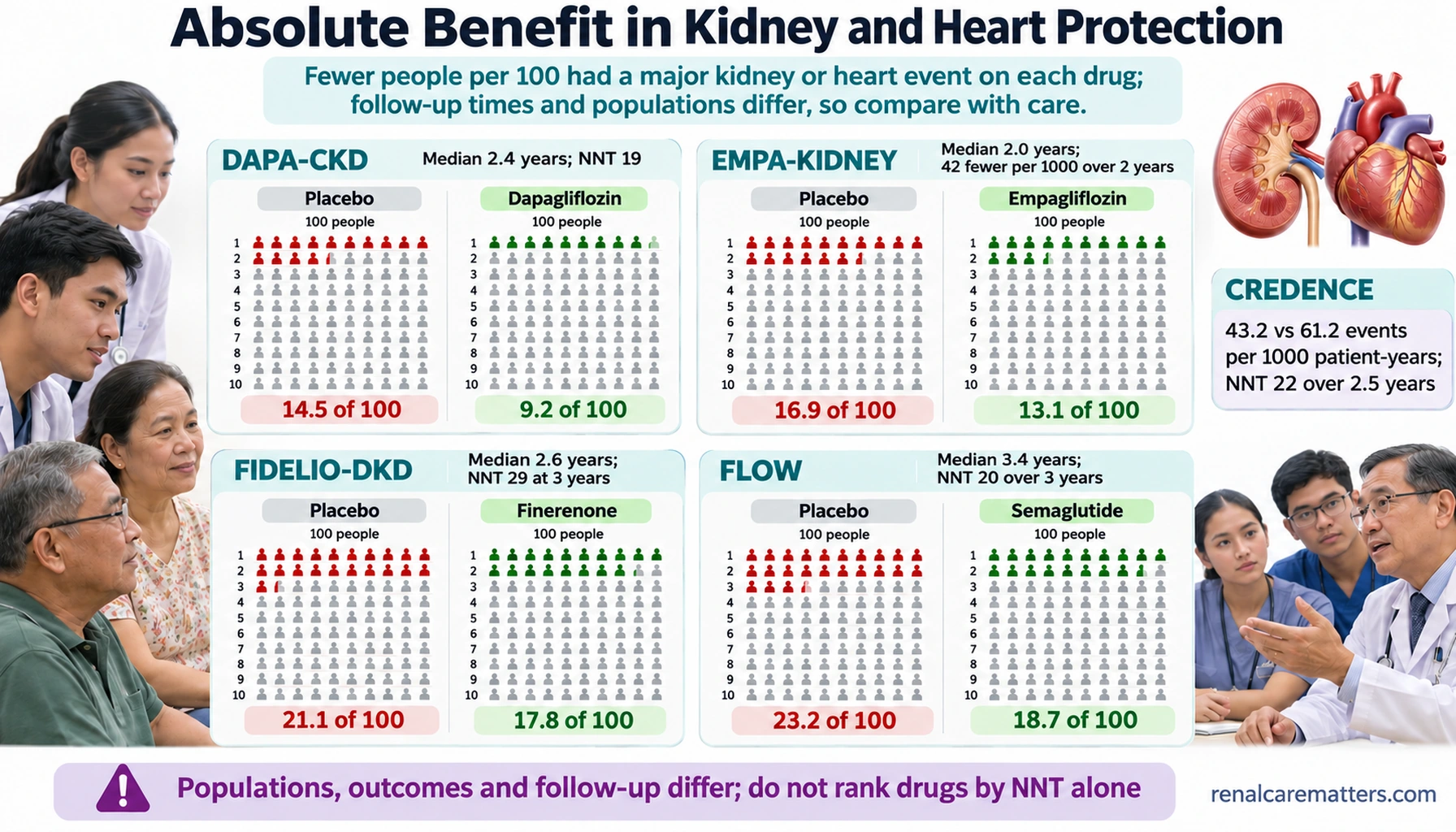
CREDENCE (canagliflozin)43.2 vs 61.2 events per 1000 patient-years; number needed to treat (NNT) 22 over 2.5 years
DAPA-CKD (dapagliflozin)9.2% vs 14.5% over a median 2.4 years; NNT 19
EMPA-KIDNEY (empagliflozin)13.1% vs 16.9% over a median 2.0 years; 42 fewer events per 1000 over 2 years
FIDELIO-DKD (finerenone)17.8% vs 21.1%; NNT 29 at 3 years for the kidney outcome
FLOW (semaglutide)18.7% vs 23.2%; NNT 20 over 3 years
SGLT2 inhibitor in type 2 diabetes and CKD (Kidney Disease: Improving Global Outcomes (KDIGO) 2024)Recommended at eGFR 20 mL/min/1.73 m² or more (1A)
Most patients with diabetes and CKD in a Philippine clinic are on one pillar, often a RASi at a low dose, and sometimes none. A few are on all four. Your work is to know which pillar each patient is missing and why, to start the next one safely, and, when money decides, to choose the one that buys the most protection for that patient.
Opening case · fictional
Case: The teacher who can afford one more medicine
Monday, 9 a.m., the nephrology clinic of a tertiary hospital in Batangas City. Mrs. Teresita Valdez, 58, teaches Grade 5 in a public elementary school. She has had type 2 diabetes for 14 years and hypertension for 9. She takes metformin and losartan, both bought as generics. Her body mass index (BMI) is 29 kg/m²; she gained weight during the pandemic years and has not lost it.
Today her eGFR is 48 mL/min/1.73 m², her ACR 620 mg/g on two samples, potassium 4.6 mmol/L, glycated hemoglobin (HbA1c) 7.6%, and standardized blood pressure 134/82 mm Hg. Her losartan is at the highest dose she tolerates. Her retina shows background diabetic retinopathy; her urine sediment is bland.
She has read online about “the new diabetes injection” and about “the kidney pill.” She says: “Doc, my salary and my husband’s pension cover one more medicine, not three. Which one?” You are the first-year fellow; your attending asks you to present a recommendation with numbers.
Before reading on, decide:
Which pillars is she on, which are missing, and why does each matter for her kidneys?
Which one medicine would you recommend first, and how would you start and monitor it?
How will you explain the benefit in absolute numbers and the cost in the Philippine setting?
Keep your answers in mind. The lesson gives you what you need, and the case review near the end shows one sound response.
Lesson · part 1
Why diabetic kidneys hyperfilter, and where each pillar acts
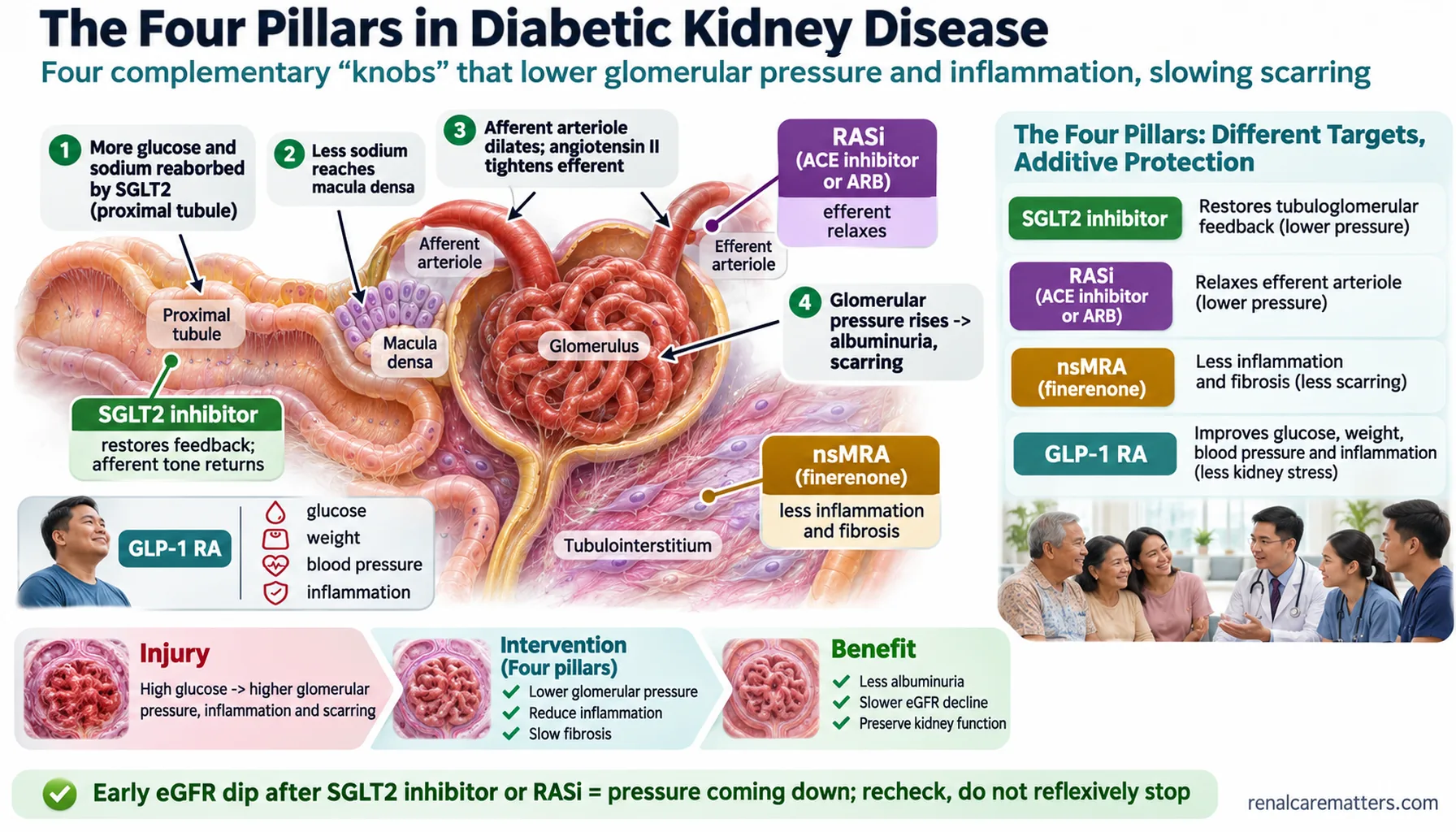
Start with the proximal tubule. Glucose filtered at the glomerulus is reabsorbed with sodium by SGLT2. In chronic hyperglycemia the tubule reabsorbs more glucose and therefore more sodium. Less sodium and chloride reach the macula densa further downstream. The macula densa reads this as “the filtration rate is low,” and tubuloglomerular feedback dilates the afferent arteriole to raise it. At the same time, angiotensin II constricts the efferent arteriole. Inflow opens, outflow tightens, and glomerular pressure rises. This is hyperfiltration: a high single-nephron GFR bought with a high glomerular pressure that injures podocytes, leaks albumin and scars the glomerulus.
Figure 2 · From hyperglycemia to scarring
More glucose filteredSGLT2 reabsorbs more glucose and sodium in the proximal tubule.
Less sodium downstreamThe macula densa senses low delivery.
Feedback misfiresThe afferent arteriole dilates; angiotensin II keeps the efferent arteriole tight.
Pressure risesGlomerular hypertension and hyperfiltration.
DamagePodocyte injury, albuminuria, tubular inflammation, fibrosis and falling GFR.
Each pillar acts on a different link. An SGLT2 inhibitor blocks proximal sodium-glucose reabsorption, restores sodium delivery to the macula densa, and lets the afferent arteriole constrict again. A RASi, meaning an angiotensin-converting enzyme (ACE) inhibitor or an angiotensin receptor blocker (ARB), relaxes the efferent arteriole. Both lower glomerular pressure, which is why both cause a small early eGFR dip that is a sign of the drug working, not of injury. An nsMRA blocks mineralocorticoid receptors on kidney, vascular and immune cells, reducing inflammation and fibrosis, with a modest effect on blood pressure. A GLP-1 RA lowers glucose, weight and blood pressure and may reduce inflammation; how much each contributes to its kidney benefit is not yet established.
Pillar
Main target
What you see after starting
Main safety watch
RASi (ACE inhibitor or ARB)
Efferent arteriole; albuminuria
Small eGFR dip, lower ACR
Potassium, creatinine rise over 30%
SGLT2 inhibitor
Proximal tubule; tubuloglomerular feedback
Small eGFR dip, mild glycosuria, slight weight loss
RememberThe early eGFR dip after an SGLT2 inhibitor or a RASi is the pressure coming down. Recheck it; do not stop the drug for it unless the rise in creatinine is large or the patient is volume depleted.
Figure 3. Four knobs on one overheated filter. Each pillar acts on a different link in the chain from hyperglycemia to scarring, which is why the benefits add.
Lesson · part 2
The trials in absolute numbers
Relative risk reductions sound alike: 30%, 39%, 28%, 18%, 24%. Absolute numbers tell you what a patient gains. Each trial below enrolled patients already on a RASi where it was indicated; the benefits are added to RASi, not instead of it. Where a paper reports a number needed to treat (NNT), it is given; where it does not, the event percentages and their difference are given, and labeled as a subtraction rather than an NNT the authors reported.
CREDENCE (canagliflozin). 4,401 adults with type 2 diabetes, an eGFR of 30 to below 90 and an ACR above 300 to 5,000 mg/g. The trial stopped early at a median 2.62 years. The primary outcome (kidney failure, doubling of creatinine, or renal or cardiovascular death) occurred at 43.2 versus 61.2 events per 1000 patient-years (hazard ratio [heart rate (HR)] 0.70). Kidney failure itself was lower (HR 0.68), as were heart failure hospitalizations (HR 0.61).1 The authors reported an NNT of 22 over 2.5 years, and estimated 47 fewer primary outcome events per 1000 patients treated for 2.5 years.1
DAPA-CKD (dapagliflozin). 4,304 adults, with or without diabetes, eGFR 25 to 75, ACR 200 to 5,000 mg/g. Over a median 2.4 years the primary outcome (50% eGFR decline, kidney failure, or renal or cardiovascular death) occurred in 9.2% versus 14.5% (HR 0.61), NNT 19. Death from any cause was 4.7% versus 6.8%. Effects were similar with and without diabetes.2
EMPA-KIDNEY (empagliflozin). 6,609 adults with an eGFR of 20 to below 45, or 45 to below 90 with an ACR of 200 mg/g or more. Over a median 2.0 years, kidney disease progression or cardiovascular death occurred in 13.1% versus 16.9% (HR 0.72), consistent with and without diabetes and across eGFR ranges.3 The authors expressed this as 42 fewer primary outcomes per 1000 patients treated for 2 years.3 Ketoacidosis occurred in 6 versus 1 patients.3
FIDELIO-DKD (finerenone). 5,734 adults with type 2 diabetes and CKD on a maximally tolerated RASi. Over a median 2.6 years, the kidney outcome (kidney failure, sustained 40% eGFR decline or renal death) occurred in 17.8% versus 21.1% (HR 0.82), and the cardiovascular outcome in 13.0% versus 14.8% (HR 0.86).4 The authors reported NNTs of 29 for the kidney outcome and 42 for the cardiovascular outcome at 3 years. Hyperkalemia led to stopping the drug in 2.3% versus 0.9%.4
FIGARO-DKD (finerenone). 7,437 adults with type 2 diabetes and earlier CKD (eGFR 25 to 90 with ACR 30 to 300 mg/g, or eGFR 60 or more with ACR 300 to 5,000 mg/g). Over a median 3.4 years the cardiovascular outcome occurred in 12.4% versus 14.2% (HR 0.87), driven mainly by fewer heart failure hospitalizations (HR 0.71). The kidney composite, 9.5% versus 10.8% (HR 0.87, 95% confidence interval 0.76 to 1.01), was not statistically significant. Hyperkalemia stopped the drug in 1.2% versus 0.4%.5 The difference in the reported cardiovascular percentages is 1.8 points; the abstract reports no NNT.
FLOW (semaglutide). 3,533 adults with type 2 diabetes and CKD (eGFR 50 to 75 with ACR above 300, or eGFR 25 to below 50 with ACR above 100 mg/g). The trial stopped early at a median 3.4 years. Major kidney disease events occurred in 331 versus 410 patients, 18.7% versus 23.2%, or 5.8 versus 7.5 per 100 patient-years (HR 0.76); cardiovascular death (HR 0.71), major cardiovascular events (HR 0.82) and death from any cause (HR 0.80) were also lower.6 Over 3 years, the authors estimated that 20 people would need treatment to prevent one primary outcome event, 45 to prevent one major cardiovascular event and 39 to prevent one death.6 The eGFR slope was 1.16 mL/min/1.73 m² per year less steep, a surrogate that agrees with the hard outcomes.6
Trial
Population
Primary outcome, drug vs placebo
Absolute benefit as reported
CREDENCE
Type 2 diabetes (T2D), eGFR 30–<90, ACR >300
43.2 vs 61.2 per 1000 patient-years
NNT 22 over 2.5 years
DAPA-CKD
With or without diabetes, eGFR 25–75, ACR 200–5,000
9.2% vs 14.5%
NNT 19 over a median 2.4 years
EMPA-KIDNEY
With or without diabetes, eGFR 20–<90 (ACR ≥200 if eGFR ≥45)
13.1% vs 16.9%
42 fewer per 1000 over 2 years
FIDELIO-DKD
T2D, moderate to severe albuminuria, on RASi
17.8% vs 21.1% (kidney)
NNT 29 at 3 years
FIGARO-DKD
T2D, earlier CKD, on RASi
12.4% vs 14.2% (cardiovascular)
Difference 1.8 points; no NNT in abstract
FLOW
T2D, eGFR 25–75 with albuminuria
18.7% vs 23.2%
NNT 20 over 3 years
What the trials do not tell you. NNTs from different trials are not directly comparable: the populations, outcomes and follow-up differ, and higher-risk populations produce smaller NNTs. Few participants in FIDELIO-DKD or FIGARO-DKD were on an SGLT2 inhibitor at baseline, so the size of benefit when the pillars are stacked is estimated rather than measured. The CONFIDENCE trial started finerenone and empagliflozin together and found that the combination lowered ACR 29% more than finerenone alone and 32% more than empagliflozin alone at 180 days, without unexpected adverse events.7 Albuminuria is a surrogate; CONFIDENCE did not test kidney failure.
The guideline position. KDIGO 2024 recommends an SGLT2 inhibitor for adults with type 2 diabetes, CKD and an eGFR of 20 mL/min/1.73 m² or more (1A); for adults with CKD and an eGFR of 20 or more with an ACR of 200 mg/g or more, or with heart failure (1A); and suggests one for adults with an eGFR of 20 to 45 and an ACR below 200 mg/g (2B). It suggests an nsMRA with proven kidney or cardiovascular benefit for adults with type 2 diabetes, an eGFR above 25, normal potassium and albuminuria of 30 mg/g or more despite a maximum tolerated RASi (2A). It recommends a long-acting GLP-1 RA for adults with type 2 diabetes and CKD who have not reached their glycemic target on metformin and an SGLT2 inhibitor, or cannot use them (1B).8 KDIGO has taken a medications management focused update of the CKD guideline through public review; check its status before teaching these statements as final.9
RememberQuote the absolute benefit and the follow-up time with every relative risk: “19 patients treated for about 2.4 years to prevent one major kidney or cardiovascular event” is something a patient can weigh.
Figure 4. Absolute benefit, trial by trial. Fewer people per 100 had a major kidney or heart event on each drug; follow-up times and populations differ, so compare with care.
Lesson · part 3
Glucose control in CKD: what HbA1c can and cannot tell you
Glucose control protects the small vessels, but in CKD both the measurement and the drugs change. HbA1c reflects the average glucose over the life of the red cell. In advanced CKD, anemia, a shortened red cell life span, iron or erythropoiesis-stimulating agent treatment and transfusion all distort it, usually downward. KDIGO 2022 recommends HbA1c to monitor glycemic control, with an individualized target ranging from below 6.5% to below 8.0% in patients with diabetes and CKD not on dialysis (1C).10 The lower end suits a younger patient with few complications and a low hypoglycemia risk; the upper end suits an older patient with advanced CKD, cardiovascular disease, limited life expectancy or a history of hypoglycemia. Where HbA1c seems discordant with finger-stick readings, trust a pattern of glucose readings over a single number.
Metformin by eGFR. KDIGO 2022 recommends metformin for patients with type 2 diabetes, CKD and an eGFR of 30 or more (1B).10 The United States Food and Drug Administration (FDA) labeling, revised in 2016, states that metformin is contraindicated below an eGFR of 30, that starting it at 30 to 45 is not recommended, that the benefit and risk should be reassessed if eGFR falls below 45 in a patient already taking it, and that it should be stopped before iodinated contrast in patients with an eGFR of 30 to 60 and restarted once kidney function is confirmed stable.11 Dose reductions by eGFR come from the label and the attending.
eGFR (mL/min/1.73 m²)
Metformin (FDA labeling)
SGLT2 inhibitor (KDIGO 2024)
45 or more
Can be used; check eGFR at least yearly
Recommended in T2D with CKD (1A)
30 to 44
Do not start; reassess if already taking
Recommended in T2D with CKD (1A)
20 to 29
Contraindicated
Recommended in T2D with CKD (1A); can be continued below 20 if tolerated, per KDIGO practice point
Below 20
Contraindicated
Not started; continued if already taking and tolerated, until kidney replacement therapy (KRT)
Hypoglycemia. As GFR falls, insulin and sulfonylureas are cleared more slowly and the kidney contributes less gluconeogenesis, so hypoglycemia becomes more likely. A teacher who skips lunch because of classroom duty, or a farmer who works through noon, is at real risk on a long-acting sulfonylurea. The glucose-lowering effect of an SGLT2 inhibitor wanes at low eGFR, but its kidney and heart benefits do not, which is why KDIGO lets it continue.
In childrenType 2 diabetes now occurs in adolescents with obesity, and albuminuria can appear within a few years of diagnosis. The kidney outcome trials in this module enrolled adults only; kidney protection in children rests on blood pressure control, RASi where albuminuria is present, weight and glucose care, and pediatric labeling for each drug. See Attending Pediatric Nephrologist, Module 17.
RememberSet the HbA1c target for the person, between below 6.5% and below 8.0%, and check the metformin dose against the eGFR every time the eGFR changes.
Lesson · part 4
Obesity and the kidney: lower thresholds for Filipinos
Obesity injures the kidney through more than diabetes and hypertension. Excess body mass raises GFR demand, so each nephron hyperfilters; visceral fat drives insulin resistance, sympathetic activity and sodium retention; and adipose tissue releases inflammatory signals. The biopsy picture of obesity-related glomerulopathy, enlarged glomeruli with secondary focal segmental sclerosis, follows this chain. In a patient with diabetes, obesity adds to every pathway the pillars target.
Which BMI. A World Health Organization (WHO) expert consultation found that the proportion of Asian people at high risk of type 2 diabetes and cardiovascular disease is substantial at BMIs below the international overweight cut point of 25 kg/m². It kept the international classification but proposed additional public health action points at 23, 27.5, 32.5 and 37.5 kg/m².12 In practice, many Filipino clinicians treat a BMI of 23 as the start of increased risk and 27.5 as high risk; waist circumference adds information when BMI understates visceral fat.
Approach
What it changes
Evidence level and caution
Diet and activity
Weight, blood pressure, glucose
Foundation for everyone; adapt to CKD potassium and phosphate needs with the dietitian
GLP-1 RA
Weight, glucose, blood pressure; kidney and heart outcomes in FLOW
FLOW enrolled people with type 2 diabetes; out-of-pocket cost is high
SGLT2 inhibitor
Modest weight loss; kidney and heart protection
Benefit does not depend on weight loss
Bariatric surgery
Large weight loss
Specialist referral; evidence for kidney outcomes is mainly observational
Weight talk needs care. Many patients have heard “magpapayat ka” (you need to slim down) at every visit and have stopped listening. Ask what the family cooks, when the patient eats, and what one change is possible this month: rice portion, sweetened drinks, merienda. Avoid crash diets and imported slimming products, some of which have caused kidney injury (Module 16).
RememberIn Filipino patients, start counting cardiometabolic risk at a BMI of 23 kg/m², and treat obesity as a kidney risk factor in its own right.
Lesson · part 5
Access and cost: sequencing when the family pays
In the Philippines, kidney protection is often paid out of pocket, month by month. A regimen that is perfect on paper and bought twice a year protects nothing. Your sequencing must combine the evidence, the patient’s risk and what the family can sustain.
What Philippine Health Insurance Corporation (PhilHealth) covers. The PhilHealth Guaranteed and Accessible Medications for Outpatient Treatment (GAMOT) benefit, part of the Yaman ng Kalusugan Program (YAKAP) primary care program, lists dapagliflozin, metformin, losartan, atorvastatin and rosuvastatin among its molecules, with an annual medicine limit of PHP 20,000 per member; finerenone and semaglutide are not on the list.13 Medicines are free only when prescribed at the member’s registered YAKAP clinic and dispensed at an accredited pharmacy at PhilHealth’s set price; a branded product priced above it is not covered unless the pharmacy offers it at that price.14 The list can change, so confirm it on the date you prescribe. Help the patient register.
Step
Why in this order
Philippine access
1. RASi at the highest tolerated dose
Foundation; benefit in albuminuric CKD; inexpensive
Generic losartan on the GAMOT list
2. SGLT2 inhibitor
Kidney, heart failure and survival benefit across diabetes status; NNT 19 to 22 over about 2.5 years in the trials; 1A
Dapagliflozin on the GAMOT list
3. nsMRA if ACR stays 30 mg/g or more and potassium is normal
Adds kidney and heart failure benefit; 2A
Out of pocket
4. GLP-1 RA if glucose or weight targets are not met, or for added cardiovascular benefit
FLOW: NNT 20 over 3 years; 1B for glycemic indication
Out of pocket; injection and cold storage
Throughout
Statin, blood pressure, glucose targets
Statins and metformin on the GAMOT list
This order is a common reading of the evidence, not a rule. A patient with heart failure gains more from an SGLT2 inhibitor; a patient with severe obesity and poor glucose control may gain more from a GLP-1 RA if it is affordable; a patient whose ACR stays high on a RASi and an SGLT2 inhibitor is the FIDELIO-DKD patient. When cost limits the list, say so in the chart, so the next doctor does not assume the missing pillar was forgotten.
Safety at the start. Before an SGLT2 inhibitor: check volume status and the diuretic dose, teach genital hygiene, and teach the sick-day rule: hold it during vomiting, diarrhea, poor intake or acute illness, and before major surgery, and restart when eating and drinking normally (KDIGO practice point).8 Ketoacidosis on an SGLT2 inhibitor can occur with near-normal glucose. Before finerenone: check potassium and plan the recheck. Before a GLP-1 RA: warn about nausea and vomiting, which can cause volume depletion and acute kidney injury (AKI) in a patient with CKD. A 2026 KDIGO diabetes guideline is in public-review draft; until it is final, the 2022 guideline stands.
Stop and callStop and call the attending nephrologist (per unit protocol, but always ask the attending nephrologist for guidance) when you find:
Nausea, vomiting, abdominal pain, fast breathing or drowsiness in a patient on an SGLT2 inhibitor, even with normal glucose
Potassium of 6.0 mmol/L or higher on a RASi or finerenone
Creatinine rising more than 30% after starting a pillar, or with vomiting and poor intake
Severe perineal pain, swelling or fever on an SGLT2 inhibitor
Recurrent hypoglycemia as eGFR falls
RememberWhen the family can buy only one more medicine, pick the pillar with the best evidence for this patient’s risk that the family can sustain every month, and write down why the others are missing.
On the floor
Real situations: problems and solutions
These are fictional but typical. For each one, cover the answer, decide what you would do, then compare. Where a step depends on local rules, your unit’s procedure and your supervisor’s direction come first.
The sick day on an SGLT2 inhibitor
What you see
A 61-year-old jeepney dispatcher in Caloocan on dapagliflozin has had vomiting and diarrhea for two days after a fiesta meal. His glucose is 168 mg/dL, but he is breathing fast and feels weak.
What is likely going on
Possible euglycemic ketoacidosis with volume depletion; the near-normal glucose does not exclude it.
What to do
Hold the SGLT2 inhibitor, check ketones, blood gas, electrolytes and creatinine, give fluids per the attending, and call.
Why it matters
Sick-day teaching at the start prevents this; ketoacidosis on an SGLT2 inhibitor is missed when clinicians wait for high glucose.
The potassium on finerenone
What you see
A 64-year-old retired seaman in Iloilo started finerenone 4 weeks ago on top of losartan. Potassium is 5.8 mmol/L; he drinks buko juice daily for his kidneys.
What is likely going on
Hyperkalemia from combined mineralocorticoid and angiotensin blockade plus dietary potassium.
What to do
Review diet and other potassium-raising drugs, follow the attending’s potassium plan, and recheck soon; hold if it reaches the stopping threshold in the label.
Why it matters
Hyperkalemia stopped finerenone in about 2 in 100 patients in FIDELIO-DKD; monitoring keeps the benefit.
The metformin that should have changed
What you see
A 70-year-old woman in Naga City has taken the same metformin dose for 8 years. Her eGFR has fallen from 62 to 28 mL/min/1.73 m² and no one has changed the prescription.
What is likely going on
Metformin is now contraindicated at her eGFR.
What to do
Stop metformin with the attending, review glucose control, and continue or start an SGLT2 inhibitor if eligible.
Why it matters
Prescriptions copied forward for years are a common route to drug harm in CKD.
The patient who wants the injection, not the pill
What you see
A 48-year-old call center supervisor in Quezon City with type 2 diabetes, CKD G3a A3 and a BMI of 33 kg/m² wants semaglutide for weight loss and asks if he can skip the SGLT2 inhibitor.
What is likely going on
Both have kidney evidence; they work on different pathways.
What to do
Explain the absolute benefits of each, what each costs him monthly, and that they can be combined if affordable; record his choice.
Why it matters
Shared decisions built on absolute numbers keep patients on treatment.
Field notes
Write the four pillars as a checklist in every diabetic CKD note: on, not on, or deferred and why.
Teach the SGLT2 inhibitor sick-day rule on the day you start it, in the patient’s own language.
Recheck the metformin dose every time the eGFR changes category.
Quote trial benefits as “out of 100 people over about 2 to 3 years,” not as percentages alone.
Ask early whether the patient is registered with a YAKAP clinic and a GAMOT pharmacy.
Case review
Back to the case: The teacher who can afford one more medicine
Pillars on and missing. She is on one pillar, losartan at the highest tolerated dose, plus metformin for glucose. She is missing an SGLT2 inhibitor, an nsMRA and a GLP-1 RA. With an eGFR of 48 and an ACR of 620 mg/g she has glomerular hypertension that losartan has only partly lowered; her residual albuminuria is the target. An SGLT2 inhibitor would lower glomerular pressure from the afferent side; finerenone would act on inflammation and fibrosis; a GLP-1 RA would help her weight and glucose. Metformin can continue at her eGFR with a dose checked against the label.
The one medicine. An SGLT2 inhibitor. She fits CREDENCE, DAPA-CKD and EMPA-KIDNEY, KDIGO 2024 recommends it at her eGFR (1A), and dapagliflozin is on the PhilHealth GAMOT list. Start it with the attending: review volume and any diuretic, teach genital hygiene and the sick-day rule, and recheck creatinine and potassium in a few weeks, expecting a small eGFR dip. If her ACR stays above 30 mg/g with normal potassium and she can later afford it, finerenone is the next step; a GLP-1 RA if glucose or weight targets are not met.
Explaining it. “In the DAPA-CKD trial, about 15 in 100 people like you on placebo had a serious kidney or heart event over about two and a half years; on the medicine it was about 9 in 100. About one person in 19 who takes it avoids such an event over that time.” Explain that the eGFR may dip a little at first and that this is expected. On cost: help her register with a YAKAP clinic and a GAMOT pharmacy, confirm that the list still includes dapagliflozin, and record that finerenone and a GLP-1 RA were deferred for cost, not forgotten.
Interactive case · fictional
Interactive case: One more medicine, and the night it went wrong
Work through a shift one decision at a time. The panel at the top changes with what you choose. After each choice you see why it is, or is not, the best move; after a weaker one you can try again or carry on and see where it leads. Your first choice at each step is scored. The score stays on this device and nothing is sent anywhere. In real practice, your unit’s protocol and the people responsible for each decision come first.
Skills lab · with your preceptor
Skills checklist: Diabetes, obesity and kidney protection
Complete with a preceptor, in clinic or on the ward. Sign-off is local. Your preceptor rates each step as satisfactory, needs practice, or not observed. Steps marked Critical must all be satisfactory before sign-off. This checklist supports supervised learning; your unit’s own procedure and competency form are the authority. A printable version of every checklist is on the trainer page.
Lists the four pillars with the mechanism and main safety watch for each
Checks SGLT2 inhibitor and nsMRA eligibility by eGFR, ACR and potassium against KDIGO 2024
Teaches sick-day rules and ketoacidosis warning signs to a patient starting an SGLT2 inhibitor
Checks metformin against the eGFR thresholds in the FDA labeling
Explains a trial result to a patient in absolute numbers with the follow-up time
Writes a sequencing plan that records which pillars were deferred for cost
Placement activity. Diabetes clinic, CKD clinic or ward
Self-assessment
Check your understanding
Each visit draws 5 questions at random from this module’s 5-question bank. Choose the single best answer for each, then select Check answers; an explanation appears under the best answer. Select New set of questions for a different mix. A good target is 4 of 5 on two different sets. Nothing you select is sent anywhere; scoring happens in your browser.
Perkovic, V., Jardine, M. J., Neal, B., Bompoint, S., Heerspink, H. J. L., Charytan, D. M., Edwards, R., Agarwal, R., Bakris, G., Bull, S., Cannon, C. P., Capuano, G., Chu, P. L., de Zeeuw, D., Greene, T., Levin, A., Pollock, C., Wheeler, D. C., Yavin, Y., ... CREDENCE Trial Investigators. (2019). Canagliflozin and renal outcomes in type 2 diabetes and nephropathy. The New England Journal of Medicine, 380(24), 2295–2306. https://doi.org/10.1056/NEJMoa1811744
Heerspink, H. J. L., Stefánsson, B. V., Correa-Rotter, R., Chertow, G. M., Greene, T., Hou, F. F., Mann, J. F. E., McMurray, J. J. V., Lindberg, M., Rossing, P., Sjöström, C. D., Toto, R. D., Langkilde, A. M., Wheeler, D. C., & DAPA-CKD Trial Committees and Investigators. (2020). Dapagliflozin in patients with chronic kidney disease. The New England Journal of Medicine, 383(15), 1436–1446. https://doi.org/10.1056/NEJMoa2024816
The EMPA-KIDNEY Collaborative Group, Herrington, W. G., Staplin, N., Wanner, C., Green, J. B., Hauske, S. J., Emberson, J. R., Preiss, D., Judge, P., Mayne, K. J., Ng, S. Y. A., Sammons, E., Zhu, D., Hill, M., Stevens, W., Wallendszus, K., Brenner, S., Cheung, A. K., Liu, Z. H., ... Haynes, R. (2023). Empagliflozin in patients with chronic kidney disease. The New England Journal of Medicine, 388(2), 117–127. https://doi.org/10.1056/NEJMoa2204233
Bakris, G. L., Agarwal, R., Anker, S. D., Pitt, B., Ruilope, L. M., Rossing, P., Kolkhof, P., Nowack, C., Schloemer, P., Joseph, A., Filippatos, G., & FIDELIO-DKD Investigators. (2020). Effect of finerenone on chronic kidney disease outcomes in type 2 diabetes. The New England Journal of Medicine, 383(23), 2219–2229. https://doi.org/10.1056/NEJMoa2025845
Pitt, B., Filippatos, G., Agarwal, R., Anker, S. D., Bakris, G. L., Rossing, P., Joseph, A., Kolkhof, P., Nowack, C., Schloemer, P., Ruilope, L. M., & FIGARO-DKD Investigators. (2021). Cardiovascular events with finerenone in kidney disease and type 2 diabetes. The New England Journal of Medicine, 385(24), 2252–2263. https://doi.org/10.1056/NEJMoa2110956
Perkovic, V., Tuttle, K. R., Rossing, P., Mahaffey, K. W., Mann, J. F. E., Bakris, G., Baeres, F. M. M., Idorn, T., Bosch-Traberg, H., Lausvig, N. L., Pratley, R., & FLOW Trial Committees and Investigators. (2024). Effects of semaglutide on chronic kidney disease in patients with type 2 diabetes. The New England Journal of Medicine, 391(2), 109–121. https://doi.org/10.1056/NEJMoa2403347
Agarwal, R., Green, J. B., Heerspink, H. J. L., Mann, J. F. E., McGill, J. B., Mottl, A. K., Rosenstock, J., Rossing, P., Vaduganathan, M., Brinker, M., Edfors, R., Li, N., Scheerer, M. F., Scott, C., Nangaku, M., & CONFIDENCE Investigators. (2025). Finerenone with empagliflozin in chronic kidney disease and type 2 diabetes. The New England Journal of Medicine, 393(6), 533–543. https://doi.org/10.1056/NEJMoa2410659
Kidney Disease: Improving Global Outcomes (KDIGO) CKD Work Group. (2024). KDIGO 2024 clinical practice guideline for the evaluation and management of chronic kidney disease. Kidney International, 105(4S), S117–S314. https://doi.org/10.1016/j.kint.2023.10.018
WHO Expert Consultation. (2004). Appropriate body-mass index for Asian populations and its implications for policy and intervention strategies. The Lancet, 363(9403), 157–163. https://doi.org/10.1016/S0140-6736(03)15268-3
Philippine Health Insurance Corporation. (2025). Nationwide implementation of PhilHealth Guaranteed and Accessible Medications for Outpatient Treatment (PhilHealth GAMOT) (PhilHealth Circular No. 2025-0013). https://www.philhealth.gov.ph/circulars/2025/PC2025-0013.pdf
Educational self-study for physicians in training. Clinical tasks need your institution’s authorization and supervision. Completing this track is an Academy learning record only. It does not confer licensure, specialist status, PSN or PNSP membership or board eligibility, procedural privileges, CPD units, or completion of an institutional training program, and it does not replace current guidelines, regulations, your institution’s protocols and formulary, or your supervisor.