Work up anemia, replete iron, and use erythropoiesis-stimulating agents (ESAs) and hypoxia-inducible factor prolyl hydroxylase inhibitors (HIF-PHIs) within the KDIGO 2026 guideline.
PublishedNailathalaGipatikPepalwal:ReferencesMga SanggunianMga TinubdanReng Reperensya:10Audience: Adult and pediatric nephrology fellows · internal medicine and pediatric residents · medical interns on medicine, pediatrics, ICU and dialysis rotations, and residents who work shifts as dialysis physicians on dutyRead timeOras ng pagbasaOras sa pagbasaOras ning pamamasa:
Training track for nephrology fellows, residents and medical interns
Study material for medical interns, residents and fellows. It explains the reasoning behind common decisions; it is not a protocol and gives no drug doses. Doses, rates and order sets come from current guidelines, product labels, your institution’s approved protocols and your supervising physician. Benefit rules change: confirm them on the date of service. Every case is fictional.
Learning objectives
After this module you should be able to
Intern: Recognize anemia in a patient with chronic kidney disease (CKD), take the bleeding, diet, medicine and transfusion history, and collect the first test set your resident orders without missing a sample.
Resident: Work up anemia and iron status in CKD, look for every correctable cause before blaming the kidneys, and propose iron therapy using the thresholds of the Kidney Disease: Improving Global Outcomes (KDIGO) 2026 anemia guideline.
Fellow: Apply the KDIGO 2026 guidance on iron, erythropoiesis-stimulating agents (ESAs), hypoxia-inducible factor prolyl hydroxylase inhibitors (HIF-PHIs) and transfusion with their stated grades, keep hemoglobin (Hgb) below the recommended ceiling, and manage hyporesponsiveness.
Pre-testBefore you read, answer the 5 self-assessment questions and note your score. After the module, select New set of questions and compare. The difference is what you learned; the questions you still miss are what to reread.
Start here
The big picture, in plain words
Your role · the tired patient with a low hemoglobinThe intern notices the pallor, asks about black stools, pain tablets and past transfusions, and gets the right tubes to the laboratory before any iron or blood is given. The resident builds the work-up, names the correctable causes, and proposes iron with the guideline threshold that justifies it. The fellow decides with the attending whether and when to add an ESA or a HIF-PHI, sets the hemoglobin ceiling, and keeps transfusion for the patient who truly needs it.
In plain wordsPicture a garment factory in Taytay. A foreman watches the orders and tells the sewers how many shirts to make. The sewers need cloth from a bodega. If the foreman stops calling for shirts, production falls. If the bodega is locked, the sewers stand idle even when the foreman shouts. In the body the kidney is the foreman, erythropoietin is the order slip, the bone marrow is the sewing floor, and iron is the cloth.
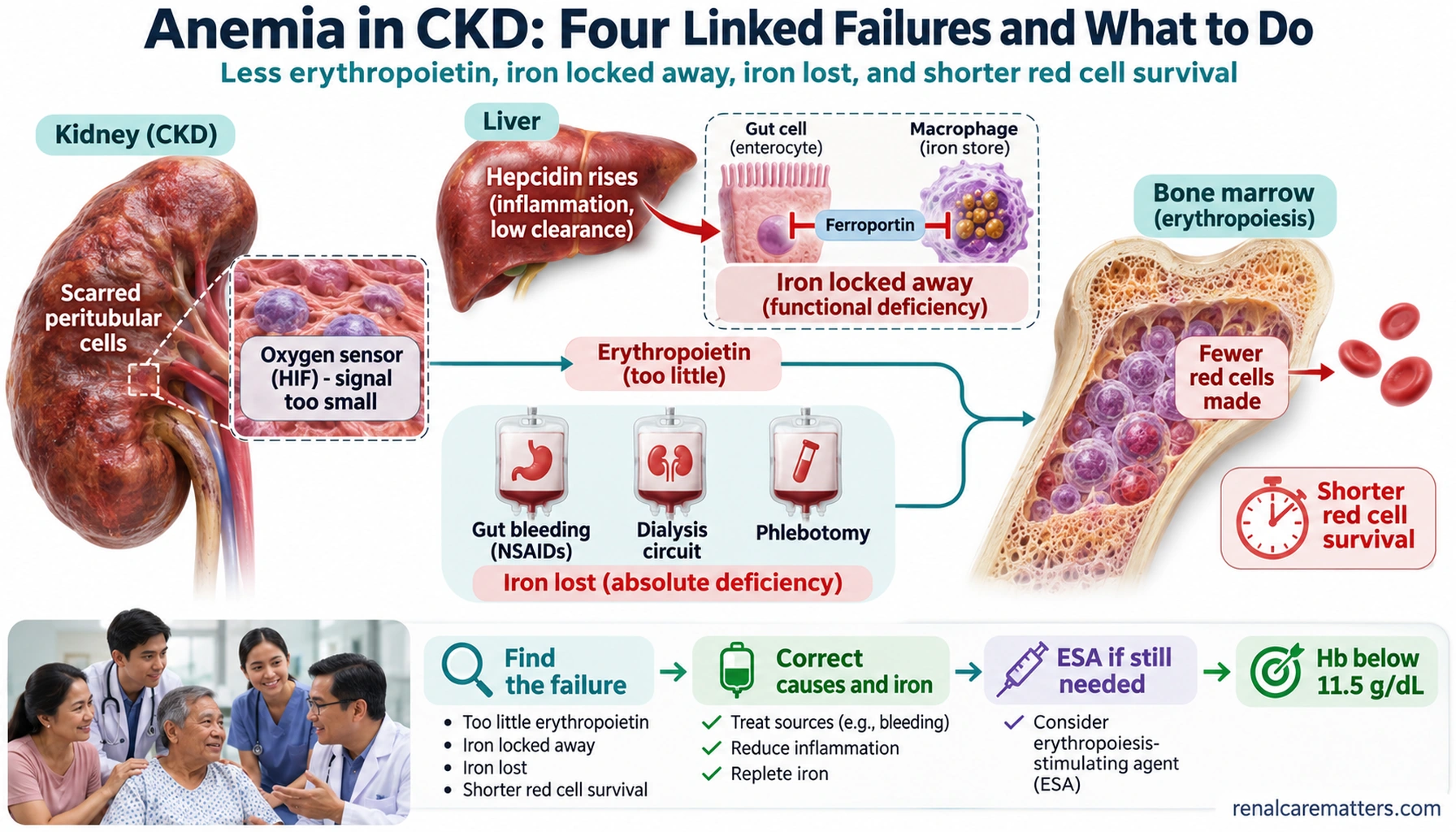
The picture has a limit. A factory has one foreman and one bodega. In CKD both fail together, and for linked reasons. The kidney’s oxygen sensor sits in fibroblast-like cells around the tubules. When they sense low oxygen, the hypoxia-inducible factor (HIF) pathway switches on the erythropoietin gene. In diseased kidneys these cells are scarred and the signal is too small for the degree of anemia. At the same time, inflammation and reduced kidney clearance raise hepcidin, the liver hormone that locks iron inside gut cells and macrophages. The marrow then has orders it cannot fill. Blood lost to dialysis circuits, phlebotomy and the gut drains the bodega further.1
Figure 1 · Key numbers
Anemia in adults (KDIGO 2026)Hemoglobin (Hb) below 13.0 g/dL in men and below 12.0 g/dL in women
Start iron in hemodialysis (KDIGO 2026)Ferritin ≤500 ng/mL and transferrin saturation (TSAT) ≤30% (2D)
Start iron, no dialysis or peritoneal dialysis (KDIGO 2026)Ferritin below 100 ng/mL with TSAT below 40%, or ferritin 100 to 300 ng/mL with TSAT below 25% (2D)
Start an ESA on dialysis (KDIGO 2026)Hb at or below 9.0 to 10.0 g/dL (2D)
Hb ceiling for adults on an ESA (KDIGO 2026)Keep Hb below 11.5 g/dL (1D)
Withhold routine iron (KDIGO 2026)Ferritin above 700 ng/mL or TSAT ≥40% (practice point)
Most anemia in CKD is a mix of too little erythropoietin and too little usable iron, and it responds to patient, stepwise correction of both. A few patients are anemic because they are bleeding, have a marrow or blood disease, or have a deficiency the kidneys did not cause. Your work is to find those first, give iron when the numbers and the patient call for it, use ESAs to avoid transfusion rather than to chase a normal hemoglobin, and remember that a hemoglobin value is a surrogate, not an outcome the patient feels.
Opening case · fictional
Case: The ward consult on a Thursday
Thursday, 10 a.m., medical ward of a tertiary hospital in Quezon City. Mrs. Corazon Villanueva, 61, a retired market vendor from Novaliches, has type 2 diabetes and CKD G4 with an estimated glomerular filtration rate (eGFR) of 22 mL/min/1.73 m². She was admitted last night for breathlessness on climbing the stairs to her apartment and swelling of both ankles. She takes losartan, insulin, and a ferrous sulfate tablet she buys from the botika “when there is money.” For her knees she takes mefenamic acid most days. For two weeks her stools have been darker than usual.
Her Hb is 8.1 g/dL, mean corpuscular volume (MCV) 78 fL, platelets normal, ferritin 90 ng/mL and TSAT 14%. No reticulocyte count was sent. Her son, an overseas Filipino worker (OFW) in Dubai, has asked about donating a kidney to her. The admitting resident, Dr. Paolo Mendoza, wants to transfuse two units tonight and “start erythropoietin (EPO) so she can go home.” Her daughter has already been told to find two blood donors for the blood bank.
Before reading on, decide:
What must be done before anyone gives blood, iron or an ESA, and which correctable causes do you see?
Does she meet a KDIGO 2026 threshold for iron, and would you give it by mouth or intravenously?
Does she need a transfusion tonight, and when would an ESA or a HIF-PHI enter the plan?
Keep your answers in mind. The lesson gives you what you need, and the case review near the end shows one sound response.
Lesson · part 1
Why the kidney makes people anemic: four linked failures
A healthy adult replaces about one percent of red cell (RBC)s each day. The marrow keeps pace because the kidney adjusts the order and the gut and macrophages release enough iron. In CKD this loop breaks at four points, and each points to a different action at the bedside.1
First, erythropoietin falls short. The level in a patient with CKD may be within the laboratory’s normal range, yet far too low for the degree of anemia. That is a relative deficiency, and it is the reason a normal erythropoietin result does not exclude renal anemia. Second, iron is locked away. Hepcidin rises with inflammation and with falling kidney clearance. It blocks the iron exporter ferroportin, so gut absorption falls and iron stays trapped in macrophages. The patient may have stored iron and still be unable to use it, which we call functional iron deficiency. Third, iron is lost. Every hemodialysis session leaves blood in the dialyzer and lines, every admission brings phlebotomy, and uremic platelets and pain tablets make gut bleeding easier. Fourth, red cells live a shorter time in a uremic environment, and other contributors such as severe hyperparathyroidism and deficiency of vitamin B12 or folate add to the problem.1
Figure 2. Four linked failures: too little erythropoietin, iron locked away by hepcidin, iron lost, and shorter red cell survival. Each one points to a different action.
Failure
What drives it
What you see
What it changes for you
Too little erythropoietin
Scarred peritubular oxygen-sensing cells
Normocytic anemia, low reticulocyte response, worse as eGFR falls
The reason ESAs and HIF-PHIs work
Iron locked away (functional deficiency)
Hepcidin from inflammation and low clearance
Ferritin normal or high, TSAT low
Oral iron is poorly absorbed; intravenous iron bypasses the gut
Iron lost (absolute deficiency)
Gut bleeding, dialysis circuit, phlebotomy, menstruation
Anemia out of proportion to the eGFR, abnormal smear or other cell lines
Expand the work-up; this is not “just the kidneys”
The proportion matters. Anemia that is severe while the eGFR is still well preserved, anemia with a low platelet or white cell count, or a microcytic picture with a ferritin far below 100 ng/mL should each make you suspect a second process. The kidney explains the anemia only when the anemia fits the kidney.
In the Philippines, add what the region brings. Ask about hookworm and other intestinal parasites in a patient from a farming area, malaria in a patient from an endemic province such as Palawan, and thalassemia trait in a microcytic patient whose iron stores are normal or whose relatives have “always been pale.” Ask about herbal products and pain tablets bought without prescription; mefenamic acid and other nonsteroidal anti-inflammatory drugs (NSAIDs) cause gut bleeding as well as kidney injury.
In childrenChildren with CKD use age-specific Hb thresholds, and anemia matters for growth, school performance and heart size as well as energy. KDIGO 2026 groups children with adults who are not on dialysis when it advises choosing the Hb at which to start an ESA by symptoms, expected benefit and risk (2D), and it publishes a separate illustration for children.2,3 Transfusion carries the same allosensitization cost for a child who will one day need a kidney. See Attending Pediatric Nephrologist, Module 18.
RememberBefore you call it renal anemia, ask which of the four failures is present: too little erythropoietin, iron locked away, iron lost, or a second cause. Each one changes what you do next.
Lesson · part 2
The work-up: what to send, how often, and how to read it
KDIGO 2026 asks you to test for anemia in CKD at referral, regularly during follow-up, and whenever symptoms suggest it. The first test set is a complete blood count (CBC), reticulocytes with the reticulocyte production index (RPI), ferritin and TSAT (practice point).3,4 The minimum frequency rises as kidney function falls: at least yearly in CKD G3, twice a year in G4, and every three months in G5 and on dialysis (practice point).3
The intern’s job is concrete. Draw the iron studies before the first iron tablet or infusion in hospital, or the numbers will mislead everyone for weeks. Note the date of the last transfusion; transfused cells change the MCV, the reticulocyte count and the ferritin. Ask about black or bloody stools, heavy menses, nosebleeds, aspirin, NSAIDs and anticoagulants, and record them in the history, not just the order sheet.
Reading ferritin and TSAT together
Ferritin reflects stored iron, but it is also an acute-phase protein. Infection, inflammation, liver disease and malignancy push it up. TSAT reflects iron in transit to the marrow, and it falls quickly when supply cannot meet demand. Neither alone tells the whole story, which is why the guideline thresholds always pair them.
Pattern
Likely meaning
Next step for the resident
Ferritin low, TSAT low, MCV falling
Absolute iron deficiency
Look for blood loss; replace iron
Ferritin normal or high, TSAT low
Functional deficiency, inflammation, or both
Look for infection and inflammation; consider intravenous iron if thresholds are met
Ferritin and TSAT adequate, reticulocytes low
Erythropoietin deficiency is likely
Correct other causes, then consider an ESA
Reticulocytes high
Bleeding or hemolysis
Smear, lactate dehydrogenase, haptoglobin, bilirubin; look for the source
Macrocytosis, or other cell lines low
Deficiency, drug effect, liver disease, marrow disease
When the first set does not explain the anemia, KDIGO lists an expanded panel: blood smear, haptoglobin, lactate dehydrogenase, C-reactive protein, vitamin B12, folate, liver tests, serum protein electrophoresis and free light chains, thyroid-stimulating hormone, parathyroid hormone and fecal occult blood (practice point).3 When iron deficiency has no clear explanation, the guideline asks you to consider evaluation for blood loss with referral to the right specialist (practice point).3 In practice, that means asking the gastroenterology service about endoscopy, especially in an older adult, in anyone with dark stools, and in anyone on an nonsteroidal anti-inflammatory drug (NSAID).
How the reticulocyte production index works (arithmetic, not a target). RPI = reticulocyte % × (patient hematocrit ÷ 45) ÷ maturation factor. The correction removes the false rise caused by fewer red cells, and the maturation factor accounts for reticulocytes released early in severe anemia. An RPI below 2 in an anemic patient means the marrow is not responding as it should.
The Philippine reality is that a CBC is cheap and a full iron panel is not, and many families pay for laboratory tests out of pocket. If you must choose, the CBC with indices, a reticulocyte count, ferritin and TSAT answer most first questions. Write down why each extra test is needed; a family will often find the money for a test they understand.
Stop and callStop and call the attending nephrologist when
Hb has fallen 2 g/dL or more since the last result without an obvious explanation;
there is melena, hematemesis, fresh rectal bleeding or a falling blood pressure;
the platelet or white cell count is also low;
the patient has chest pain, breathlessness at rest or confusion with the anemia.
Do this per unit protocol, but always ask the attending nephrologist for guidance.
RememberDraw the iron studies before the first dose of iron or the first unit of blood. Numbers taken after either one mislead the next three doctors.
Lesson · part 3
Iron: when the thresholds say yes, and by which route
Iron comes first because an ESA cannot build red cells without it, and because correcting iron deficiency alone raises Hb in some patients. KDIGO 2026 lists iron deficiency among the correctable causes to address before starting an ESA or a HIF-PHI (practice point).3
Population
KDIGO 2026 statement
Grade
Hemodialysis
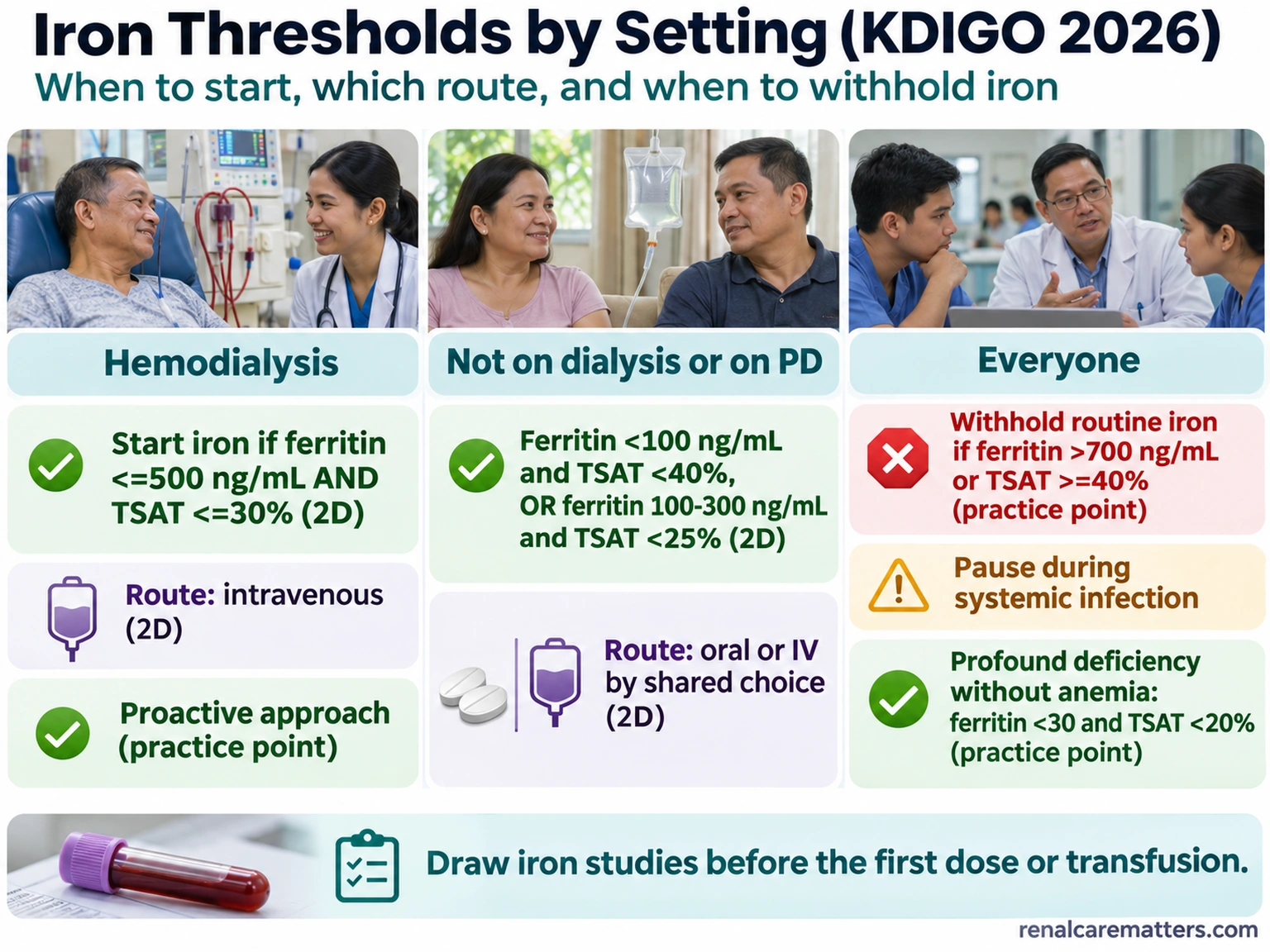
Start iron if ferritin ≤500 ng/mL and TSAT ≤30%
2D
Hemodialysis, route
Intravenous rather than oral iron when starting
2D
Hemodialysis, approach
Give intravenous iron proactively to keep iron status stable
Practice point
Not on dialysis, or on peritoneal dialysis
Start iron if ferritin below 100 ng/mL with TSAT below 40%, or ferritin 100 to 300 ng/mL with TSAT below 25%
2D
Not on hemodialysis, route
Oral or intravenous, chosen by preference, severity, efficacy, tolerability, availability and cost
2D
Everyone treated with iron
Reasonable to withhold routine iron if ferritin is above 700 ng/mL or TSAT is 40% or higher
Practice point
Profound iron deficiency without anemia
Ferritin below 30 ng/mL and TSAT below 20%: consider oral or intravenous iron
Practice point
These statements come from the guideline and its executive summary.3,4 Notice the grades. Every iron threshold is 2D: a weak suggestion on very low certainty evidence. The trials that informed them used these cut points as entry criteria; none tested the thresholds against each other for outcomes patients feel. Treat them as sensible boundaries, not as proof.
Monitoring and safety
Test Hb, ferritin and TSAT about every three months in patients not on dialysis or on peritoneal dialysis, and every one to three months on hemodialysis (practice points). Switch from oral to intravenous iron if oral iron fails after one to three months or is not tolerated, and consider pausing iron during a systemic infection (practice points). Give intravenous iron only where an acute reaction can be managed; routine test doses and premedication are usually not needed (practice points).3 The doses come from your unit formulary and the label, not from memory.
The evidence behind proactive intravenous iron in hemodialysis
PIVOTAL randomized 2,141 adults starting maintenance hemodialysis in the United Kingdom to a proactive high-dose intravenous iron sucrose strategy, held only when ferritin was above 700 µg/L or TSAT was 40% or more, or to a reactive low-dose strategy triggered by ferritin below 200 µg/L or TSAT below 20%. Over a median of 2.1 years, the composite of nonfatal myocardial infarction, nonfatal stroke, heart failure admission or death occurred in 29.3% of the proactive group and 32.3% of the reactive group (hazard ratio [heart rate (HR)] 0.85, 95% confidence interval 0.73 to 1.00). That is about 3 fewer events per 100 patients over two years, a number needed to treat (NNT) of roughly 33. The proactive group needed about a fifth less ESA, and infection rates did not differ.5 This was an open-label randomized controlled trial (RCT) with blinded end-point review, in incident hemodialysis patients. It does not tell you about patients not on dialysis, and its iron ceiling is where the KDIGO practice point to withhold iron comes from.
For patients not on dialysis, trials comparing intravenous with oral iron showed modest differences in Hb, which is a surrogate. KDIGO therefore leaves the route to shared choice (2D).3 In the Philippines that choice is shaped by money and travel. Oral iron is cheap and taken at home; it causes constipation and abdominal upset, and absorption is poor when hepcidin is high. Intravenous iron needs a facility visit and a trained nurse, but one or a few visits may replace months of tablets.
For patients on maintenance hemodialysis, Philippine Health Insurance Corporation (PhilHealth) describes its hemodialysis package of PHP 6,350 per session, effective October 9, 2024, as including drugs and medicines for anemia management, and its advisory lists erythropoietin preparations among the minimum standards of the package.6,7 Confirm what your unit actually supplies on the date of service. A patient not yet on dialysis has no such package and usually pays for every vial and tablet.
Figure 3. Iron thresholds by setting, all graded 2D, with the practice point to withhold routine iron. Ferritin is always paired with TSAT.
RememberPair ferritin with TSAT, name the KDIGO threshold you are using and its 2D grade, and choose the route by setting and patient: intravenous in hemodialysis, a shared choice everywhere else.
Lesson · part 4
ESAs and HIF-PHIs: treat to avoid harm, not to reach normal
Once iron and other causes are corrected, the remaining anemia is mostly erythropoietin deficiency. ESAs replace the missing signal by injection. HIF-PHIs are tablets that block the enzymes that break down HIF, so the body’s own erythropoietin rises and iron handling improves. Both raise Hb. The question that cost nephrology a decade of trials was how high to raise it.
The trials that set the ceiling
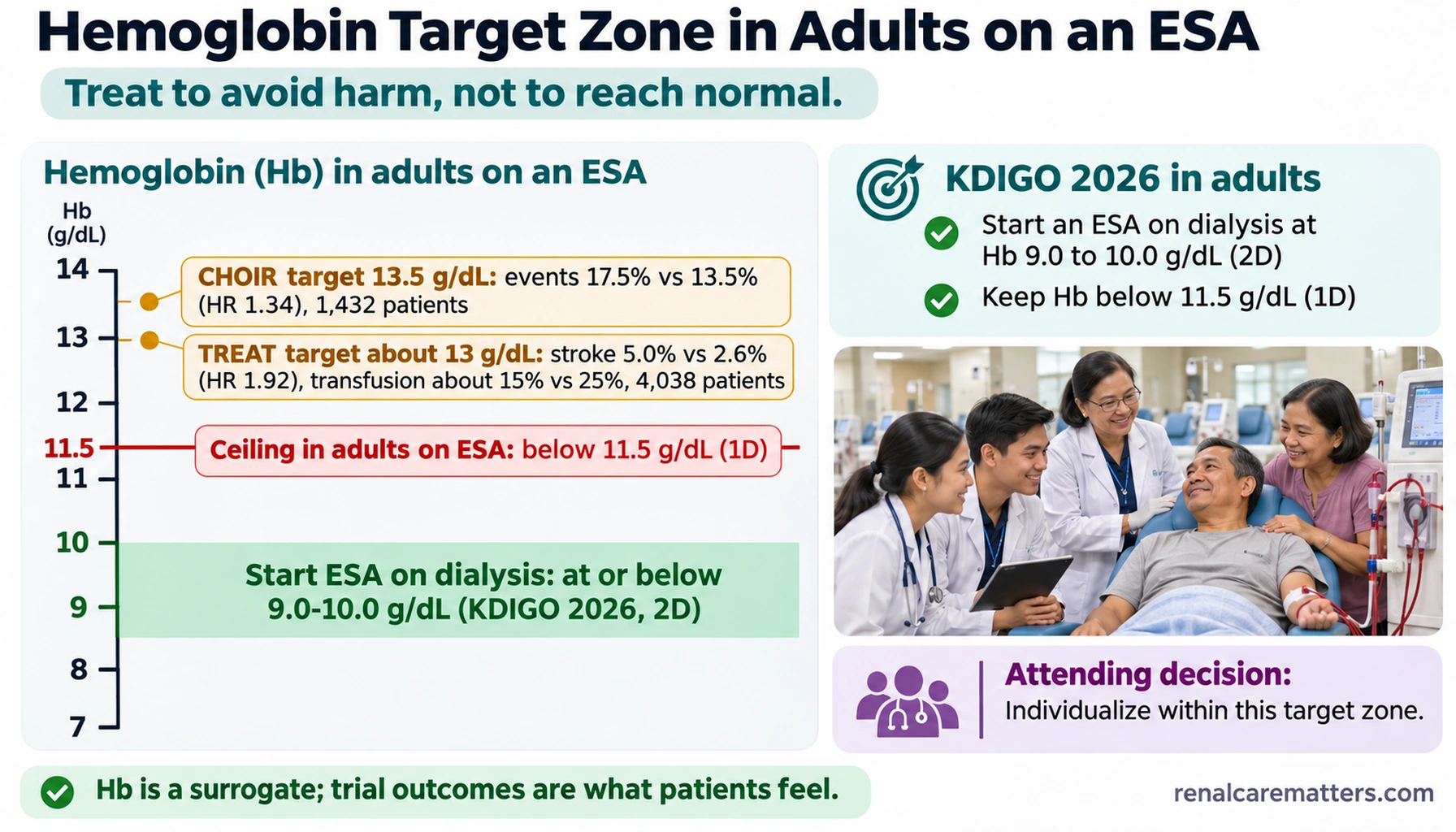
CHOIR (Correction of Hemoglobin and Outcomes in Renal Insufficiency) randomized 1,432 patients with CKD not on dialysis to epoetin alfa targeting Hb 13.5 g/dL or 11.3 g/dL. Over a median of 16 months, the composite of death, myocardial infarction, heart failure admission or stroke occurred in 125 patients (17.5%) in the high-target group and 97 (13.5%) in the low-target group (HR 1.34, 95% confidence interval 1.03 to 1.74). Quality of life improved equally in both groups.8 That is about 4 more events per 100 patients for aiming higher, with nothing gained in how patients felt. CHOIR was open label.
TREAT (Trial to Reduce Cardiovascular Events with Aranesp Therapy) randomized 4,038 patients with type 2 diabetes, CKD not on dialysis and anemia to darbepoetin alfa targeting Hb about 13 g/dL, or to placebo with rescue darbepoetin when Hb fell below 9.0 g/dL. Death or a cardiovascular event did not differ (632 versus 602 patients; HR 1.05). Stroke occurred in 101 patients (5.0%) on darbepoetin and 53 (2.6%) on placebo (HR 1.92). Transfusions were fewer with darbepoetin (297 versus 496 patients, about 15% versus 25%), and fatigue improved only modestly.9 Read the trade-off in absolute terms: for every 100 patients treated to the higher target, about 10 avoided a transfusion and about 2 more had a stroke.
Figure 4. Treat to avoid harm, not to reach normal. KDIGO 2026: start an ESA on dialysis at Hb 9.0 to 10.0 g/dL (2D); keep Hb below 11.5 g/dL in adults (1D).
What KDIGO 2026 recommends
Question
KDIGO 2026 statement
Grade
Correct first
Address all correctable causes, including iron deficiency, before an ESA or HIF-PHI
Practice point
Which agent first
An ESA rather than a HIF-PHI as first-line treatment
2D
Start on dialysis
Start an ESA when Hb is at or below 9.0 to 10.0 g/dL
2D
Start without dialysis (including transplant recipients and children)
Choose the starting Hb by symptoms, expected benefit of a higher Hb, and the risks of transfusion and of ESA
2D
Ceiling in adults
Keep Hb below 11.5 g/dL while on an ESA
1D
HIF-PHI safety
Avoid HIF-PHIs in people at increased risk of adverse events; Hb thresholds for HIF-PHIs are unknown, so use the ESA thresholds
Practice points
Events on treatment
Suspend an ESA during acute stroke, access thrombosis or thromboembolism
Practice point
These statements are from the guideline and its executive summary.3,4 The ceiling is the guideline’s one strong recommendation, yet its certainty is very low. That combination is deliberate: the panel judged that the harms seen in CHOIR and TREAT were serious enough to recommend against higher targets for almost everyone, even though no trial tested 11.5 g/dL itself.
HIF-PHIs: an alternative, not a default
ASCEND-ND randomized 3,872 patients with CKD not on dialysis to oral daprodustat or injected darbepoetin alfa. The rise in Hb was similar, and a first major adverse cardiovascular event (MACE) occurred in 19.5% versus 19.2% over a median of 1.9 years (HR 1.03, 95% confidence interval 0.89 to 1.19), which met the trial’s noninferiority margin.10 Noninferiority with a margin of 1.25 is not proof of equal safety, and longer experience with these agents is still limited. KDIGO keeps ESAs first (2D) and asks you to avoid HIF-PHIs in people with active cancer, recent cardiovascular events or recent thrombosis (practice points).3 A tablet may still suit a patient who cannot reach a clinic for injections, after a frank discussion.
When the Hb will not rise
ESA hyporesponsiveness means Hb fails to rise, or needs escalating ESA, despite treatment. The guideline asks you first to identify and treat the cause (practice point).3 The usual list is iron deficiency, infection or inflammation, ongoing blood loss, hyperparathyroidism, inadequate dialysis, missed injections, and, rarely, antibody-mediated pure red cell aplasia (PRCA), which needs the ESA stopped and hematology involved (practice point).3 Do not answer hyporesponsiveness by doubling the dose; in the trials, patients who needed the most ESA did worst.
In the Philippines, the ESA for a patient not on dialysis is usually bought by the family, a few vials at a time. Ask how the vials are stored; most ESAs need refrigeration, and a brownout in a typhoon can spoil them. Ask whether doses were skipped because of money. Missed doses look like hyporesponsiveness in the chart.
RememberUse an ESA to spare the patient symptoms and transfusions, never to reach a normal Hb. In adults keep Hb below 11.5 g/dL (1D), and treat a poor response by finding its cause.
Lesson · part 5
Transfusion stewardship: blood is a scarce drug with long effects
A transfusion raises Hb within hours and can relieve angina or breathlessness the same night. It also carries volume, potassium, infection risk and, for a future transplant candidate, sensitization to human leukocyte antigens (HLA) that can make a matched kidney harder to find for years. KDIGO 2026 frames transfusion as part of a whole strategy decided with the patient (practice point).3
KDIGO 2026 practice point
What it means on your ward
Base transfusion on symptoms and signs of anemia, not an arbitrary Hb threshold
Ask what the patient feels and what the heart shows; do not write “transfuse if Hb below 8” by reflex
In transplant candidates, avoid transfusion when possible
Ask about transplant plans before every unit; a living donor offer changes the calculus
Transfuse when benefits outweigh risks in acute anemia
Hemorrhage, unstable coronary disease, urgent surgery
Transfusion may be preferred when an ESA or HIF-PHI is ineffective or harmful
Recent stroke, active cancer, thrombosis
Use strategies that reduce transfusion
Fewer and smaller blood draws, continue ESA and iron in hospital, follow Hb trends
These practice points are from the guideline.3 There is no Hb threshold recommendation in the chapter: the panel did not find evidence to set one for people with CKD.
The trials remind you that preventing transfusion is a real benefit. In TREAT, about one in four patients on placebo was transfused, against about one in seven on darbepoetin.9 The same trial showed the price of chasing a high Hb. The fellow holds both facts and helps the patient choose.
The Philippine blood bank and the family
Many Philippine hospitals ask the family to bring replacement donors before or after a transfusion. A daughter who spends a day recruiting donors for a unit that was not needed has lost wages and goodwill, and the blood bank has lost a unit someone else needed. Before you send the family out, write down the reason for the transfusion. If the patient is stable, symptomatic only on exertion and has a correctable cause, treat the cause first and reassess in the morning.
Fewer blood draws matter more than most residents think. Combine tests, use pediatric tubes where your laboratory accepts them, and stop daily CBCs once the trend is clear.
Stop and callStop and call the attending nephrologist when a patient with CKD is bleeding actively, has chest pain or breathlessness at rest with anemia, has a fall in Hb that changes your plan, or is a transplant candidate and a transfusion is being considered. Do this per unit protocol, but always ask the attending nephrologist for guidance.
RememberBefore every unit, write three things in the chart: the symptom or sign that justifies it, whether the patient is a transplant candidate, and what you are doing about the cause.
On the floor
Real situations: problems and solutions
These are fictional but typical. For each one, cover the answer, decide what you would do, then compare. Where a step depends on local rules, your unit’s procedure and your supervisor’s direction come first.
The ferritin of 1,100 in the infected catheter patient
What you see
A 58-year-old man on hemodialysis in Pampanga has a fever from his tunneled catheter, Hb 8.6 g/dL, ferritin 1,100 ng/mL and TSAT 15%. The unit’s standing order gives intravenous iron today.
What is likely going on
Ferritin is high because of inflammation; TSAT is low because hepcidin traps iron. More iron now adds little and may not be safe during infection.
What to do
Ask the attending nephrologist to hold the iron during the systemic infection, treat the catheter infection, and recheck iron studies after recovery.
Why it matters
KDIGO suggests withholding routine iron above ferritin 700 ng/mL and considering a pause during systemic infection (practice points).
The Hb of 12.4 on a busy Saturday
What you see
A 64-year-old woman on hemodialysis in Marikina, on an ESA for years, has Hb 12.4 g/dL. Nobody has changed the dose in three months.
What is likely going on
She is above the KDIGO ceiling for adults on an ESA.
What to do
Report it to the attending nephrologist so the dose can be reduced per the unit protocol, and recheck Hb in two to four weeks.
Why it matters
Higher Hb targets were associated with more strokes and cardiovascular events in trials; the ceiling is graded 1D.
The grandfather who wants his son’s kidney
What you see
A 52-year-old jeepney driver with CKD G5 not yet on dialysis has Hb 7.9 g/dL and mild exertional breathlessness. His son is being worked up as a living donor. The admitting team writes for two units.
What is likely going on
Symptomatic but stable anemia in a transplant candidate.
What to do
Look for correctable causes, start iron if the thresholds are met, discuss an ESA, and keep transfusion for instability, active bleeding or symptoms at rest, after talking with the transplant team.
Why it matters
Transfusion can sensitize him to HLA antigens and narrow his transplant options; KDIGO advises avoiding it in candidates when possible.
The vials in the ice box
What you see
A 47-year-old teacher with CKD G4 in Tacloban has a falling Hb on an ESA. She keeps her vials in a styrofoam box with ice because power was cut after a typhoon.
What is likely going on
Likely spoiled ESA or missed doses, not true hyporesponsiveness.
What to do
Ask about storage and doses taken, check iron status, and work with the family and the social worker on safe storage before changing the plan.
Why it matters
Missed or spoiled doses look like hyporesponsiveness in the chart and lead to needless dose escalation.
Field notes
Write the iron threshold and its grade next to every iron order: “ferritin 90, TSAT 14%, meets KDIGO 2026 non-dialysis threshold (2D).”
Ask “Are you waiting for a kidney transplant?” before you sign for a unit of blood.
Combine blood draws and stop daily CBCs once the trend is clear; phlebotomy is a cause of anemia in hospital.
Ask the family how ESA vials are stored and whether any doses were skipped for cost.
When Hb will not rise, list the causes you checked in the note before anyone suggests a higher dose.
Case review
Back to the case: The ward consult on a Thursday
Before anything is given. Send a reticulocyte count and a blood smear now, before the first unit or the first iron dose, and add vitamin B12, folate and fecal occult blood. Ask the intern to document the dark stools, the daily mefenamic acid and any past transfusions. Stop the NSAID. Her picture is not simple renal anemia: microcytosis, a ferritin of 90 ng/mL and two weeks of dark stools on an NSAID point to gut blood loss on top of erythropoietin deficiency. Ask gastroenterology about endoscopy. Her ankle swelling and breathlessness also need a volume assessment, because a fluid-overloaded heart makes anemia feel worse.
Iron. She is not on dialysis, so the KDIGO 2026 threshold is ferritin below 100 ng/mL with TSAT below 40%, or ferritin 100 to 300 ng/mL with TSAT below 25% (2D). With ferritin 90 ng/mL and TSAT 14% she meets it clearly. Her irregular oral iron failed, possibly because of cost, side effects and hepcidin, and she may be losing blood faster than tablets can replace it. Intravenous iron in hospital, given where a reaction can be managed and once infection is excluded, is a reasonable shared choice. Write the doses from the formulary. Recheck Hb, ferritin and TSAT in about three months.
Transfusion and ESA. She is breathless on stairs, not at rest, has no chest pain, and her blood pressure is stable. Transfusion tonight is not clearly needed and carries a real cost: her son’s offer of a kidney makes her a transplant candidate, and KDIGO advises avoiding transfusion in candidates when possible. Transfuse if she bleeds actively, becomes unstable or develops symptoms at rest. Tell her daughter to pause the donor search until the team decides. An ESA comes after iron and the bleeding source are dealt with. If Hb stays low and she has symptoms, an ESA is the first choice over a HIF-PHI (2D), with Hb kept below 11.5 g/dL (1D). Discuss cost honestly; outside the dialysis package her family will pay for each vial.
Interactive case · fictional
Interactive case: The falling hemoglobin in Chair 7
Work through a shift one decision at a time. The panel at the top changes with what you choose. After each choice you see why it is, or is not, the best move; after a weaker one you can try again or carry on and see where it leads. Your first choice at each step is scored. The score stays on this device and nothing is sent anywhere. In real practice, your unit’s protocol and the people responsible for each decision come first.
Skills lab · with your preceptor
Skills checklist: Anemia work-up and iron decision in CKD
Complete with a preceptor on two patients with CKD and anemia, on the ward or in clinic. Sign-off is local. Your preceptor rates each step as satisfactory, needs practice, or not observed. Steps marked Critical must all be satisfactory before sign-off. This checklist supports supervised learning; your unit’s own procedure and competency form are the authority. A printable version of every checklist is on the trainer page.
Takes a focused anemia history: bleeding, NSAIDs and anticoagulants, diet, menses, past transfusions, and transplant plans.
Orders or collects the KDIGO first test set (CBC, reticulocytes, ferritin, TSAT) before any iron or blood is given.
Interprets ferritin and TSAT together and states whether the patient meets a KDIGO 2026 iron threshold, with its grade.
Lists the correctable causes found and the plan for each before an ESA is discussed.
States the Hb ceiling for an adult on an ESA, its grade, and the trials behind it, in plain words a patient can follow.
Writes a transfusion justification that names the symptom, the transplant status and the plan for the cause.
Placement activity. Medical ward, renal clinic or hemodialysis unit
Self-assessment
Check your understanding
Each visit draws 5 questions at random from this module’s 5-question bank. Choose the single best answer for each, then select Check answers; an explanation appears under the best answer. Select New set of questions for a different mix. A good target is 4 of 5 on two different sets. Nothing you select is sent anywhere; scoring happens in your browser.
Babitt, J. L., & Lin, H. Y. (2012). Mechanisms of anemia in CKD. Journal of the American Society of Nephrology, 23(10), 1631–1634. https://doi.org/10.1681/ASN.2011111078
Kidney Disease: Improving Global Outcomes (KDIGO) Anemia Work Group. (2026). KDIGO 2026 clinical practice guideline for the management of anemia in chronic kidney disease (CKD). Kidney International, 109(1S), S1–S99. https://doi.org/10.1016/j.kint.2025.06.006
Babitt, J. L., Berns, J. S., Bozkurt, B., Cheung Khedairy, R. S., Cuevas, Y., Effa, E. E., Eisenga, M. F., Fishbane, S., Ginzburg, Y. Z., Haase, V. H., Hedayati, S. S., Kim, S., Moura-Neto, J. A., Nagler, E. V., Rossignol, P., Sahay, M., Tanaka, T., Yee-Moon Wang, A., Wheeler, D. C., ... Tonelli, M. (2026). Executive summary of the KDIGO 2026 clinical practice guideline for the management of anemia in chronic kidney disease (CKD). Kidney International, 109(1), 44–56. https://doi.org/10.1016/j.kint.2025.06.005
Macdougall, I. C., White, C., Anker, S. D., Bhandari, S., Farrington, K., Kalra, P. A., McMurray, J. J. V., Murray, H., Tomson, C. R. V., Wheeler, D. C., Winearls, C. G., Ford, I., & PIVOTAL Investigators and Committees (2019). Intravenous iron in patients undergoing maintenance hemodialysis. The New England Journal of Medicine, 380(5), 447–458. https://doi.org/10.1056/NEJMoa1810742
Philippine Health Insurance Corporation. (2024). Clarification on PhilHealth Circular No. 2024-0014 re: Institutionalization of 156 hemodialysis sessions and coverage expansion (Revision 1) (PhilHealth Advisory No. 2024-0036). https://www.philhealth.gov.ph/advisories/2024/PA2024-0036_v1.pdf
Singh, A. K., Szczech, L., Tang, K. L., Barnhart, H., Sapp, S., Wolfson, M., Reddan, D., & CHOIR Investigators. (2006). Correction of anemia with epoetin alfa in chronic kidney disease. The New England Journal of Medicine, 355(20), 2085–2098. https://doi.org/10.1056/NEJMoa065485
Pfeffer, M. A., Burdmann, E. A., Chen, C. Y., Cooper, M. E., de Zeeuw, D., Eckardt, K. U., Feyzi, J. M., Ivanovich, P., Kewalramani, R., Levey, A. S., Lewis, E. F., McGill, J. B., McMurray, J. J., Parfrey, P., Parving, H. H., Remuzzi, G., Singh, A. K., Solomon, S. D., Toto, R., & TREAT Investigators (2009). A trial of darbepoetin alfa in type 2 diabetes and chronic kidney disease. The New England Journal of Medicine, 361(21), 2019–2032. https://doi.org/10.1056/NEJMoa0907845
Singh, A. K., Carroll, K., McMurray, J. J. V., Solomon, S., Jha, V., Johansen, K. L., Lopes, R. D., Macdougall, I. C., Obrador, G. T., Waikar, S. S., Wanner, C., Wheeler, D. C., Więcek, A., Blackorby, A., Cizman, B., Cobitz, A. R., Davies, R., DiMino, T. L., Kler, L., ... Perkovic, V. (2021). Daprodustat for the treatment of anemia in patients not undergoing dialysis. The New England Journal of Medicine, 385(25), 2313–2324. https://doi.org/10.1056/NEJMoa2113380
Educational self-study for physicians in training. Clinical tasks need your institution’s authorization and supervision. Completing this track is an Academy learning record only. It does not confer licensure, specialist status, PSN or PNSP membership or board eligibility, procedural privileges, CPD units, or completion of an institutional training program, and it does not replace current guidelines, regulations, your institution’s protocols and formulary, or your supervisor.